Spring bulbs for Kingston and Surbiton gardens
A homeowner’s guide to five months of colour, from January snowdrops to May alliums.
The first burst of colour after a long winter is one of the genuine pleasures of UK gardening. With the right succession of bulbs planted once in autumn, a garden can carry colour from January through to May, with very little ongoing work and at very modest cost. This guide covers what to plant for each month, where to plant it, and the practical detail that turns a one-season display into a planting that comes back stronger every year.
For the planting-action companion to this guide, including timing windows, hole depth, soil preparation and squirrel protection, see our autumn planting guide. This guide focuses on which bulbs deliver what colour when, and how to plan a succession that flowers without interruption.
Updated October 2026
Bulbs go into almost every planting scheme we build. If you would like a bulb display planned and planted for you, it is part of our hard and soft landscaping work, and we plant bulbs for clients on our garden maintenance rounds across Kingston, Surbiton and Surrey every autumn.
Why spring bulbs are exceptional value
- Plant once, flower for years. Most spring bulbs are reliably perennial and naturalise, meaning they spread gently and increase in flower count year on year. A hundred daffodils planted this autumn will have grown into much bigger clumps within five years.
- Almost no maintenance. Bulbs need no watering once established (the autumn-to-spring growing season is naturally wet), no feeding beyond an annual mulch, and no protection from pests except the early-flowering varieties at risk from squirrels.
- Work in every type of space. Lawns, mixed borders, pots, paving cracks, under deciduous trees, in shady corners – there’s a bulb suited to almost any garden situation.
- Carry the garden through the leanest months. January to April is when most gardens look their poorest. Bulbs deliver colour exactly when it’s most welcome, before the perennial borders have woken up.
- Pollinator value. Early bulbs (snowdrops, winter aconites, crocuses) are critical nectar sources for queen bumblebees emerging from hibernation when little else is in flower.
Five months of succession planting
The aim is for each wave of colour to be coming up as the previous wave finishes. Done well, the garden has uninterrupted bulb colour from late January until the perennials take over in late May.
January-February: the earliest pioneers
- Galanthus nivalis (AGM) – common snowdrop. Pure white nodding flowers, sometimes lifting their petals on sunny days to reveal green markings. Naturalises beautifully under deciduous trees and in damp grass. Best planted ‘in the green’ (with leaves attached) in February-March rather than as dry bulbs in autumn – they establish far more reliably.
- Eranthis hyemalis (AGM) – winter aconite. Buttercup-yellow flowers held in a ruff of green leaves, often appearing through frost in January. Carpets the ground in established colonies. Likes alkaline to neutral soil; struggles on heavy acid clay without lime added.
- Cyclamen coum (AGM). Pink, magenta or white shuttlecock flowers from January to March, with marbled rounded leaves. Excellent under trees and shrubs.
- Iris reticulata ‘Katharine Hodgkin’ (AGM). Compact (10-15 cm) miniature iris with pale blue and yellow flowers in February. Excellent in shallow troughs and at the front of well-drained borders. ‘Harmony’ (deep blue) and ‘Pixie’ (violet) are equally reliable.
February-March: crocuses, dwarf daffodils and early colour
- Crocus tommasinianus (AGM). Pale lilac flowers in February, the first crocus to flower each year. Naturalises spectacularly in lawns and grass; one of the easiest bulbs to establish.
- Crocus vernus Dutch hybrids. Larger, showier crocuses in white, purple and yellow striped varieties. ‘Jeanne d’Arc’ (pure white), ‘Pickwick’ (silver-white with deep lilac stripes) and ‘Yellow Mammoth’ are popular choices.
- Narcissus ‘February Gold’ (AGM). Compact daffodil (30 cm) with golden-yellow trumpet flowers, despite the name usually flowering early March in Surrey. Excellent for naturalising in grass.
- Narcissus ‘Tête-à-tête’ (AGM). Dwarf daffodil (15-20 cm) with multiple bright yellow flowers per stem. Outstanding for pots, troughs and the front of borders.
- Anemone blanda (AGM). Daisy-like flowers in blue, pink, or white from late February. Spreads gently into a low carpet. Soak the corms overnight before autumn planting to improve establishment.
- Scilla forbesii (formerly Chionodoxa) – glory-of-the-snow. Bright blue star-shaped flowers in March. Naturalises freely.
March-April: daffodils, hyacinths and the main flush
- Standard daffodils (Narcissus). ‘Carlton’ (AGM, golden yellow), ‘Ice Follies’ (AGM, cream with lemon centre fading to white), ‘Mount Hood’ (AGM, pure white) and ‘Cheerfulness’ (AGM, double white scented) are all reliable. For a long flowering season, mix early, mid and late cultivars.
- Narcissus ‘Thalia’ (AGM). Multi-headed pure-white daffodil with reflexed petals. Elegant where ordinary yellow daffodils would be too bold.
- Hyacinthus orientalis. The traditional hyacinth, intensely fragrant. ‘Delft Blue’, ‘Woodstock’ (deep purple), ‘City of Haarlem’ (primrose yellow). After their first year in the ground the spikes are less dense but still attractive. Plant near doors, paths and seating where the scent will be appreciated.
- Muscari armeniacum – grape hyacinth. Dense spires of cobalt-blue flowers in April, like miniature inverted clusters of grapes. Spreads easily, almost too easily – site where it can naturalise.
- Fritillaria meleagris (AGM) – snake’s head fritillary. Drooping chequered purple or white bell flowers, native UK wildflower of damp meadows. Plant in grass that will be left long until July.
April-May: tulips, alliums and the late spring finale
- Tulips (Tulipa). The flagship of late spring. Important UK reality: most modern hybrid tulips are not reliably perennial here – they flower brilliantly in year one, then weakly or not at all afterwards. Either treat as annuals (replant fresh bulbs each autumn) or choose perennial groups: species tulips (Tulipa clusiana, T. sylvestris), Darwin Hybrids (large flowers, comparatively long-lived), or Fosteriana / Greigii types (compact, reliably perennial).
- Specific tulip recommendations. ‘Apricot Beauty’ (soft apricot single early), ‘Spring Green’ (AGM, ivory with green flame), ‘Queen of Night’ (deep maroon-black), ‘Ballerina’ (AGM, orange lily-flowered, fragrant), ‘China Pink’ (AGM, soft pink lily-flowered) and ‘Purissima’ (AGM, white Fosteriana, one of the most reliably perennial).
- Allium hollandicum ‘Purple Sensation’ (AGM). Drumstick purple flower heads on metre-tall stems in May. The signature bulb of contemporary planting. Bees and hoverflies love the flowers; the dried seed heads provide structure into autumn.
- Allium christophii (AGM). Huge (20 cm diameter) silvery-purple star-shaped flower heads at knee height. Outstanding for cutting and drying.
- Camassia leichtlinii. Tall (1 m) spires of blue or cream star-shaped flowers in May. Naturalises beautifully in damp grass; a key plant in spring meadow schemes.
- Leucojum aestivum – summer snowflake. Despite the name, flowers in April-May. White bell-shaped flowers with green tips on 60 cm stems. Happy in damp, even heavy ground; best in full sun.
Where to plant – matching bulbs to the location
Naturalised in lawns
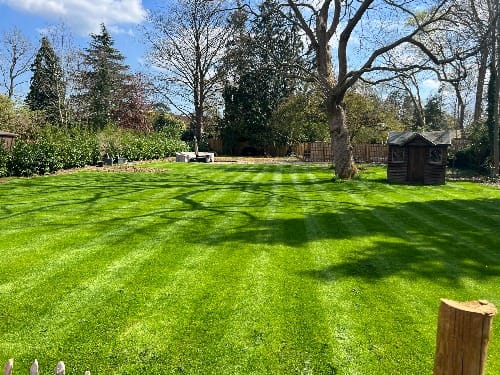
The most dramatic spring effect of all. Lift a square of turf, scatter bulbs informally (resist neat rows), replace the turf. Crocus tommasinianus, Narcissus ‘February Gold’, ‘Tête-à-tête’ and standard daffodils all naturalise well. Mowing must be delayed until at least six weeks after flowering finishes to let the bulbs build reserves for next year – typically late June for daffodils, late May for crocuses. Plan the bulb area where a late mow won’t bother you. Scatter the bulbs by hand and plant them where they land; it looks far more natural than any pattern. Plant generously: 50 to 100 crocuses or 30 to 50 small daffodils per square metre. The RHS has a step-by-step guide to planting bulbs in grass.
Under deciduous trees and shrubs
Spring bulbs evolved for exactly this niche – flowering before the tree canopy closes, then going dormant when the shade arrives. Snowdrops, winter aconites, Cyclamen coum, Anemone blanda, Scilla forbesii and small daffodils all thrive under Amelanchier, Acer, Magnolia, Betula and similar trees. Avoid evergreen trees and dense conifer shade.
Mixed borders
Bulbs work beautifully through perennial borders, flowering in the gaps before the perennials get going and dying back as the perennial foliage covers their messy leaves. Plant in drifts of 5-15 of the same variety rather than scattering individuals. Best mid-border choices: Allium ‘Purple Sensation’, Camassia, hyacinths, mid-sized daffodils, fritillaries.
Did you know?
Woodland bulbs beat the canopy. Galanthus nivalis and Eranthis hyemalis flower and feed in the sun of late winter, before the trees come into leaf. That is why part shade under deciduous trees suits them so well.
Summer sleepers need the sun. Tulips and alliums such as Allium hollandicum ‘Purple Sensation’ come from hot, dry hillsides. They flower, then rest underground through the summer. They need full sun (the RHS counts that as more than 6 hours of direct sun at midsummer) to build next year’s flower. In shade they come up ‘blind’, all leaf and no flower.
Every bulb on our list is marked full sun, part shade or shade, so you can match it to your garden.
Pots and containers – the lasagne method
Layering bulbs in a single pot (the ‘lasagne’ technique) delivers twelve weeks of continuous flower from a single planting. Use a generous pot, minimum 30 cm deep, 30 cm wide:
- Bottom layer (20 cm deep): tulips. Late spring colour. About 12-15 bulbs around the perimeter.
- Cover with 5 cm of compost.
- Middle layer (12 cm deep): daffodils. Mid-spring colour. 7-10 bulbs.
- Cover with 5 cm of compost.
- Top layer (8 cm deep): crocuses or grape hyacinths. Early spring colour. 15-20 corms.
- Cover with 5 cm of compost. Top off with grit or moss for finish.
Each layer pushes up through the one above, delivering a continuous succession of flower from February to May. Use peat-free John Innes No. 2 mixed with horticultural grit for drainage. Cover with chicken wire if squirrels are a problem in your area (they almost always are in Surrey). The RHS guide to planting bulbs in a pot covers the basics, and our autumn and winter pots guide has more container ideas.
Where to buy good bulbs
Bulb quality matters more than variety. Big, firm bulbs flower better and come back stronger than the small, soft ones in cheap bags. For home gardeners buying their own, two UK bulb specialists we recommend:
- J. Parker’s: a wide range at good prices, including tulips, daffodils and narcissi, alliums, crocus and snowdrops.
- Bloms Bulbs: a specialist bulb grower, strong on tulips, daffodils and narcissi and alliums, with good combination collections for pots and borders.
Order in September or early October for the best choice, and plant as soon as the bulbs arrive, tulips excepted. For larger schemes we source bulbs in bulk for our clients and plant them as part of the job. You can also buy the same top-quality bulbs from us, supply only: see the Flourish bulb list, with over 200 varieties priced per pack.
Practical points for Kingston and Surbiton
- When to plant. September to November for most bulbs (September for daffodils, alliums, smaller bulbs; October-November for hyacinths). Plant tulips in November-December when the soil is cold – earlier planting in warm autumn soil increases the risk of Botrytis tulipae (tulip fire), the most serious tulip disease. Plant snowdrops ‘in the green’ in February-March; they rarely establish reliably from dry autumn bulbs.
- Planting depth. The standard rule is three times the bulb’s height from the base of the bulb to the soil surface. A daffodil bulb 50 mm tall sits at 150 mm depth. Shallow planting is a common reason for poor performance and short-lived displays. On heavy clay, planting slightly shallower (around 2.5 times) with grit at the base improves results.
- Heavy clay (common across Kingston, Surbiton, Richmond). Add a 25 mm layer of horticultural grit or coarse sand at the base of the planting hole to prevent bulbs sitting in waterlogged ground. Alternatively, build raised beds or plant in pots. Avoid waterlogged spots entirely; bulbs will rot.
- Squirrel protection. Suburban Surrey is squirrel central. Grey squirrels dig up and eat tulip, crocus and lily bulbs. Daffodils, alliums, fritillaries and hyacinths are largely safe (mildly toxic to squirrels). Protect at-risk plantings with: chicken wire laid flat on the soil over the bulbs and pegged down, taken off once the shoots are about 5 cm tall; a layer of 25 mm wire mesh just below the soil surface in pots; or planting deeper than the squirrels typically dig (often deeper than the standard depth). Avoid bonemeal – its scent attracts foxes, dogs and squirrels.
- Aftercare. Once bulbs have finished flowering, deadhead the spent flower (preventing seed production diverts the plant’s energy back to the bulb). Leave foliage to die back naturally for at least six weeks – this is when next year’s flower is being built inside the bulb. Don’t fold, knot or rubber-band the leaves; this restricts photosynthesis and weakens the bulb. Cutting or mowing within six weeks of flowering is the single most common reason for declining bulb displays.
- Annual feeding. A single application of a balanced general fertiliser after flowering, plus a 50-75 mm autumn mulch of well-rotted compost, keeps perennial bulbs vigorous. No other feeding is needed.
Planting ideas we use in client gardens
- Snowdrops under Amelanchier in a front garden. The white-on-white combination of Galanthus nivalis at ground level and Amelanchier lamarckii blossom above is one of the most quietly beautiful spring sights. Both flower in February-March.
- Miniature daffodils naturalised through a lawn. Narcissus ‘Tête-à-tête’ or ‘February Gold’ scattered in drifts across part of a lawn that’s left unmown until July. Plant them thickly at the start; they will spread from there.
- Bold tulip containers brightening a townhouse patio. Three or four matching pots of a single tulip variety (‘Queen of Night’, ‘Spring Green’ AGM, or ‘Apricot Beauty’) using the lasagne method for succession through spring. Replant fresh tulip bulbs each autumn for reliable colour.
- Camassia and alliums adding drama to back garden borders. Drifts of Camassia leichtlinii in early May handing over to Allium ‘Purple Sensation’ AGM in mid-May, with the spent allium seed heads carrying structure into June.
- Spring meadow under a fruit tree. Fritillaria meleagris, Narcissus poeticus ‘Actaea’, Camassia leichtlinii and Crocus tommasinianus naturalised in long grass beneath an apple, cherry or pear tree. Mow once in July after everything has set seed. Adds genuine wildlife value as well as beauty.
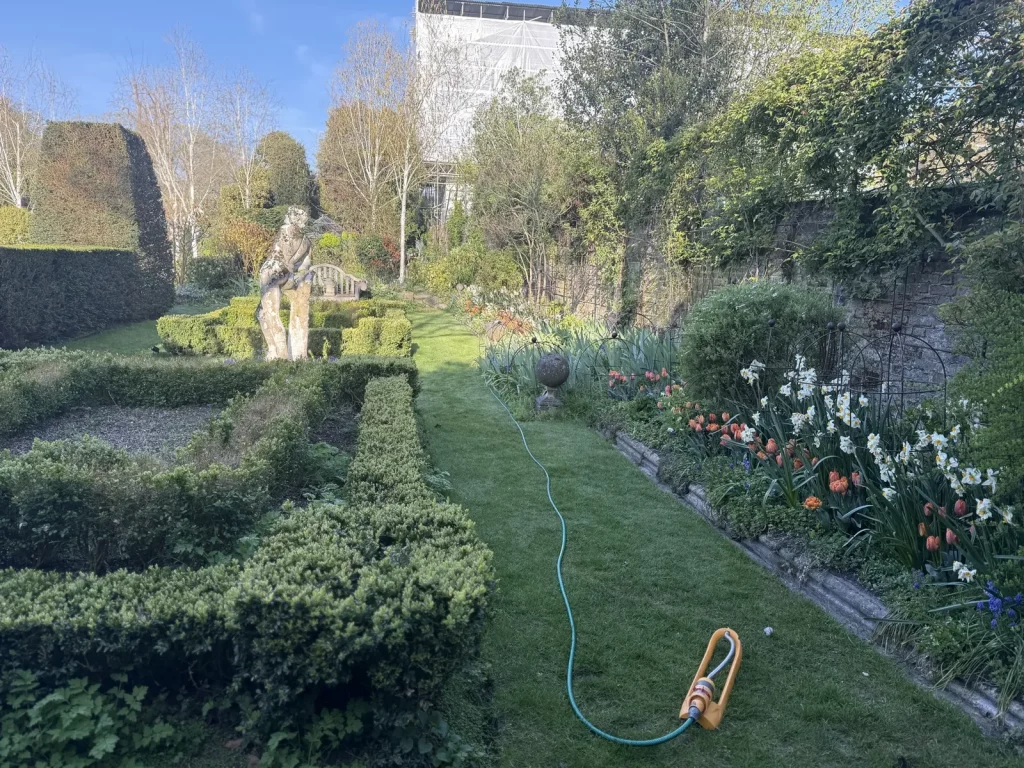
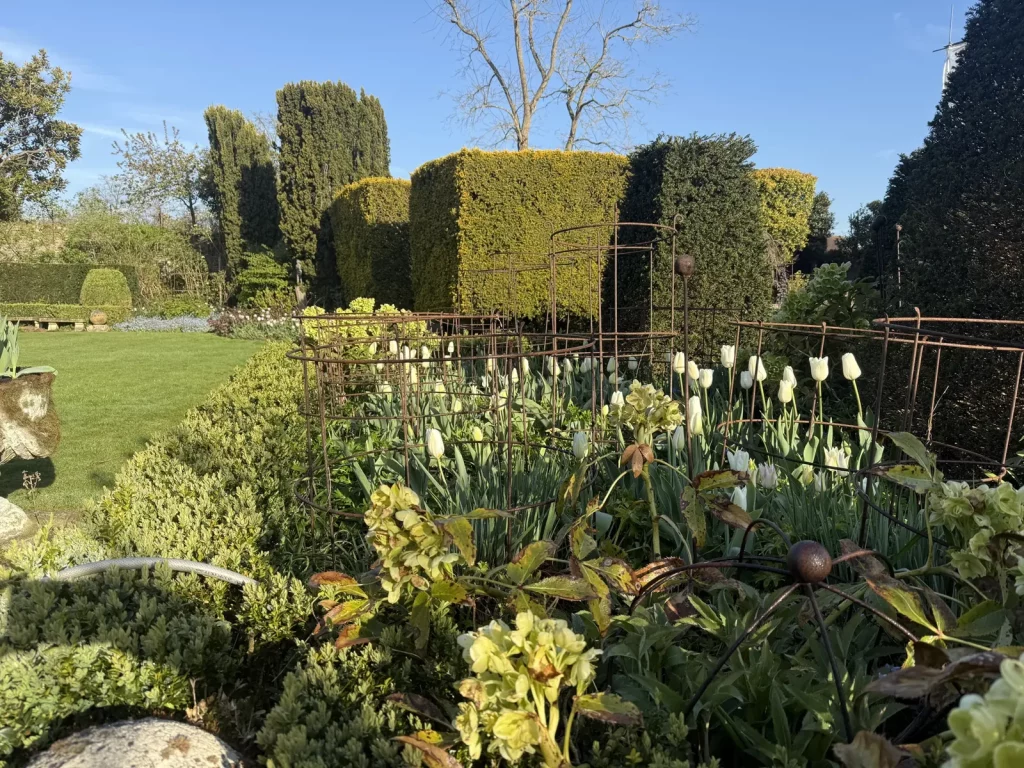
- Bulbs through a formal walled garden. In a walled garden we look after in Ham, narcissi, tulips and grape hyacinths fill the borders each April, between clipped yew and box, before the summer perennials take over (photos above).
Frequently asked questions
When should I plant spring bulbs?
September to early November for daffodils, alliums, crocuses and smaller bulbs. October to November for hyacinths. November-December for tulips – earlier planting in warm autumn soil increases the risk of tulip fire (Botrytis tulipae). Snowdrops are best planted ‘in the green’ in February-March rather than as dry autumn bulbs; they establish far more reliably from rooted plants.
How deep should I plant bulbs?
The standard rule is three times the bulb’s height, measured from the base of the bulb to the soil surface. A 50 mm tall daffodil bulb goes at 150 mm depth. A 25 mm crocus corm at 75 mm. Tulips at around 150-200 mm (slightly deeper than the rule helps deter squirrels and improves perenniality). Shallow planting is the most common cause of poor flowering and short-lived displays.
Do tulips really come back year after year?
Most modern hybrid tulips don’t reliably perennialise in UK gardens – they flower brilliantly in year one, then weakly or not at all afterwards, especially on heavy clay. There are two solutions: either treat them as annuals (replant fresh bulbs every autumn for full colour each year), or choose perennial groups specifically bred or selected for longevity. Species tulips (Tulipa clusiana, T. sylvestris), Darwin Hybrids and Fosteriana types are all reliably long-lived in UK conditions. Planting deeper (200 mm rather than the standard 150 mm) also improves perenniality.
How do I protect bulbs from squirrels?
Squirrels target tulips, crocuses and lilies most enthusiastically. Daffodils, alliums, fritillaries, snowdrops and hyacinths are mildly toxic and largely safe. Three practical defences: lay chicken wire flat on the soil over the bulbs and peg it down (shoots come through the mesh but squirrels can’t dig); for pots, lay 25 mm wire mesh just below the compost surface; or plant tulips and crocuses 25-50 mm deeper than the standard rule suggests, beyond the depth squirrels typically dig. Don’t use bonemeal – its scent attracts squirrels, foxes and dogs to dig in the disturbed soil.
Can I cut down the foliage after the flowers fade?
No – wait at least six weeks. After flowering, the foliage is photosynthesising to build next year’s flower inside the bulb. Cutting, mowing or folding/knotting the leaves within six weeks restricts that process and progressively weakens the bulb until it stops flowering altogether. The slightly tatty post-flowering period is the price of strong displays the following year. Underplant naturalised bulb areas with later-emerging perennials (hardy geraniums, hostas) which mask the dying foliage.
Will bulbs grow well in heavy clay soil?
Most will, provided drainage is improved. Heavy clay holds winter wet which can rot bulbs, particularly tulips, lilies and crown imperials. Add a 25 mm layer of horticultural grit or coarse sand at the base of the planting hole, plant slightly shallower than the standard rule (around 2.5x bulb height instead of 3x), and avoid waterlogged spots entirely. Daffodils, snowdrops, Camassia, Fritillaria meleagris and alliums all cope with clay well. Tulips are the most demanding – many growers in Surrey treat them as annuals and replant each year specifically because of clay-soil losses.
Related pages
- Planting design and installation: how we plan and plant bulbs into a full scheme
- The Flourish bulb list: buy our bulbs supply only, priced per pack
- Autumn planting: when and how to get bulbs in the ground
- Autumn and winter pots: layered bulb pots and winter container planting ideas
- Improving clay soil: preparing heavy clay so bulbs do not rot
- Hard and soft landscaping: new borders and planting as part of a wider build
- Garden maintenance: seasonal planting and care, including Kingston and Surbiton
Let’s plan your spring garden
Flourish Landscaping designs and plants gardens across Kingston, Surbiton, Richmond, Esher and the wider Surrey area. Bulb planting is a natural part of how we approach a planting scheme – see our planting design and installation service, our hard and soft landscaping work, or our autumn planting guide for the other jobs that suit the same season.
Contact us to arrange a consultation.
Written by Craig Davis BSc (Hons) Horticulture, member of the Chartered Institute of Horticulture. Craig has over 40 years in horticulture: in the family business since the age of 13 and a horticulture graduate since 1992, he designs, builds and plants gardens across Kingston, Surrey and South West London.
Good to know
Frequently asked questions
September to early November for daffodils, alliums, crocuses and smaller bulbs. October to November for hyacinths. November-December for tulips - earlier planting in warm autumn soil increases the risk of tulip fire (Botrytis tulipae). Snowdrops are best planted 'in the green' in February-March rather than as dry autumn bulbs; they establish far more reliably from rooted plants.
The standard rule is three times the bulb's height, measured from the base of the bulb to the soil surface. A 50 mm tall daffodil bulb goes at 150 mm depth. A 25 mm crocus corm at 75 mm. Tulips at around 150-200 mm (slightly deeper than the rule helps deter squirrels and improves perenniality). Shallow planting is the most common cause of poor flowering and short-lived displays.
Most modern hybrid tulips don't reliably perennialise in UK gardens - they flower brilliantly in year one, then weakly or not at all afterwards, especially on heavy clay. There are two solutions: either treat them as annuals (replant fresh bulbs every autumn for full colour each year), or choose perennial groups specifically bred or selected for longevity. Species tulips (Tulipa clusiana, T. sylvestris), Darwin Hybrids and Fosteriana types are all reliably long-lived in UK conditions. Planting deeper (200 mm rather than the standard 150 mm) also improves perenniality.
Squirrels target tulips, crocuses and lilies most enthusiastically. Daffodils, alliums, fritillaries, snowdrops and hyacinths are mildly toxic and largely safe. Three practical defences: lay chicken wire pegged 30-40 cm above the bulbs in the ground (shoots come through but the squirrels can't dig); for pots, lay 25 mm wire mesh just below the compost surface; or plant tulips and crocuses 25-50 mm deeper than the standard rule suggests. Don't use bonemeal - its scent attracts squirrels, foxes and dogs to dig in the disturbed soil.
No - wait at least six weeks. After flowering, the foliage is photosynthesising to build next year's flower inside the bulb. Cutting, mowing or folding/knotting the leaves within six weeks restricts that process and progressively weakens the bulb until it stops flowering altogether. The slightly tatty post-flowering period is the price of strong displays the following year. Underplant naturalised bulb areas with later-emerging perennials (hardy geraniums, hostas) which mask the dying foliage.
Most will, provided drainage is improved. Heavy clay holds winter wet which can rot bulbs, particularly tulips, lilies and crown imperials. Add a 25 mm layer of horticultural grit or coarse sand at the base of the planting hole, plant slightly shallower than the standard rule (around 2.5x bulb height instead of 3x), and avoid waterlogged spots entirely. Daffodils, snowdrops, Camassia, Fritillaria meleagris and alliums all cope with clay well. Tulips are the most demanding - many growers in Surrey treat them as annuals and replant each year specifically because of clay-soil losses.