
Dealing with flooded gardens
Providing expert drainage solutions, from lawn aeration and soil remediation to installing French drains, to solve waterlogging and reclaim your flooded garden.
Lawns turn to mud, flower beds become ponds, and patios remain unusable for days. It is a common issue across our region, thanks to heavy clay soil and sloping ground. Waterlogging is almost always a soil and infrastructure problem rather than a surface one, and lasting solutions combine proven drainage engineering with considered planting. With the right approach, even the soggiest garden can be transformed. Flourish is led by Craig Davis, who holds a BSc (Hons) in Horticulture and brings over 40 years of practical experience, and that knowledge informs every drainage scheme we design.
View our other landscaping services
In this guide
Why South West London gardens flood
- Clay soil: our region sits on dense London Clay, which holds water instead of draining it. Once saturated, it simply cannot take more water, leading to surface pooling and prolonged waterlogging.
- Topography: gardens at the bottom of hills or slopes receive runoff from higher ground, often collecting more water than they can absorb. This is particularly common in parts of Esher and Cobham.
- Aquifers and water table: high water tables and perched groundwater layers mean gardens can be wet from below as well as above.
- Old infrastructure: many older properties lack adequate drainage or have blocked soakaways, collapsed pipes or ineffective garden grading.
As local landscaping experts, Flourish Landscaping has helped many homeowners across our region resolve persistent garden drainage problems.
How to spot poor garden drainage
- Standing puddles that linger for hours or days
- Squelchy or boggy lawns, especially in winter
- Moss, algae, and yellowing grass
- Foul-smelling or sticky clay soil
- Water collecting near walls or garden buildings
Our garden drainage solutions
Every garden is different, so we tailor our approach following a detailed site survey. Below are the most effective solutions for South West London’s clay-heavy ground:
- Soil conditioning: incorporating grit, compost or gypsum improves structure and surface drainage.
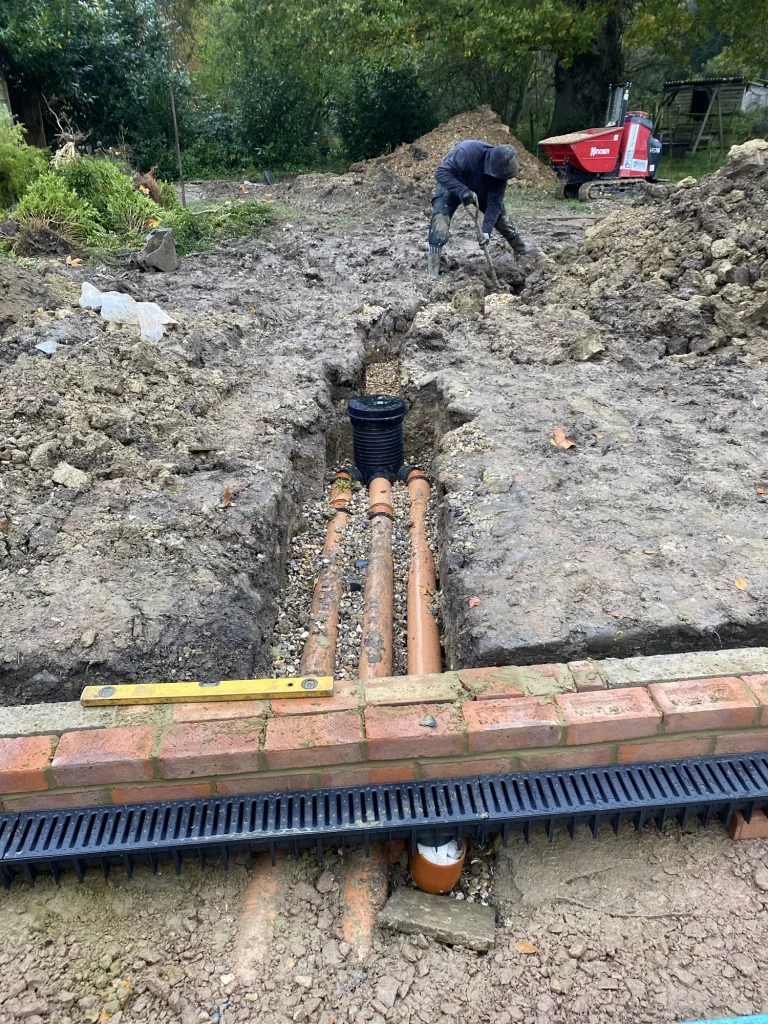
- French drains: subsurface gravel trenches with perforated pipes to intercept and redirect water.
- Soakaway crates: modular storage below ground to temporarily hold water and allow slow release, often paired with a pump in clay soils.
- Sump and pump systems: essential for severe flooding, a below-ground chamber collects water and pumps it to a suitable outlet.
- Regrading and swales: reshaping land to improve runoff direction and reduce pooling.
- Rain gardens: plant-filled depressions that accept excess water and support wildlife, an attractive complement to engineered drainage rather than a replacement for it.
- Permeable surfacing: paths and patios that allow water to pass through, reducing runoff. See our patios, paths and driveways service for permeable options.
Drainage without large trenches or pumps
Some properties, particularly small gardens or listed homes, cannot accommodate heavy excavation or machinery.
We offer subtle alternatives:
- Shallow French drains with discreet outlet points
- Slimline linear channel drains near buildings or paving
- Permeable paving or gravel paths to reduce runoff
- Rain garden zones in borders with moisture-tolerant planting
- Simple gutter redirection or water butts to control roof runoff
Fish tail drainage with sump and pump: specification
For high water flow or complex sites like sloping driveways or courtyards, we install fish tail channel systems, combining:
- V-profile wide-entry channels with cast iron or galvanised steel grates
- Below-ground sump chamber
- Automatic submersible pump
- Outlet to stormwater drain, soakaway or ditch
- Optional silt trap and filter
These are high-performance solutions for areas needing fast and controlled drainage.
Planting for damp and seasonal water
Drainage engineering deals with the worst of the problem, but well-chosen planting helps absorb seasonal water, soften the edges of regraded areas, and bring borders back to life after sustained wet periods. The following species genuinely thrive in damp Surrey conditions and are mainstays of our rain garden planting plans.
For the wettest zones of rain gardens
Iris pseudacorus (yellow flag iris), Caltha palustris (marsh marigold), and Lobelia cardinalis all tolerate standing water for short periods and bring colour and structure to the lowest, wettest points.
For damp borders that flood occasionally
Iris sibirica, Astilbe spp., Persicaria amplexicaulis and Astrantia major all cope well with periodic saturation and reward with strong seasonal interest.
Structural shrubs for wet soils
Cornus alba ‘Sibirica’ (red-stemmed dogwood) and Salix purpurea ‘Nana’ (dwarf purple willow) both tolerate seasonally wet ground and bring strong winter stem interest.
Grasses and sedges for movement
Carex pendula (pendulous sedge) and Carex elata ‘Aurea’ (Bowles’s golden sedge) are particularly good for damp Surrey gardens, both providing the long arching foliage that softens transitions between hard drainage features and lawn.
Regulations to be aware of
We always advise clients on legal compliance, including:
- Water Industry Act 1991: discharge to foul sewers requires permission
- Building Regulations Part H: soakaways and drains must meet national standards
- Environment Agency guidance: needed for discharge into watercourses or flood-sensitive zones
- Rights of discharge: legal issues if draining into neighbouring land
Flourish Landscaping manages permissions and ensures all systems comply with local and national rules.
A local case study
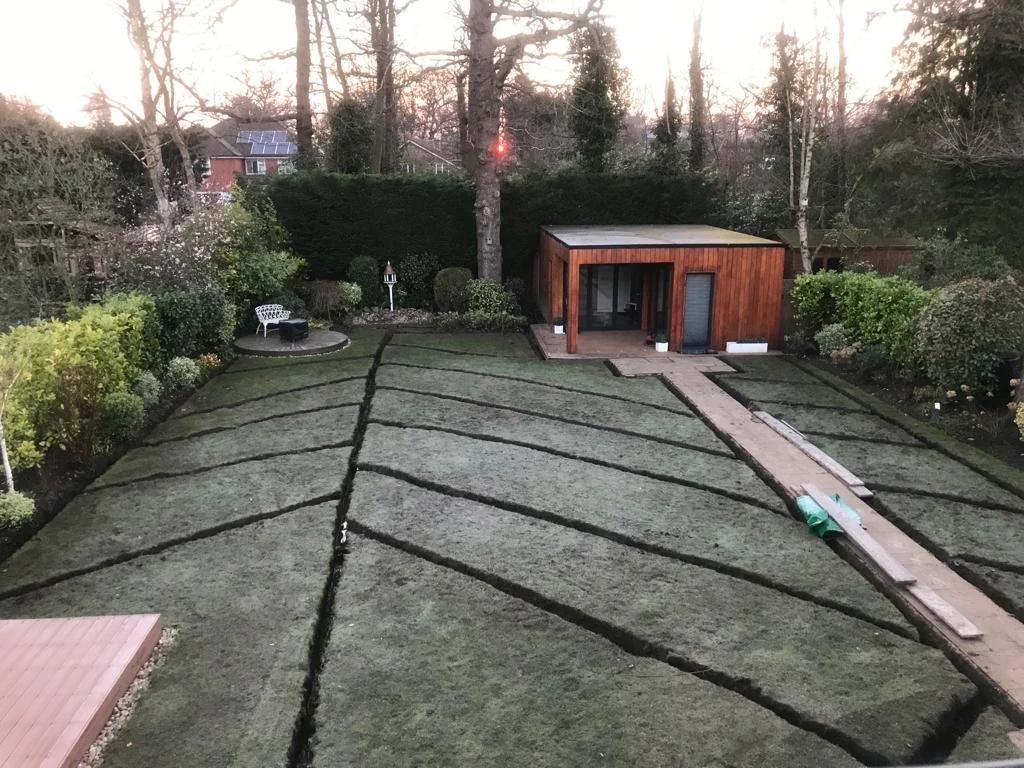
A family in Cobham contacted us after years of battling with a boggy lawn. We installed lateral French drains across the lawn, connected to a sump and pump system, and subtly regraded the lawn’s centre. Within days, the garden had dried out. A year later, it remains green, firm and fully usable, even after winter rainfall.
Common questions about garden drainage
How long does a garden drainage installation take?
A focused French drain or soakaway installation in a domestic garden typically takes between three days and two weeks on site, depending on the length of trench required, ground conditions and what is being reinstated above. Larger schemes involving regrading, sump and pump systems, or fish tail channel drainage can take longer. We provide a clear written programme as part of every quotation.
Do I need planning permission for garden drainage?
Most domestic drainage works fall within permitted development and do not require planning permission. Permissions and approvals can still apply for connections to public sewers, discharge into watercourses, or works near protected trees or listed structures. We assess this at the survey stage and manage any required approvals on your behalf.
Can drainage work be carried out in winter?
Yes, and winter is often the best time to diagnose the problem because the symptoms are most visible. The work itself is sometimes harder when ground is saturated and reinstatement of lawns and planting is typically scheduled for spring, but the drainage installation itself can proceed in most weather.
Will my garden be left in a mess?
No. We protect existing features, separate excavated soil for reuse where appropriate, and make good every surface we open up. Lawns are reseeded or returfed to match. Plant retention is planned at the survey stage so anything worth keeping is lifted, heeled in safely, and replanted on completion.
How long does a properly installed drainage system last?
French drains and soakaway crates built to current standards typically perform for 20 to 30 years with minimal intervention. Pumped systems have a pump lifespan of 8 to 15 years depending on duty cycle. We specify pumps with replaceable components and accessible chambers so maintenance and eventual replacement is straightforward.
Can drainage be combined with other landscaping works?
Yes, and ideally it should be. Drainage is far easier and more cost-effective to install at the same time as new paving, planting or complete garden builds, rather than being retrofitted later. We routinely build drainage into wider project specifications when appropriate.
Areas we cover
We resolve flooded gardens and design drainage solutions across Kingston upon Thames, Surbiton, Richmond and the wider Surrey and South West London area, where heavy London Clay creates persistent waterlogging issues. Key locations include:
Ready to fix your flooded garden?
Whether you are battling soggy turf, patio puddles or standing water near your home, Flourish Landscaping is here to help. Our experienced team offers bespoke drainage assessments and clear, practical solutions that work with your space, your budget, and your future plans.
Contact us today for a no-obligation consultation and get your garden back, drier, safer and more enjoyable, all year round.
Explore Flourish in more depth
Related services
- Hard and soft landscaping
- Patios, paths and driveways
- Planting design and installation
- Garden design and build
- Low-maintenance gardens
Garden advice and tools
About Flourish
Good to know
Frequently asked questions
A focused French drain or soakaway installation in a domestic garden typically takes between three days and two weeks on site, depending on the length of trench required, ground conditions and what is being reinstated above. Larger schemes involving regrading, sump and pump systems, or fish tail channel drainage can take longer. We provide a clear written programme as part of every quotation.
Most domestic drainage works fall within permitted development and do not require planning permission. Permissions and approvals can still apply for connections to public sewers, discharge into watercourses, or works near protected trees or listed structures. We assess this at the survey stage and manage any required approvals on your behalf.
Yes, and winter is often the best time to diagnose the problem because the symptoms are most visible. The work itself is sometimes harder when ground is saturated and reinstatement of lawns and planting is typically scheduled for spring, but the drainage installation itself can proceed in most weather.
No. We protect existing features, separate excavated soil for reuse where appropriate, and make good every surface we open up. Lawns are reseeded or returfed to match. Plant retention is planned at the survey stage so anything worth keeping is lifted, heeled in safely, and replanted on completion.
French drains and soakaway crates built to current standards typically perform for 20 to 30 years with minimal intervention. Pumped systems have a pump lifespan of 8 to 15 years depending on duty cycle. We specify pumps with replaceable components and accessible chambers so maintenance and eventual replacement is straightforward.
Yes, and ideally it should be. Drainage is far easier and more cost-effective to install at the same time as new paving, planting or complete garden builds, rather than being retrofitted later. We routinely build drainage into wider project specifications when appropriate.