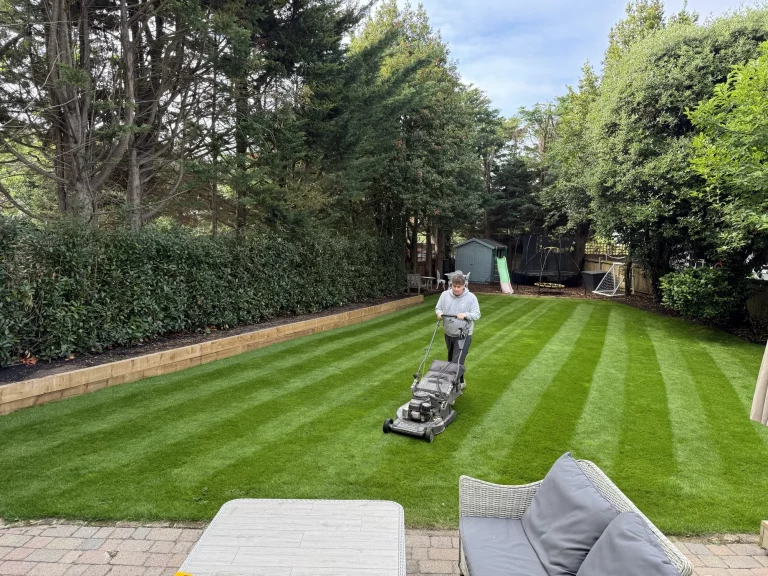
Lawn renovation and seeding
How to bring a tired lawn back, or sow a new one that lasts
Updated October 2026
Most lawns we look at across Kingston, Surbiton and the wider Surrey area have the same complaints: moss, thin patches, compaction, weeds and grass that gives up in shade. They nearly always come back to the same few causes: poor drainage on London Clay, the wrong cutting height, the wrong feed at the wrong time, or shade the original grass was never going to cope with.
This guide covers both jobs in one place: renovating a lawn you already have, and sowing a new one from seed. Autumn is the main window for both, with spring as the second chance. The cultural basics matter far more than any product, and chemicals come last, not first. If you would rather we did the heavy lifting, new lawns and turf are part of our hard and soft landscaping work, and autumn renovation is part of our regular garden maintenance.
Renovate, reseed or turf?
- Renovate when the lawn is basically sound but tired: moss, thatch, thin patches, some weeds. Scarify, aerate, overseed and feed, and it will usually come back within a season.
- Reseed from scratch when the lawn is more weed and moss than grass, badly uneven, or sitting on compacted ground that needs digging over. Seed gives the deepest-rooted lawn and the widest choice of grasses, at roughly a quarter of the material cost of turf.
- Turf when you need to use the garden quickly. It can usually be walked on lightly within three weeks, but it costs more and you get whatever grasses the turf grower sowed.
When to do the work: autumn first, spring second
Timing decides more renovations and sowings than any product or machine. Grass seed germinates when the soil is consistently above about 8°C and stays moist, and does best at 10 to 18°C.
Late August to early October: the main window
The soil is still warm from summer, rain is more reliable, weeds are slowing down, and new grass has months of cool, damp weather to root before it faces a summer. This is when we do full renovation work (scarifying, hollow-tine aeration, overseeding, top dressing and autumn feeding) and when we book most new lawns. On our heavy local clay we aim for September, before the ground turns cold and sticky.
April to May: the second window
Good for moss control, a light scarify and patching bare areas. A full overhaul or a new sowing in spring can work, but the young grass heads into its first summer shallow-rooted and will need careful watering through any dry spell. Summer sowings need daily watering and often struggle; winter sowings sit cold and wet and get eaten by birds.
Renovating an existing lawn
Step 1: deal with moss, and why it is there
Moss likes damp, compacted, shaded lawns with weak grass. It is a symptom, not the disease. Kill it without fixing the cause and it is back within a year.
- Rake or scarify it out first. On a lightly mossed lawn that is often enough on its own.
- Where moss is heavy, iron sulphate (or a lawn moss treatment based on it) blackens the moss and greens up the grass. Use it in October or April, wait 7 to 14 days until the moss is black, then scarify it out.
- Fix the cause: improve drainage, aerate, let in more light where you can, raise the cutting height and overseed thin areas. Without this, moss moves straight back in.
Step 2: scarify
Scarifying pulls out dead thatch, dead moss and debris that smother the grass. It looks brutal on the day, with brown patches and bare soil, but the lawn recovers quickly once it is seeded and fed.
- Autumn: deep scarification across the whole lawn, followed by overseeding.
- Spring: a light pass only. Hard scarifying going into summer can leave the lawn too thin to cope with drought.
- Small lawns can be done with a spring-tine rake. Anything bigger is far easier with a powered scarifier.
Step 3: aerate
Compacted soil stops water, air and feed reaching the roots, and it is one of the most common reasons a lawn looks tired despite feeding. Aeration opens channels for water and roots.
- Solid tines (a garden fork or spiked roller) for light compaction and routine care.
- Hollow tines, which pull out cores of soil, for heavy compaction, family lawns and clay. Far more effective, and best done in autumn.
- Top dress after hollow-tining with a sandy loam to keep the holes open and slowly improve the soil. On clay, done every autumn for a few years, this does more for a lawn than anything else. Our guides to improving clay soil and topsoil go into more detail.
Step 4: feed for the season
This is where most lawn programmes go wrong. A spring feed is the wrong feed for autumn. High nitrogen in October produces soft growth that is wide open to Fusarium patch (Microdochium patch) over winter.
- Spring and early summer: a higher-nitrogen feed (an NPK ratio in the order of 9-7-7) while the grass is growing and the soil is moist. Do not overdo it; too much nitrogen gives lush, weak growth that disease loves.
- Autumn: a low-nitrogen, higher-potassium feed (in the order of 3-12-12) in September or October, to toughen the grass for winter rather than push it on.
- Before sowing or overseeding: a pre-seed feed that is low in nitrogen and higher in phosphorus, to help new roots. A standard lawn feed is too rich in nitrogen for seedlings.
Step 5: overseed
Overseeding fills thin patches and brings in stronger modern grasses, gradually upgrading an older lawn.
- Mow the lawn short (about 25 mm) and collect the clippings, then scarify or rake hard so the seed can reach bare soil. After hollow-tining, seed drops into the holes on its own.
- Sow at 15 to 25 g/m² over the whole lawn, a little heavier into bare patches.
- Top dress with a thin layer (5 to 10 mm) of sandy loam or good topsoil and brush it in with a stiff broom.
- Keep it moist until it germinates, which takes 7 to 21 days depending on the grasses and the weather, and keep the birds off (see below).
Step 6: weeds, non-chemical first
The best weed control in a lawn is thick, healthy grass. A dense lawn crowds out most common weeds (dandelion, plantain, daisy, buttercup) before they get going, which is why correct mowing, feeding and overseeding usually solve a weed problem on their own.
- Hand-weed rosette weeds such as dandelion and plantain with a daisy grubber or long-handled weeder.
- Mow at the right height (see below) so the grass stays dense.
- Overseed bare patches promptly so weeds have nowhere to land.
- Consider living with some of them. Clover and self-heal in a lawn feed bees and stay green in drought. More on that under mixed-species lawns.
The RHS does not support routine pesticide use, and nor do we. Where a lawn has severe, established weeds that cultural work alone has not shifted, a selective lawn weedkiller can be used once, in late spring or early autumn while the weeds are growing, on a calm dry day, always following the label. Leave at least four weeks (longer if the label says so) before overseeding, and never use it on a new lawn in its first six months.
Choosing grass seed
There is no single best lawn seed. The right mix depends on how the lawn will be used, how much light it gets and the soil. These are the four mixtures we specify most often. Buy proper lawn seed from a recognised UK seed house; a cheap bag of agricultural ryegrass looks coarse from day one.
Hardwearing family lawn
For children, dogs, garden furniture and weekly mowing. Built around Lolium perenne (perennial ryegrass) at 60 to 70 per cent, with the rest made up of Festuca rubra (creeping red fescue) and a fine-leaved Chewings fescue (Festuca rubra subsp. commutata). Modern dwarf ryegrasses give a much finer, denser lawn than the coarse ryegrasses of twenty years ago. This is what most domestic gardens need.
Fine ornamental lawn
The bowling-green look. A blend of fine fescues (Festuca rubra subsp. rubra, Chewings fescue and Festuca ovina) with Agrostis capillaris (common bent), and no ryegrass. It gives a very fine, dense, dark green lawn, but it will not take heavy wear and needs mowing closer and more often (15 to 25 mm). Right for a lawn that is admired rather than played on.
Shade-tolerant lawn
For tree cover or a north-facing garden. The mix leans on fine fescues with Poa nemoralis (wood meadow-grass), the grass that copes best with shade. An honest note: no grass thrives in dense shade. Under a mature beech or sycamore even the best shade mix struggles, and shade-tolerant ground cover such as Pachysandra terminalis or Geranium macrorrhizum is often the better answer. Our page on common problems in shady gardens covers moss and thin grass in shade.
Mixed-species and bee lawns
The biggest change in lawns over the last few years. A standard grass mix with Trifolium repens (white clover) at around 5 per cent, and optionally Prunella vulgaris (self-heal), Bellis perennis (daisy) and Achillea millefolium (yarrow). Clover fixes its own nitrogen, so the lawn needs less feed; the deeper-rooted plants stay green through drought; and the flowers feed pollinators. The trade-off is a less uniform look, which is worth deciding on before you sow.
Sowing a new lawn
Preparation: where the lawn is really made
This is the part most often rushed, and it decides whether a lawn lasts five years or twenty-five.
- Clear the ground. Strip any old turf and fork out weeds and perennial roots by hand. Bindweed, couch grass and ground elder are the ones that come back through a new lawn, so take your time: fork the ground over, let regrowth appear over two or three weeks, and fork out again. Covering the area with a light-excluding sheet for a few weeks also weakens them. Only on a badly infested site, as a last resort, would we consider a glyphosate treatment three to four weeks ahead, applied strictly to the label.
- Cultivate. Dig or rotavate to 150 to 200 mm. On clay, work in horticultural sharp sand and well-rotted compost to improve drainage and structure. Skipping this is the most common reason lawns fail on London Clay.
- Level and firm. Rake to a rough tilth, firm it by shuffling across on your heels (do not stamp), then rake again. Repeat two or three times until the surface is level and firm with no soft spots.
- Pre-seed feed. About a week before sowing, rake a low-nitrogen, higher-phosphorus pre-seed fertiliser into the top 25 mm, at the rate on the pack.
- Final rake. A fine, level seedbed with no clods bigger than about 10 mm. It should look like a good garden tilth, not a billiard table.
Sowing
- Rate: 35 to 50 g/m² for a new lawn. Start from the rate on the bag and, if anything, err slightly high.
- Method: split the seed in half. Sow one half walking one way and the other half at right angles, for even cover. A hand-held spreader is fine up to about 50 m².
- Cover lightly: rake the seed in so it sits 5 to 10 mm down, then firm with a light roller (on dry soil only) or the back of a rake. Seed buried 25 mm deep will not come up.
- Keep the birds off: fleece, hessian or fine netting pegged down at the edges for the first fortnight, removed as soon as you see green.
- Water: keep the surface moist but not waterlogged until germination is well under way. If the seed dries out once it has started to germinate, those seedlings are lost.
Germination, the first cut and aftercare
- Germination: ryegrass shows in 7 to 14 days; fescues and bents take 14 to 21. A patchy first flush is normal.
- First cut: when the grass reaches about 75 mm, usually five or six weeks after sowing. Mower on its highest setting, sharp blade, top third only.
- Keep off for at least three weeks and go gently for the first two months. Furniture and play equipment stay off until after the second cut.
- First weeds: most annual weeds that come up with the grass disappear after a few cuts, because they cannot stand regular mowing. Hand-weed anything that persists.
- Feeding: a lawn sown in spring gets an autumn feed in September or October. A lawn sown in autumn needs nothing until spring.
Mowing heights
One set of numbers to work to, for new and established lawns alike:
- Most family lawns: 25 to 40 mm through the growing season.
- Shaded lawns, dry spells and a lawn’s first season: raise it to 40 to 50 mm. Longer grass shades its own roots and copes better.
- Fine ornamental lawns: 15 to 25 mm, mown often.
- Little and often: never take off more than a third of the height in one cut. Start the year with the mower at its highest setting and lower it over several cuts.
Common problems and how to avoid them
- Birds on new seed. Netting or hessian for the first two weeks.
- Drying out during germination. In dry, breezy weather, check new seed at least twice a day for the first ten days.
- Patchy germination. Almost always uneven sowing or seed sown too deep. Oversow the thin areas after two weeks.
- Disease. Damping off, red thread and Fusarium patch are encouraged by overwatering, poor air movement and too much nitrogen. The right feed for the season and sensible watering prevent most of it. A well-fed, well-mown lawn rarely needs treating.
- Sowing on a slope. Heavy rain washes seed downhill. Use hessian or a fine biodegradable mesh on anything steeper than about 1 in 10.
- Pests. See our guide to garden pests and diseases.
- Overwatering established lawns. It gives shallow, weak roots. An established lawn on clay comes through most UK summers without watering and greens up again when the rain returns.
Frequently asked questions
Is it better to seed or turf a new lawn?
Both work. Turf gives a finished look straight away and can be walked on lightly within about three weeks. Seed gives a deeper-rooted, more resilient lawn at roughly a quarter of the material cost, and you choose exactly which grasses go in, including clover. Seed needs three to four months to establish properly. If you need the garden quickly, turf; if the best long-term lawn matters more, seed.
How much grass seed do I need per square metre?
35 to 50 g/m² for a new lawn and 15 to 25 g/m² for overseeding. So a 1 kg bag covers roughly 20 to 30 m² of new lawn, or 40 to 65 m² of overseeding. Start from the rate on the bag.
When is the best time to renovate or sow a lawn in the UK?
Late August to early October, ideally September, while the soil is still warm and the rain is coming back. April to May is the second window. Outside those, results are much less reliable.
How long does grass seed take to germinate?
Perennial ryegrass shows in 7 to 14 days; fescues and bents take 14 to 21. A patchy first flush is normal. The first cut is usually five or six weeks after sowing.
Can I have a good lawn on heavy clay?
Yes, but preparation matters more. For a new lawn, dig to 150 to 200 mm and work in sharp sand and well-rotted compost. For an existing lawn, hollow-tine and top dress with sandy loam every autumn for a few years. Without that, a clay lawn compacts, puddles in winter and cracks in summer.
Should I add clover to my lawn?
For a lower-input lawn, yes. White clover at around 5 per cent of the mix feeds the grass with its own nitrogen, stays green in drought and feeds bees. The look is a little less uniform than pure grass.
Do I need weedkiller to fix a weedy lawn?
Usually not. Thickening the grass by overseeding, feeding correctly and mowing at the right height crowds out most weeds, and hand-weeding deals with the rest. A selective lawn weedkiller is a last resort for severe, established weeds, never on a lawn under six months old.
Related pages
- Hard and soft landscaping: new lawns, turf and lawn edging as part of a wider build
- Garden maintenance: regular mowing, feeding and seasonal lawn care, including Kingston and Surbiton
- Autumn planting: other garden jobs that suit the same autumn window
- Improving clay soil: fixing the heavy London Clay behind many poor lawns
When to call us in
Full autumn renovation (hollow-tine aeration, deep scarifying, overseeding and top dressing) is heavy work and goes far better with proper machinery. We do it as part of our garden maintenance service across Kingston, Surbiton, Richmond and the wider Surrey and South West London area, and we prepare and sow or turf new lawns as part of our hard and soft landscaping work. For an honest look at your lawn or a quotation, please get in touch.
Written by Craig Davis BSc (Hons) Horticulture, member of the Chartered Institute of Horticulture. Craig has over 40 years in horticulture: in the family business since the age of 13 and a horticulture graduate since 1992, he designs, builds and plants gardens across Kingston, Surrey and South West London.