
Garden lighting and garden electrics
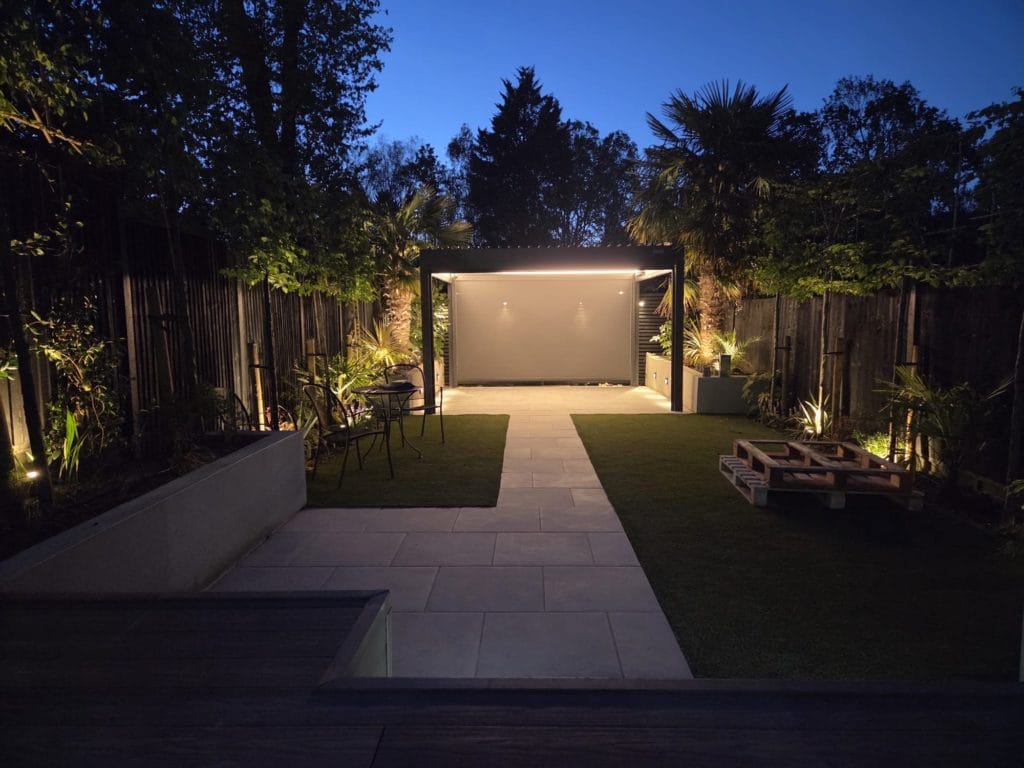
Transforming your garden after dark with expertly designed lighting schemes that create atmosphere, highlight key features and extend your enjoyment into the evening.
Whether you want to highlight a favourite tree, make your steps safer, or enjoy alfresco evenings in style, our garden lighting and electrics services bring your outdoor space to life after dark. Lighting schemes are designed by our team under the direction of Craig Davis BSc (Hons) Horticulture, with all electrical installation carried out by qualified electricians working to Part P of the Building Regulations and BS 7671.
We design and install low-voltage outdoor lighting and garden electrics to enhance mood, function and safety. Our solutions are neat, durable, weather-rated and tailored to your garden’s style and usage.
View our other landscaping services
In this guide
- Common installations
- Lighting design principles
- Fitting types and techniques
- Low-voltage vs mains systems
- Garden electrics
- Compliance and safety
- Lighting for planting and trees
- Why choose Flourish
- Common questions
- Areas we cover
Common installations
- Path and step lighting: safe and stylish access after dark, with low-glare fittings positioned to avoid blinding anyone walking on the path
- Feature lighting: spotlighting trees, water features, pergolas and key planting, often using uplighters set at the base of specimen plants
- Decking and patio lighting: integrated deck lights with discreet wiring, often combined with our decking and paving work
- Security and sensor lighting: discreet PIR-activated lights that respond to movement, well-suited to driveways, side passages and back gates
- Outdoor sockets: weatherproof IP-rated sockets for lawnmowers, patio heaters, hot tubs, festive lighting and outdoor power tools
- Smart controls: WiFi-enabled switches, timers and dimmers that you can control from your phone, including holiday mode and automatic dusk-to-dawn switching
- Garden room and outbuilding power: full electrical supply for garden rooms, studios and outdoor kitchens, including consumer units and dedicated circuits
We use weather-rated, long-lasting fittings and always work with qualified electricians to ensure everything is compliant, safe and guaranteed.
Lighting design principles
The difference between a beautifully lit garden and a generically over-bright one is in the design, not the fittings. We work to four principles that consistently produce gardens that look good after dark rather than just illuminated.
Layering
A good scheme combines multiple light sources at different heights and intensities: low-level path lights, mid-level wall washers, uplighters at the base of trees, and occasional feature highlights. Layered lighting creates depth and visual interest where a single source flatlights everything.
Restraint
Less is almost always more. We aim to light what matters and leave shadow elsewhere. Overlit gardens lose their evening atmosphere and create light pollution that disturbs wildlife and neighbours. A few well-placed fittings achieve more than a perimeter of floodlights.
Warm colour temperature
Most outdoor LED fittings are now available in a range of colour temperatures measured in kelvin. We typically specify 2700K (warm white) for residential gardens, which flatters planting and brick and feels inviting rather than clinical. The 4000K cool white sometimes used in commercial settings can make a domestic garden look like a car park.
Dimming and control
A dimmable system lets you adjust intensity for different occasions, soft and subtle for a quiet evening, brighter for entertaining. Smart controllers allow zone-by-zone control, holiday mode and pre-set scenes, all from a phone or wall switch.
Fitting types and techniques
- Spike-mounted uplighters: for lighting trees, shrubs and feature plants from beneath. Easily moved as planting matures.
- In-ground uplighters: flush-fitted into paving or lawn for a clean architectural effect; ideal for lighting walls, columns and large trees.
- Wall-mounted downlighters: for path lighting from above, often hidden under eaves or pergola beams for indirect light.
- Bollard and post lights: low-glare path lighting at mid-height for safe routes through the garden.
- Recessed deck and step lights: integrated into timber or stone surfaces for a clean, modern finish; particularly important on steps for safety.
- Festoon and string lights: weatherproof permanent festoons over patios and seating areas, considerably more durable than the temporary versions sold for parties.
- Submerged pond and water feature lights: fully waterproof (IP68) fittings designed to be submerged in ponds and water features.
Low-voltage vs mains systems
Two main systems are used for garden lighting, each with different applications.
Low-voltage 12V systems
A mains-powered transformer steps the supply down to 12V, which then powers all the lighting fittings. The advantages are significant: cabling can be buried at shallower depths, fittings are touchsafe in the garden, installation is faster, and the system is forgiving if a cable is accidentally damaged. Low-voltage is our default choice for most decorative garden lighting.
Mains 230V systems
For larger gardens, brighter fittings, security floodlights, outdoor sockets and outbuilding power, mains 230V circuits are required. These are designed, installed and tested by qualified electricians under Part P of the Building Regulations, with armoured cable buried at the correct depth, RCBO protection and full Part P certification on completion.
Garden electrics
Beyond lighting, the modern garden often needs significant electrical provision. We design and install the full range of garden electrics, including:
- Weatherproof IP65 outdoor double sockets for general garden use
- Dedicated supply to garden rooms, studios and outdoor kitchens, with sub-board, lighting circuits, sockets and data cabling
- Power for irrigation controllers and water feature pumps
- Outdoor EV charging point installation by qualified electricians, including 7kW domestic units
- Hot tub and pool electrics with appropriate IP rating, RCD protection and bonding
- CCTV cabling and discreet integration with garden lighting circuits
Compliance and safety
Outdoor electrical work is governed by national standards that exist to keep people safe. We never compromise on compliance:
- Part P of the Building Regulations: covers electrical safety in dwellings and includes garden electrical installations. All notifiable work is registered with the local building control authority.
- BS 7671: the UK wiring regulations, applicable to all electrical installation. Sets standards for cable selection, protection, bonding and testing.
- IP ratings: every outdoor fitting we install carries an appropriate IP rating, typically IP65 minimum for general outdoor use and IP67 or IP68 for in-ground or submerged applications.
- RCD/RCBO protection: all outdoor circuits are protected by residual current devices that trip in the event of an earth fault, preventing electric shock.
- Full electrical certification: every installation is tested and certified on completion. You receive an Electrical Installation Certificate (EIC) and Building Regulations compliance certificate for your records and for future house sales.
Lighting for planting and trees
Lighting can transform the way a garden’s planting reads at night. Specimen trees and sculptural plants uplit from beneath become dramatic focal points; pale bark and silver foliage almost glow. Plants that work particularly well with uplighting include:
- Betula utilis var. jacquemontii (Himalayan birch): brilliant white bark that takes light beautifully
- Acer palmatum spp. (Japanese maples): delicate branching architecture, particularly beautiful uplit in autumn
- Phyllostachys spp. (bamboo): vertical stems and gentle movement read dramatically when uplit
- Taxus baccata topiary forms: clipped yew shapes throw striking shadows when crosslit
- Cornus kousa: layered horizontal branching reveals beautifully under careful lighting
Lighting planting also requires attention to wildlife. We avoid overlighting hedges and dense planting that wildlife uses for shelter and movement, and we specify warm colour temperatures and lower intensities where lighting falls near nesting habitats.
Why choose Flourish
- Designed by horticulturalists, installed by qualified electricians: lighting schemes that work with the planting rather than against it, installed to full Part P certification
- Director-level oversight from Craig Davis BSc (Hons) Horticulture
- Specification matched to use: we are not tied to any single brand and specify fittings based on the brief, the budget and the conditions
- Integrated approach: lighting designed alongside paving, planting, irrigation and garden rooms rather than retrofitted as an afterthought
- Independent accreditations through APL, TrustMark, Chartered Institute of Horticulture, Gardeners Guild and HTA, see our partners and accreditations page
- Rated 5.0 from 57 Google reviews; see our customer reviews
Common questions about garden lighting
Do I need a qualified electrician for garden lighting?
For any work involving the mains 230V supply, including outdoor sockets, garden room circuits and most security floodlighting, yes, this is legally notifiable under Part P of the Building Regulations and must be carried out by a qualified electrician. Decorative low-voltage 12V lighting can be installed by a competent landscaper but we always run our lighting work through our qualified electrical partners regardless, for safety and certification.
How long does a garden lighting installation take?
A standalone low-voltage scheme on an established garden typically takes two to four days on site. Larger schemes involving mains 230V circuits, outdoor sockets and garden room electrics typically take one to two weeks. Where lighting is being installed as part of a wider build, cabling is run during groundworks, which keeps disruption to a minimum.
How long do garden LED fittings last?
Quality outdoor LED fittings have an L70 rating typically between 30,000 and 50,000 hours, equivalent to 15 to 20 years of normal use at around 6 hours per evening. Replaceable lamps allow individual bulbs to be changed; sealed integrated fittings are replaced as a unit when they fail.
Can lighting be added to an existing garden without major disruption?
Yes. Low-voltage lighting is particularly suited to retrofit work, since cabling can be tucked into mulch and beneath lawn edges with minimal excavation. Mains-powered installation requires more substantial trenching but still rarely needs disruption to existing planting, since cables are routed along edges and beneath paving where possible.
What colour temperature should garden lighting be?
For residential gardens we typically specify 2700K warm white. This flatters planting, brick and timber, and creates the relaxing evening atmosphere that most clients want. 3000K is a slightly crisper warm white that works well with contemporary architecture. We rarely specify the 4000K cool white sometimes used in commercial settings, since it can make a domestic garden feel clinical.
Can I control my garden lights from my phone?
Yes. Smart controllers integrate with most lighting systems and offer phone-based control, scheduling, dimming, scene presets and automatic dusk-to-dawn switching. Brands we install regularly include Hue, Lutron and Rako, depending on the wider home automation set-up if any. Holiday mode is a popular feature, varying lighting times automatically to create the impression the house is occupied.
Do I need to worry about light pollution or wildlife?
Yes, and good lighting design addresses both. We avoid overlighting, use downward-directed fittings where possible, specify warm colour temperatures (which are less disruptive to nocturnal wildlife than cool white), and use timers or PIR sensors so lights are only on when needed. Light pollution from poorly designed schemes affects neighbours, hedgehogs, bats, moths and the wider ecosystem; thoughtful design respects all of these.
Areas we cover
We design and install garden lighting and electrics across Kingston upon Thames, Surbiton, Richmond and the wider Surrey and South West London area. Key locations include:
Want your garden to glow?
Get in touch for a site visit and quote, and let’s light it up.
Explore Flourish in more depth
Related services
- Decking
- Patios, paths and driveways
- Garden rooms
- Garden features and structures
- Irrigation
- Garden design and build
Garden advice and tools
About Flourish
Good to know
Frequently asked questions
For any work involving the mains 230V supply, including outdoor sockets, garden room circuits and most security floodlighting, yes, this is legally notifiable under Part P of the Building Regulations and must be carried out by a qualified electrician. Decorative low-voltage 12V lighting can be installed by a competent landscaper but we always run our lighting work through our qualified electrical partners regardless, for safety and certification.
A standalone low-voltage scheme on an established garden typically takes two to four days on site. Larger schemes involving mains 230V circuits, outdoor sockets and garden room electrics typically take one to two weeks. Where lighting is being installed as part of a wider build, cabling is run during groundworks, which keeps disruption to a minimum.
Quality outdoor LED fittings have an L70 rating typically between 30,000 and 50,000 hours, equivalent to 15 to 20 years of normal use at around 6 hours per evening. Replaceable lamps allow individual bulbs to be changed; sealed integrated fittings are replaced as a unit when they fail.
Yes. Low-voltage lighting is particularly suited to retrofit work, since cabling can be tucked into mulch and beneath lawn edges with minimal excavation. Mains-powered installation requires more substantial trenching but still rarely needs disruption to existing planting, since cables are routed along edges and beneath paving where possible.
For residential gardens we typically specify 2700K warm white. This flatters planting, brick and timber, and creates the relaxing evening atmosphere that most clients want. 3000K is a slightly crisper warm white that works well with contemporary architecture. We rarely specify the 4000K cool white sometimes used in commercial settings, since it can make a domestic garden feel clinical.
Yes. Smart controllers integrate with most lighting systems and offer phone-based control, scheduling, dimming, scene presets and automatic dusk-to-dawn switching. Brands we install regularly include Hue, Lutron and Rako, depending on the wider home automation set-up if any. Holiday mode is a popular feature, varying lighting times automatically to create the impression the house is occupied.
Yes, and good lighting design addresses both. We avoid overlighting, use downward-directed fittings where possible, specify warm colour temperatures (which are less disruptive to nocturnal wildlife than cool white), and use timers or PIR sensors so lights are only on when needed. Light pollution from poorly designed schemes affects neighbours, hedgehogs, bats, moths and the wider ecosystem; thoughtful design respects all of these.