
Garden styles
How to choose the right one for your outdoor space
Choosing a garden style is not about following a trend. It is about understanding how you want to use your outdoor space, what will thrive in your conditions, and which aesthetic will still feel right in ten years.
For many homeowners across Kingston, Surbiton, Richmond, Esher, Cobham, and the surrounding areas of Surrey, the hardest part of planning a new garden is not the construction – it is knowing what kind of garden they actually want. The style question comes before everything else: before the layout is drawn, before materials are chosen, before a single plant is selected. Getting it right at this stage shapes every decision that follows.
A garden style is more than a look. It is a set of design principles about structure, materials, planting character, seasonal interest, and maintenance commitment that inform each other and create a coherent, considered space. A contemporary garden built with the right materials but planted informally will not feel resolved. A naturalistic planting scheme dropped onto a formal hard landscaping framework will fight itself. Style brings those elements into alignment.
This guide introduces the six garden styles that Flourish designs and builds most frequently across South West London and Surrey, along with the soil and site conditions each style suits, the plants that deliver the best results in our working area, and what each style realistically involves to maintain over time. It sits within our wider Garden advice section, alongside our Garden orientation guide and Awkward garden types pages.
Why garden style matters before design begins
The style of a garden determines far more than how it looks on the day it is finished. It determines how it matures, how much care it requires through the year, what it looks like in January as well as July, and whether it will suit the property and the way the family uses the space in five years as well as in five months.
Getting the style decision wrong is expensive to correct. Replacing a formal scheme with a naturalistic one is not simply a replanting exercise – the hard landscaping, the levels, and the planting infrastructure may all need to change. This is why we spend time early in the design process understanding how a client wants to feel in their garden, not just what they want it to look like. The answers shape everything.
The gardens we design most frequently across Surrey and South West London reflect the particular character of the area. The Victorian and Edwardian properties of Surbiton, Kingston, and Twickenham often suit a planting style that acknowledges the heritage of the house while feeling genuinely contemporary in its execution. The larger detached plots of Esher, Cobham, and Thames Ditton frequently accommodate more structured, formal approaches where scale and proportion come into their own. The urban gardens of Richmond and Clapham lend themselves well to contemporary designs where strong geometry and high-quality materials create maximum impact in limited space.
Surrey’s London Clay subsoil is the shared condition that runs beneath all of these gardens. It is fertile, moisture-retentive, and heavy, and it requires consideration whichever style is chosen. Some styles – tropical planting in particular – actually benefit from clay’s moisture-holding properties. Others, such as Mediterranean gardens, require significant drainage preparation to prevent the kind of waterlogging that turns a gravel garden into a muddy basin. Knowing what the soil requires for each style is as important as knowing which plants to choose. Our Common garden problems page and garden design and build service explain how we assess and resolve those practical issues from the outset.
The six garden styles we design and build
Below is an introduction to each style we work with most regularly across Kingston, Surbiton, Esher, Cobham, Thames Ditton, Twickenham, Richmond, and the surrounding area. Each has a dedicated guide with detailed planting advice, soil preparation guidance, maintenance requirements, and information on how the Flourish team approaches each style from first design to completed build.
Contemporary gardens
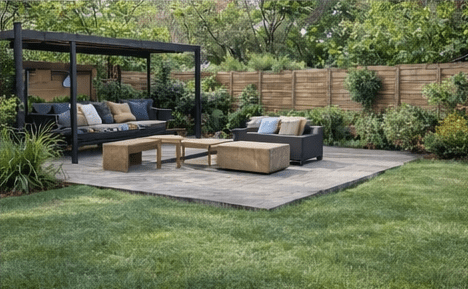
Contemporary garden design is defined by clean geometry, strong structure, and a restrained planting palette that provides year-round interest without complexity. It is among the most popular styles we design across South West London, particularly in urban and suburban settings where the garden is as much an extension of the interior living space as it is a planted outdoor area.
Hard landscaping in contemporary gardens typically features large-format porcelain or natural stone paving, architectural timber or composite cladding, and structural planting in bold, repeated masses. Calamagrostis × acutiflora ‘Karl Foerster’, Stipa gigantea, Pennisetum alopecuroides, and Miscanthus sinensis cultivars provide movement and seasonal presence. Structural shrubs including Pittosporum tenuifolium, Viburnum davidii, and Sarcococca confusa deliver evergreen form throughout the year.
On Surrey clay, contemporary gardens are well suited to the conditions, provided surface drainage is properly addressed from the outset. The large paved areas that characterise contemporary design require correct falls and, in heavier clay conditions, sub-surface drainage to prevent pooling. Explore our contemporary garden design guide.
Naturalistic gardens
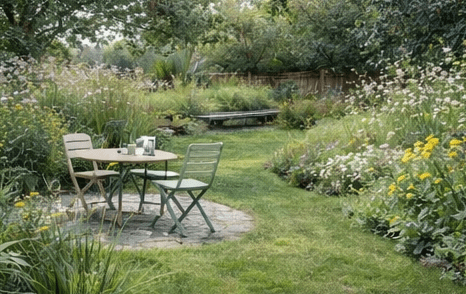
Naturalistic garden design draws on the principles developed by designers such as Piet Oudolf and the New Perennial movement – planting that mimics the layered, seasonal rhythms of natural plant communities rather than imposing a single designed moment. The result is a garden that looks effortlessly composed in summer, carries structural interest through winter, and develops genuine character as it matures.
Key plants for naturalistic schemes on Surrey clay include Persicaria amplexicaulis ‘Firetail’, Echinacea purpurea, Sanguisorba officinalis, Actaea simplex ‘Atropurpurea’, Molinia caerulea subsp. arundinacea ‘Transparent’, Verbena bonariensis, and Rudbeckia fulgida var. sullivantii ‘Goldsturm’. These species are robust, tolerant of clay conditions, and provide months of flowering interest followed by structural seedheads that carry into winter.
Naturalistic gardens are not low maintenance, but the maintenance is seasonal rather than constant – a winter cut-back and a summer edit, rather than weekly clipping and bedding. Understanding the difference is important at the design stage. Explore our naturalistic garden design guide.
Formal gardens
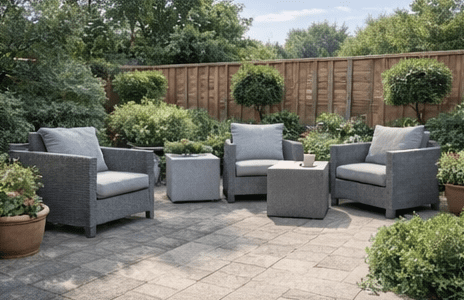
Formal garden design is built on symmetry, clear axes, and strong structural planting. It is a style with deep roots in the historic gardens of the UK, and one that suits the grander detached properties of Esher, Cobham, and Kingston Hill particularly well, though it translates into smaller urban gardens with equal success when proportion and scale are handled carefully.
Structure comes from clipped hedging – Taxus baccata, Carpinus betulus, Ilex aquifolium – and from trained or pleached trees including Carpinus betulus ‘Frans Fontaine’, Tilia cordata, and Pyrus calleryana ‘Chanticleer’. Topiary specimens in Buxus alternatives such as Ilex crenata ‘Dark Green’ or Taxus shapes anchor focal points and define axes. Planting within the formal framework tends to be seasonal and interchangeable – the structure is the garden, and the planting supports it.
On Surrey clay, formal gardens are achievable with careful preparation, though the heave and movement of clay soils over time must be accounted for in the construction of walls, paths, and edging that define the geometric framework. Explore our formal garden design guide.
Cottage gardens

The cottage garden style is one of the most enduringly popular in the UK, and for good reason. It is generous, relaxed, seasonal, and full of life – exactly the opposite of the ordered precision of formal design, and quite distinct from the structured restraint of contemporary schemes. Handled well, it is also one of the most demanding styles to design, because an apparently artless abundance requires careful planning to deliver interest across the full growing season without gaps.
Key plants for a Surrey cottage garden include Rosa ‘Gertrude Jekyll’, Rosa ‘Falstaff’, Geranium ‘Rozanne’, Alchemilla mollis, Digitalis purpurea, Delphinium elatum hybrids, Phlox paniculata cultivars, Astrantia major, Nepeta × faassenii, Thalictrum delavayi, and Campanula lactiflora. Shrub roses are the backbone of most cottage schemes, providing structure, fragrance, and repeat flowering from June to October.
Surrey clay is broadly well suited to cottage-style planting, which generally favours moisture-retentive soil. Drainage should still be addressed where necessary, as roses in particular suffer in waterlogged conditions. Explore our cottage garden design guide.
Mediterranean gardens
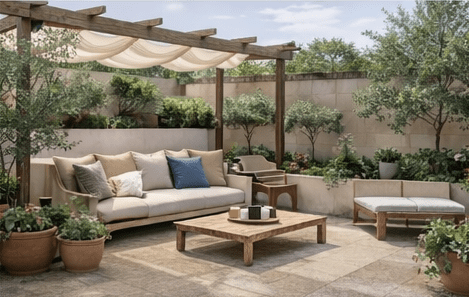
Mediterranean garden design captures the sun-baked, restrained character of southern France, coastal Spain, and the Italian hillside – gravel, terracotta, silver foliage, and the scent of lavender and thyme in dry heat. It is a style that suits south and west-facing gardens strongly, and one that requires less water and less ongoing maintenance than most other approaches once the planting is established.
Key plants for a Surrey Mediterranean garden include Lavandula angustifolia ‘Hidcote’, Cistus × purpureus, Phlomis fruticosa, Stipa tenuissima, Olea europaea, Salvia officinalis cultivars, Santolina chamaecyparissus, Artemisia ‘Powis Castle’, Salvia rosmarinus, and Verbascum species. These are drought-tolerant, sun-loving plants that perform best in free-draining conditions.
The critical challenge for Mediterranean gardens on Surrey clay is drainage preparation. Clay retains water in ways that are fundamentally incompatible with drought-tolerant planting. Raised beds, grit incorporation, and properly engineered drainage are not optional extras in this context – they are prerequisites for the style to succeed. Explore our Mediterranean garden design guide.
Tropical gardens
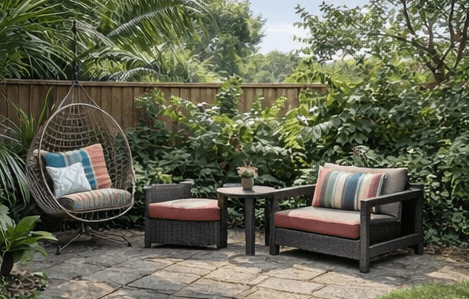
Tropical garden design creates bold, lush impact through large-leaved architectural planting, vivid colour, and layered canopy density. It is a style that works particularly well in sheltered, enclosed gardens – the walled plots of Richmond and Kingston town centre, or the south-facing rear gardens of larger Surbiton and Esher properties where reflected warmth encourages the kind of growth that makes tropical planting convincing.
Key plants for a Surrey tropical garden include Musa basjoo, Trachycarpus fortunei, Tetrapanax papyrifer ‘Rex’, Canna × generalis cultivars, Hedychium gardnerianum, Ensete ventricosum, Fatsia japonica, Melianthus major, Gunnera manicata, and Phyllostachys aureosulcata f. spectabilis. Hardy species such as Trachycarpus fortunei and Fatsia japonica require minimal winter protection. Tender species including Hedychium and Ensete need lifting or insulating before the first frost.
Surrey clay is actually well suited to many tropical species, particularly the large-leaved moisture-lovers that struggle in thin, free-draining soils. The fertility and moisture-retention of clay supports the kind of vigorous growth that makes tropical planting dramatic. Explore our tropical garden design guide.
Which style suits your garden and your lifestyle?
The right garden style is not simply the one you find most attractive when browsing images online. It is the one that suits the conditions of your site, the way you use your outdoor space, the amount of time you want to spend maintaining it, and the character of your property.
A beautiful Mediterranean garden that needs lifted tender plants over winter is not well matched to a household that travels frequently from September to March. A formal scheme of clipped hedging and topiary is not right for a family with young children who want a lawn and open space. A naturalistic planting scheme in a north-facing garden with heavy shade will not deliver the sun-loving prairie effect it was designed for.
These are the conversations we have with clients before a pencil goes anywhere near a design. Understanding what the style actually requires – in terms of site, maintenance, budget, and commitment – is what allows us to create gardens that still feel right five years after they are completed, not just on the day the last plant goes in. If you are still working through those early decisions, our Planning your perfect garden guide, garden design guide, and garden costs guide are useful starting points.
How Flourish can help you choose and create your garden style
Choosing a garden style and translating it into a scheme that will actually thrive in your specific garden is not something that should be done from mood boards alone. It requires an understanding of your soil, your aspect, your maintenance appetite, and your budget, alongside the design knowledge to make the style work at the scale and in the context of your particular plot.
Craig Davis BSc (Hons) Horticulture brings over 40 years of practical experience designing and building gardens across Surrey and South West London. Eli Jacobacci, our in-house garden designer, develops detailed design plans and planting schemes that bring each style to life with the specificity and proportion that makes the difference between a garden that looks good on paper and one that genuinely delivers. Our construction team, led by specialists including Trevor, who has 40 years of fencing and hard landscaping experience, builds each scheme to a standard that matches the design intent.
The process begins with a conversation about your site, how you use the space, and what you want from a garden. From there we assess the conditions, develop a design brief, and produce a scheme that is right for your plot, your lifestyle, and your investment. You can read more about our garden design and build service and our planting design and installation service.
Frequently asked questions
How do I know which garden style is right for me?
Start with how you want to use the space rather than how you want it to look. A garden designed around your lifestyle will be more satisfying in practice than one chosen for its visual appeal alone. Maintenance commitment, budget, and the conditions of your particular site then narrow the field considerably. Our consultation process works through all of these factors before any design decisions are made.
Can I mix garden styles?
Yes, and many of the most successful gardens draw on more than one influence. A contemporary structure with naturalistic planting within it is a common and effective combination. A formal framework around a cottage-style planted area works well. The key is ensuring the elements are deliberately combined rather than inconsistently mixed – the structure, materials, and planting need to relate to each other coherently.
Which garden style requires the least maintenance?
Mediterranean gardens, once properly established and provided with the drainage preparation they require on Surrey clay, are among the lowest-maintenance styles available. Contemporary gardens with structural evergreen planting and gravel or paved surfaces are also relatively manageable. Naturalistic and cottage gardens require more seasonal intervention, though the work is concentrated rather than constant. If reducing workload is a major priority, see our low-maintenance gardens page.
Does my garden’s aspect affect which style I should choose?
Significantly. Mediterranean planting requires full sun and free-draining conditions – south and west-facing gardens are its natural home. Tropical planting can tolerate more shade and benefits from shelter and warmth. Formal and contemporary styles are more aspect-flexible, though planting choices will vary. Our Garden orientation guide covers the specific implications of each aspect in detail.
Which garden style works best on Surrey clay?
Most styles are achievable on Surrey clay with appropriate preparation. Tropical and cottage-style planting generally suit clay conditions well. Contemporary and formal schemes work on clay provided drainage is addressed. Mediterranean gardens require the most significant drainage intervention to succeed on heavy clay soils.