Small gardens
Big ideas for making the most of a small garden.
In London and its suburbs, gardens are precious spaces. They may be getting smaller, but ambitions for them are not. A modern garden needs to be a dining room, a lounge, a playground and a tranquil escape, all within a compact footprint. The challenge is creating these distinct areas without making the space feel cluttered or cramped.
The secret isn’t magic; it’s intelligent design. At Flourish Landscaping, we specialise in unlocking the hidden potential of small and awkward gardens across Kingston, Surbiton, Esher and Coombe, including the compact Victorian and Edwardian plots of Surbiton, Norbiton and Berrylands where every metre has to earn its place. By applying proven design principles, we make small gardens feel more spacious, more functional and far more beautiful. Here is how.
Principle 1: design with the sun, let nature guide your layout
Before a single plan is drawn, the most crucial step is to observe. A successful layout is built around the natural rhythms of your garden, especially the movement of light. Spend a day watching your space and ask:
- Where does the morning sun fall? This is your prime location for a breakfast patio or a quiet reading nook to start the day.
- Where is the cool, afternoon shade? This becomes the perfect spot for a children’s play area or a comfortable lounge zone, protected from the heat of the day.
- Which areas are most sheltered and private? These are your natural choices for an intimate dining space.
By mapping the sun’s path and identifying existing features such as trees, boundary walls and pathways, we create a blueprint that works with your garden rather than against it. In a small garden, this matters even more, since there is no room to put the wrong thing in the wrong place.
Principle 2: divide without walls, the art of subtle separation
The biggest mistake in small garden zoning is creating solid barriers that block sightlines and shrink the space. The goal is to create distinct “rooms” that feel connected, not closed off. We achieve this with clever visual cues:
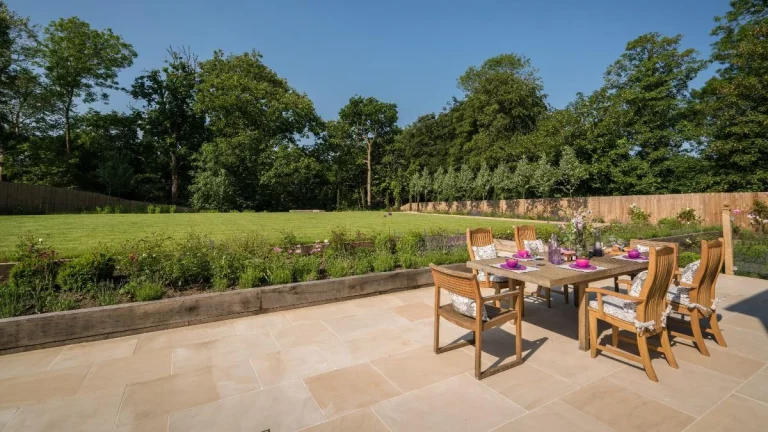
- A change in level. A sunken patio for a lounge area instantly creates an intimate, enclosed feeling. A raised deck for dining elevates the space and separates it from the lawn.
- A shift in material. Seamlessly transition from sleek porcelain paving in a dining zone to warm composite decking in a relaxation area, or use naturalistic gravel paths around planted borders.
- A “living” screen. Use a line of elegant, tall ornamental grasses such as Calamagrostis × acutiflora ‘Karl Foerster’, a panel of slatted cedar screening, or a set of pleached Carpinus betulus (hornbeam) to create a semi-transparent screen that divides the space while maintaining a sense of openness.
Principle 3: make every seat the best seat in the house
A small garden cannot afford a single dud corner. Every seat needs to look out on something worth seeing, and every viewpoint needs to be carefully composed. This layered approach adds depth and interest, making the garden feel larger and more dynamic.
- The built-in solution. In tight spaces, bespoke built-in benches are a game-changer. They provide maximum seating with a minimal footprint and can be designed with integrated planters or hidden, waterproof storage for cushions.
- The focal point. Turn a simple seating area into a destination with a portable fire pit or a stylish chiminea. This creates a natural gathering point and extends the garden’s use into cooler evenings.
- The all-weather lounge. A pergola or a retractable awning transforms a patio into a reliable outdoor room, offering protection from both intense sun and light rain, dramatically increasing its usability.
Principle 4: integrate play, elevate style
A family garden can be both fun for children and chic for adults. The key is to integrate play features seamlessly into the design rather than letting them dominate it.
- The disappearing trampoline. A sunken trampoline, flush with the lawn, provides endless fun without obstructing views or taking over the garden visually.
- The hidden sandpit. A simple timber-framed sandpit can be fitted with a sturdy lid that doubles as a small deck or stage when not in use.
- Natural play. Move beyond plastic. A series of stepping-stones, a cluster of climbable logs or a child-safe water feature can provide hours of imaginative play while adding to the garden’s natural beauty.
Principle 5: plant in layers, vertical as well as horizontal
In a small garden, walls and fences are not boundaries to hide; they are planting opportunities. Vertical planting doubles the green footprint without taking up any ground space.
- Climbers and wall shrubs. Trachelospermum jasminoides (star jasmine) brings glossy evergreen foliage and intense summer scent; Hydrangea petiolaris handles north-facing walls; Clematis armandii provides evergreen cover with early spring flowers.
- Living walls and modular planters. Where wall space is limited, modular planting systems can carry herbs, ferns or compact perennials in a structured grid.
- Multi-stem trees. A single multi-stem Amelanchier lamarckii or Betula utilis subsp. jacquemontii brings height and structure without dominating the footprint, ideal for the compact Surbiton and Berrylands plots we work with most often.
Small gardens across Kingston, Surbiton, Esher and Coombe
Each part of our area brings its own small-garden challenges. Surbiton, Norbiton and Berrylands are dominated by Victorian and Edwardian terraced houses with narrow rear gardens, often long and thin, where zoning into three or four distinct areas makes the space feel substantially larger. Kingston town centre and the apartments around the riverside often have compact courtyard gardens or balconies that benefit from intensive planting and built-in furniture. Esher, Thames Ditton and Hinchley Wood include both modest plots and substantial gardens; even the larger gardens often contain an awkward, narrow side return or shaded corner that responds well to the same small-garden thinking.
Final thoughts
A small garden does not have to mean small ambitions. With thoughtful zoning, considered planting and design choices that work with the architecture of the house, every outdoor space can become a hardworking, multifunctional sanctuary that perfectly complements your lifestyle. It is not about how much space you have, but how intelligently you use it.
Related pages
- Garden designs and plans: a measured plan that makes every metre of a small garden count
- Awkward garden types: ideas for narrow, sloping, courtyard and side-return gardens
- Multi-stem trees: the best trees for height and structure in a compact plot
- Flourish Sun Planner: map where the sun falls before you decide on a layout
- Small garden in Thames Ditton: one of our small garden projects from start to finish
Let’s create your perfect garden
Ready to unlock the full potential of your garden, whatever its size? Flourish Landscaping designs and builds small gardens across Kingston, Surbiton, Esher, Coombe and the surrounding KT postcodes. We bring the same design discipline to a compact courtyard as we do to the substantial gardens of Coombe Hill, because the principles that make a great garden work do not change with the square metres.
Contact us today to arrange a consultation and start transforming your garden into the perfect outdoor space for you and your family.
Written by Craig Davis BSc (Hons) Horticulture, member of the Chartered Institute of Horticulture. Craig has over 40 years in horticulture: in the family business since the age of 13 and a horticulture graduate since 1992, he designs, builds and plants gardens across Kingston, Surrey and South West London.