Planting plans in Kingston and Surbiton
Planting plans drawn for the light your borders actually get, by our in-house designer. From £495 plus VAT.
A planting plan is a scaled drawing of your borders with every plant named, counted and placed: botanical name, pot size, quantity and spacing, so the border can be bought and planted exactly as designed. Ours are drawn by Eli, our in-house garden designer, for gardens across Kingston, Surbiton and the surrounding area. Planting plans start from £495 plus VAT for one or two borders.
What makes a plan work is not the plant list. It is knowing where the light actually lands in your garden, which is rarely what the compass says.
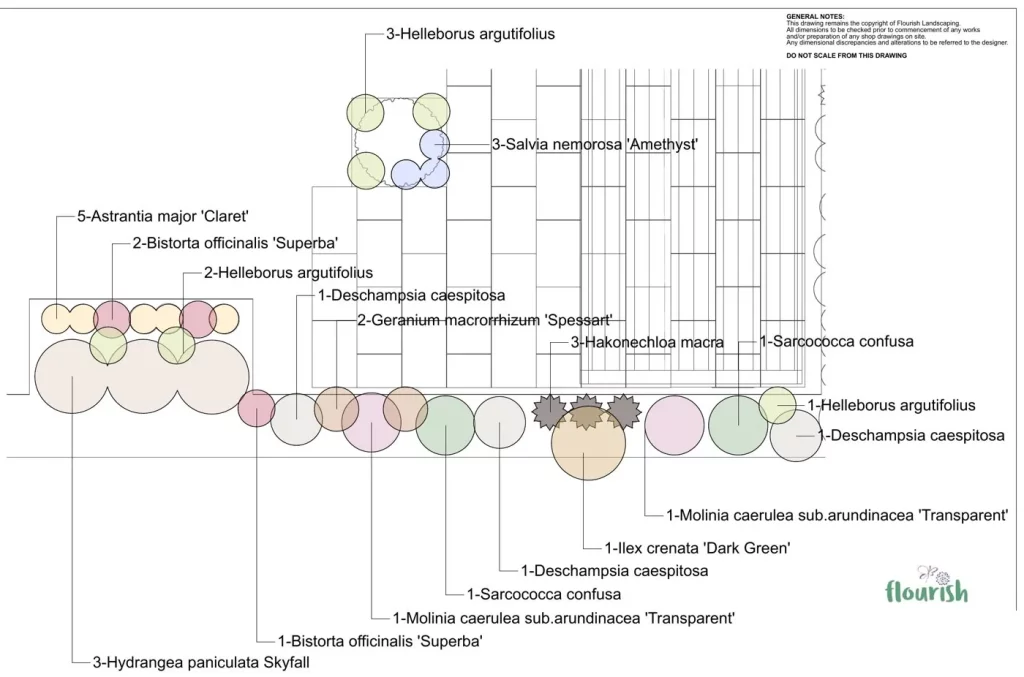
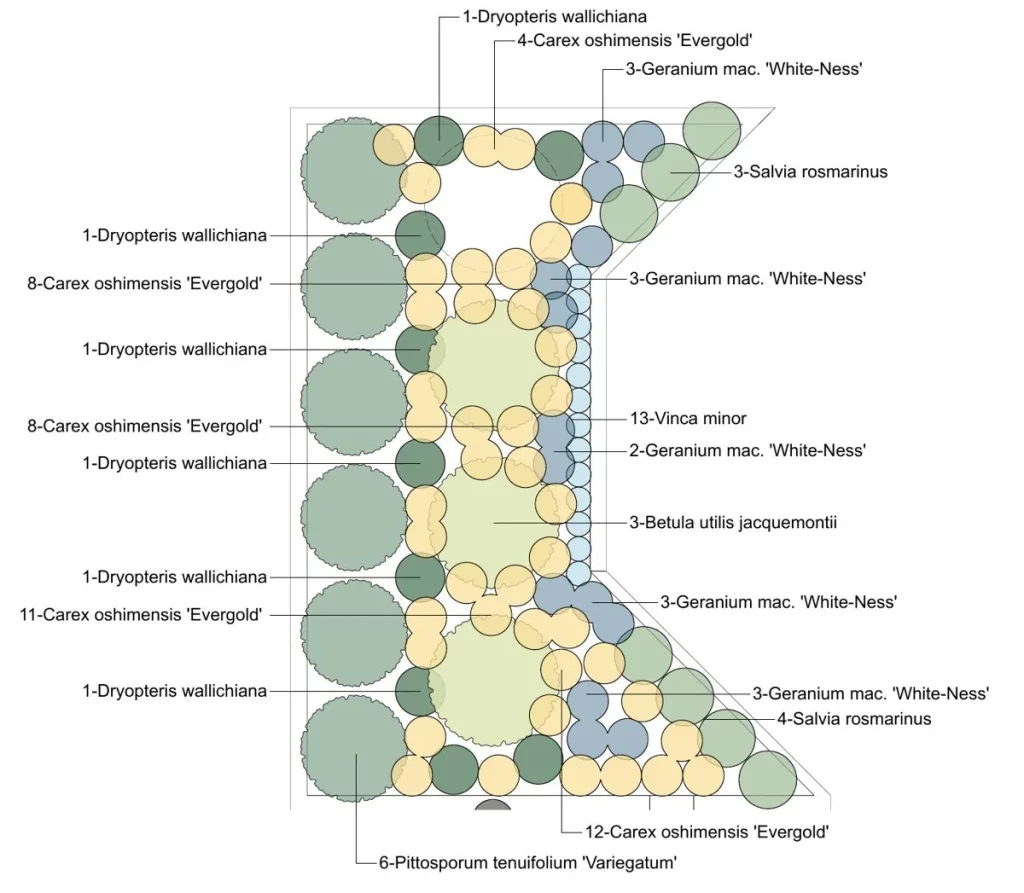
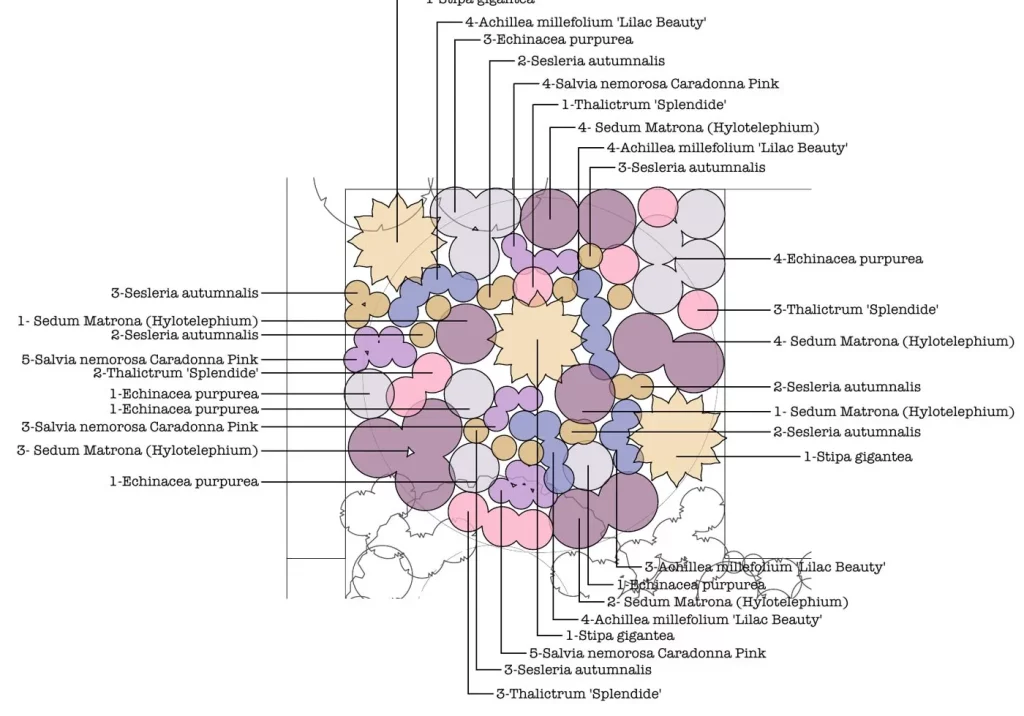
Parts of Eli’s plans as drawn for clients. Names and addresses removed.
Why “north-facing” is only the start
The way a garden faces tells you where the sun travels. It does not tell you what reaches each border. That depends on what stands between the sun and the soil: your house, the fences, the neighbours’ extensions and everybody’s trees. Two north-facing gardens on the same road can need completely different plants.
Fences on every side
Most gardens here are fenced on three sides, usually at 1.8 m, and each fence casts its own shadow. At midday in June a 1.8 m fence throws about 1 m of shade. In March and September that grows to over 2 m, and in December to nearly 7 m. So a 1.2 m border at the foot of a south-side fence sits in shade for most of the spring, autumn and winter, while the border opposite gets full sun.
This catches people out in south-facing gardens. The bed in front of the back fence faces north, and in a small garden it can be the shadiest spot you have. A single compass reading for the whole garden hides all of that.
Semi-detached, detached and terraced
A detached house usually has a gap down each side, so low morning and evening sun slips across the garden. In a semi, the attached side is blocked by the neighbour’s house and often their extension, so one side of the garden loses its low sun altogether. A terrace is walled on both sides, which leaves light down the middle and the side borders in shade for much of the day.
Rear extensions matter too. A two-storey wall casts shade well into the garden for half the year, and it throws a rain shadow: the soil at its foot stays dry even after a wet week.
Trees, yours and the neighbours’
A tree brings two kinds of shade. There is the shadow of the canopy, and there is dry shade underneath, where the roots take the water and the leaves keep the rain off. A deciduous tree lets spring light through before it leafs up, which is why bulbs, hellebores and woodland plants do well under one. An evergreen or a big conifer next door gives shade all year.
You can cut back branches that overhang your garden to the boundary. If the tree has a Tree Preservation Order, or stands in a conservation area, any work needs the council’s consent first, and several parts of Surbiton and Kingston are conservation areas. We work with a local tree surgeon and can handle the application if a tree needs lifting or thinning before planting.
The soil underneath
Most gardens in Surbiton and Kingston sit on heavy London Clay, which holds water in winter and cracks in summer. Closer to the Thames some sit on lighter, faster-draining river gravels. The plan allows for whichever you have, along with the soil preparation it needs. Our guide to improving clay soil explains the work.
How we read the light on your visit
- We take the compass bearing of the garden and of each border, not just the house.
- We measure the boundaries, extensions and walls, and note every tree that shades the garden, on your side or the neighbours’.
- We work out where the shade falls at midday in June, March and December, the same way our free garden sun planner does, and mark each border as sun, part shade, shade or dry shade.
- We dig a test hole to check the soil and drainage, and note the plants worth keeping.
Only then do the plants get chosen. A border in 2 m of winter shade gets plants that are happy there, rather than a sun-lover that sulks for three seasons.
What your planting plan includes
- A scaled drawing of each border, with every plant placed.
- A plant list with botanical and common names, quantities, pot sizes and spacing, ready to order from.
- The light and soil for each border, so you can see why each plant is there.
- Notes on flowering times and seasonal interest, so the borders work through the year.
- A colour palette for the scheme. Our garden colour schemes page shows twelve of them.
- Notes on soil preparation and aftercare.
We can supply and plant the scheme for you, or you can plant it yourself.
Planting plan prices
| Garden | Planting plan |
|---|---|
| One or two borders | from £495 |
| Whole garden, 80 to 200 m² | £795 to £1,500 |
| Larger gardens | priced after the visit |
All fees are plus VAT and fixed in writing after the first visit. Half is paid when you accept the proposal and half when we hand over the plan. If you want new paving, paths or structures as well, our full garden design service covers the whole layout.
How it works
- Visit. We look at the garden, read the light and soil, and talk through what you want from the borders.
- Proposal. A fixed fee in writing.
- Plan. Eli draws the plan and plant list, overseen by Craig Davis, BSc (Hons) Horticulture.
- Planting. We supply and plant it, or hand it over for you to plant. We can look after it afterwards on our garden maintenance round.
Plants for the light you actually have
Once each border has a light reading, the guides below help with the choices: partial shade, dry shade, full shade, and the aspect guides for north-facing, east-facing, west-facing and south-facing gardens. For a long thin plot, see long, narrow gardens.
Frequently asked questions
What is a planting plan?
A scaled drawing of a border or garden showing where every plant goes, with a list of each plant’s botanical name, quantity, pot size and spacing. It turns an idea into something you can order and plant.
How much does a planting plan cost?
From £495 plus VAT for one or two borders, and £795 to £1,500 plus VAT for a whole garden of 80 to 200 m². Larger gardens are priced after the visit. The fee is fixed in writing before we start.
Can I plant it myself?
Yes. The plan and plant list are yours to use. Many clients plant it themselves; others ask us to supply and plant it.
My garden is north-facing. Is that a problem?
No. It narrows the choice, it does not ruin it. North-facing gardens often have a sunny far end in summer, and the shade near the house suits ferns, hellebores, hydrangeas and woodland plants. What matters is the light in each border, which is what the plan works out.
My neighbour’s tree shades my garden. What can I do?
You can cut overhanging branches back to the boundary, unless the tree is protected by a Tree Preservation Order or stands in a conservation area, when the council has to agree first. Then plant for the shade that is left: the plan will treat the area under the canopy as dry shade.
Do you cover my area?
We draw planting plans across Kingston upon Thames, Surbiton, Tolworth, Berrylands, New Malden, Thames Ditton, Long Ditton, Hampton Wick, Teddington, Richmond and Esher.
Ask for a planting plan
Send us a photo of your garden and your postcode at hello@flourishlandscaping.co.uk, call 0208 399 0533, or use the button below.
This page was created with AI assistance and reviewed for accuracy by Craig Davis, BSc (Hons) Horticulture.