
Garden wildlife facts
The surprising lives of the creatures sharing your Surrey garden
Most people know their garden has bees and butterflies. Few know how many species share their plot, how strange their lives are, or how much a well-planned garden matters to them. The facts below are checked against conservation and scientific sources, listed at the foot of the page. Every one is a reason to garden a little differently, and our guide to sustainable and wildlife-friendly gardens shows how.
Bees
The honeybee gets the attention, but it is one species out of more than 270. The others are 24 bumblebees (six of them cuckoos, which lay their eggs in other bumblebees’ nests) and around 250 solitary bees: mining bees, mason bees, leafcutter bees and others that nest alone, make no honey and are very effective pollinators. Most solitary bees are so docile they almost never sting.
The bumblebee year in a Surbiton garden
February. A queen wakes underground, half-starved after six to eight months living on her fat. Her first meal has to be close: winter heather, a hellebore, a crocus in the lawn.
March. She flies low and slow along hedge bottoms, zig-zagging, looking for an old mouse nest to move into. If you see a big bee behaving like that, she is house-hunting.
April. She lays her first eggs and sits on them like a bird, shivering her flight muscles to keep them warm. A month later her first daughters take over the shopping.
June to August. A buff-tailed nest can reach 400 workers. Late in summer it raises new queens and males, and the old queen’s work is done. She dies at about 13 months old, which in bumblebee terms is a long and full life.
Autumn. The new queens mate, feed hard and dig in for winter. The common carder is often the last bumblebee still out, working the Michaelmas daisies in late October.
Source: Dave Goulson, Gardening for Bumblebees (2021).
Where solitary bees actually live
Most UK solitary bees nest in the ground, which makes a sunny patch of bare, undisturbed soil one of the most useful wildlife features a garden can have. Look for the small volcano-shaped mounds of the tawny mining bee on lawns and paths in April. They are harmless and a sign of a healthy garden.
The rest nest in cavities. Mason bees seal their eggs into hollow stems with mud walls. Leafcutter bees line their cells with neat semicircles cut from rose and other leaves. Those perfectly round notches are not damage; they are a nursery.
For the garden: a bee hotel helps the cavity nesters, but most species need the soil. Give them a patch of sunny bare ground and a long run of single flowers first. See plants for pollinators.
Who’s who in your garden
- Tree bumblebee (Bombus hypnorum): fox-brown, black and white-tailed. It arrived in the UK in 2001, and the first one was caught by Dave Goulson himself. It now nests in bird boxes and lofts across London. A crowd of bees outside a nest in early summer is just males waiting for a queen. They can’t sting and will be gone in weeks.
- Ivy bee (Colletes hederae): unknown to science until 1993, first found in Britain in 2001. It times its whole life to ivy flowering, which makes it the last bee of the year.
- Wool carder bee (Anthidium manicatum): the female combs the fluff off lamb’s ear (Stachys byzantina) to line her nest. The male guards a patch of flowers and attacks other bees that land.
- Leafcutter bee (Megachile): if your rose or lilac leaves have neat semicircles cut out of them, a leafcutter has been lining her nest. No harm done to the plant.
- Red mason bee (Osmia bicornis): the main tenant of bee hotels, and a better pollinator of apple and pear blossom than the honey bee.
- Tawny mining bee (Andrena fulva): bright orange, and the maker of those little volcanoes in spring lawns.
Butterflies, and what they really need
Nectar feeds adult butterflies but does nothing for their caterpillars, which are fussy eaters. A garden full of nectar with no caterpillar food plants is a restaurant with no maternity ward: adults visit and move on.
The Red Admiral, Peacock, Small Tortoiseshell and Comma, four of the most familiar garden butterflies, all lay their eggs on the common nettle, Urtica dioica.
| Butterfly | Caterpillar food plant | Worth knowing |
|---|---|---|
| Red Admiral | Common nettle; also hop and pellitory-of-the-wall | Once only a summer migrant, it now increasingly overwinters in southern England and can be seen on ivy flowers and windfall fruit into November. |
| Peacock | Common nettle | The black caterpillars feed together in silk webs, easy to spot on nettles in early summer. |
| Small Tortoiseshell | Common nettle | Hibernates as an adult, sometimes indoors in a cool room. |
| Comma | Common nettle; also hop, elm and currant | The caterpillar is disguised as a bird dropping. |
| Painted Lady | Thistles | A long-distance migrant from North Africa and southern Europe. Not a nettle feeder, a common mistake. |
| Brimstone | Buckthorn, Rhamnus cathartica, and alder buckthorn, Frangula alnus | Often the first butterfly of the year; the lemon-yellow male can fly on warm February days. |
| Holly Blue | Holly in spring, ivy in late summer | Its two broods use different food plants, which is unusual among British butterflies. |
| Orange-tip | Cuckooflower and garlic mustard | Only the male has the orange tips; the female is often mistaken for a white. |
| Meadow Brown, Gatekeeper, Ringlet, Speckled Wood | Native grasses | Letting part of a lawn grow long is the most useful thing you can do for this whole group. |
More in our guide to butterflies in your garden.
Dragonflies and damselflies
Most of a dragonfly’s life is spent underwater. The bright adult patrolling a pond in summer is the short last act of a larval life that can last from one to several years below the surface, where the larva is itself a fierce predator.
Their four wings work independently, so dragonflies can hover, fly backwards and change direction almost instantly. Their huge compound eyes see almost all the way round. The basic design has barely changed in 300 million years. It works.
At a sunny garden pond near Kingston, expect the broad-bodied chaser, often the first to find a new pond, the southern hawker, which breeds happily in small garden ponds, the common darter, flying late into autumn, and the emperor dragonfly.
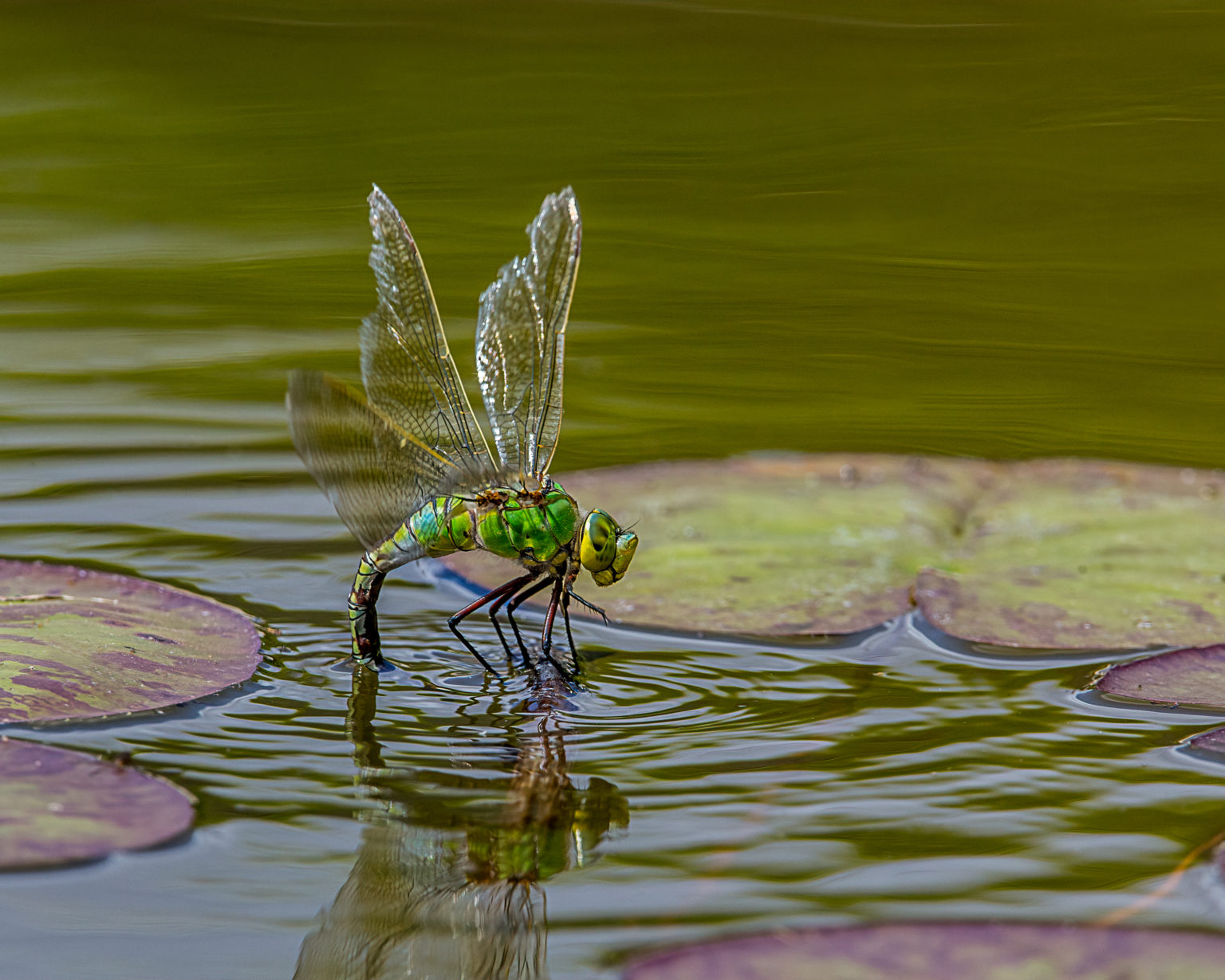
For the garden: a sunny wildlife pond with no fish, a shallow beach and native plants is the best thing you can add for dragonflies, frogs and newts. See wildlife ponds.
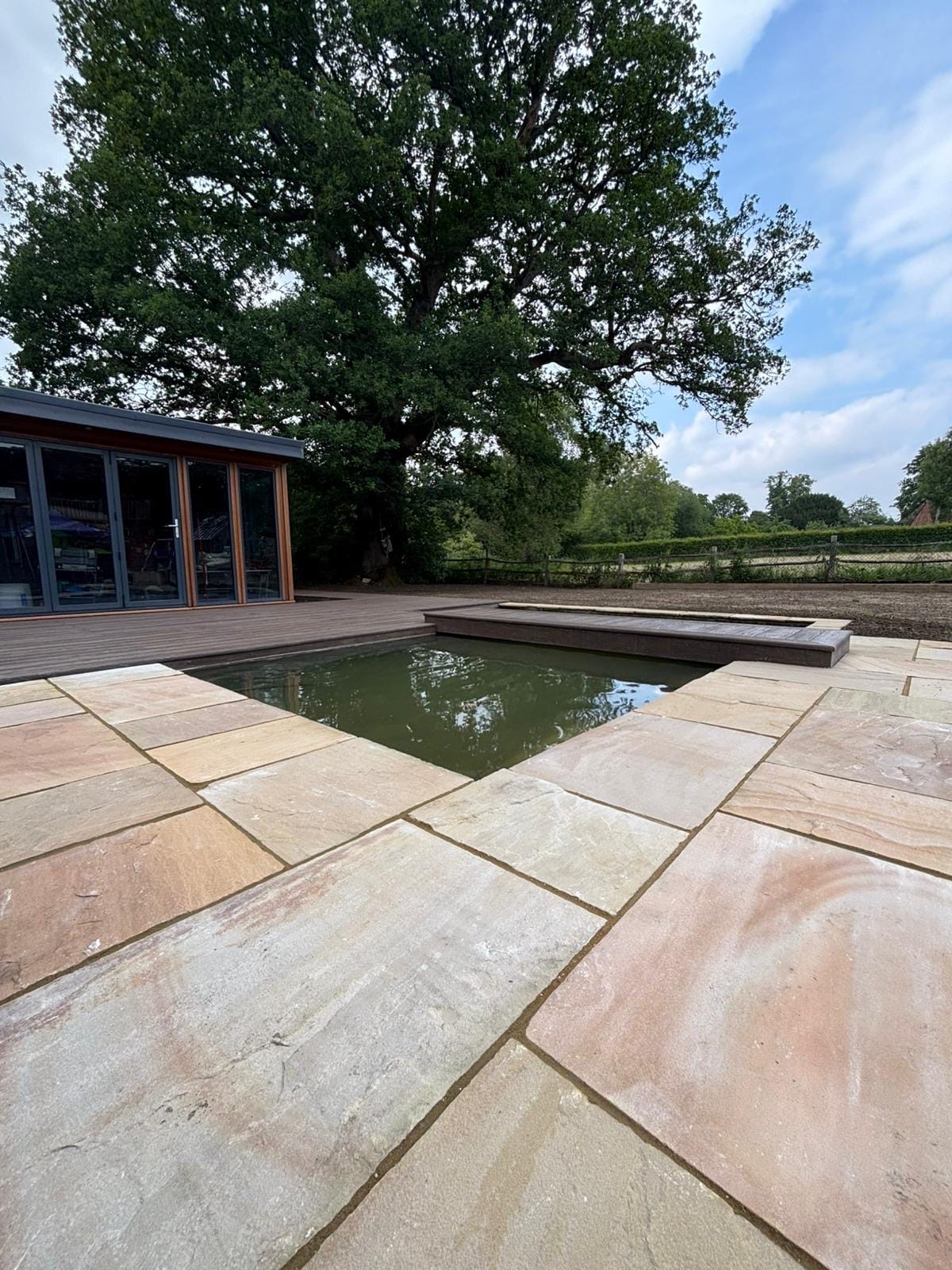
Newts, the land animals people think live in water
Newts are not water animals. They visit ponds to breed and spend most of the year on land, under log piles, in compost heaps, beneath stones and in rough grass. A pond brings them in to breed; the log pile and the long grass are where they live.
On land they hunt at night, taking worms, woodlice, insects and slugs. A log pile beside a pond is patrolled by slug-hunters all season, which is wildlife gardening paying its way.
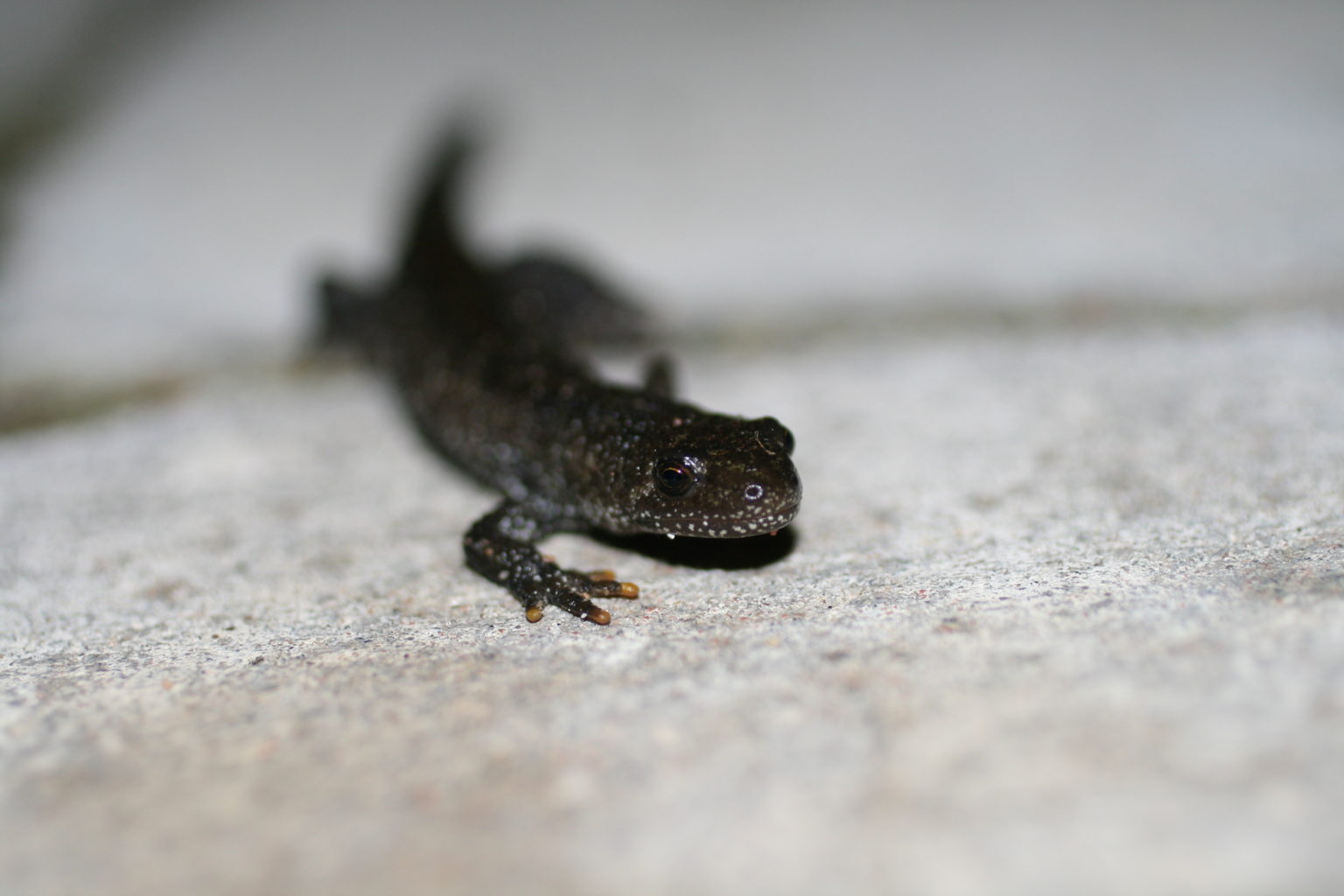
Great crested newts
The great crested newt is Britain’s largest newt and is protected under the Wildlife and Countryside Act 1981 and the Conservation of Habitats and Species Regulations 2017. In spring the males grow a jagged crest along the back and tail. Females fold each egg, one at a time, into the leaf of a pond plant.
For the garden: a new, well-planted pond is a real help to newts. If you already have great crested newts, work that would disturb them or their pond needs a licence from Natural England, so ask before you dig. Our garden law page has more.
Stag beetles, and why Kingston matters
The stag beetle, Lucanus cervus, is rare across much of Europe, but south-west London and the Thames valley hold some of its strongest populations. Richmond Park and Wimbledon Common, both on Kingston’s doorstep, are Special Areas of Conservation with the stag beetle among the reasons. Kingston gardens are prime stag beetle country.
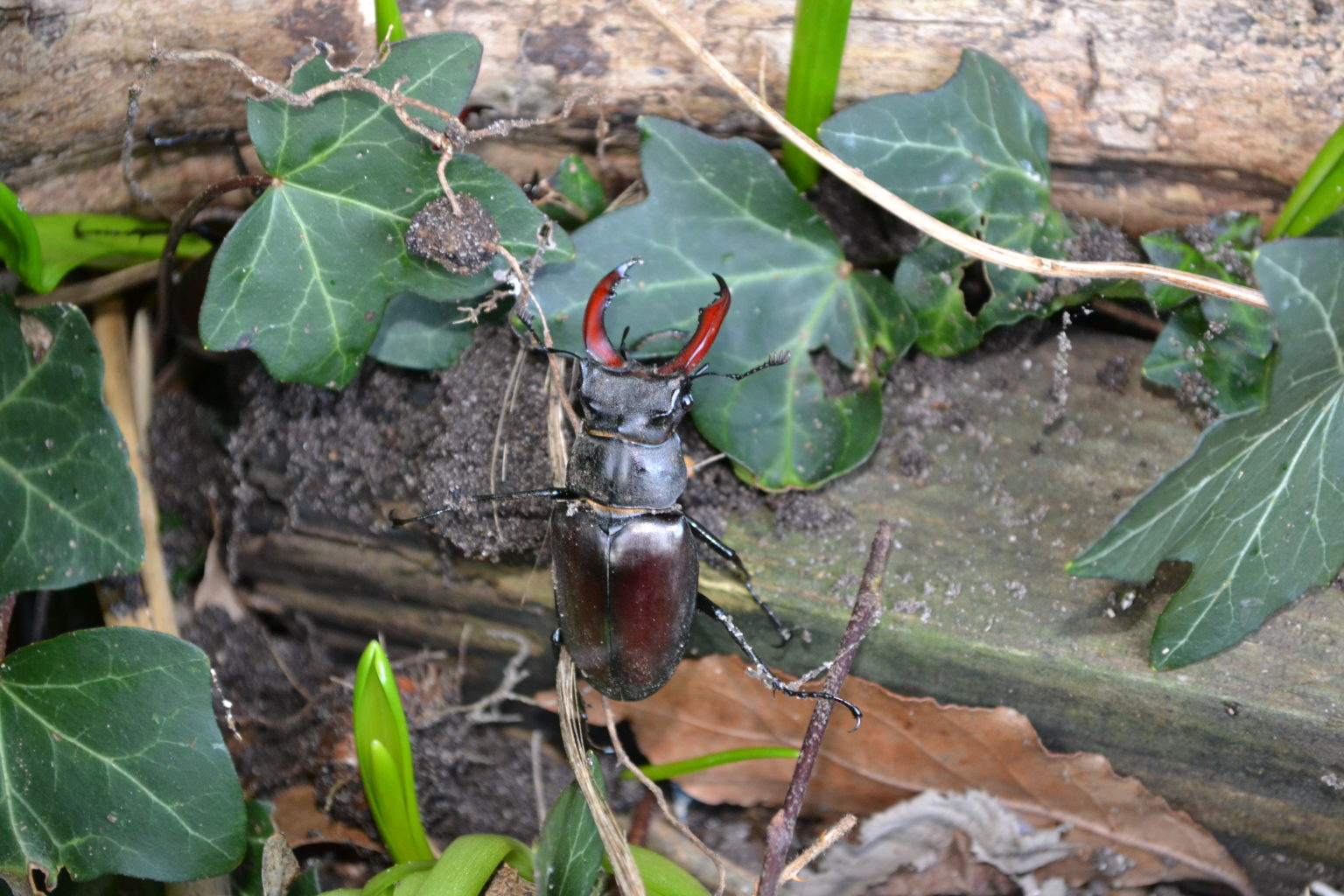
The male’s “antlers” are huge jaws, used to wrestle rival males. Adults eat no solid food at all; they live on reserves built up as larvae, with the odd sip of sap or fruit juice. Look for males flying clumsily on warm June evenings.
The most useful thing you can do for stag beetles: don’t grind out old stumps where it is safe to leave them. The larvae live underground for years in and around buried rotting wood. A few logs buried upright in a shady bed make a stag beetle nursery.
May bugs and the grubs in your lawn
The cockchafer, or May bug, is Britain’s largest chafer, a big brown beetle that blunders into lit windows on May evenings. It spends three to five years underground as a grub and only a few weeks as an adult. Count the leaves on its fan-shaped antennae: males have seven, females six.
In 1320, cockchafers were reportedly put on trial in Avignon and ordered to leave town. The story goes that, as a boy, Nikola Tesla built an engine powered by May bugs glued to a spindle. Neither episode ended well for the beetles.
What is that grub?
| Where you find it | Likely grub | What it looks like | What to do |
|---|---|---|---|
| In or around buried dead wood or a stump | Stag beetle | Large, white, C-shaped, orange-brown head and legs | Leave it. Put the wood and soil back carefully. |
| In lawn or border soil | Cockchafer or garden chafer | White, C-shaped, brown head; garden chafer smaller | Tolerate in small numbers. Birds and hedgehogs eat them. |
| In a compost heap | Rose chafer | White, C-shaped; the adult is a metallic green beetle | Leave it. It helps break down compost and does not harm living plants. |
| In lawn, grey, legless and rubbery | Leatherjacket (crane fly larva) | Grey-brown, no legs, soft | Can yellow a lawn in large numbers; see our lawn renovation guide. |
| In soil, thin and hard, orange-yellow | Wireworm (click beetle larva) | Slim, shiny, wire-like | Common after old grassland is dug over; usually dies down as the garden settles. |
Bee, wasp or hoverfly?
Newspapers regularly illustrate stories about bees with photos of hoverflies. Here’s how to tell. Hoverflies have one pair of wings, bees and wasps have two. Hoverflies have huge eyes and tiny stubby antennae, and they hang in the air as if on a string. They can’t sting; the stripes are a bluff.
The UK has 256 species. The bumblebee hoverfly even copies a bumblebee’s habit of raising a leg in warning, then lays its eggs in bee and wasp nests. The drone fly passes for a honey bee and starts life as a rat-tailed maggot, breathing through a snorkel in a rotting puddle. Gardening is not always glamorous.
Moths, the overlooked majority
Britain has around 2,500 moth species against 60 butterflies, and there are more day-flying moths than there are butterflies. Moth caterpillars on native trees such as oak, birch and willow are a main food for garden birds raising chicks; blue tits rely on them. A few nibbled leaves are a sign the garden is feeding the birds.
- Hummingbird hawk-moth, Macroglossum stellatarum: a day-flying migrant that hovers at flowers like a hummingbird and is often reported as one. It loves red valerian, honeysuckle and verbena.
- Elephant hawk-moth, Deilephila elpenor: its large caterpillar has false eyes and puffs up like a snake when threatened. It feeds on rosebay willowherb and, in gardens, on fuchsias, which belong to the same family.
- Death’s-head hawk-moth, Acherontia atropos: the skull-marked moth on the poster for The Silence of the Lambs. It squeaks when handled and raids beehives for honey. A rare migrant.
- Six-spot burnet, Zygaena filipendulae: a day-flying moth of grassland, green-black with crimson spots. The colours are a warning: it carries cyanide compounds linked to the bird’s-foot trefoil its caterpillars eat.
For moths: plant some flowers that scent the evening, such as honeysuckle, night-scented stock and white Nicotiana, near where you sit, and keep garden lighting low and warm. See garden lighting.
Frequently asked questions
Do newts live in ponds?
Only to breed. They spend most of the year on land, in log piles, compost heaps and long grass near water.
What should I do if I dig up a big white grub near an old stump?
It may well be a stag beetle larva. Put it back with the wood and soil and leave the area alone.
Which butterflies need nettles?
The Red Admiral, Peacock, Small Tortoiseshell and Comma lay their eggs on common nettle. The Painted Lady uses thistles instead.
Sources
- Dave Goulson, Gardening for Bumblebees (Square Peg, 2021)
- RHS Plants for Pollinators
- Butterfly Conservation
- Joint Nature Conservation Committee (JNCC)
- Natural England
Read more
- Sustainable and wildlife-friendly gardens
- Plants for pollinators
- Wildlife ponds
- Butterflies in your garden
- Drought-tolerant gardens
- Garden design and build
We design, build and maintain gardens where these are everyday visitors. Arrange a consultation or email us photos of your garden.
Written by Craig Davis, BSc (Hons) Horticulture, member of the Chartered Institute of Horticulture, with over 40 years in horticulture. This page was created with AI assistance and reviewed for accuracy by Craig Davis.