Victorian front gardens
How to modernise a Victorian front garden without losing its character.
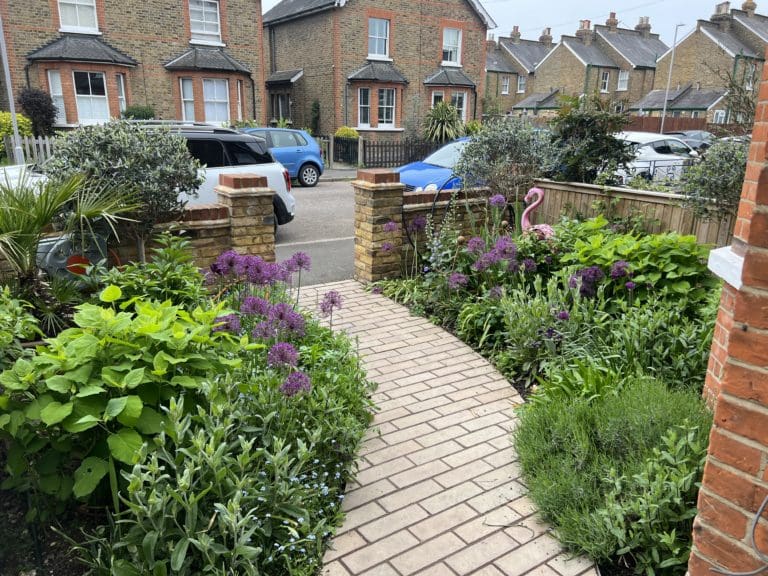
Victorian and Edwardian front gardens in Kingston, Surbiton and Hampton were never meant to be decorative extras. They were carefully composed entrance spaces that set the tone for the house before you reached the door. Their defining feature was the path: a clear, confident line of geometric tiled paving or stone, framed by planting and boundaries that balanced openness with privacy.
When these paths and steps are reinstated with care, they do far more than improve kerb appeal. They restore the rhythm of the street, reconnect the house to its architectural roots, and make everyday arrivals feel considered rather than purely functional. Flourish Landscaping specialises in restoring these front gardens in a way that feels authentic to the period while working quietly for modern life.
What the originals were like
Victorian front gardens in Kingston and Surbiton followed clear, disciplined design rules. Paths were straight or deliberately aligned, boundaries were low to keep the street visually open, and planting was structured rather than loose. The materials, however, were where character and status were most clearly expressed.
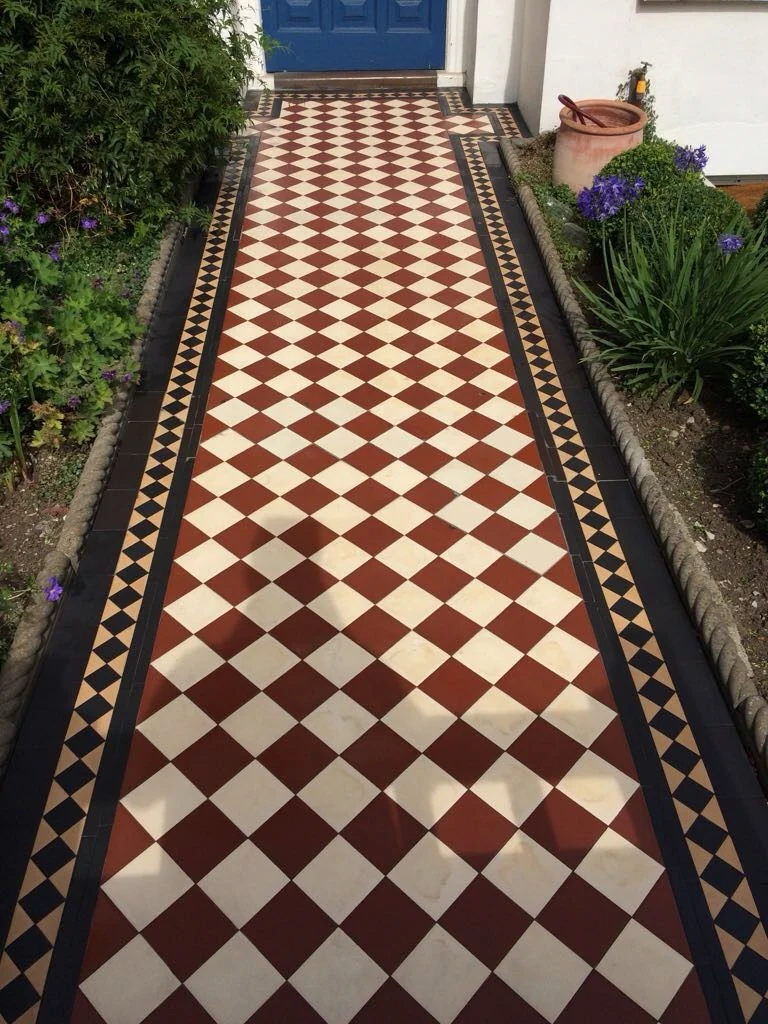
Geometric and encaustic tiled paths
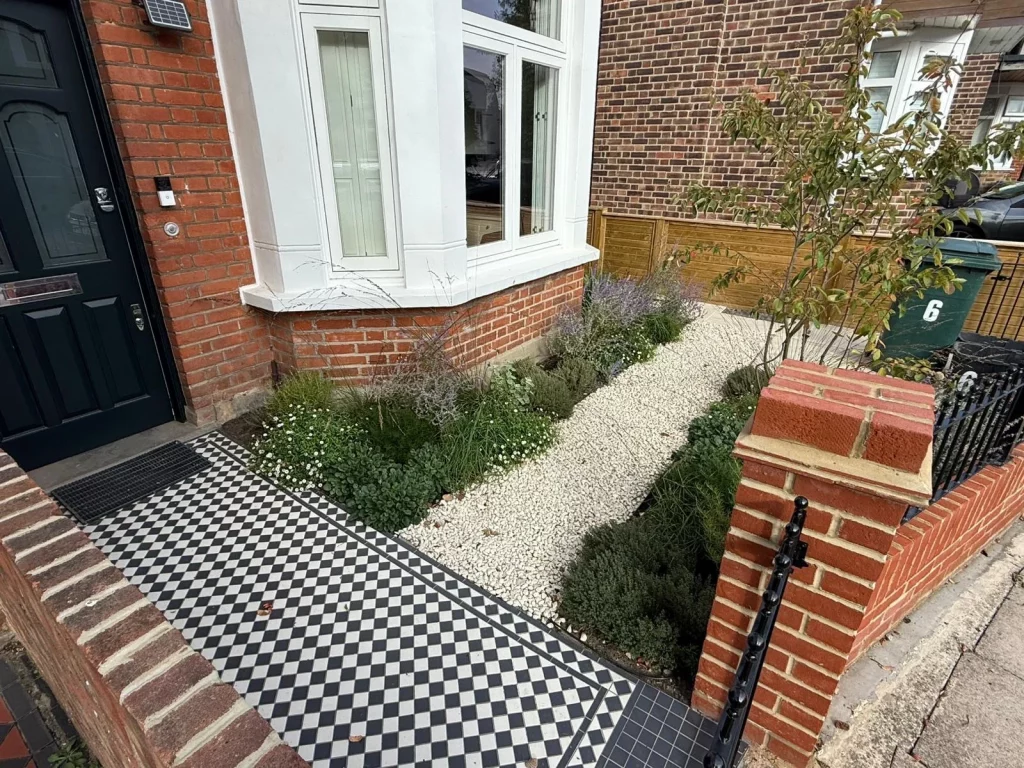
Traditional Victorian tiled paths were laid in strong repeating patterns with contrasting borders that framed the design. In this context, encaustic simply means patterned clay tiles where the design runs through the tile rather than sitting on the surface, making them extremely durable and well suited to outdoor use.
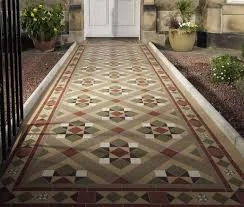
While black, white, terracotta and buff are the colours most commonly associated with Victorian paths, many original paths were multicoloured. Deep reds, greens, ochres and muted blues appeared in more intricate layouts. These richer patterns were more expensive and required skilled laying, so they quietly signalled confidence, taste and financial comfort. On Kingston and Surbiton’s streets, a colourful tiled path was a deliberate statement made at the threshold.
York stone and Portland stone paths and steps
Alongside tiles, many houses used large-format York stone or Portland stone slabs for their paths. These materials created a calm, elegant approach and aged beautifully over time.
A key period detail was the use of bullnosed stone steps, which appeared in two important locations:
- At the boundary, where the private garden met the public footpath and changes in level needed to be resolved neatly.
- At the front door, often with one or two deep steps that softened the rise and added a refined architectural finish.
This bullnosed profile is one of the most distinctive details of Victorian entrances and one that Flourish carefully reinstates, matching proportions while improving modern safety and durability.

Clay knot (rope) edging
Another feature that sometimes survives is clay knot edging, also known as rope edging. This twisted clay border became popular in the late Victorian and Edwardian period as a decorative way to edge lawns and planting beds.
It was sometimes used alongside simpler tiled paths, particularly on smaller or more modest houses, but it was not usually paired with the most elaborate geometric designs found on higher-status villas. Today it divides opinion. Some homeowners enjoy its nostalgic charm, while others find it visually busy. Flourish treats it sensitively, retaining it where it genuinely adds character or replacing it with cleaner brick, stone or metal edging for a more timeless finish.
Period-appropriate planting
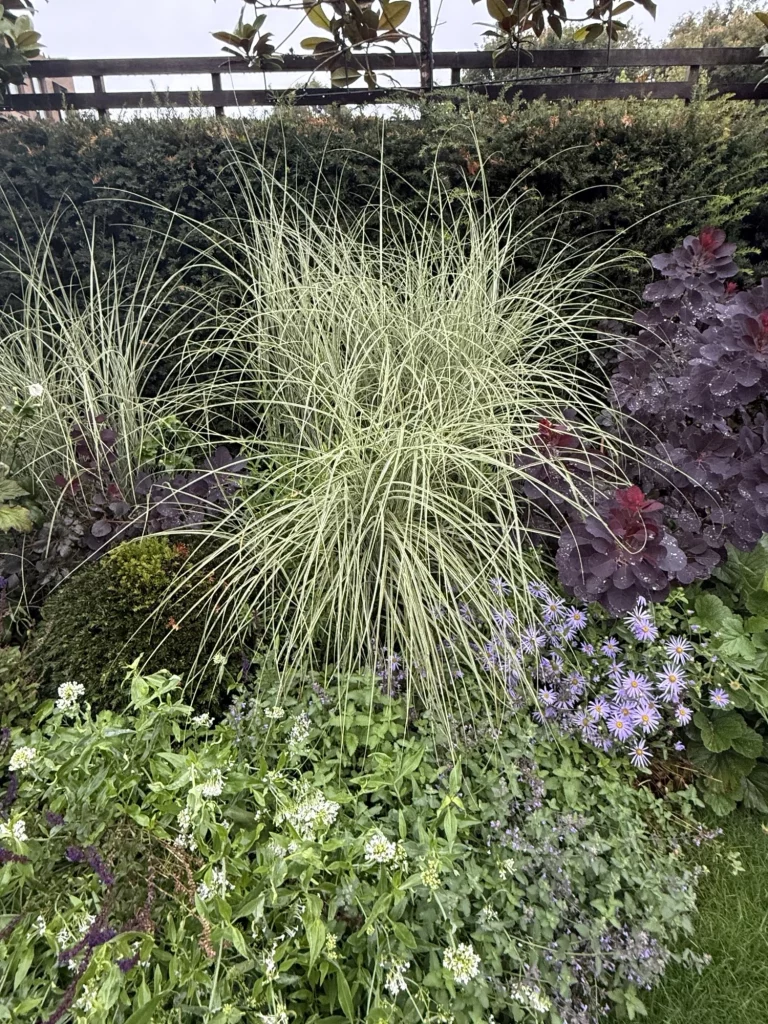
Original Victorian front gardens used a small, disciplined plant palette. Structure mattered more than seasonal display, and the planting was chosen to frame the architecture rather than compete with it. The historically appropriate Victorian and Edwardian palette includes:
- Evergreen structure. Buxus sempervirens as clipped balls, low hedges or topiary cones (with Ilex crenata as the modern box-blight alternative), Taxus baccata (yew) for clipped forms, Aucuba japonica for shaded corners, Fatsia japonica for architectural foliage.
- Period roses. Rosa ‘Madame Alfred Carrière’ (cream-white climber, north-wall tolerant, introduced 1879), Rosa ‘Albertine’, Rosa rugosa, modern David Austin English roses bred in the period style (‘Gertrude Jekyll’, ‘Munstead Wood’).
- Climbers on walls and railings. Wisteria sinensis, Clematis montana, Jasminum officinale, Hedera helix in classical-style trained forms.
- Cottage-style perennials. Digitalis purpurea (foxglove), Alchemilla mollis, Geranium macrorrhizum, Astrantia major, all of which were available and grown in the period.
- Standard trees and bays. Pleached Tilia × europaea for high boundaries (where space permits), standard Laurus nobilis (bay) in pots either side of the front door for permanent presence.
The principle is simple: a few well-chosen plants used confidently, rather than the all-of-everything mix that suits a more informal cottage garden.
Why reinstating a tiled or stone path transforms a front garden
Across Kingston and Surbiton, we see the same transformation time and again. Once a properly proportioned path and set of steps are reinstated, the entire frontage feels resolved.
The path restores structure. Victorian plots are compact, so strong lines matter. A well-aligned path anchors the garden and gives clarity, even when modern requirements such as storage or access are introduced.
The materials reconnect house and street. Tiles, York stone and Portland stone have a permanence that modern paving rarely achieves. Restoring them brings coherence back to the façade and reinforces the building’s original presence.
Bullnosed steps complete the journey. Softened edges turn functional level changes into elegant transitions. A bullnosed step at the boundary followed by bullnosed entrance steps creates a dignified, welcoming approach that feels unmistakably period.
A restored Victorian path is not a decorative detail. It is the backbone of the front garden.
Restoration versus replacement
One of the first questions a Victorian frontage poses is whether to restore an existing path or replace it entirely. The right answer depends on what has survived, and on what condition it’s in.
- Restore where the original survives in reasonable condition. Even a partially-cracked or weed-grown original path is usually worth saving. Lifted tiles can be reset; missing tiles can be sourced from heritage suppliers (Original Style, Topps Tiles Heritage, Olde English Tiles) or reclaimed from architectural salvage; broken bullnosed stone can be hand-finished to match. The patina of an authentic Victorian path cannot be reproduced; once lost it is gone.
- Reinstate to original pattern where the path has been lost. If the original was concreted over, tarmacked or replaced with non-period block paving, the best approach is a period-correct reinstatement using quality reproduction tiles and proper bedded construction. Photographs of neighbouring houses on the same street usually show what the original pattern would have been.
- Replace where reinstatement isn’t possible. On properties where original details have been long removed and the architecture has been heavily altered, a period-style design rather than strict restoration may be the right call. The aim becomes coherent character rather than literal accuracy.
Modern needs, period style: the Flourish approach
Today’s front gardens have to work harder. Parking, bins, bikes, deliveries, lighting and improved access all need to be considered, often within a very small footprint. Flourish specialises in integrating these modern needs without disturbing the period character.
Our approach typically includes:
- Engineered, permeable sub-bases beneath traditional tiles or stone to provide drainage and long-term stability, and to comply with the 2008 General Permitted Development Order rule on hard surfacing over 5 sq m at the front of a property.
- Bespoke tile layouts designed around the proportions of the house rather than generic patterns.
- Hand-finished bullnosed steps in York stone or Portland stone, crafted to suit the frontage.
- Careful material transitions, such as tiles near the house and stone, clay pavers or setts nearer the boundary.
- Discreet bin and bike storage detailed as bespoke joinery rather than off-the-shelf plastic units, often built behind a slatted timber screen with climbing plants.
- EV charging cable runs planned and installed before the surface goes down, avoiding the visible retrofits seen on many drives.
- Structured planting to soften hard materials and frame the path.
- Discreet lighting, used sparingly and with purpose.
Everything is designed to feel calm, intentional and rooted in the building’s history.

A gentle approach to lighting
Victorian front gardens rarely need much lighting, and restraint almost always produces the most elegant result. These houses were designed to be appreciated in daylight, so lighting should simply support safe access and add a quiet sense of welcome.
For a small Victorian terrace or semi, one well-chosen wall light near the front door is often enough. Where there are changes in level, particularly around bullnosed stone steps, one or two discreet step or path lights can guide the way without drawing attention to themselves.
Occasionally, a single subtle uplight can be used to catch the shape of a small tree or clipped evergreen, but only where it genuinely adds something. Warm white light (2700K LED), simple fittings and a limited number of sources always sit best. When done well, the lighting almost disappears during the day and gently supports the restored path, steps and planting at night.
Style ideas for reinstating Victorian paths
Flourish regularly works with homeowners to choose an approach that suits both the house and the street.
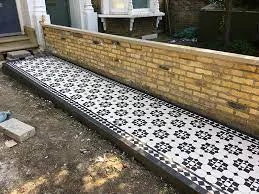
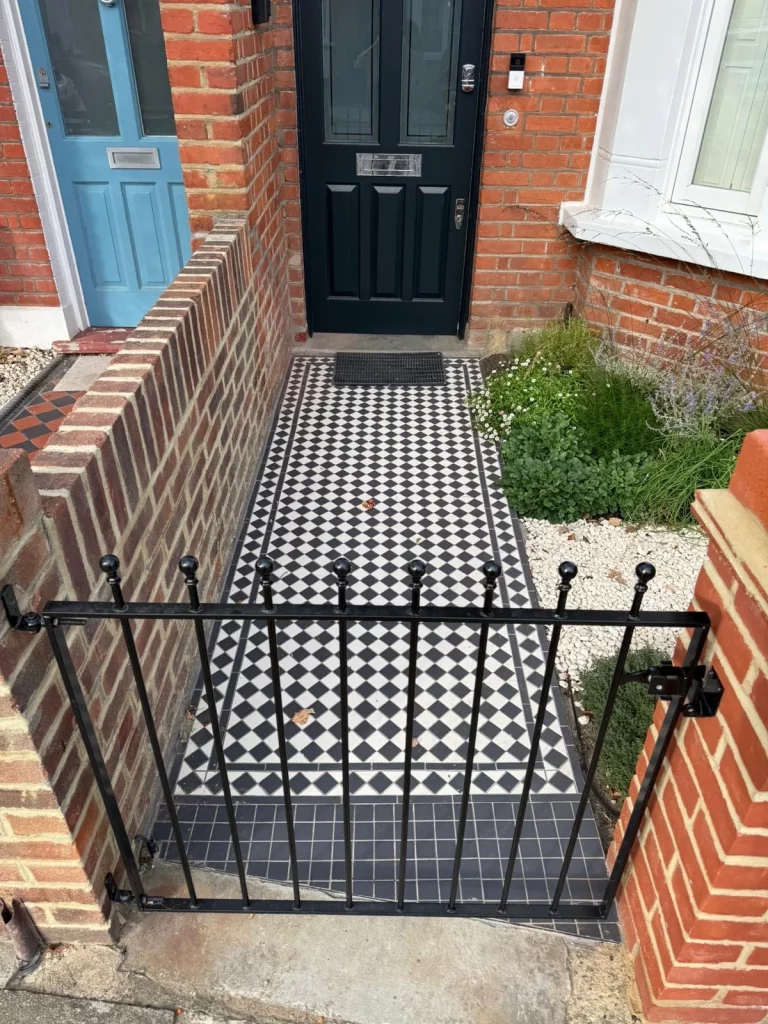
- Classic black and white geometric tiles for terraces with strong architectural lines.
- Terracotta and buff patterns for warmer, more relaxed cottage-style homes.
- Full-width York stone paths with bullnosed steps for understated elegance.
- Portland stone paths and entrance steps for a lighter, refined look.
- Hybrid period-modern layouts, combining tiles near the door with stone or clay paving towards the gate.
- Soft Victorian contemporary schemes, using restrained planting and a limited material palette.
Each approach is adapted to the specific house rather than applied as a formula.
Planning and conservation considerations
Many of the Victorian and Edwardian streets in Kingston, Surbiton and Hampton sit within designated conservation areas (Surbiton has several, including Berrylands, the Avenues, and parts of South Bank). Additional rules can also apply under Article 4 directions where local councils have removed certain permitted development rights to protect period character.
- Boundary walls and railings. Demolition or significant alteration of a front boundary in a conservation area generally requires planning permission. Reinstating a missing boundary in period style is usually welcomed; removing or radically altering an existing one is rarely permitted.
- Hard surfacing. The Town and Country Planning (General Permitted Development) Order 2008 requires any new hard surfacing over 5 sq m at the front of a property to be permeable, or drain to a soakaway, or planning permission is required. Period-correct tiled paths laid over a permeable sub-base comply.
- Listed buildings. If the property is listed, even small external changes (including paint colours, tile patterns and boundary work) may require Listed Building Consent. Check with the local conservation officer at Kingston, Elmbridge or Richmond Council.
- Tree Preservation Orders. Mature trees in front gardens of period properties are frequently TPO-protected; check before any work that could affect roots or canopy.
Flourish works through these requirements as part of any front-garden project on a period property, including liaison with the local conservation officer where appropriate.
Why Flourish Landscaping for Victorian front gardens
Frequently asked questions
What is an encaustic tile, and why does it matter for a Victorian path?
An encaustic tile is a patterned clay tile where the design runs through the body of the tile rather than sitting as a glaze on the surface. The pattern is created from contrasting clays fused together during manufacture, so even decades of foot traffic wear cannot remove it. This durability is why Victorian tiled paths survive a century or more of weather and use, where surface-glazed tiles would have worn smooth within a few years. Modern reproduction encaustic tiles (Original Style, Topps Tiles Heritage, Olde English Tiles) follow the same principle.
Should I restore my original Victorian tiled path or replace it?
If any meaningful proportion of the original survives in reasonable condition, restoration is almost always the right call. Authentic Victorian tiles develop a patina that cannot be reproduced; once lost it is gone forever. Lifted or cracked tiles can be reset, missing tiles can be sourced from heritage suppliers or salvage, and broken bullnosed stone can be hand-finished. Replacement is appropriate where the original was concreted over or removed long ago, in which case a period-correct reinstatement (using quality reproduction tiles and traditional construction) gives the best result.
Do I need planning permission for a new Victorian-style path?
For most reinstatements no, provided the path is laid over a permeable sub-base (or drains to a soakaway) to comply with the Town and Country Planning (General Permitted Development) Order 2008 rule on hard surfacing over 5 sq m at the front of a property. However, if the property is listed, in a conservation area with an Article 4 direction, or if you are altering boundary walls or railings, planning permission or Listed Building Consent may be required. Flourish checks the planning context for every period-property project as a matter of course.
What is a bullnosed step and why does it matter?
A bullnosed step is a stone step where the front edge is rounded (or ‘bullnosed’) rather than left as a sharp arris. The profile is one of the most distinctive details of Victorian and Edwardian entrances. It softens the visual edge, reduces chipping over time, and creates a more refined, dignified transition between levels. Bullnosed steps appeared in two key locations on period properties: at the boundary where the garden met the public footpath, and at the front door (typically one or two deep steps). Reinstating bullnosed steps is one of the highest-impact details in any Victorian front-garden restoration.
Can a Victorian front garden accommodate a car and EV charging?
Often yes, but it requires careful design. Many Victorian terraces have narrow front gardens that won’t fit a car at all; semi-detached and detached Victorian villas usually have enough space for one or two cars. The keys to making it work are: a permeable surface compliant with the 2008 GPDO, dropped kerb permission from the council, EV cable runs planned before the surface goes in, careful proportion of car space to planted strips so the garden doesn’t become a sea of paving, and (often) retaining a path-and-steps frontage to the door even where parking takes up most of the garden width.
What plants are right for a Victorian front garden?
The historically appropriate palette is structural and disciplined: clipped Buxus sempervirens (or Ilex crenata as the modern box-blight alternative), Taxus baccata forms, Aucuba japonica for shaded corners, standard Laurus nobilis (bay) in pots either side of the front door, period-appropriate climbing roses (Rosa ‘Madame Alfred Carrière’, ‘Albertine’), Wisteria sinensis on walls, and a few cottage-style perennials (Digitalis purpurea, Alchemilla mollis, Astrantia major). The principle is a small, confident plant palette that frames the architecture rather than competes with it.
Let’s restore your Victorian front garden
If you live in a Victorian or Edwardian property in Kingston, Surbiton, Richmond or the wider Surrey area and you’d like to restore or reinstate the front, we’d be glad to help. See our patios, paths and driveways service for the way we work, or our kerb appeal guide for the wider picture.
Contact us to arrange a consultation and start the conversation.
Good to know
Frequently asked questions
An encaustic tile is a patterned clay tile where the design runs through the body of the tile rather than sitting as a glaze on the surface. The pattern is created from contrasting clays fused together during manufacture, so even decades of foot traffic wear cannot remove it. This durability is why Victorian tiled paths survive a century or more of weather and use, where surface-glazed tiles would have worn smooth within a few years. Modern reproduction encaustic tiles (Original Style, Topps Tiles Heritage, Olde English Tiles) follow the same principle.
If any meaningful proportion of the original survives in reasonable condition, restoration is almost always the right call. Authentic Victorian tiles develop a patina that cannot be reproduced; once lost it is gone forever. Lifted or cracked tiles can be reset, missing tiles can be sourced from heritage suppliers or salvage, and broken bullnosed stone can be hand-finished. Replacement is appropriate where the original was concreted over or removed long ago, in which case a period-correct reinstatement gives the best result.
For most reinstatements no, provided the path is laid over a permeable sub-base (or drains to a soakaway) to comply with the Town and Country Planning (General Permitted Development) Order 2008 rule on hard surfacing over 5 sq m at the front of a property. However, if the property is listed, in a conservation area with an Article 4 direction, or if you are altering boundary walls or railings, planning permission or Listed Building Consent may be required.
A bullnosed step is a stone step where the front edge is rounded rather than left as a sharp arris. The profile is one of the most distinctive details of Victorian and Edwardian entrances. It softens the visual edge, reduces chipping over time, and creates a more refined, dignified transition between levels. Bullnosed steps appeared in two key locations on period properties: at the boundary where the garden met the public footpath, and at the front door (typically one or two deep steps). Reinstating bullnosed steps is one of the highest-impact details in any Victorian front-garden restoration.
Often yes, but it requires careful design. Many Victorian terraces have narrow front gardens that won't fit a car at all; semi-detached and detached Victorian villas usually have enough space for one or two cars. The keys to making it work are: a permeable surface compliant with the 2008 GPDO, dropped kerb permission from the council, EV cable runs planned before the surface goes in, careful proportion of car space to planted strips so the garden doesn't become a sea of paving, and often retaining a path-and-steps frontage to the door even where parking takes up most of the garden width.
The historically appropriate palette is structural and disciplined: clipped Buxus sempervirens (or Ilex crenata as the modern box-blight alternative), Taxus baccata forms, Aucuba japonica for shaded corners, standard Laurus nobilis (bay) in pots either side of the front door, period-appropriate climbing roses (Rosa 'Madame Alfred Carriere', 'Albertine'), Wisteria sinensis on walls, and a few cottage-style perennials (Digitalis purpurea, Alchemilla mollis, Astrantia major). The principle is a small, confident plant palette that frames the architecture rather than competes with it.