Victorian tiled paths
Restoration and new geometric and encaustic tiled paths for period homes in Kingston, Surbiton, Richmond and Surrey.
We restore original Victorian tiled paths and lay new ones in period patterns across Kingston, Surbiton, Richmond and north Surrey. That covers the tiles, the bullnosed York stone or Portland stone steps, the front wall and railings, and the planting around them. Every job starts with a free site visit and a fixed written quote.
If your path is cracked, sunk, half missing or buried under concrete, it can almost always be brought back. Original Victorian tiles are fired clay and usually outlast the base they sit on.
What we do
- Path restoration. Cleaning, lifting and re-bedding loose tiles, rebuilding failed bases and matching missing tiles.
- New period paths. Geometric and encaustic paths laid to a pattern that suits the age and style of the house.
- Steps. Bullnosed York stone or Portland stone steps at the gate and the front door.
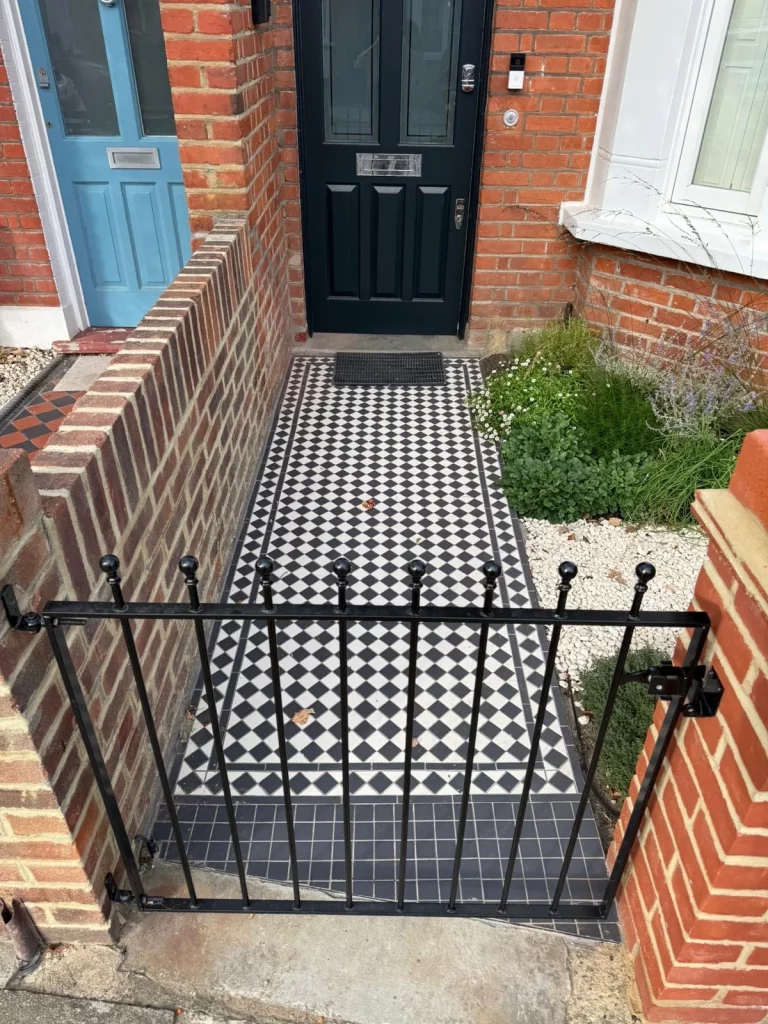
- Walls and railings. Rebuilding dwarf walls, piers and copings, and reinstating railings and gates. See our fencing and boundaries page.
- The front garden around it. Planting, bin and bike storage, lighting, and cable runs for an EV charger laid before the surface goes down.
Restore or replace?
Restore if the original path is still there, even if it is cracked, weedy or has tiles missing. The colour and wear of a 120-year-old path cannot be copied, and once it is lifted and skipped it is gone.
Reinstate if the path has been concreted, tarmacked or replaced with block paving. Good reproduction tiles now match the original colours and sizes closely. Neighbouring houses on the same street usually show what the original pattern was.
Design afresh where the house has been heavily altered and there is nothing left to follow. The aim then is a path that suits the house, not a copy of one that never existed.
How we lay a tiled path
Most failed tiled paths fail because of what is underneath them. On the London Clay around Kingston and Surbiton the base matters more than the tiles. Our specification follows the tile manufacturers’ fixing guidance and BS 5385-3.
- Survey. We photograph and measure the path, record the pattern and count missing or broken tiles.
- Base. We dig out to a compacted Type 1 sub-base and lay a concrete base with a gentle fall, so rainwater runs off rather than sitting under the tiles. The concrete is left to cure before any tiling starts.
- Sealing before laying. Unglazed tiles are treated with a breathable impregnating sealer before fixing, so adhesive and grout do not stain them.
- Fixing. Tiles are laid on a solid bed of exterior-grade adhesive, not loose sand and cement. Joints are kept narrow, around 2 mm, as on the originals.
- Grouting and movement joints. Joints are grouted in a neutral grey, and movement joints are built in where the path meets walls and steps.
- Final seal. Once clean and dry the path is sealed again with a matt, UV-stable impregnator. No gloss finishes, which look wrong on period tiles.
On a restoration the same rules apply to each section we lift. Sound tiles are cleaned off and re-fixed on a repaired base rather than mortared back over the problem.
Geometric and encaustic tiles
Geometric tiles are single-colour clay tiles in squares, triangles, hexagons and octagons. The pattern comes from how they are arranged. The colour runs right through, so wear never shows a different colour underneath.
Encaustic tiles have the pattern inlaid in contrasting clays through the body of the tile. They cost more and were used as feature panels on higher-status paths, framed by geometric borders.
Replacement tiles come from specialist makers such as Original Style, from heritage suppliers, or from architectural salvage yards when an exact old tile is needed.
Patterns and colours
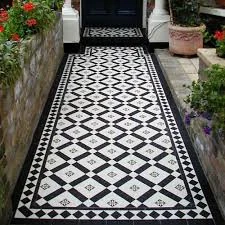
A Victorian path is usually built in three parts: an outer border, an inner border and a central field.
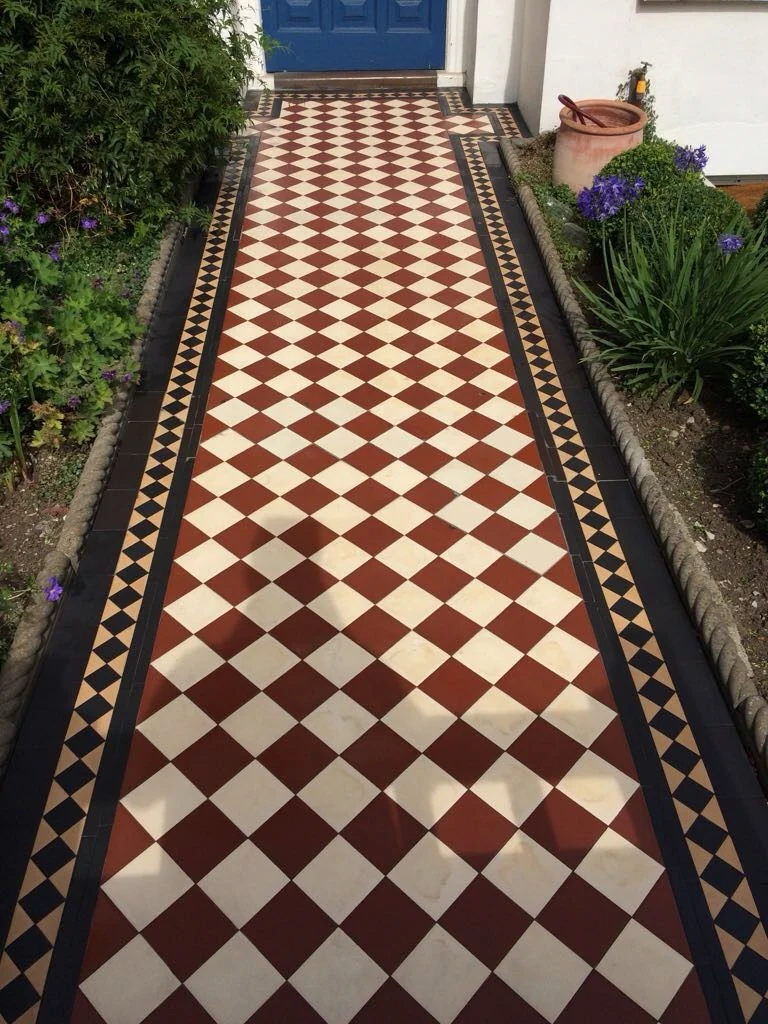
- Chequerboard. Two contrasting squares. Black and white is the classic terrace path; black and red suits plainer streets.
- Octagon and dot. Octagons with small contrasting squares in the gaps. A step up from chequerboard.
- Star and box panels. More elaborate central layouts for wider paths on villas.
- Borders. Tramlines, rope and Greek key borders, often where each street showed its own character.
The standard palette was black, white, buff, terracotta, blue, green, ochre and grey. Mid-Victorian paths tend to be simpler; late-Victorian and Edwardian paths use more colour. The common mistake is an over-elaborate pattern on a modest terrace. Look along the street first: the neighbours’ surviving path is usually the best guide.
A path needs at least 900 mm clear width to feel comfortable; 1.0 to 1.2 m reads as generous. We lay sample tiles out against your brick and front door colour before ordering.
Planning and conservation areas
- Hard surfacing. In England, new hard surfacing over 5 m² in a front garden must be permeable or drain to a permeable area, or it needs planning permission. We lay tiled paths to fall into a planted bed or soakaway so they comply.
- Conservation areas. Many period streets in Kingston, Richmond and Elmbridge are in conservation areas, and some have Article 4 directions. Removing or altering a front wall or railings may need permission; reinstating them in period style is usually welcomed.
- Listed buildings. Even small external changes can need Listed Building Consent. We check before work is priced.
Our garden law guide covers boundaries and permitted development in more detail.
The rest of a Victorian front garden
Victorian front gardens were simple: a straight path, a low boundary that kept the street open, and a small, disciplined plant palette chosen to frame the house.
- Evergreen structure. Taxus baccata clipped into low hedges or cones, Ilex crenata in place of box now that box blight is widespread, and Fatsia japonica for a shaded corner.
- Roses and climbers. Rosa ‘Madame Alfred Carrière’ on a north-facing wall, Wisteria sinensis and Trachelospermum jasminoides on railings.
- Perennials. Alchemilla mollis, Geranium macrorrhizum and Digitalis purpurea along the path edge.
- At the door. A pair of standard Laurus nobilis in pots.
Rope-top clay edging suits plainer paths; on elaborate patterns a clean brick or stone edge usually looks better. For lighting, one warm-white wall light at the door and a step light on any level change is normally enough.
Where we work
We lay and restore tiled paths across Kingston (including the Norbiton terraces), Surbiton, Berrylands, Thames Ditton, Richmond, Kew, East Sheen, Teddington, Twickenham and New Malden. See all areas we cover.
Recent period work includes the Victorian garden in Thames Ditton and the small family garden in Surbiton.
Frequently asked questions
How much does a Victorian tiled path cost?
It depends on the length and width of the path, the pattern, whether tiles are original or new, the state of the base, and whether steps, walls or railings are included. We price each path after a free site visit and give a fixed written quote.
Can a path with missing tiles be restored?
Yes, almost always. Missing tiles can be matched from reproduction ranges or salvage. We source them before work starts so the path is finished in one go.
What is the difference between geometric and encaustic tiles?
Geometric tiles are single colours cut into shapes and arranged into a pattern. Encaustic tiles have the pattern inlaid through the tile itself.
Can new tiles be laid over my existing concrete path?
Sometimes. If the concrete is sound, level and drains properly it can be used as the base. If it is cracked, sinking or holds water, it comes out.
How long does a tiled path last?
The clay tiles themselves last well over a century, as the originals on Kingston’s streets show. The base and jointing are what fail, which is why we rebuild those properly.
Do I need planning permission?
Usually not for the path itself, provided it drains to a permeable area. Walls and railings in conservation areas and anything at a listed building may need consent. We check before quoting.
Book a free site visit
Send us a photo of your path and your postcode at hello@flourishlandscaping.co.uk, call 0208 399 0533, or use the button below.