Boost kerb appeal
Simple changes that make your home look better from the street.
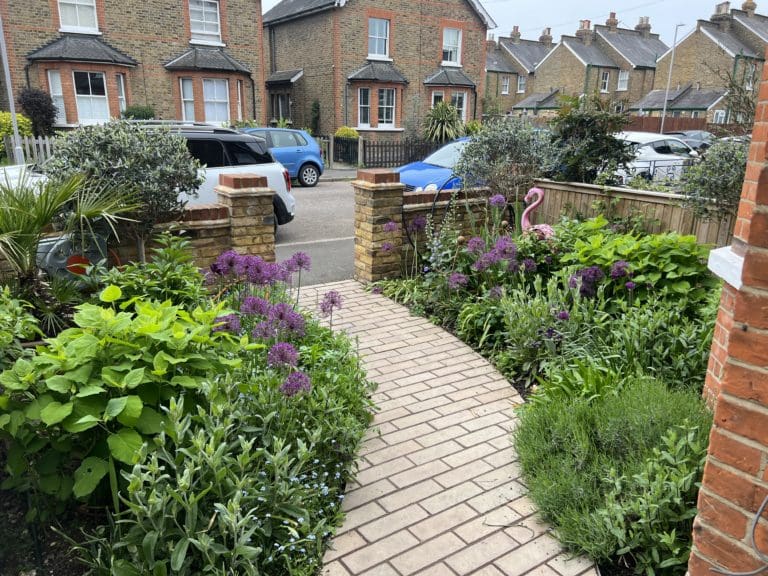
The front garden is the first thing visitors, neighbours and prospective buyers see, and it sets the tone for the whole house. A well-designed front in a Kingston, Surbiton or Esher street raises the perceived value of a property significantly. This guide sets out the elements that genuinely lift kerb appeal: proper planting, considered materials, a good front door, decent lighting and the small details (gate, path edges, bin storage) that separate a tidy front from a memorable one.
Front gardens in south-west London and Surrey have evolved sharply in the last decade. Where the default was once a small lawn with a shrub or two, the modern front garden combines off-street parking (often with EV charging), permeable surfacing under the 2008 planning rules, low-maintenance planting and decent lighting. Done well, the result reads more generous and more cared-for than the much larger back gardens behind. Done badly, it’s a sea of grey block paving with a single token shrub. The difference is design intent.
1. Low-maintenance, year-round planting
Front-garden planting needs to look good every month of the year because there’s no “off-season” behind a closed gate. The principle is structure first (evergreen shrubs and clipped forms), seasonal interest layered on top (perennials and grasses), and ground cover beneath to fill gaps and suppress weeds.
- Evergreen structure. Clipped Buxus sempervirens balls (or its disease-resistant alternative Ilex crenata for areas with box blight risk), Taxus baccata cones, Pittosporum tobira ‘Nanum’, Hebe rakaiensis, dwarf Choisya ternata ‘Sundance’. Three to five matched specimens read as design; one of each reads as a collection.
- Drought-tolerant Mediterranean plants. Front gardens often catch reflected heat from walls, paving and cars. Lavandula angustifolia ‘Hidcote’ (compact, AGM), Rosmarinus officinalis, Salvia nemorosa ‘Caradonna’, Perovskia ‘Blue Spire’, Cistus × purpureus. All thrive in poor, free-draining soil and require almost no maintenance once established.
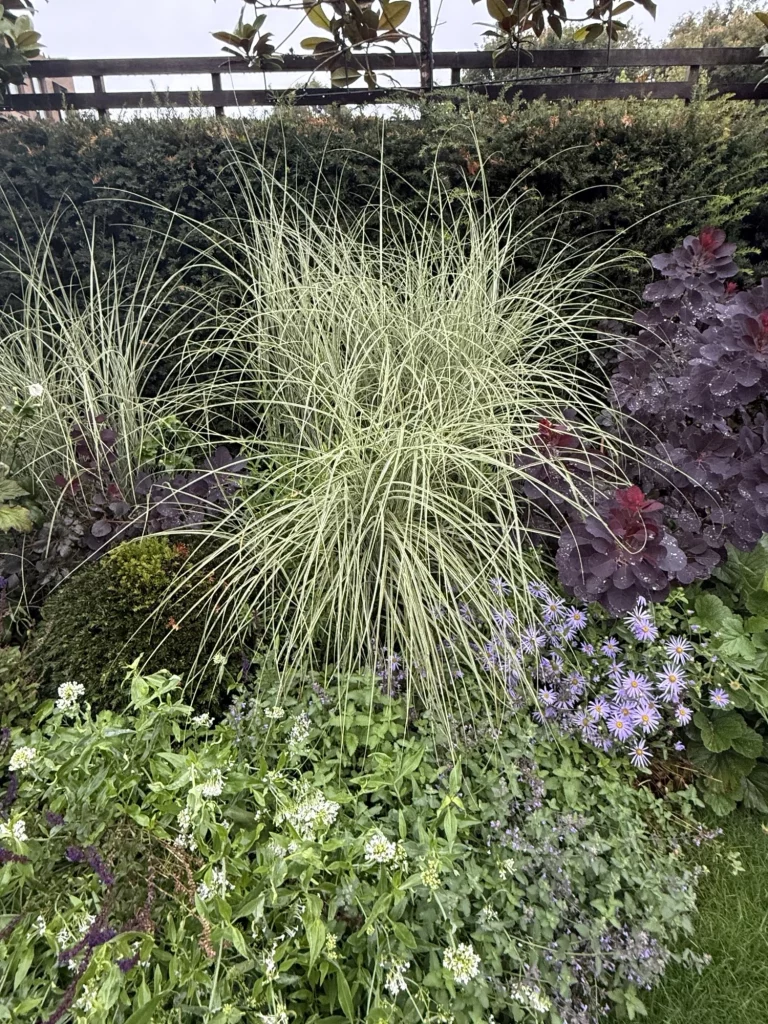
- Ornamental grasses for movement. Stipa tenuissima, Festuca glauca ‘Elijah Blue’, Calamagrostis × acutiflora ‘Karl Foerster’ (AGM) for vertical structure. Grasses soften hard landscaping and read brilliantly in low winter light.
- Ground cover. Erigeron karvinskianus (Mexican fleabane, the white-and-pink daisy that seeds happily into paving cracks; AGM), Geranium macrorrhizum ‘Album’, Thymus serpyllum (creeping thyme) in paving joints, Hylotelephium ‘Autumn Joy’. Avoid Lysimachia nummularia (creeping Jenny): vigorous to the point of invasiveness in damp shade.
- Spring bulbs. Narcissus ‘Tete-a-tete’, Crocus tommasinianus AGM, Allium ‘Purple Sensation’ planted in autumn give early colour before perennials wake up.
For a deeper planting palette, see our low-maintenance garden ideas and drought-tolerant gardens guides.
2. Driveway surfaces: the permeability rule
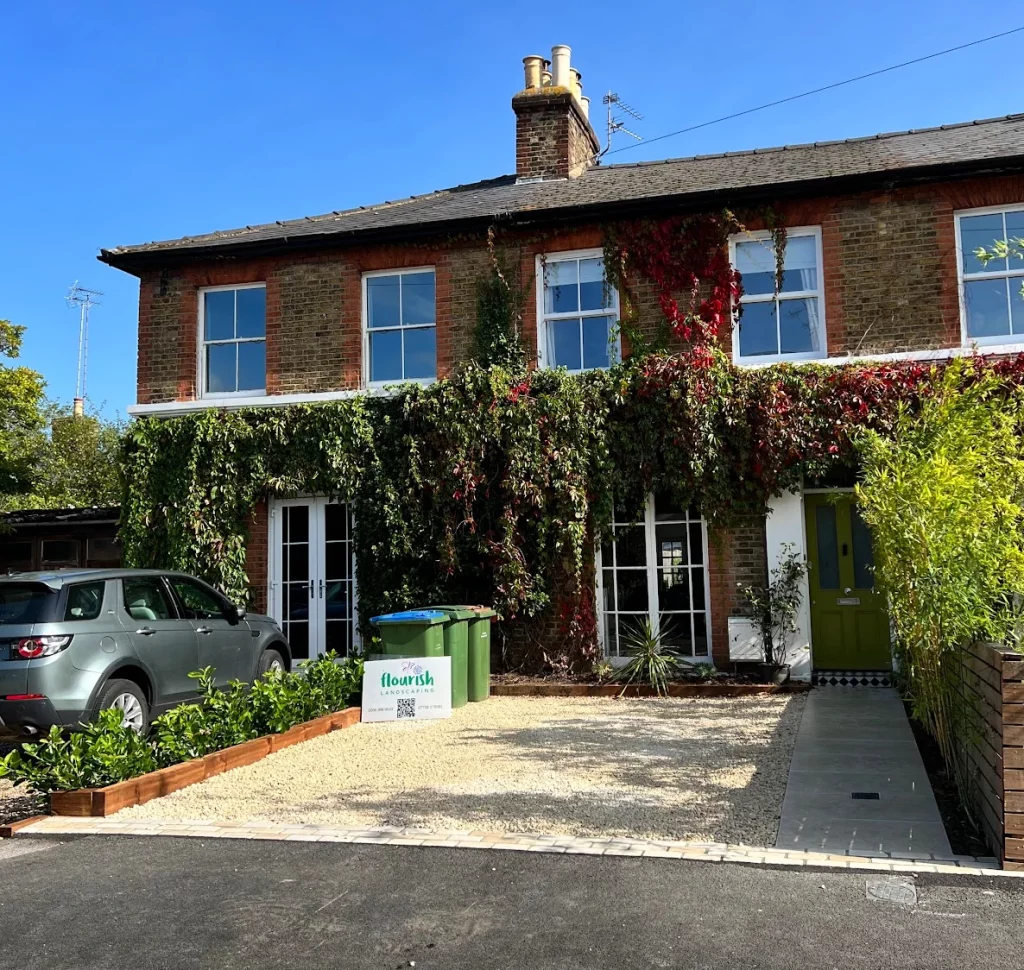
Under the Town and Country Planning (General Permitted Development) Order 2008, any new hard surfacing over 5 sq m at the front of a property must be permeable, or drain to a soakaway, or planning permission is required. This rule has shaped a generation of better-designed front drives. The compliant options:
- Resin-bound aggregate. Naturally permeable, smooth, low-maintenance, comes in dozens of colour blends to suit any house. Typically £80 to £140 per sq m installed (2026 prices) including proper sub-base. The best-looking modern surface for period and contemporary houses alike.
- Permeable block paving. Standard or premium clay or concrete blocks laid over a permeable sub-base with wider joints filled with grit. The traditional choice, suits most architectural styles, easy to repair, cost similar to resin.
- Gravel with stabilising grid. Plastic or composite grid system filled with gravel, prevents the gravel migrating and rutting. The most affordable permeable option (£40 to £80 per sq m), works well on rural and semi-rural sites.
- Natural stone (Yorkstone, granite setts, sandstone). Permeable if laid with sand-filled joints over a permeable sub-base. The most expensive option (£150 to £250+ per sq m) but the most beautiful for heritage properties.
- Hybrid green drives. Grass-and-paving combinations where vehicle tracks are paved and the rest is planted. Distinctive, sustainable, but require more upkeep than a fully paved drive.
If installing EV charging, plan the cable run before the surface goes down. Trying to retrofit a buried cable into a finished drive is expensive and often visible.
3. The front door is the focal point
No single feature does more for kerb appeal than a well-painted front door. The cost is low, the effort is a weekend, and the visual impact is disproportionate. The 2026 palette is moving away from primary colours toward deeper, more architectural tones:
- Deep greens. Farrow & Ball Studio Green, Card Room Green; Little Greene Olive Colour. Suits red-brick Edwardian and Victorian streetscapes particularly well.
- Inky blues and blacks. Off-Black, Hague Blue, Railings. Strong on white-rendered or painted houses.
- Warm terracottas and clays. Picture Gallery Red, Eating Room Red. The riskier but most distinctive direction.
- Soft heritage neutrals. Mouse’s Back, Mole’s Breath, French Gray. For listed or sensitive period properties where bolder colour would feel out of place.
Pair with quality ironmongery (knocker, letterplate, knob or pull, house numbers) in a consistent finish: aged brass, polished chrome, or matt black. Cheap-looking mismatched fittings undermine an expensive door colour. Add quality flanking pots either side of the door, planted with structural evergreens (clipped Buxus, dwarf Pittosporum, standard Laurus nobilis) for permanent presence.
4. Pathway design
The path from gate to front door is one of the most-walked routes in any home. It deserves proper material specification and proper detailing.
- Victorian encaustic tile paths. The classic feature of late-Victorian and Edwardian terrace houses in Kingston, Surbiton and the wider London suburbs. Original tiles are worth restoring; quality reproductions (Original Style, Topps Tiles heritage range) are widely available for replacement.
- Yorkstone or limestone slabs. Best for heritage properties and gardens that need to feel grounded. Random-coursed Yorkstone is the most authentic for older properties; sawn limestone reads more contemporary.
- Brick paths. Match the house brick where possible. Herringbone or stretcher-bond layouts both work; running-bond can read as utilitarian.
- Width matters. A path to the front door should be at least 900 mm wide; 1.2 m is more generous and allows two people to walk side by side. Anything narrower feels mean.
- Edging. A clean edge (brick, granite sett, steel edge, hand-cut stone) separates path from planting and stops gravel migrating. The right edge sharpens a path; a missing edge makes everything read as untidy.

5. Boundaries: gate, fence and hedge
The front boundary defines what a property looks like from the street. Get it right and the rest of the front works hard for you; get it wrong and the best planting in the world can’t rescue the impression.
- Hedges. The best front boundary in most cases. Taxus baccata (yew) for a slow-growing, dense, premium hedge; Carpinus betulus (hornbeam) for a faster-growing semi-deciduous option that holds russet leaves all winter; Buxus sempervirens for low formal hedging (with Ilex crenata as the box-blight alternative). Note: hedge height in front gardens is subject to the High Hedges Act 2005 if it exceeds 2 m and obstructs neighbours.
- Slatted timber fences. Modern, generous-looking, allow light through, look architectural with planting growing through them. The best contemporary solution for properties that don’t suit a hedge.
- Picket fences and railings. Traditional choice for cottages and Victorian terraces. Painted in deep heritage tones rather than glaring white.
- Brick or rendered walls. Substantial, expensive to build, but the best long-term solution for premium properties. A low brick wall topped with railings is a Surrey period-property classic.
- Bespoke gates. A good gate transforms the entrance. Oak side gates with wrought-iron hinges, painted softwood pedestrian gates, mild-steel powder-coated gates with simple vertical bar detail are all current. Avoid: cheap aluminium picket-style gates that warp and tarnish.
See our garden fencing and screening service for the way we build and detail these elements, including bespoke gates and oak-framed work by our 40-year-experience fencing specialist Trevor.
6. Lighting: security and atmosphere
A well-lit front does two things at once: it’s welcoming and it’s a meaningful deterrent. The principle is layered lighting (multiple low-output fittings) rather than one harsh floodlight that strafes the street and annoys the neighbours.
- Wall-mounted up/down lights. Either side of the front door, or flanking a porch. Provide direct light at the entrance and beautiful wall washes either side.
- Recessed path lights. Set into the path edge or low wall, throwing light across the surface. Avoid the spike-in-the-border solar lights that fall over and stop working after a season; specify mains-powered or proper hard-wired low-voltage units.
- Spike spotlights uplighting trees or shrubs. A single uplight at the base of a multi-stem Amelanchier, Acer palmatum or pleached tree transforms a front garden after dark.
- Bollard lights. For longer drives where you need to mark the route without intense overhead light.
- Warm colour temperature. Specify 2700K or 3000K LED. Cool white (4000K+) reads as commercial car park, not domestic warmth.
7. Bin storage, bikes and the practical stuff
The single most-overlooked element of UK front-garden design. Three wheelie bins (general, recycling, food) in plain view is the visual equivalent of leaving the curtains open with a pile of washing on the floor. Sort it.
- Bespoke bin store. Timber-framed enclosure sized to the bins, with a hinged lid and front access. Cedar, oak, painted softwood. Treated and detailed properly, it reads as joinery rather than a shed.
- Behind a hedge or trellis. A slatted timber screen with a climbing rose or Trachelospermum jasminoides (star jasmine) conceals bins from the street while letting refuse collectors access them.
- Bike storage. A purpose-built timber bike box (Asgard, Trimetals or bespoke) holds two or three bikes neatly, with planting on top for a green roof. Easier to insure than a bike against the front wall.
- Parcels. A discreet parcel-drop box by the door (Brizo, Eltako, bespoke) avoids the doorstep pileup and is more secure than the standard “leave it round the back” routine.
8. Wildlife-friendly front gardens
Front gardens connect to neighbouring properties and form wildlife corridors through whole streets. Small contributions add up. The most effective single changes:
- Hedgehog highways. A 13 cm by 13 cm gap at the base of fences allows hedgehogs to roam between gardens. Hedgehog populations have collapsed in part because of fragmented gardens; the gap is a small, cheap intervention with measurable benefit.
- Pollinator planting. Single-flowered Lavandula, Salvia nemorosa, Eryngium, Echinacea, Verbena bonariensis, Origanum vulgare. All on the RHS Plants for Pollinators list and all front-garden suitable.
- Berry-bearing shrubs for birds. Cotoneaster franchetii (also exceptional at filtering air pollution), Pyracantha in trained or hedge form, Sorbus aucuparia (rowan, for streets with room for a small tree).
- Avoid artificial grass. Now firmly out of design favour and increasingly council-restricted. Heat-retaining, microplastic-shedding, useless for wildlife, and a complete dead zone for soil ecology.
What to avoid
- Wall-to-wall block paving with no planting. The visual default for too many UK front gardens. Even a 300 mm planted strip down each side of a drive transforms it.
- Cool grey porcelain on a Victorian house. Architectural mismatch. Warm-toned natural stone reads infinitely better next to London brick.
- Solar pier-cap lights and disco-fountain features. Date the garden the day they’re installed.
- Plastic topiary and fake plants. Look fake immediately, deteriorate quickly in UV, shed microplastic.
- Over-pruning everything into balls. One or two clipped specimens read as design; everything clipped looks like a hotel forecourt.
- Ignoring the bins. No design intervention compensates for three wheelie bins in plain view.
Frequently asked questions
Do I need planning permission for a new driveway?
Usually not, provided you comply with the Town and Country Planning (General Permitted Development) Order 2008: any new hard surfacing over 5 sq m at the front of a property must be permeable, or drain to a soakaway, or planning permission is required. Resin-bound aggregate, permeable block paving, gravel with stabilising grid and natural stone with sand-filled joints over a permeable sub-base all comply. Solid concrete, asphalt or impermeable block paving over 5 sq m requires planning permission. The rule applies to houses; flats may have additional restrictions in their lease.
Which front door colour adds most value?
UK estate-agent surveys consistently identify deep greens, navy blue and dark grey-black as the highest-perceived-value front door colours, particularly on Edwardian and Victorian properties. Bright primary colours (red, yellow, royal blue) appeal to a narrower market and can deter buyers. The most important factor is condition: a well-prepared, properly painted door in almost any sensible colour reads better than a chipped or weathered one. Specify a proper exterior gloss or eggshell paint (Farrow & Ball, Little Greene, Mylands) rather than economy ranges that fade quickly.
What is the best low-maintenance front-garden plant?
For a single front-garden plant that genuinely thrives on neglect, Lavandula angustifolia ‘Hidcote’ (English lavender) on free-draining soil is hard to beat: aromatic, pollinator-friendly, drought-tolerant, evergreen, and looks good for ten years if trimmed annually after flowering. For a structural alternative, Pittosporum tobira ‘Nanum’ (dwarf Japanese mock orange) gives compact evergreen presence with fragrant white flowers in May. For total fuss-free ground cover, Geranium macrorrhizum ‘Album’ covers ground in any soil type, in sun or part shade, and almost never needs intervention.
How tall can my front hedge be?
There is no absolute height limit for a front hedge under planning law, but the High Hedges Act 2005 allows neighbours to complain to the local council if an evergreen or semi-evergreen hedge over 2 m is ‘adversely affecting’ their reasonable enjoyment of their property, typically by blocking light. In practice, front hedges in the 1.2 to 1.8 m range avoid this issue and read as generous without dominating the street. Some local conservation areas and Article 4 directions impose additional rules; check with the local planning authority if in doubt.
What does a typical front garden refresh cost?
A guide range for Surrey in 2026: a cosmetic refresh (planted strips down each side of an existing drive, repainted door, new gate, bin store and pots) typically costs £3,000 to £8,000. A full front-garden redesign with new permeable drive, planting, lighting, gate and boundary treatments typically costs £15,000 to £40,000 depending on size and material specification. Heritage properties with natural stone surfaces and bespoke ironwork can run higher. For more on full-project planning, see our planning your garden transformation guide.
How do I conceal wheelie bins without making the front look worse?
The best solution is a bespoke timber bin store sized exactly to the bins, with a hinged lid (so the bins can be lifted out without dragging) and front-opening doors. Cedar, oak or painted softwood, treated and detailed to match other timber on the property, reads as quality joinery rather than a shed. The next-best option is a slatted timber screen with a climbing plant (Trachelospermum jasminoides, climbing rose, Clematis) trained through it. Avoid: the basic plastic bin enclosure, which advertises its presence; and tucking bins behind a single shrub, which looks worse than just leaving them in the open.
Related pages
- Patios, paths and driveways: driveway and path options that suit your frontage
- Victorian tiled paths: restoring or laying a period tiled front path
- Victorian front gardens: planting and layout ideas for period house frontages
- Fencing and screening: front boundaries, gates and screens we build
Let’s lift your kerb appeal
If you would like a front-garden redesign that genuinely transforms how your home looks from the street, we’d be glad to help. Flourish Landscaping designs and builds front gardens, driveways and boundaries across Kingston, Surbiton, Richmond, Esher and the wider Surrey area. See our patios, paths and driveways service for the way we work.
Contact us to arrange a consultation and start the conversation.
Written by Craig Davis BSc (Hons) Horticulture, member of the Chartered Institute of Horticulture. Craig has over 40 years in horticulture: in the family business since the age of 13 and a horticulture graduate since 1992, he designs, builds and plants gardens across Kingston, Surrey and South West London.
Good to know
Frequently asked questions
Usually not, provided you comply with the Town and Country Planning (General Permitted Development) Order 2008: any new hard surfacing over 5 sq m at the front of a property must be permeable, or drain to a soakaway, or planning permission is required. Resin-bound aggregate, permeable block paving, gravel with stabilising grid and natural stone with sand-filled joints over a permeable sub-base all comply. Solid concrete, asphalt or impermeable block paving over 5 sq m requires planning permission.
UK estate-agent surveys consistently identify deep greens, navy blue and dark grey-black as the highest-perceived-value front door colours, particularly on Edwardian and Victorian properties. Bright primary colours (red, yellow, royal blue) appeal to a narrower market and can deter buyers. The most important factor is condition: a well-prepared, properly painted door in almost any sensible colour reads better than a chipped or weathered one.
For a single front-garden plant that genuinely thrives on neglect, Lavandula angustifolia 'Hidcote' (English lavender) on free-draining soil is hard to beat: aromatic, pollinator-friendly, drought-tolerant, evergreen, and looks good for ten years if trimmed annually after flowering. For a structural alternative, Pittosporum tobira 'Nanum' gives compact evergreen presence with fragrant white flowers in May. For total fuss-free ground cover, Geranium macrorrhizum 'Album' covers ground in any soil type, in sun or part shade, and almost never needs intervention.
There is no absolute height limit for a front hedge under planning law, but the High Hedges Act 2005 allows neighbours to complain to the local council if an evergreen or semi-evergreen hedge over 2 m is 'adversely affecting' their reasonable enjoyment of their property, typically by blocking light. In practice, front hedges in the 1.2 to 1.8 m range avoid this issue and read as generous without dominating the street.
A guide range for Surrey in 2026: a cosmetic refresh (planted strips down each side of an existing drive, repainted door, new gate, bin store and pots) typically costs £3,000 to £8,000. A full front-garden redesign with new permeable drive, planting, lighting, gate and boundary treatments typically costs £15,000 to £40,000 depending on size and material specification. Heritage properties with natural stone surfaces and bespoke ironwork can run higher.
The best solution is a bespoke timber bin store sized exactly to the bins, with a hinged lid (so the bins can be lifted out without dragging) and front-opening doors. Cedar, oak or painted softwood, treated and detailed to match other timber on the property, reads as quality joinery rather than a shed. The next-best option is a slatted timber screen with a climbing plant (Trachelospermum jasminoides, climbing rose, Clematis) trained through it. Avoid the basic plastic bin enclosure and tucking bins behind a single shrub.