Shade plants for Surrey gardens
Why understanding shade types matters more than choosing shade-tolerant plants
Most disappointing shade plantings across Kingston, Surbiton and Surrey are not failures of plant selection. They are failures of shade assessment at the start of the project. “Shade-tolerant” is not a single condition, and plants marketed as suitable for shade fail routinely when matched to the wrong shade type.
The difference between partial shade beneath deciduous trees and deep shade against a north-facing wall is greater than the difference between partial shade and full sun. Yet gardeners frequently treat “shade plants” as a single category, select species that look appealing in photographs, and wonder why the results disappoint despite apparently appropriate placement.
This post introduces our complete shade plants guide for Surrey gardens – covering the four distinct shade types every gardener should recognise, the species that genuinely thrive in each condition, and the assessment process that prevents the planting failures that account for most disappointed expectations in shaded borders.
Four shade types, four different planting communities
Shade is a spectrum, not a binary condition. Effective shade planting starts with recognising which of the four main shade types describes your specific situation.
Partial shade involves 3–6 hours direct sun or bright indirect light throughout the day. This is the “sweet spot” for most shade-tolerant species, including Astrantia major, Geranium species, Brunnera macrophylla, Epimedium and Digitalis purpurea. The widest range of plants thrive here.
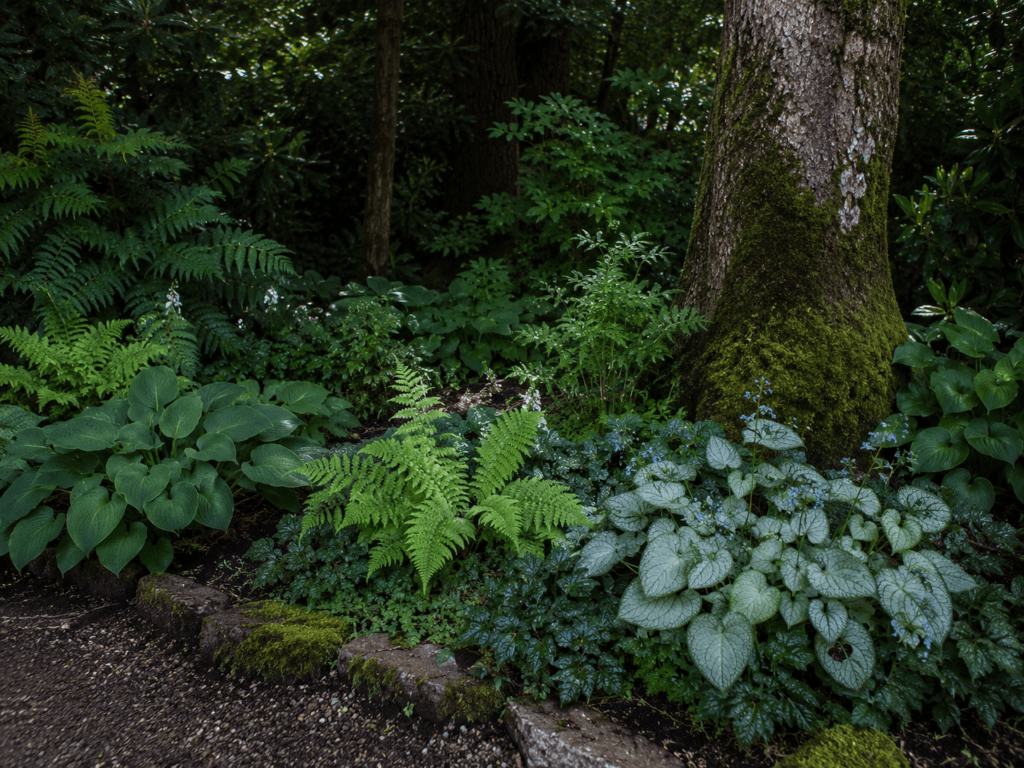
Full shade involves less than 3 hours of direct sun, or no direct sun at all. North-facing borders, narrow passages between buildings, and beneath evergreen canopies all create full shade conditions. Species selection narrows considerably to true shade specialists: ferns, Pachysandra terminalis, Liriope muscari, Sarcococca, and Euphorbia amygdaloides var. robbiae.
Dry shade combines shade with consistently dry soil from tree root competition or rain shadow. This is the most challenging condition in the garden and the one most often misjudged. Geranium macrorrhizum, Euphorbia amygdaloides var. robbiae, Cyclamen hederifolium, and Epimedium all tolerate this combination once established.
Wet shade combines shade with consistently moist or waterlogged soil – common on Surrey clay where reduced evaporation compounds the clay’s water retention. Hosta, Astilbe, Primula, Ligularia and Rodgersia all thrive in these conditions and create some of the most dramatic foliage effects available in any garden.
Why most shade planting goes wrong
The single most common failure is assuming “shade-tolerant” means “prefers shade.” Many plants marketed as shade plants actually prefer partial shade and tolerate deeper shade with significantly reduced performance. Astrantia, Hosta and Digitalis all flower more prolifically in partial shade than full shade, despite appearing in shade plant lists.
The second most common failure is ignoring moisture conditions. Shade and moisture are independent variables. Dry shade beneath beech trees differs fundamentally from moist woodland shade beneath ash. Planting moisture-loving species like Hosta or Astilbe in dry shade produces poor results regardless of appropriate light levels.
The third common failure is expecting flowering displays in deep shade. Deep shade supports foliage interest and occasional flowers but does not support the floral abundance of perennial borders. Design for foliage texture, form and variegation rather than flower performance in deeper shade.
Surrey clay and shade conditions
The London Clay underlying most Kingston, Surbiton, Esher and Cobham gardens creates specific challenges and opportunities in shaded situations. Clay in shade warms slowly in spring, delaying growth. Reduced evaporation in shade compounds clay’s water retention, potentially creating waterlogged conditions. Without organic matter, clay structure deteriorates in shaded borders where biological activity is naturally lower.
The opportunities are equally significant. Clay’s moisture retention benefits moisture-loving shade plants. Clay’s nutrient supply (through cation exchange capacity) supports vigorous growth once plants are established. Most shade plants thrive on clay if drainage is managed appropriately.
Reliable shade performers on Surrey clay include Astrantia major, Helleborus × hybridus, Geranium species, Bergenia cultivars and Brunnera macrophylla. Species to avoid on clay shade include Hebe, Cistus, and other Mediterranean species requiring free drainage.
Read the complete shade plants guide
Our complete shade plants guide covers all four shade types in detail, with species recommendations for each, soil moisture assessment techniques, design principles for shaded borders, and the specific challenges and opportunities of shade planting on Surrey clay.
The guide includes dedicated child pages for each shade type:
- Plants for partial shade – woodland edge species for the most versatile shade situation
- Plants for full shade – true shade specialists for deep shade conditions
- Plants for dry shade – specialists tolerating both shade and drought
- Plants for wet shade – moisture-loving species for waterlogged shade
Every recommendation is based on over 40 years of experience with shade planting on Surrey gardens, with realistic expectations of what each species delivers and the conditions required for success.
Read the complete shade plants guide →
How Flourish can help
Shade garden design is one of the situations where professional input pays back most directly. Matching species to actual conditions, preparing soil appropriately on Surrey clay, and designing for sustained interest across seasons all benefit from experienced specification. Craig Davis BSc (Hons) Horticulture has been designing and planting shade borders across Kingston, Surbiton, Esher and Cobham for over 40 years.
Book a consultation with Flourish Landscaping to discuss shade planting for your garden.