Spring planting
What to plant in spring for the best summer displays.
Spring is the most consequential moment in the gardening year. The choices made between late February and mid-May set the tone for everything that follows. Soil is finally workable, daylight lengthens by several minutes each day, and root growth races ahead of leaf growth, which is exactly why spring is the best time to plant almost every herbaceous perennial and bare-root shrub in a British garden.
At Flourish Landscaping we plant hundreds of borders, beds, hedges and containers across Kingston, Surbiton, Esher and Coombe every spring. This page sets out what really matters: the realistic UK spring planting window, what to do month by month, how to prepare London Clay before anything goes in, the plants we trust for serious spring impact in our area, and the design thinking behind borders that look intentional from March through to October.
The UK spring planting window
Spring in the south-east runs roughly from late February to the end of May. Soil temperatures need to reach 7 to 10°C before most planting and direct sowing succeeds, typically mid-March in our area, sometimes earlier in sheltered gardens. Mid-May, traditionally marked by the week of the RHS Chelsea Flower Show, is the practical end of frost risk. After that, even tender bedding can safely go out. Northern Surrey and outer south-west London sit reliably in this southern pattern, although a frost pocket in low-lying Esher or near the River Mole can hold cold air a fortnight later than the surrounding gardens.
March: the working month
March is when the heaviest work happens. Cut back ornamental grasses and herbaceous perennials left standing for winter structure. Lift and divide congested clumps of Hemerocallis, Hosta, Geranium, Astrantia, Aster and most other summer perennials. The RHS endorses early spring as the ideal moment. Mulch beds with a 50 to 75mm layer of well-rotted compost or composted bark, kept clear of crowns. Plant bare-root roses, shrubs and hedging while still dormant. Plant summer-flowering bulbs: Allium, Lilium, Gladiolus, and Dahlia tubers potted up inside in March, planted out after frost.
April: the planting month
April is when most container-grown perennials and shrubs go in. Soil temperatures are reliably warm enough for fast root establishment, but the ground retains the winter moisture that helps plants through their first summer. This is also the moment to plant Echinacea, Salvia and other prairie perennials that resent autumn planting on cold clay. Hardy annual seeds can be sown directly outdoors, including Calendula, Centaurea cyanus, Nigella damascena and Papaver rhoeas. Half-hardy annuals such as Cosmos and Zinnia start indoors under cover, ready to harden off and plant out after mid-May.
May: the consolidation month
From mid-May, the tender plants come out. Half-hardy annuals, bedding, Dahlia tubers raised under cover, Salvia ‘Amistad’ and other tender perennials all go into their summer positions. The Chelsea chop, cutting back tall perennials such as Sedum, Helenium, Aster and Phlox by a third or a half in late May, delays flowering by two to three weeks and produces sturdier, bushier plants less prone to flopping. May is also the moment to deadhead spring bulbs and let foliage die back naturally; bulb foliage feeds next year’s display and should never be tied, cut or removed early.
Preparing London Clay for spring planting
London Clay underlies almost every garden across Kingston, Surbiton, Esher and Coombe. It is fertile, moisture-retentive and capable of growing extraordinary plants, but only once it is opened up, lightened and reliably drained. The mistake is to plant directly into unimproved clay and hope. Our routine pre-planting preparation:
- Work soil only when it is friable. Clay smeared and compacted in wet conditions is harder to recover from than under-cultivation. Wait for a drying week.
- Incorporate well-rotted organic matter generously. Composted bark, leaf mould, mushroom compost or aged farmyard manure, dug into the top 200 to 300mm of the bed.
- Add horticultural grit for plants needing sharper drainage. Echinacea, Lavandula, Stipa, Salvia and Verbena bonariensis all benefit from a 30 per cent grit-to-soil mix in their planting zone.
- Mulch annually with a 50 to 75mm layer of organic matter after planting. This suppresses weeds, conserves moisture, feeds the soil and dramatically improves clay structure over three to five seasons.
- Never plant into a hole filled with bagged compost on clay. The surrounding clay behaves as a sump, drowning the roots. Improve the wider bed, not the hole.
Spring-flowering plants that earn their place
A good spring display does not happen by accident. The plants that consistently perform in our local gardens, and that we plant in volume across every planting design project, fall into a handful of categories.
Spring bulbs, planted in autumn for spring display
Worth flagging early: a great spring bulb display is planted the previous October and November, not in March. If you are reading this in spring and your borders need more bulbs, make a note for autumn. The reliable performers for our area:
- Galanthus nivalis (common snowdrop), January and February, ideally planted “in the green” rather than as dry bulbs
- Crocus tommasinianus and Crocus chrysanthus, February into March, excellent naturalised in lawn edges
- Narcissus ‘Thalia’, ‘Tête-à-Tête’, ‘Jenny’, ‘Pheasant’s Eye’ and ‘Actaea’, March and April, the backbone of every spring border we design
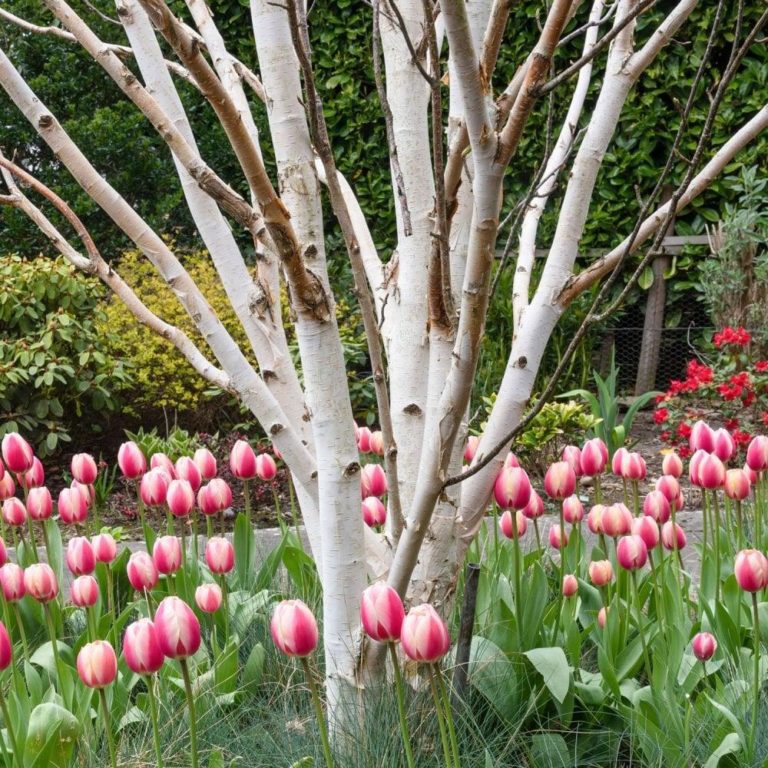
- Tulipa, late-flowering single varieties such as ‘Queen of Night’, ‘Spring Green’, ‘Ballerina’ and ‘Mistress’ provide April and May colour; treat most as annuals on heavy clay
- Hyacinthoides non-scripta (English bluebell), for woodland-edge planting; avoid the invasive Spanish hybrid Hyacinthoides × massartiana
- Fritillaria meleagris (snake’s head fritillary), naturalised in long grass in shady areas, particularly effective beneath veteran trees common in Coombe and Esher gardens
- Allium ‘Purple Sensation’ and Allium ‘Globemaster’, bridging May into June and bringing in the early perennial season
Spring-flowering perennials
- Helleborus × hybridus (Lenten rose), late winter and early spring; one of the most useful plants for shaded gardens beneath mature trees
- Pulmonaria ‘Blue Ensign’ and Pulmonaria saccharata, March and April, excellent ground cover with silvered foliage
- Brunnera macrophylla ‘Jack Frost’, sprays of forget-me-not blue against frosted silver leaves; tolerant of dry shade
- Primula vulgaris (native primrose), March and April, naturalising freely in shadier corners
- Geranium phaeum, Geranium macrorrhizum and Geranium ‘Rozanne’, workhorse hardy geraniums that span spring into summer
- Euphorbia characias subsp. wulfenii and Euphorbia × martinii, architectural lime-green bracts from April
- Aquilegia vulgaris (granny’s bonnet), May into early June, ideal in cottage-garden and naturalistic schemes
- Dicentra spectabilis (now Lamprocapnos spectabilis, bleeding heart), arching racemes of pink hearts in April and May
Spring-flowering shrubs and small trees
- Magnolia stellata and Magnolia ‘Leonard Messel’, March, compact enough for smaller Surbiton and Norbiton gardens
- Amelanchier lamarckii (snowy mespilus), April; white flowers, copper spring foliage, autumn colour and edible berries; one of the best small trees for our area
- Prunus ‘Tai-haku’ (great white cherry) and Prunus ‘Shirotae’, April, for properties with the room for a single specimen cherry
- Viburnum × burkwoodii and Viburnum carlesii, heavily scented spring flowers
- Daphne odora ‘Aureomarginata’, exceptional fragrance from February into April
- Cornus mas (cornelian cherry), clouds of acid-yellow flowers in February and March
Planting for pollinators and biodiversity
Pollinator-friendly planting is no longer a niche concern; it is design discipline. Early-emerging queen bumblebees in February and March need forage well before the summer borders crank up. The plants the RHS lists on its Plants for Pollinators register for early spring include Crocus, Galanthus, Pulmonaria, Helleborus, Mahonia, Erica carnea, Daphne, single-flowered Narcissus (avoid double cultivars, which lack accessible nectar) and Salix caprea and willow catkins generally. We weave these into every garden, particularly where mature trees already provide a wider habitat structure.
Naturalistic planting and the New Perennial influence
The most influential gardening movement of the past two decades is the naturalistic New Perennial style, associated in the UK with Tom Stuart-Smith, Dan Pearson and Sarah Price, and built around drifts and matrices of long-lived perennials and grasses, with bulbs for spring layers and structure from clipped evergreens. This is the planting language behind Wisley’s new perennial borders, Trentham Gardens in Staffordshire and many of the Gardens Illustrated cover gardens of recent years. The approach translates particularly well to our local gardens: tolerant of variable rainfall, low on chemical inputs, full of structure across all four seasons, and visually substantial in the larger garden plots typical of Coombe and Esher.
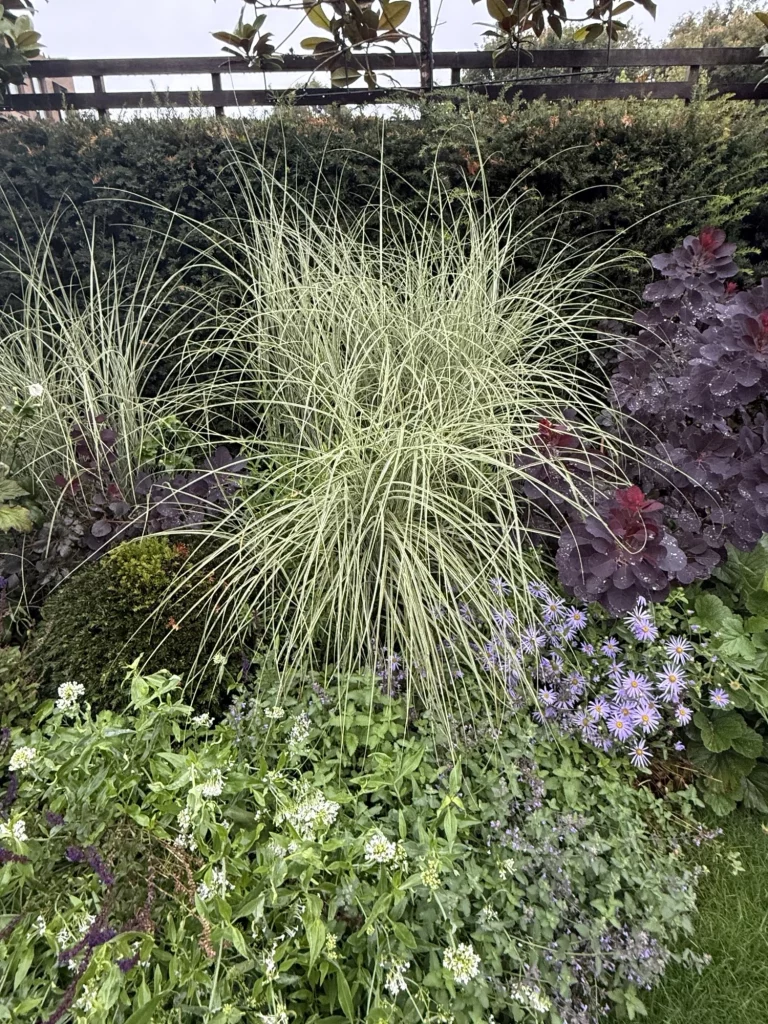
For a naturalistic spring-into-summer scheme we typically combine: Allium bulbs (for the May bridge), Echinacea, Salvia nemorosa, Hylotelephium, Persicaria amplexicaulis, Astrantia major, Verbena bonariensis, Geranium ‘Rozanne’, and grasses such as Calamagrostis × acutiflora ‘Karl Foerster’, Stipa tenuissima, Molinia caerulea and Sporobolus heterolepis. Structure comes from clipped Taxus domes, Hakonechloa macra at path edges and Sarcococca confusa for winter scent. The result is a garden that earns its place from February to December rather than peaking in July and collapsing by August.
Common spring planting mistakes
- Planting tender perennials and bedding too early. A sunny April weekend tempts everyone; the late frost in early May regularly punishes them. Wait until mid-May for tender material, regardless of how mild the previous fortnight has been.
- Walking on wet clay. Compacts the soil and undoes years of structural improvement. If the lawn is squelchy, the borders are not ready either.
- Cutting back spring bulb foliage too early. Bulbs need their leaves to photosynthesise and feed next year’s flowers. Six weeks minimum after flowering before any tidying.
- Skipping the mulch. Clay improves dramatically with annual organic mulch, but the work has to happen every year. Skip a year and the soil resets.
- Planting on impulse without a plan. Pot-by-pot purchases from the garden centre produce restless, busy borders. The best gardens are designed before they are planted.
Spring planting across Kingston, Surbiton, Esher and Coombe
Each part of our area brings its own spring planting profile. Surbiton, Norbiton and Berrylands gardens are typically compact Victorian or Edwardian plots where the spring display has to work hard in a small space, concentrated bulb planting, layered perennials and well-judged small trees. Kingston Hill and Coombe properties have the room for substantial spring schemes, drifts of Narcissus and bluebells naturalised in long grass, large beds of hellebores and pulmonarias beneath mature beech and oak, and considered shrub planting that reads from the house. Esher, Thames Ditton and Hinchley Wood sit between the two, with KT10 gardens often combining contemporary architecture with mature trees that benefit from layered naturalistic underplanting in spring.
Final thoughts
A good spring border is built on three things: well-prepared soil, the right plant in the right place, and a plan that reads as a season rather than a moment. Get all three right and the garden looks intentional from February right through to the first frost. Skip any one and the display is shorter, thinner and easier to forget.
Related pages
- Hard and soft landscaping: our planting and landscaping service, from bed preparation to planting
- Improving clay soil: how to open up London Clay before you plant
- Weeding guide: the spring weeds to tackle before new planting goes in
- Lawn renovation: spring repairs for tired and patchy lawns
- Spring bulbs: what to plant in autumn for next spring
Let’s create your perfect garden
Flourish Landscaping designs, plants and maintains gardens across Kingston, Surbiton, Esher, Coombe and the surrounding KT postcodes. We work with you from the planting plan through to the long-term maintenance schedule that keeps the garden looking right for years to come: bulb orders placed in late summer, beds prepared through autumn and winter, planting executed in the right window, and follow-up care that takes care of the Chelsea chop, the deadheading and the seasonal cut-back without you having to think about it.
Contact us today to arrange a consultation and start transforming your garden into the perfect outdoor space for you and your family.
Written by Craig Davis BSc (Hons) Horticulture, member of the Chartered Institute of Horticulture. Craig has over 40 years in horticulture: in the family business since the age of 13 and a horticulture graduate since 1992, he designs, builds and plants gardens across Kingston, Surrey and South West London.