Low-maintenance gardens
Beautiful, lasting gardens that ask for less. Designed and planted to work with your soil, your aspect and the time you actually have.
A low-maintenance garden is not a no-maintenance garden. It is a garden designed and planted so that the right things happen on their own, and the work that remains is small, predictable and satisfying. This guide sets out the principles, the plants and the honest upkeep behind a garden that earns its keep year after year.
Most low-maintenance advice falls down in two places. It assumes generous sun and free-draining soil, neither of which is a given on Surrey clay. And it leans on a handful of fashionable plants without explaining the design decisions that make them work. We design and plant gardens across Kingston, Surbiton, Richmond and the wider Surrey area, and the gardens that genuinely need less attention share a common architecture: good soil, generous mulch, dense planting and a backbone of evergreen structure. Get those right and the plant list becomes the easy bit.
What low-maintenance actually means
A useful working definition: a garden that looks intentional in every month of the year and needs no more than a few hours of focused attention each month, plus a couple of bigger seasonal sessions in spring and autumn. That is achievable. What is not achievable is a garden that needs nothing. Plants grow, leaves fall, weeds find a way in. The point is to design so that the routine work is short, the skill required is modest, and the rewards are visible.
Four principles that do the heavy lifting
1. Right plant, right place
Beth Chatto’s phrase has been quoted for decades because it is the single most important idea in low-maintenance planting. Match a plant to the conditions it evolved for and it will largely look after itself. Put a Mediterranean sun-lover in damp shade and it will be a project for the rest of its short life. Before any plant goes in the ground, we test soil type, drainage, hours of direct sun, and exposure. If you only do one thing, do this. The orientation of your garden shapes everything that follows.
2. Mulch generously, every year
A 50–75 mm layer of bark, composted woodchip or mushroom compost across all bare soil does four jobs at once: it smothers most weed seedlings, holds moisture through dry spells, feeds the soil as it breaks down, and quietly improves heavy clay over time. Top it up every spring before the garden wakes up. This single annual task replaces an enormous amount of weeding and watering. We use it on every garden we look after as part of our garden maintenance programmes.
3. Plant densely
Bare soil is an invitation for weeds. Plant closely enough that adjacent plants meet within two seasons and there is nowhere for an unwanted seedling to land. This is the principle behind the matrix planting championed by designers like Tom Stuart-Smith and Nigel Dunnett, and it works just as well in a domestic border. It also tends to look far more generous and considered than the spaced-out bedding most of us were taught to do.
4. Build in evergreen structure
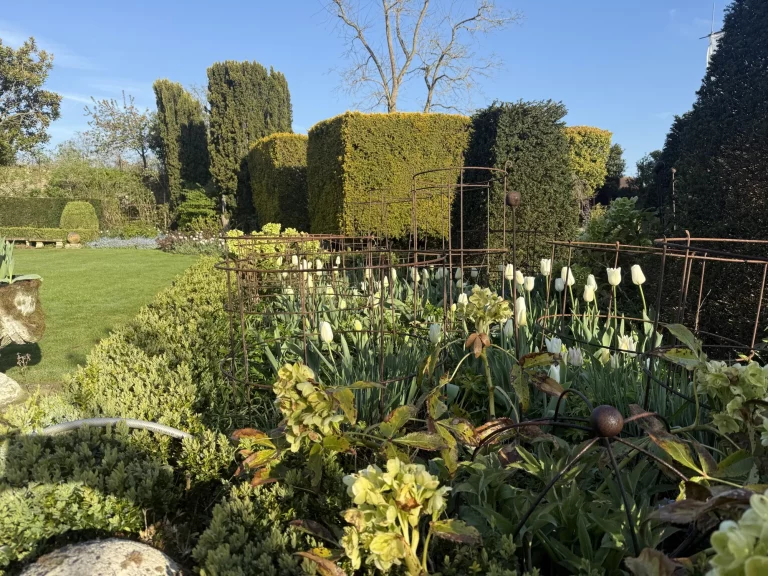
A garden that holds its shape in February is a garden that earns its low-maintenance credentials. A skeleton of well-placed evergreens, clipped or natural, means the eye has something to land on when the perennials are below ground. Aim for around a third of the planting to be evergreen, weighted towards the most visible borders and the views from indoors.
Reliable plants for a low-maintenance UK garden
Every plant below earns its place because it needs no staking, no annual division, no special soil and no chemical intervention to look good. Where a plant is fussy in one respect, we have said so plainly. Links go to the RHS Plant Finder for full cultural detail.
Backbone evergreens
- Pittosporum tobira ‘Nanum’ – compact, dark-glossy, dome-forming and entirely undemanding. The single best small evergreen we plant. Hardy in sheltered Surrey gardens.
- Choisya ternata ‘Sundance’ and Choisya × dewitteana ‘Aztec Pearl’ – Mexican orange blossom. Aromatic foliage, white spring flowers, mostly self-shaping. Tolerates sun or part shade.
- Sarcococca confusa – Christmas box. Glossy, modest, and in midwinter astonishingly fragrant. The shade plant we recommend most often.
- Hebe rakaiensis – a low, neat dome that wants nothing more than sun and decent drainage. Good in front of taller perennials.
- Buxus sempervirens (Box) – the classic structural evergreen for clipped shape. Worth flagging: box blight and box tree caterpillar are now serious risks across the south-east. If you want the box look without the worry, Ilex crenata ‘Dark Green’ is the leading substitute.
- Taxus baccata (Yew) – for larger structure and hedging. Slower than people fear, longer-lived than any of us, and reliably trouble-free on most UK soils.
Workhorse perennials
- Geranium ‘Rozanne’ – voted the RHS Plant of the Centenary at Chelsea, and rightly. Flowers from June to first frost, smothers ground, asks for nothing. The one perennial we would never be without.
- Nepeta racemosa ‘Walker’s Low’ – catmint. Soft mauve flowers for months, hates being fussed over, brilliant at the front of a sunny border.
- Lavandula angustifolia ‘Hidcote’ – the most reliable English lavender for UK conditions. Needs full sun and free drainage; will sulk in wet clay. On heavy soil, plant on a slight mound with added grit.
- Hylotelephium ‘Herbstfreude’ (formerly Sedum ‘Autumn Joy’) – the classic ice plant, reclassified by botanists but unchanged in the garden. Late summer to autumn flower heads, brilliant winter silhouettes if left standing.
- Echinacea purpurea – coneflower. Long-lasting flowers, structural seed heads, pollinator favourite. Wants sun and reasonable drainage.
- Salvia nemorosa ‘Caradonna’ – upright dark stems, intense violet spires. A planting-scheme staple.
- Alchemilla mollis – lady’s mantle. Pleated leaves that hold rain like mercury, lime-green froth in early summer. Self-seeds enthusiastically: brilliant for edges, less brilliant for tidy minds.
- Erigeron karvinskianus – Mexican fleabane. The plant that softens every step, wall and gravel edge it touches. Flowers for months.
- Rudbeckia fulgida ‘Goldsturm’ – black-eyed Susan, the reliable late-summer yellow. Tolerates heavier soil than most prairie perennials.
Ornamental grasses
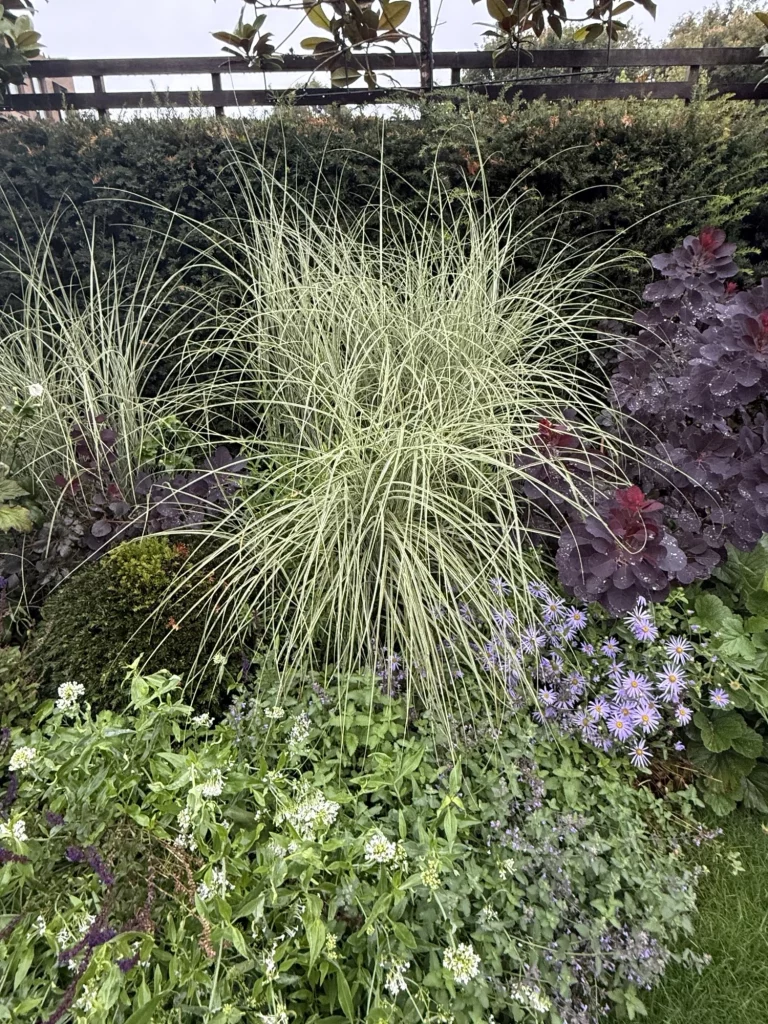
Grasses give movement, texture and a long season of interest, and most need only one chop a year. They are central to the naturalistic style associated with Piet Oudolf and now widely adopted by British designers.
- Stipa tenuissima – Mexican feather grass. Fine, flowing, blonde by midsummer. Cut to the ground or comb out the old growth each spring.
- Hakonechloa macra – Japanese forest grass. The shade grass. Cascades over edges, glows in autumn, never a nuisance.
- Calamagrostis × acutiflora ‘Karl Foerster’ – tall, vertical, architectural. Stands through winter wind. The structural grass of choice for British designers.
- Miscanthus sinensis ‘Morning Light’ – finer and more elegant than the species, with pale-edged leaves that catch low sun.
- Anemanthele lessoniana – pheasant’s tail grass. Bronze tints from autumn onwards. Tolerates more shade than most grasses.
Groundcovers that suppress weeds
- Geranium macrorrhizum – the best perennial groundcover for dry shade we know. Spreads steadily, never thuggish.
- Pachysandra terminalis – evergreen, mat-forming, ideal for deep shade where nothing else will earn its keep.
- Vinca minor – lesser periwinkle. Tough, evergreen, with neat violet-blue flowers. Avoid the larger Vinca major, which can outgrow its welcome.
- Thymus serpyllum – creeping thyme. Brilliant between paving and along sunny edges. Honest warning: it will not take regular foot traffic. It is a fragrant edging, not a lawn.
Plants for sun-baked, dry spots
Beth Chatto’s gravel garden at Elmstead Market has, by her own published rule, never been watered. These are the kinds of plants that earn that level of self-sufficiency.
- Sempervivum (houseleeks) – the original rooftop succulent. Wants only sun and grit.
- Phedimus spurius (formerly Sedum spurium) – mat-forming stonecrop. Spreads gently, smothers weeds, flowers in summer.
- Cistus × purpureus – sun rose. Short-lived but generous: papery pink flowers for weeks every summer.
- Achillea ‘Moonshine’ – yarrow. Flat plates of soft yellow, ferny silver foliage, indifferent to drought once established.
- Verbena bonariensis – tall, wiry, transparent. Self-seeds gently and rewards every season. Cut back to base in late spring.
What to avoid if low maintenance is the goal
All of these are wonderful plants in the right setting. None of them belong in a garden where the brief is low input.
- Wisteria – demands twice-yearly pruning (July and February) and constant training to flower well.
- Hybrid tea and floribunda roses – deadheading, spraying, mulching, pruning. Beautiful but never low-input. If you must have roses, choose the tougher shrub or rugosa types.
- Leyland cypress (× Cupressocyparis leylandii) – grows at speed and turns every hedge into a year-on-year battle. Taxus baccata is slower, easier, and lasts a lifetime.
- Annual bedding – pretty for a season, then it’s gone and you start again.
- Running bamboos – Phyllostachys and similar will spread underground for metres if uncontained. Clump-forming Fargesia species are the better choice.
- High-input lawns – weekly mowing, feeding, scarifying, edging. A mixed-species or longer-cut lawn, or a reduction in lawn area in favour of planting and gravel, will halve the work.
The upkeep you genuinely cannot skip
Even the best-designed garden has a small, fixed annual rhythm. If these are done, almost everything else takes care of itself.
- Late winter – cut back grasses and faded perennial stems before new growth pushes through (usually February in Surrey).
- Early spring – top up mulch across all beds. This is the highest-return job in the year.
- Through summer – a fortnightly half-hour walk-around to pull the few weeds that get through and deadhead anything that benefits.
- Autumn – light tidy, leave seed heads and grasses standing for winter interest and wildlife, clear leaves only where they smother lawn or path.
- Every three to four years – reshape evergreen structure and divide any clumping perennials that are losing vigour at the centre.
“The lowest-maintenance gardens we build are not the simplest ones. They are the ones planned around the soil, the aspect and the way the family actually use the space. Spend the time on the design and the soil at the start, and the garden gives that time back to you every year afterwards.”
Craig Davis, director, Flourish Landscaping. Craig holds a BSc (Hons) in Horticulture and brings more than 30 years of practical experience to every garden the team designs and plants.
Frequently asked questions
How do I make my existing garden lower maintenance?
Start with three changes that pay back fast. Mulch every bed deeply each spring. Replace the highest-input plants (bedding, hybrid teas, fast hedging) with reliable shrubs and perennials suited to the site. And reduce or reshape any lawn that is more work than pleasure. These three steps, done well, will cut routine work by more than half.
What are the best low-maintenance plants for clay soil?
Most of Surrey sits on clay. Plants that thrive in it without intervention include Geranium ‘Rozanne’, Alchemilla mollis, Hylotelephium ‘Herbstfreude’, Rudbeckia fulgida ‘Goldsturm’, Calamagrostis × acutiflora ‘Karl Foerster’, Choisya ternata and Taxus baccata. Avoid lavender, cistus and most Mediterranean silver-leaved plants unless you can raise the bed and add significant grit.
Is a gravel garden really the lowest-maintenance option?
A well-designed gravel garden, planted through a permeable membrane and topped with 50–75 mm of washed gravel, is among the lowest-maintenance approaches we offer, particularly on free-draining soils. On heavy clay, it requires more groundwork to drain properly, and the plant palette is more restricted. It rewards good design and good preparation rather than being a quick fix.
How often should a low-maintenance garden be mulched?
Once a year, in early spring before perennials push through. Aim for a 50–75 mm layer of composted bark, woodchip or mushroom compost across all bare soil. Done annually, this single job replaces a large share of weeding and watering work for the rest of the year.
Are artificial lawns a low-maintenance solution?
They reduce mowing, not maintenance. Artificial turf still needs brushing, occasional washing, weed control around edges, and a periodic top-up of infill. It also offers nothing to pollinators or soil health, gets unpleasantly hot in summer, and has to be replaced in time. We rarely recommend it. A reduced-area real lawn, a mixed-species lawn, or replacing turf with planted ground will usually serve a family better.
Will a low-maintenance garden still look good in winter?
That is the test, and the answer comes down to design. A garden with around a third evergreen structure, plus grasses and perennials left standing into winter, will hold its shape from November to February. Without that backbone, it can look bare. Plan the winter view before the summer one and the garden will earn its place all year.
Let’s design a garden that gives you time back
If you want a garden that looks intentional in every season and asks for less of your weekends, we’d be glad to talk it through. Flourish Landscaping designs, builds and maintains low-maintenance gardens across Kingston, Surbiton, Richmond and the wider Surrey area, with planting schemes tailored to your soil, aspect and the way you actually use the space.
Contact us to arrange a consultation and start the conversation.
Good to know
Frequently asked questions
Start with three changes that pay back fast. Mulch every bed deeply each spring. Replace the highest-input plants (bedding, hybrid teas, fast hedging) with reliable shrubs and perennials suited to the site. And reduce or reshape any lawn that is more work than pleasure. These three steps, done well, will cut routine work by more than half.
Most of Surrey sits on clay. Plants that thrive in it without intervention include Geranium 'Rozanne', Alchemilla mollis, Hylotelephium 'Herbstfreude', Rudbeckia fulgida 'Goldsturm', Calamagrostis x acutiflora 'Karl Foerster', Choisya ternata and Taxus baccata. Avoid lavender, cistus and most Mediterranean silver-leaved plants unless you can raise the bed and add significant grit.
A well-designed gravel garden, planted through a permeable membrane and topped with 50 to 75 mm of washed gravel, is among the lowest-maintenance approaches available, particularly on free-draining soils. On heavy clay, it requires more groundwork to drain properly, and the plant palette is more restricted. It rewards good design and good preparation rather than being a quick fix.
Once a year, in early spring before perennials push through. Aim for a 50 to 75 mm layer of composted bark, woodchip or mushroom compost across all bare soil. Done annually, this single job replaces a large share of weeding and watering work for the rest of the year.
They reduce mowing, not maintenance. Artificial turf still needs brushing, occasional washing, weed control around edges, and a periodic top-up of infill. It also offers nothing to pollinators or soil health, gets unpleasantly hot in summer, and has to be replaced in time. A reduced-area real lawn, a mixed-species lawn, or replacing turf with planted ground will usually serve a family better.
That is the test, and the answer comes down to design. A garden with around a third evergreen structure, plus grasses and perennials left standing into winter, will hold its shape from November to February. Without that backbone, it can look bare. Plan the winter view before the summer one and the garden will earn its place all year.