UK garden trends for 2026
What’s shaping garden design this year and how to use it at home.
UK garden design in 2026 is moving in a clearer direction than for many years. The themes coming through from RHS Chelsea Flower Show 2025 and 2026, from the leading practitioners and from the gardens we are actually building across Kingston and Surrey, are remarkably consistent: bolder colour, climate-adapted planting, real craftsmanship over off-the-shelf finishes, and an honest reckoning with what gardens are actually for. This guide sets out the trends that genuinely matter and how to use each in a domestic UK garden.
Garden trends move slowly compared to fashion or interiors. What we’re seeing in 2026 is the maturation of directions that have been building for several years, now firmly settled into the mainstream of UK design practice. The nine themes below cover what we are specifying and building on Flourish projects this year.
1. ‘Strong beauty’: bolder, more confident colour
Jo Thompson’s Glasshouse Garden, which won Gold at RHS Chelsea Flower Show 2025, set the colour direction for the year. The scheme was built around what Thompson called ‘strong beauty’: deep reds, burgundies and crimsons with accents of apricot, coral and peach. Roses including Rosa ‘Charles de Mills’ and Rosa ‘Tuscany Superb’, combined with Astrantia ‘Burgundy Manor’, gave the garden its signature richness.
The shift away from pale, washed-out palettes has been building for several years and is now firmly mainstream. For the wider colour picture see our garden colour trends 2026 guide.
2. Naturalistic planting goes mainstream
Tom Stuart-Smith, nine-time RHS Chelsea Gold medal winner and Vice President of the Royal Horticultural Society, continues to set the benchmark for naturalistic planting. His Tate Britain Garden, awarded Gold at RHS Chelsea Flower Show 2026 and funded by the Clore Duffield Foundation, drew on East Asian woodland planting with drought-tolerant species selected for London’s rising temperatures. The garden featured Ficus carica, Magnolia grandiflora, Hakonechloa macra and Melianthus major, with reclaimed paving and low-carbon concrete benches. It will be transferred to Tate Britain on Millbank as part of the wider Clore Garden, due to open in 2027.
The wider new-perennial movement, championed in the UK by Stuart-Smith, Dan Pearson and Sarah Price (building on the Dutch designer Piet Oudolf’s work), continues to shape domestic gardens. Pleached Tilia, clipped Buxus and Taxus for structure, with loose perennial planting and ornamental grasses for movement: this combination is now the default for serious UK garden design.
3. Climate-adapted planting
Baz Grainger’s ‘Save for a Rainy Day’ Garden at RHS Chelsea Flower Show 2025, sponsored by Killik & Co, made the case for climate adaptation more directly than any recent show garden. Drawing inspiration from Aquitaine in south-western France, Grainger specified species that traditional southern English gardens may now need to consider: Zelkova serrata, Pinus mugo ‘Mughus’, Persicaria virginiana ‘Filiformis’, Artemisia ludoviciana ‘Valerie Finnis’ and Salvia sclarea. The garden also showcased rainscaping techniques for managing the new pattern of heavy episodic rainfall and longer dry periods.
On our own projects across Kingston, Surbiton and Esher, we are specifying more Mediterranean and dry-garden species year on year: Lavandula, Perovskia, Stipa tenuissima, Salvia nemorosa, Verbena bonariensis, Eryngium, Achillea, Phlomis and Cistus. The traditional cottage-garden mix that thrived on regular June rainfall now demands more irrigation to look the same. Climate-adapted planting reduces watering, reduces failure rates, and increasingly looks more contemporary. See our drought-tolerant gardens guide for the full plant list.
4. Craftsmanship over catalogue specification
The shift from generic landscaping toward site-specific craftsmanship is one of the most rewarding developments in UK garden building. Bespoke joinery, hand-cut stone, considered paving layouts and proper attention to junctions and edges separate well-built gardens from generic ones. The invisible details (sub-base specification, drainage falls, the precise way one material meets another) determine whether a garden looks beautiful for two years or twenty.
In our work across the Surrey area, the most-requested craftsmanship elements in 2026 are bespoke hardwood benches integrated with planting, hand-cut natural stone steps with curved or tapered profiles, oak-framed pergolas with proper mortise-and-tenon joinery, and rendered or hand-pointed brick walls in deep painted colours.
5. The return of natural stone
Porcelain paving dominated UK garden specification from roughly 2015 to 2022. The pendulum is now swinging back. Natural stone (sawn sandstone, riven slate, granite setts, reclaimed Yorkstone) is returning for its depth, texture and the way it ages: porcelain looks new for a long time but never gains character, where natural stone develops patina year on year. We work in partnership with London Stone for natural stone supply on most of our build projects.
The other shift is away from cool grey porcelains toward warmer tones (putty, cream, sandstone, travertine effects). These harmonise better with London brick and Edwardian housing stock that dominates our area. For more on paving see our garden paving guide.
6. Pergolas as essential, not optional
The pergola has shifted from decorative feature to essential infrastructure. In a UK climate of unpredictable summers, an overhead structure transforms how often a garden is genuinely used. Louvred-roof pergolas with adjustable slats (Renson, Corradi and similar systems) offer instant controllable shelter from sun and light rain. Traditional oak-framed pergolas clothed in Wisteria, Vitis vinifera ‘Purpurea’ or climbing roses give the soft, organic version of the same function.
In Surrey gardens, where dining and entertaining outdoors is a year-round aspiration if not always a year-round reality, a well-designed pergola adds genuinely useful months to the garden year.
7. Plant predictions: the 2026 palette
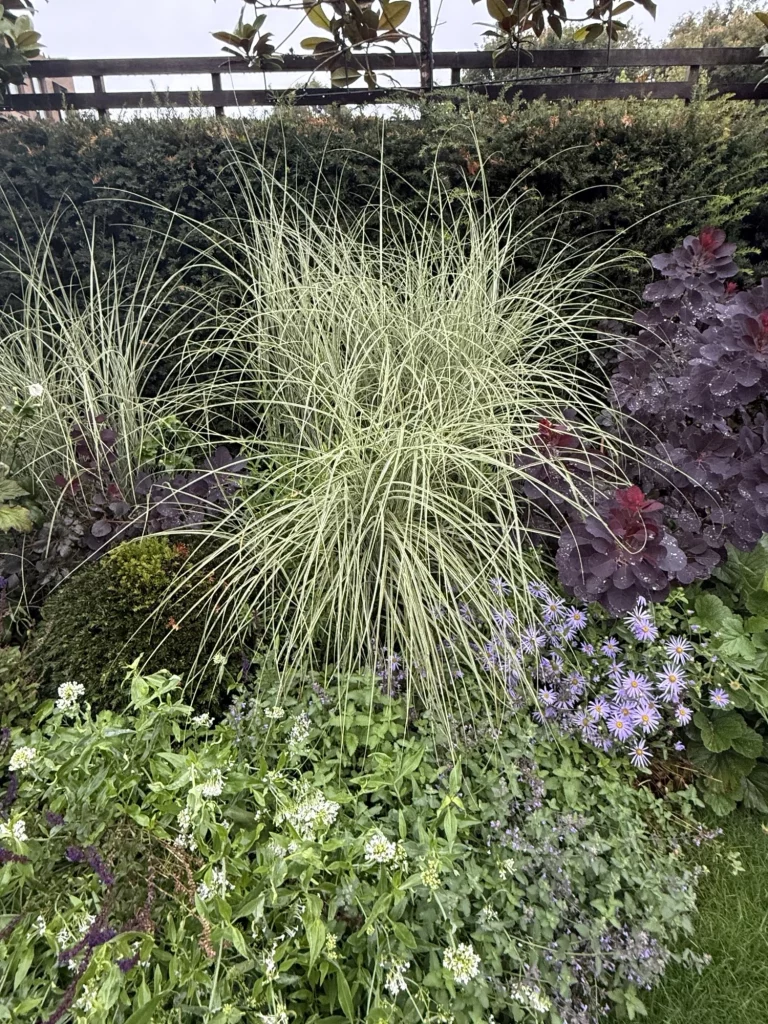
Sarah Raven, writing for her Perch Hill nursery, has highlighted soft romantic colours and textural planting as a continuing 2026 direction: Verbascum ‘Southern Charm’, Stipa tenuissima and Linaria purpurea ‘Peachy’ all combine gentle tones with movement and structure. The RHS new-perennial palette continues to dominate, with Persicaria amplexicaulis, Symphyotrichum (formerly Aster) and Molinia cultivars carrying late-summer interest.
For our most-specified Surrey perennials for 2026, see our summer flowering plants guide.
8. Edible and productive planting
RHS predictions point to growing appetite for edible plants integrated into ornamental schemes: Vaccinium corymbosum (blueberries), Lonicera caerulea (honeyberries), espaliered apples and pears against walls, herb borders combined with ornamentals. The Gold-winning Garden of the Future at RHS Chelsea 2025 (designed by Matthew Butler and Josh Parker) made an explicit case for resilient edible crops including chickpeas, sweet potatoes and climate-smart growing techniques.
For domestic Surrey gardens, the easiest entry points are espaliered fruit on south or west-facing walls (apples, pears, figs, quinces), a small kitchen-garden bed for high-turnover herbs and salads, and blueberries in pots (the only practical way to grow them without acidifying garden soil).
9. Front gardens reimagined for electric vehicles
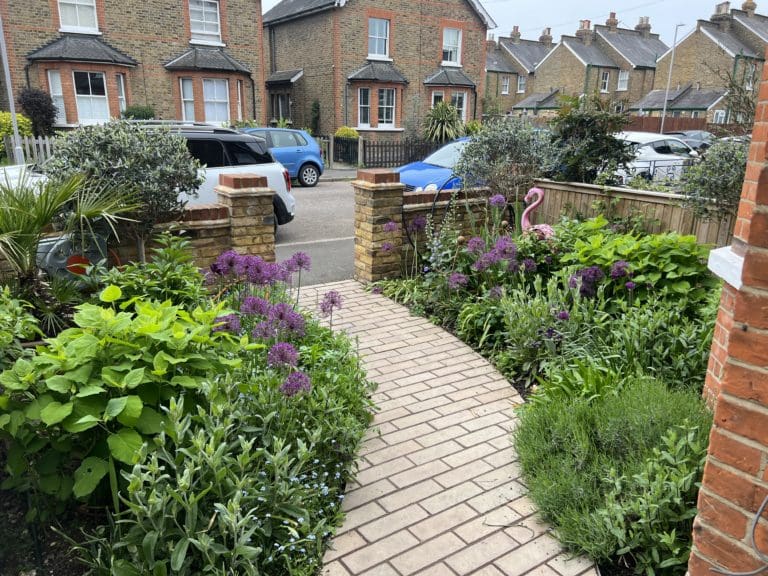
With electric vehicle ownership rising sharply across south-west London and Surrey, front gardens are being redesigned to combine charging infrastructure with greenery and permeable drainage. Under the Town and Country Planning (General Permitted Development) Order 2008, hard surfacing over 5 sq m at the front of a property must be permeable or drain to a soakaway, which has driven a generation of better-designed front gardens that incorporate planted strips, gravel zones and resilient groundcover.
Reliable plants for the dual-purpose front garden: Geranium ‘Rozanne’, Erigeron karvinskianus (Mexican fleabane, which seeds happily into paving cracks), Nepeta ‘Six Hills Giant’, low Lavandula, clipped Buxus sempervirens or its disease-resistant alternative Ilex crenata.
Pulling it together: gardens for wellbeing
The thread connecting all of these trends is a more honest view of what gardens are for. The colour, the planting, the craftsmanship, the pergolas, the edibles: each one is in service of how the garden is genuinely used and how it makes people feel. The term ‘biophilic design’, increasingly used in landscape and interior practice alike, names a principle that good gardeners have always understood: regular contact with nature is restorative.
The clearest indicator of this shift is Project Giving Back, the grant-making charity that has funded gardens for good causes at RHS Chelsea Flower Show since 2022 and intends to fund 60 cause-led gardens in total. Thompson’s Glasshouse Garden supporting women in prison, the Tate Britain Garden bringing horticulture into a national gallery, the WaterAid garden, the National Autistic Society gardens: this generation of show gardens is making the case for gardens with purpose beyond decoration.
How these translate to a Surrey domestic garden
A typical 2026 commission for a south-west London or Surrey garden combines several of the above:
- Warm-toned natural stone or porcelain paving instead of the cool greys of the previous decade
- A pergola over the main dining area, often with integrated lighting and irrigation for climbers
- A simplified planting palette built around climate-adapted perennials and grasses, with three or four colour families rather than the cottage-garden everything-of-everything
- Considered hard-landscape detailing: bespoke benches, well-cut stone steps, hand-pointed brick, painted wall sections in deep colours
- A small kitchen-garden element if the site allows, even if just espaliered fruit on a wall or a herb bed by the back door
- Permeable front-garden treatment on properties with off-street parking, particularly where EV charging is being installed
What to avoid
- Chasing trends as decoration. The trends above work because they reflect real shifts in climate, material quality and how people use gardens. Picking one as a styling exercise without addressing the underlying need produces gardens that date quickly.
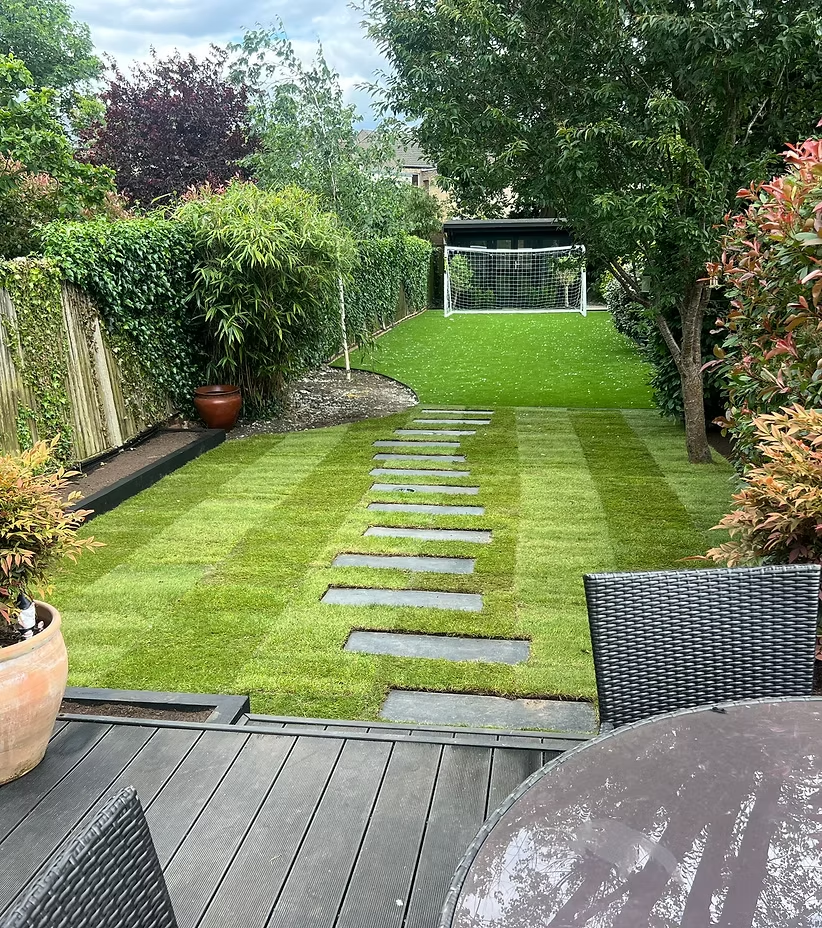
- Artificial grass. Now firmly out of design favour: heat-retaining, microplastic-shedding, useless for wildlife, and prohibited or discouraged by an increasing number of councils. The case against has become overwhelming.
- Cool grey porcelain everywhere. The decade-long default look. Still works in some contexts but increasingly reads as dated.
- One-of-everything planting. The opposite of the new-perennial approach. Repetition in groups of three or five is the foundation of confident design.
- Smart-home gimmicks. Colour-changing fountains, Bluetooth-controlled plant pots and similar. The lifespan is short, the visual life shorter.
“The trends our clients are asking about in 2026 are the ones that have been quietly building for years: confident colour, properly built hard landscape, planting that actually copes with the climate we’ve got rather than the one we used to have. None of this is new at Chelsea level, but it’s now firmly mainstream in domestic gardens too. The clients who do best are the ones who pick two or three of these directions that suit their plot and their lives, and ignore the rest.”
Craig Davis, director, Flourish Landscaping. Craig holds a BSc (Hons) in Horticulture and brings more than 30 years of practical experience to every garden the team designs and plants.
Frequently asked questions
What was ‘strong beauty’ at Chelsea 2025?
The colour direction described by Jo Thompson for her Gold-medal-winning Glasshouse Garden at RHS Chelsea Flower Show 2025. The palette combined deep reds, burgundies and crimsons with accents of apricot, coral and peach: a richer, more confident approach than the pale pastels and cool tones that dominated UK domestic gardens for the previous decade. The Glasshouse Garden was designed to support The Glasshouse, a social enterprise supporting women in UK prisons through horticultural training.
Should I plant Mediterranean species in a UK garden?
Increasingly, yes. UK summers are reliably hotter and drier than they were a generation ago, and traditional ‘British sun’ planting (full-sun roses, herbaceous perennials, lawn) is needing more irrigation to perform as expected. Mediterranean and dry-garden species (Lavandula, Perovskia, Stipa tenuissima, Salvia nemorosa, Verbena bonariensis, Eryngium, Achillea, Phlomis, Cistus) handle heat and drought far better and increasingly read as contemporary rather than exotic. The caveat: most of these need sharp drainage, which means heavy clay sites may need raised beds or significant grit amendment.
Is natural stone better than porcelain paving?
Each has its uses. Porcelain is uniform, slip-resistant, low-maintenance and resistant to staining; it suits contemporary architecture and works well as a level continuation of indoor flooring. Natural stone has more depth, more colour variation, weathers attractively and ages into character rather than just wearing down. Cost is broadly comparable. The 2026 trend is back toward natural stone (sandstone, slate, granite, reclaimed Yorkstone) particularly in heritage and period-property contexts, while porcelain remains the right choice for sleek contemporary schemes. We work with London Stone for natural stone supply on our build projects.
Are louvred pergolas worth the cost?
For frequent outdoor entertainers, yes. Louvred-roof pergolas (Renson, Corradi, Suns Lifestyle and similar) typically cost £8,000 to £25,000 installed depending on size and specification. The benefit is the instant controllable shelter, which in UK weather extends usable outdoor hours significantly across spring, summer and autumn. For lighter-use gardens, a traditional oak-framed pergola with climbers gives most of the visual benefit at a fraction of the cost (typically £3,000 to £8,000 installed), though without the rain-shedding function.
How do I make my front garden EV-ready?
The two key considerations are permeability and planting. Any hard surfacing over 5 sq m at the front of a property must be permeable or drain to a soakaway under the 2008 General Permitted Development Order; resin-bound gravel, permeable block paving and gravel-with-grids all comply. Add planting strips between parking bays and around the charging point, and select resilient species that cope with occasional vehicle disturbance and reflected heat from cars (Geranium ‘Rozanne’, Erigeron karvinskianus, Nepeta, low Lavandula, clipped Buxus or Ilex crenata). Position the EV charger so the cable run is short and protected.
Which 2026 trends actually make sense for a smaller garden?
For smaller gardens (under 80 sq m), the trends that genuinely work are confident colour planting in three colour families, climate-adapted species that need less irrigation, a single well-detailed hard-landscape feature (a small pergola, a painted feature wall, a bespoke bench), and a small productive element such as espaliered fruit. Avoid: too much variety in a confined space, multiple competing materials, and oversized structures that overwhelm the plot. The principle of confident restraint is more important in a small garden than a large one.
Let’s apply these to your garden
If you would like to discuss which 2026 directions would suit your garden, we’d be glad to help. Flourish Landscaping designs and builds gardens across Kingston, Surbiton, Richmond, Esher and the wider Surrey area. See our garden design and build service for the way we work, or read our planning your garden transformation guide for the wider picture.
Contact us to arrange a consultation and start the conversation.
Good to know
Frequently asked questions
The colour direction described by Jo Thompson for her Gold-medal-winning Glasshouse Garden at RHS Chelsea Flower Show 2025. The palette combined deep reds, burgundies and crimsons with accents of apricot, coral and peach: a richer, more confident approach than the pale pastels and cool tones that dominated UK domestic gardens for the previous decade. The Glasshouse Garden was designed to support The Glasshouse, a social enterprise supporting women in UK prisons through horticultural training.
Increasingly, yes. UK summers are reliably hotter and drier than they were a generation ago, and traditional 'British sun' planting is needing more irrigation to perform as expected. Mediterranean and dry-garden species (Lavandula, Perovskia, Stipa tenuissima, Salvia nemorosa, Verbena bonariensis, Eryngium, Achillea, Phlomis, Cistus) handle heat and drought far better and increasingly read as contemporary rather than exotic. Most of these need sharp drainage, which means heavy clay sites may need raised beds or significant grit amendment.
Each has its uses. Porcelain is uniform, slip-resistant, low-maintenance and resistant to staining; it suits contemporary architecture and works well as a level continuation of indoor flooring. Natural stone has more depth, more colour variation, weathers attractively and ages into character rather than just wearing down. Cost is broadly comparable. The 2026 trend is back toward natural stone (sandstone, slate, granite, reclaimed Yorkstone) particularly in heritage and period-property contexts, while porcelain remains the right choice for sleek contemporary schemes.
For frequent outdoor entertainers, yes. Louvred-roof pergolas (Renson, Corradi, Suns Lifestyle and similar) typically cost £8,000 to £25,000 installed depending on size and specification. The benefit is the instant controllable shelter, which in UK weather extends usable outdoor hours significantly across spring, summer and autumn. For lighter-use gardens, a traditional oak-framed pergola with climbers gives most of the visual benefit at a fraction of the cost (typically £3,000 to £8,000 installed), though without the rain-shedding function.
The two key considerations are permeability and planting. Any hard surfacing over 5 sq m at the front of a property must be permeable or drain to a soakaway under the 2008 General Permitted Development Order; resin-bound gravel, permeable block paving and gravel-with-grids all comply. Add planting strips between parking bays and around the charging point, and select resilient species that cope with occasional vehicle disturbance and reflected heat from cars (Geranium 'Rozanne', Erigeron karvinskianus, Nepeta, low Lavandula, clipped Buxus or Ilex crenata). Position the EV charger so the cable run is short and protected.
For smaller gardens (under 80 sq m), the trends that genuinely work are confident colour planting in three colour families, climate-adapted species that need less irrigation, a single well-detailed hard-landscape feature (a small pergola, a painted feature wall, a bespoke bench), and a small productive element such as espaliered fruit. Avoid: too much variety in a confined space, multiple competing materials, and oversized structures that overwhelm the plot. The principle of confident restraint is more important in a small garden than a large one.