Summer flowering plants
Plants that will give you colour all summer long.
A garden that flowers all summer doesn’t happen by accident. It is built from layered planting that succeeds in waves from June to October, mixing perennials with annuals, climbers with shrubs, and structural foliage with flowers. This guide sets out the plants that genuinely deliver three or four months of colour in UK gardens, organised by category so you can build a planting scheme rather than just pick favourites. Every plant named here is one we specify routinely on Flourish projects across Surrey.
A few principles before the plant lists. UK summer flowering breaks into three overlapping waves: early summer (June, the rose and peony peak), high summer (July and August, the perennial peak), and late summer (August into October, the dahlia and grass peak). The mistake most amateur gardens make is over-investing in early summer; the well-designed planting carries colour through to first frost.
Herbaceous perennials for sunny borders
The backbone of any summer-flowering scheme. These return reliably year after year, expand slowly into established clumps, and form the structural rhythm of a border.
- Lavandula angustifolia ‘Hidcote’ (English lavender). The classic compact lavender (45 to 60 cm). Holds RHS Award of Garden Merit. Aromatic, attracts bees in extraordinary numbers, July to August. Demands sharp drainage and full sun; struggles on heavy wet clay without raised planting.
- Salvia nemorosa ‘Caradonna’. Deep violet flower spikes on near-black stems, June to August (longer with deadheading). One of the most reliable and architectural summer perennials. AGM.
- Geranium ‘Rozanne’. The longest-flowering hardy geranium ever introduced: violet-blue saucer flowers from June to first frost. AGM. Will spread by 90 cm and weave gently through neighbouring plants.
- Echinacea purpurea (coneflower). Pink-purple daisies with prominent bronze cones, July to September. Drought-tolerant once established. Pair with grasses in the new-perennial style.
- Rudbeckia fulgida ‘Goldsturm’. Deep gold daisies with dark cones, July through September. AGM. The reliable hot-yellow workhorse.
- Helenium ‘Moerheim Beauty’. Bronze-orange daisies July to September. AGM. The signature plant of the late-summer hot border.
- Verbena bonariensis. Tall (1.2 to 1.8 m), wiry stems carrying small violet-purple flower clusters from July to first frost. Reads transparent, allows you to see through to plants behind. AGM. Self-seeds gently.
- Achillea ‘Moonshine’ or ‘Walther Funcke’. Flat-topped umbels in pale yellow or rust-orange, June through August. AGM. Excellent cut flower, drought-tolerant.
- Agapanthus ‘Headbourne Hybrids’. Drumstick heads of blue or white flowers on tall stems, July to August. AGM. Suits pots beautifully (and flowers better when slightly root-bound). The deeper-blue Agapanthus ‘Black Pantha’ is a striking newer cultivar.
- Alstroemeria ‘Indian Summer’. Bronze foliage with apricot-orange flowers from June through October. AGM. Tough, drought-tolerant, excellent cut flower.
- Crocosmia ‘Lucifer’. Arching sprays of scarlet flowers on sword-like foliage, July to August. AGM. The definitive UK hot-red perennial.
- Kniphofia ‘Tawny King’ (red-hot poker). Cream-and-tawny pokers from July into October. Architectural late-summer height.
- Leucanthemum × superbum ‘Becky’ (Shasta daisy). The reliable improvement on the classic Shasta: sturdy stems that don’t flop, white daisies with yellow centres from June through August. AGM.
- Hylotelephium ‘Autumn Joy’ (formerly Sedum spectabile). Flat pink flower heads from August, turning deep russet through autumn. AGM. Drought-tolerant and pollinator-magnet.
Roses for repeat flowering
Roses peak in mid-June but the right cultivars flower again in flushes through to October. Specify modern repeat-flowering varieties rather than once-flowering ramblers if you want continuous colour. David Austin English roses combine the form and fragrance of old roses with modern repeat-flowering habit, and have become the default specification in UK domestic gardens.
- Rosa ‘Munstead Wood’. Deep velvety crimson, strong old-rose fragrance, shrub. Named for Gertrude Jekyll’s garden.
- Rosa ‘Gertrude Jekyll’. Rose-pink, exceptional fragrance (used commercially for rose oil). Shrub.
- Rosa ‘Boscobel’. Salmon-pink, myrrh fragrance, compact shrub. One of the best modern repeat performers.
- Rosa ‘Iceberg’. Pure white, floribunda, exceptional repeat-flowering. The white-garden classic. AGM.
- Rosa ‘Madame Alfred Carrière’. Creamy-white climber that tolerates north-facing walls. The reliable shade-tolerant rose.
- Rosa ‘New Dawn’. Pale pink climber, repeat-flowering, also north-wall tolerant. AGM. One of the most-planted climbers in the UK.
For shadier borders
North-facing and woodland-edge borders need a different palette. Cool colours and silver-white flowers read brilliantly in low light, and these plants flower well without full sun.
- Hydrangea arborescens ‘Annabelle’. Vast white globular flowerheads, June to September. AGM. The transformative shrub for a shaded mid-summer border.
- Astrantia major ‘Roma’. Dusky pink pincushion flowers June through August. Repeat-flowers strongly if cut back after first flush. AGM (for the species).
- Geranium phaeum ‘Samobor’. Chocolate-marked foliage with deep burgundy flowers, May to July.
- Aconitum ‘Spark’s Variety’. Deep violet hooded flowers on tall stems, July to August. Note: all parts toxic if ingested; site away from kitchen gardens and pets.
- Astilbe ‘Fanal’. Deep crimson plumes over bronze foliage, June and July. AGM. Needs moist soil; struggles in dry shade.
- Anemone × hybrida ‘Honorine Jobert’. Pure white single flowers, August to October. AGM. The late-summer star of the shaded border.
Climbers for walls, fences and pergolas
- Clematis ‘Étoile Violette’. Deep velvety purple, July to September. AGM. Vigorous late-flowering clematis (Group 3, prune hard in February).
- Clematis ‘Perle d’Azur’. Sky-blue saucer flowers, June to August.
- Trachelospermum jasminoides (star jasmine). Evergreen, fragrant white pinwheel flowers June to August. AGM. The contemporary go-to climber.
- Lonicera periclymenum ‘Serotina’ (late Dutch honeysuckle). Cream-and-red fragrant flowers July through September. Excellent for moths and pollinators.
- Jasminum officinale (common jasmine). Intensely fragrant white star flowers June to September. Vigorous; needs strong support.
Summer-flowering shrubs
- Hydrangea paniculata ‘Limelight’. Pyramidal cream-green flowerheads July through October, aging to pink. AGM. Flowers on new wood, so prune hard in March.
- Hydrangea macrophylla. The classic mophead and lacecap hydrangeas, June to September. Flower colour depends on soil pH: blue on acid soils, pink on alkaline. Heavy clay tolerant.
- Buddleja davidii (butterfly bush). The legendary butterfly magnet. Long panicles of fragrant flowers July to September. Prune hard in March for the biggest flowers. Buddleja ‘Black Knight’ is the deep-violet AGM variety.
- Hibiscus syriacus ‘Oiseau Bleu’ (rose of Sharon). Large blue-violet trumpet flowers July to September. AGM. Late to come into leaf in spring; don’t panic when it looks dead in April.
- Lavatera × clementii ‘Barnsley’. Profuse pale pink hibiscus-like flowers June through September. Fast-growing, short-lived (5 to 7 years).
Annuals for instant impact
Annuals fill the gaps that perennials and shrubs leave, particularly in new gardens where perennials need a year or two to establish. Direct-sown or planted as small plug plants in April or May, they flower from June through to first frost.
- Cosmos bipinnatus. Tall, feathery foliage with single saucer flowers in pink, white or magenta, July through October. The single best annual for ease and abundance. Cut for the vase, the more you cut the more you get.
- Nicotiana sylvestris (tobacco plant). Tall (1.5 m) with drooping white trumpet flowers, evening-fragrant. The white-garden annual.
- Cleome hassleriana (spider flower). Striking spidery pink, white or violet flowers July to October. Architectural height and a long flowering season.
- Ammi majus (bishop’s flower). Lacy white umbels June to September. The contemporary alternative to baby’s breath for cutting.
- Helianthus annuus (sunflower). The summer holiday standard, especially for families with children. Smaller branching cultivars like ‘Vanilla Ice’ or ‘Italian White’ flower more abundantly than the giants.
- Antirrhinum majus (snapdragon). Classic cottage-garden spires June through October, treated as half-hardy annuals in most UK gardens.
Late summer headliners: dahlias, cannas and grasses
The most under-used wave of the summer year. From August through to first frost (typically late October in Surrey), the right plants carry the garden through what is often its richest period.
- Dahlias. The undisputed late-summer star. Dahlia ‘Bishop of Llandaff’ (scarlet, dark foliage), Dahlia ‘David Howard’ (apricot-orange, AGM), Dahlia ‘Café au Lait’ (huge cream-pink dinnerplate flowers). See our full dahlias guide.
- Canna ‘Purpurea’. Tropical-leaved drama with orange-red flowers August to October. Lift tubers before winter in most UK gardens.
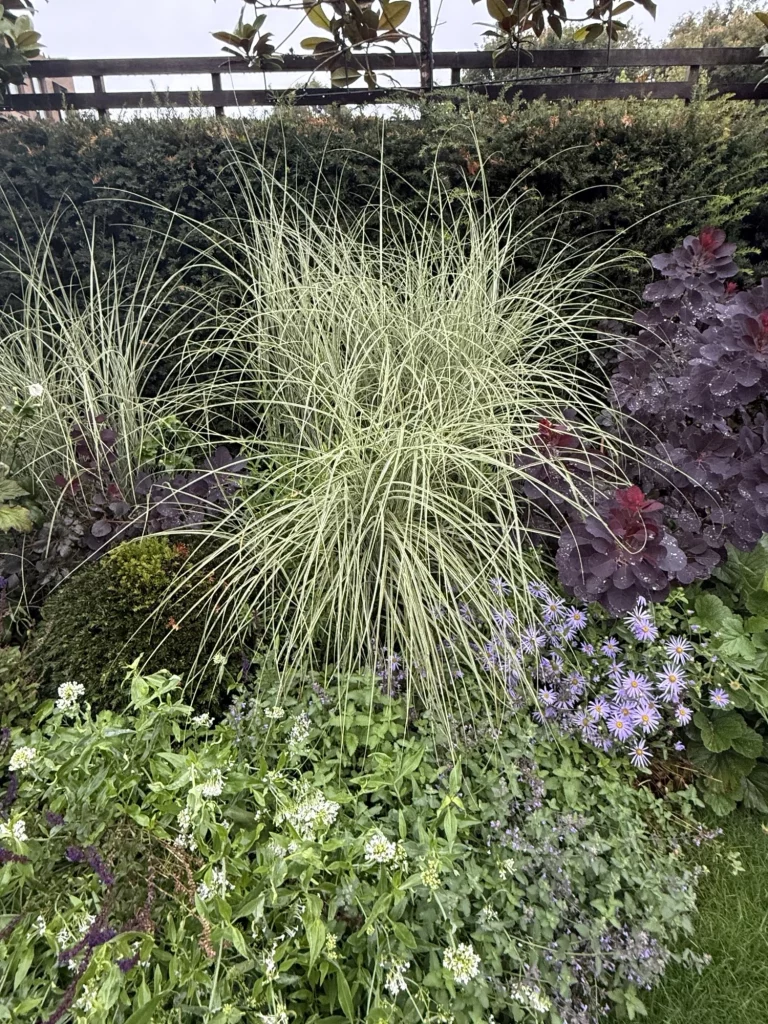
- Miscanthus sinensis ‘Morning Light’. Silver-variegated foliage with feathery flowers August to October. AGM. The reliable structural grass.
- Calamagrostis × acutiflora ‘Karl Foerster’. Upright vertical grass with pinky-buff flower spikes from July, holding well into winter. AGM.
- Stipa gigantea. Giant feather grass with oat-like flowers held high above the foliage, June through August. AGM. Architectural showstopper.
Summer pots and containers
For patios and small spaces, summer-flowering pots transform the look of an outdoor seating area. The thriller-filler-spiller principle (one tall focal plant, a mid-height filler, and trailing edge plants) gives the most reliable visual result.
- Thrillers (focal): Agapanthus, Cordyline australis, Phormium, Canna, dwarf Cosmos.
- Fillers (mid-height bulk): Pelargonium (the proper name for what most people call geraniums in pots), Petunia, Salvia farinacea, Argyranthemum.
- Spillers (trailing): Bidens ferulifolia, Calibrachoa (million bells), Lobelia erinus, trailing Verbena hybrids.
Pot growing demands more water than border planting (summer pots may need daily watering in July and August), so consider drip irrigation if you travel.
Best for pollinators
For gardens prioritising bees, butterflies and hoverflies, plants on the RHS Plants for Pollinators list are the right starting point. Among summer-flowering plants the standouts are:
- Lavandula angustifolia ‘Hidcote’, Salvia nemorosa ‘Caradonna’, Verbena bonariensis, Echinacea purpurea, Eryngium (sea holly), Origanum vulgare, Buddleja davidii, single-flowered roses, single-flowered dahlias such as ‘Bishop of Llandaff’.
- Avoid double-flowered cultivars: the doubled petals replace nectaries, making the flowers visually showy but useless for pollinators.
- Aim for continuous flowering from March through October so pollinators have a continuous food source.
Designing for succession
A border that delivers colour from June to October needs plants in three overlapping waves. A simple framework that works in most sunny domestic borders of 3 to 5 m length:
- Early summer wave (June): peonies, Geranium ‘Rozanne’ coming into flower, roses at first flush, Astrantia, Achillea, foxgloves finishing.
- High summer wave (July to August): Salvia nemorosa ‘Caradonna’, Echinacea, Rudbeckia, Verbena bonariensis, Agapanthus, Lavandula, Crocosmia, Hydrangea paniculata opening, Phlox.
- Late summer wave (August to October): dahlias, Helenium, Anemone × hybrida, Hylotelephium ‘Autumn Joy’, Aster family (now Symphyotrichum), ornamental grasses at full height.
Aim for at least three or four plants flowering in each wave, repeated in clumps of three to five through the border so the rhythm carries across the planting.
What to avoid
- Buying plants at the garden centre on a sunny May Saturday. Everything in flower looks tempting, but a border designed around what is flowering in May peaks in May and looks tired the rest of the year. Plan the planting on paper first.
- Lavender on heavy wet clay. It will sulk for two years and die. Plant on a raised bed with sharp drainage, or substitute with Perovskia ‘Blue Spire’ which tolerates clay better.
- Double-flowered cultivars in a pollinator-focused garden. Visually showy, ecologically useless. Single-flowered forms feed insects; doubled forms don’t.
- Planting summer bulbs into cold wet clay in March. Dahlia tubers, Canna and Gladiolus rot before they sprout. Wait until April when the soil has warmed.
- Skimping on deadheading. The single most useful task in summer borders. Cut off spent flowers and most plants flower for weeks longer.
- One of everything. Three or five of the same plant in a clump reads as design; one of every variety reads as a collection. Repetition is the foundation of good planting.
Frequently asked questions
What is the longest-flowering perennial for a UK summer garden?
Geranium ‘Rozanne’ is widely accepted as the longest-flowering hardy perennial ever introduced: violet-blue saucer flowers continuously from June to first frost (typically late October in Surrey), often five months of flower from a single plant. It holds an RHS Award of Garden Merit and is one of our most-specified perennials for that reason. Verbena bonariensis and Alstroemeria ‘Indian Summer’ also flower from June to first frost.
Which summer flowers are best for pollinators?
Single-flowered varieties of Lavandula angustifolia, Salvia nemorosa, Verbena bonariensis, Echinacea purpurea, Eryngium, Origanum vulgare, Buddleja davidii, single-flowered roses and single-flowered dahlias (such as ‘Bishop of Llandaff’) are all on the RHS Plants for Pollinators list. Avoid double-flowered cultivars: the extra petals replace the nectaries, making them visually showy but ecologically useless.
What flowers in a shaded summer border?
For shaded or north-facing borders, Hydrangea arborescens ‘Annabelle’, Astrantia major ‘Roma’, Geranium phaeum ‘Samobor’, Astilbe (in moist soil), Anemone × hybrida ‘Honorine Jobert’ (late summer), and Aconitum all flower well without full sun. Use cool colours (white, violet, deep pink) and silver foliage for the best effect in low light; pure white can read as a hole in deep shade, so cream is often a better choice.
When should I plant summer flowering plants?
The best window for planting hardy perennials and shrubs is autumn (September to November), when the soil is still warm but rain is reliable, allowing roots to establish before winter. The second-best window is spring (March to April). Summer bulbs and tubers like dahlias and cannas go in from April once the soil has warmed. Half-hardy annuals like cosmos and pelargoniums go out after the last frost, typically mid-May in Surrey.
How do I get my garden to flower all summer?
Plan for three overlapping waves of flowering: early summer (peonies, first-flush roses, Astrantia), high summer (Salvia, Echinacea, Lavandula, Agapanthus), and late summer into autumn (dahlias, Helenium, Anemone × hybrida, ornamental grasses). Three to four plants flowering in each wave, planted in groups of three or five and repeated through the border, gives continuous colour from June to October. Combine with regular deadheading to extend each plant’s flowering period.
Are roses really worth growing for summer flowers?
The right roses are exceptionally rewarding. Modern repeat-flowering shrub roses, particularly the David Austin English roses, combine the fragrance and form of old roses with multiple flushes from June into October. Rosa ‘Munstead Wood’, ‘Gertrude Jekyll’, ‘Boscobel’ and the floribunda ‘Iceberg’ are all reliable performers. Avoid once-flowering ramblers if continuous colour matters. See our roses guide for the full picture.
Related pages
- Hard and soft landscaping: how we plan, supply and plant summer borders as part of a full garden build
- Improving clay soil: preparing heavy clay so lavender, salvias and other sun lovers do not sit wet
- Echinacea: the coneflowers we trust on local clay and how to plant them
- Dahlias for late summer colour: choosing, planting and growing the late-season headliners
- Best rose varieties for clay: repeat-flowering roses that cope with heavy soil
Let’s design your summer borders
If you would like beautifully planned summer borders that deliver continuous colour from June to October, we’d be glad to help. Flourish Landscaping designs and installs planting schemes across Kingston, Surbiton, Richmond, Esher and the wider Surrey area. See our planting design and installation service for the way we work.
Contact us to arrange a consultation and start the conversation.
Written by Craig Davis BSc (Hons) Horticulture, member of the Chartered Institute of Horticulture. Craig has over 40 years in horticulture: in the family business since the age of 13 and a horticulture graduate since 1992, he designs, builds and plants gardens across Kingston, Surrey and South West London.
Good to know
Frequently asked questions
Geranium 'Rozanne' is widely accepted as the longest-flowering hardy perennial ever introduced: violet-blue saucer flowers continuously from June to first frost (typically late October in Surrey), often five months of flower from a single plant. It holds an RHS Award of Garden Merit and is one of our most-specified perennials for that reason. Verbena bonariensis and Alstroemeria 'Indian Summer' also flower from June to first frost.
Single-flowered varieties of Lavandula angustifolia, Salvia nemorosa, Verbena bonariensis, Echinacea purpurea, Eryngium, Origanum vulgare, Buddleja davidii, single-flowered roses and single-flowered dahlias (such as 'Bishop of Llandaff') are all on the RHS Plants for Pollinators list. Avoid double-flowered cultivars: the extra petals replace the nectaries, making them visually showy but ecologically useless.
For shaded or north-facing borders, Hydrangea arborescens 'Annabelle', Astrantia major 'Roma', Geranium phaeum 'Samobor', Astilbe (in moist soil), Anemone x hybrida 'Honorine Jobert' (late summer), and Aconitum all flower well without full sun. Use cool colours (white, violet, deep pink) and silver foliage for the best effect in low light; pure white can read as a hole in deep shade, so cream is often a better choice.
The best window for planting hardy perennials and shrubs is autumn (September to November), when the soil is still warm but rain is reliable, allowing roots to establish before winter. The second-best window is spring (March to April). Summer bulbs and tubers like dahlias and cannas go in from April once the soil has warmed. Half-hardy annuals like cosmos and pelargoniums go out after the last frost, typically mid-May in Surrey.
Plan for three overlapping waves of flowering: early summer (peonies, first-flush roses, Astrantia), high summer (Salvia, Echinacea, Lavandula, Agapanthus), and late summer into autumn (dahlias, Helenium, Anemone x hybrida, ornamental grasses). Three to four plants flowering in each wave, planted in groups of three or five and repeated through the border, gives continuous colour from June to October. Combine with regular deadheading to extend each plant's flowering period.
The right roses are exceptionally rewarding. Modern repeat-flowering shrub roses, particularly the David Austin English roses, combine the fragrance and form of old roses with multiple flushes from June into October. Rosa 'Munstead Wood', 'Gertrude Jekyll', 'Boscobel' and the floribunda 'Iceberg' are all reliable performers. Avoid once-flowering ramblers if continuous colour matters.