Echinacea
A tough, reliable perennial that looks great and supports pollinators.
Discover the best Echinacea for Kingston, Surbiton, Esher and Coombe gardens, which cultivars actually last, how to improve heavy London Clay, and why spring planting makes all the difference.
Echinacea is not a shy plant. When it is happy, it stands tall, holds its head high and flowers for months without apology. When it is unhappy, it quietly disappears underground and leaves you wondering what went wrong. Success in gardens across Kingston, Surbiton, Esher and Coombe comes down to knowing which cultivars are worth your time and how to give them conditions they can actually live with.
At Flourish Landscaping we use Echinacea regularly in planting schemes from Surbiton terraces to the substantial gardens of Coombe and Esher. We love it for its confidence, structure and wildlife value, but we are selective. Not every Echinacea is cut out for London Clay.
Why Echinacea is worth the effort
When planted properly, Echinacea earns its place in the border. It brings:
- Strong colour through mid and late summer, when many gardens start to fade
- Upright structure that gives clarity to mixed planting
- Excellent pollinator value for bees and butterflies, recognised by the RHS as Plants for Pollinators
- Seedheads that look good well into winter and provide forage for goldfinches
- A sense of intention rather than fussiness
Think of Echinacea as the backbone of a summer border, holding everything together while softer planting weaves around it.
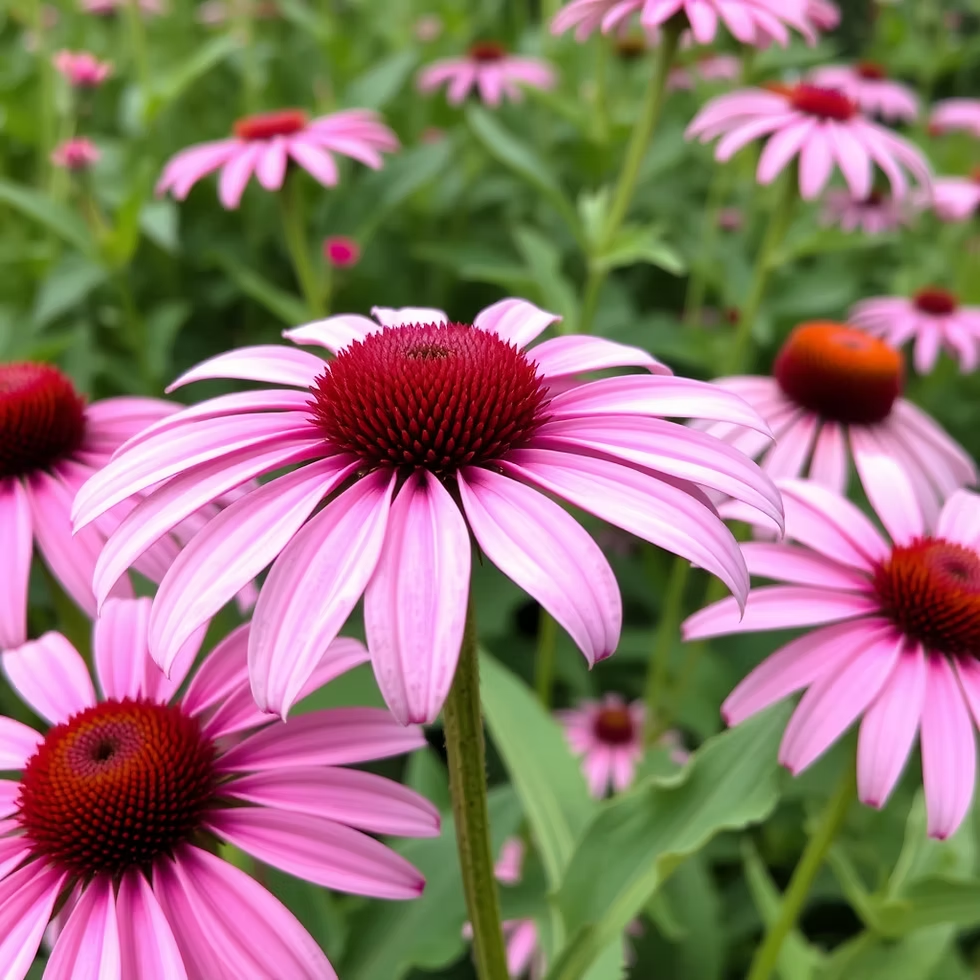
The Echinacea that actually work in Kingston, Surbiton, Esher and Coombe gardens
This is where experience matters. Below are the Echinacea we trust, why we use them, and what makes each one worth specifying in a planting design.
Echinacea purpurea (the species)
USP: tough, honest and unfussy. This is the original and still one of the best. Echinacea purpurea copes better with heavier soils than most modern hybrids and is far more forgiving in real-world gardens. It carries classic pink petals, strong stems and excellent longevity, and holds an RHS Award of Garden Merit. If you want an Echinacea that turns up every year and quietly gets on with the job, this is it.
Echinacea purpurea ‘Magnus’
USP: the benchmark for modern Echinacea. ‘Magnus’ is our most-used cultivar. Broad petals, a generous cone and excellent stem strength make it reliable and visually confident. It does not flop, does not sulk and does not need propping. It holds an RHS Award of Garden Merit and is one of the most widely planted perennials in our local schemes. It works beautifully with ornamental grasses, Salvia and other prairie-style perennials, and looks good from first flower to final seedhead.
Echinacea purpurea ‘Rubinstern’
USP: depth of colour with backbone. ‘Rubinstern’ (also sold as ‘Ruby Star’) brings a deeper, richer pink that holds its colour well in strong sun. It feels bolder and slightly more architectural than softer pink forms, and is a good choice when you want Echinacea to feel assertive rather than delicate. Particularly effective in contemporary planting schemes around Esher and Hinchley Wood.
Echinacea purpurea ‘White Swan’
USP: calm, elegant and endlessly useful. ‘White Swan’ carries soft white petals and a warm central cone that lifts darker planting and brings light into a border. It works particularly well in front gardens and more restrained schemes, including the discreet planting that suits properties on the Coombe estate. It can open with a faint green tinge that soon fades, and once established it proves surprisingly robust. A quiet achiever with excellent manners.
Echinacea pallida
USP: grace and movement rather than bulk. This is the Echinacea for people who think they do not like Echinacea. Slender stems and long, drooping petals give it a much lighter, more natural feel, in the tradition of naturalistic planting championed by designers such as Tom Stuart-Smith and widely covered in Gardens Illustrated. Echinacea pallida threads beautifully through grasses and softer planting, adding movement rather than mass. It prefers leaner soil and rewards you with elegance rather than volume.
Echinacea tennesseensis
USP: neat, tidy and slightly different. With petals that face upwards rather than droop, this species has a crisp, upright look. It stays compact and controlled, making it useful where space is tighter or planting needs to feel precise, ideal for smaller Surbiton and Norbiton gardens. It is also one of the more resilient species once established, provided drainage is good.
The Echinacea we treat with caution
Some Echinacea look irresistible on the nursery bench but struggle in the heavy clay gardens typical of Kingston, Surbiton, Esher and Coombe.
Double-flowered cultivars
USP: impressive looks, short lifespan. These often promise drama but rarely deliver longevity. Heavy flower heads and complex forms are more prone to rot in wet winters, and many are short-lived even in good conditions. They also offer reduced value to pollinators compared with single-flowered forms.
Bright reds, oranges and yellows
USP: high impact, high risk. Cultivars such as ‘Tomato Soup’ and ‘Tiki Torch’ can look spectacular, but they are far less forgiving of winter wet. We only use them where drainage is exceptional and client expectations are realistic.
Why Echinacea should be planted in spring, not autumn
This is non-negotiable on the London Clay that underlies almost every garden across our area.

Echinacea needs warm soil to build roots. If planted in autumn it sits in cooling, wet clay before it has had a chance to establish. That is when rot sets in, and it is the single most common cause of Echinacea failure across the borough.
Spring planting gives:
- Faster root development
- Better establishment
- Stronger flowering
- Far higher survival rates
If Echinacea fails locally, the planting season is usually the reason. The RHS confirms spring planting for Echinacea on heavier soils.
How we make Kingston, Surbiton, Esher and Coombe soil work for Echinacea
Poor drainage is the single biggest obstacle to growing Echinacea on local soils, from the lower-lying gardens near the River Mole in Esher to the heavy clay slopes of Coombe Hill. This is how we deal with it:
- Break up compacted clay to at least 25 to 30 centimetres
- Add generous quantities of horticultural grit
- Mix grit evenly through the planting area
- Create a slight mound so the crown sits proud of surrounding soil
- Use a grit mulch rather than bark to keep the crown dry
This mimics the free-draining prairie conditions Echinacea evolved in and dramatically improves long-term success, even on the most demanding clay sites.
Sun, space and restraint
Echinacea needs full sun, ideally six hours or more each day. Shaded borders, north-facing gardens and areas under the mature oaks, beeches and limes common in Coombe and Esher are not suitable.
Spacing matters too. Crowded plants trap moisture at the base, which increases the risk of disease and winter loss. Give Echinacea room to breathe and it will reward you for it.
How Echinacea fits into a Flourish planting scheme
We use Echinacea when clients want planting that:
- Feels confident rather than fussy
- Supports wildlife
- Holds its structure through summer
- Still looks good in winter
- Does not demand constant attention
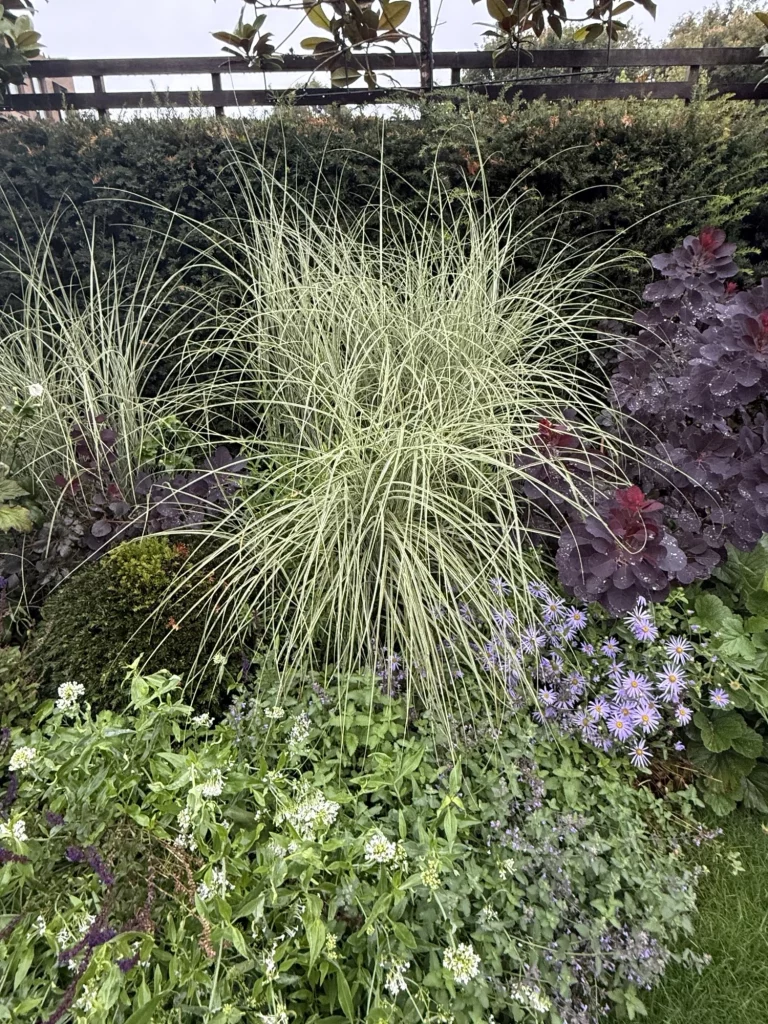
It pairs beautifully with ornamental grasses such as Calamagrostis × acutiflora ‘Karl Foerster’ and other prairie-style perennials, creating planting that feels relaxed but clearly intentional. We often combine it with low-maintenance perennials and structural shrubs to create gardens that work hard without asking too much in return.
Frequently asked questions about Echinacea
Does Echinacea grow well in Kingston, Surbiton, Esher and Coombe gardens?
Yes, provided drainage is improved and it is planted in spring. Heavy London Clay and winter wet are the main challenges locally.
Why does Echinacea disappear after a year?
Usually because of winter wet, autumn planting, or unsuitable hybrid cultivars.
Can Echinacea grow in clay soil?
Yes, but only once the clay is broken up and drainage is improved with horticultural grit.
How much sun does Echinacea need?
Full sun. Less than six hours a day leads to weak growth and poor flowering.
Should Echinacea be cut back in autumn?
No. Leave seedheads standing through winter for structure and wildlife value, and cut back in early spring.
Final thoughts
Echinacea is not difficult, but it does expect a bit of respect. Give it sun, drainage and time to establish, and it becomes one of the most expressive and hardworking plants in a Kingston, Surbiton, Esher or Coombe garden.
Related pages
- Hard and soft landscaping: how we plan, supply and plant borders as part of a full garden build
- Improving clay soil: breaking up heavy London Clay so perennials like Echinacea survive the winter
- Summer flowering plants: the perennials, shrubs and annuals that keep a border in colour from June to October
- Dahlias for late summer colour: the other big performer for August to first frost
- Naturalistic gardens: the prairie-style planting that Echinacea suits best
Let’s create your perfect garden
We pride ourselves on our extensive plant knowledge, including Echinacea, and on our ability to plant and maintain them so they thrive year after year. We work across Kingston, Surbiton, Esher, Coombe and the surrounding KT postcodes. If you would like these confident, wildlife-friendly perennials in your garden, get in touch.
Contact us today to arrange a consultation and start transforming your garden into the perfect outdoor space for you and your family.
Written by Craig Davis BSc (Hons) Horticulture, member of the Chartered Institute of Horticulture. Craig has over 40 years in horticulture: in the family business since the age of 13 and a horticulture graduate since 1992, he designs, builds and plants gardens across Kingston, Surrey and South West London.
Good to know
Frequently asked questions
Yes, provided drainage is improved and it is planted in spring. Heavy London Clay and winter wet are the main challenges locally.
Usually because of winter wet, autumn planting, or unsuitable hybrid cultivars.
Yes, but only once the clay is broken up and drainage is improved with horticultural grit.
Full sun. Less than six hours a day leads to weak growth and poor flowering.
No. Leave seedheads standing through winter for structure and wildlife value, and cut back in early spring.