Dahlias for late summer colour
A practical UK guide to choosing, planting and growing dahlias for a garden that peaks from August to first frost.
Dahlia is the plant that carries a UK garden from late July through to the first hard frost, often into November. While the early summer perennials are going over and the asters and grasses are still warming up, the dahlias arrive at full volume and refuse to stop. They are not low-maintenance, but they reward the work like very few other plants do.
Once dismissed in design circles as a fussy showbench flower, Dahlia has been thoroughly rehabilitated over the last twenty years by Christopher Lloyd at Great Dixter, by Sarah Raven’s long campaign for it as a cut flower, and by the RHS Wisley trial gardens. Designers now use dahlias confidently in mixed naturalistic borders, in cutting gardens, and in large statement containers. We plant them across Kingston, Surbiton, Richmond and the wider Surrey area, and they are one of the most-requested plants in any brief that asks for late-season colour.
This guide covers the dahlia types worth knowing, the cultivars we recommend most often, how to grow them well on heavy London clay, and the design combinations that show them at their best.
Understanding the dahlia types
The RHS recognises ten official dahlia classes, distinguished by flower form. The ones that matter most for domestic gardens are these:
- Single-flowered. A central disc surrounded by a single ring of petals. The best dahlias for pollinators because the disc is open and accessible. Dahlia ‘Bishop of Llandaff’ is the famous example.
- Collerette. A central disc, an outer ring of petals, and a small inner ‘collar’ of contrasting shorter petals. Also pollinator-friendly.
- Waterlily. Layered, flatter, elegant blooms that read as classic mid-sized garden flowers. Dahlia ‘Café au Lait’ is the most famous cultivar of any class in this country at the moment.
- Decorative. Fully double, rounded blooms with broad, flat petals. The classic show dahlia. Available in miniature (under 100 mm), small, medium, large and giant (over 250 mm, the ‘dinner-plate’ types).
- Ball and pompon. Tight, geometrically perfect spherical blooms. Pompons are under 50 mm, balls are 90 to 180 mm. Brilliant for cutting and for tight, formal arrangements.
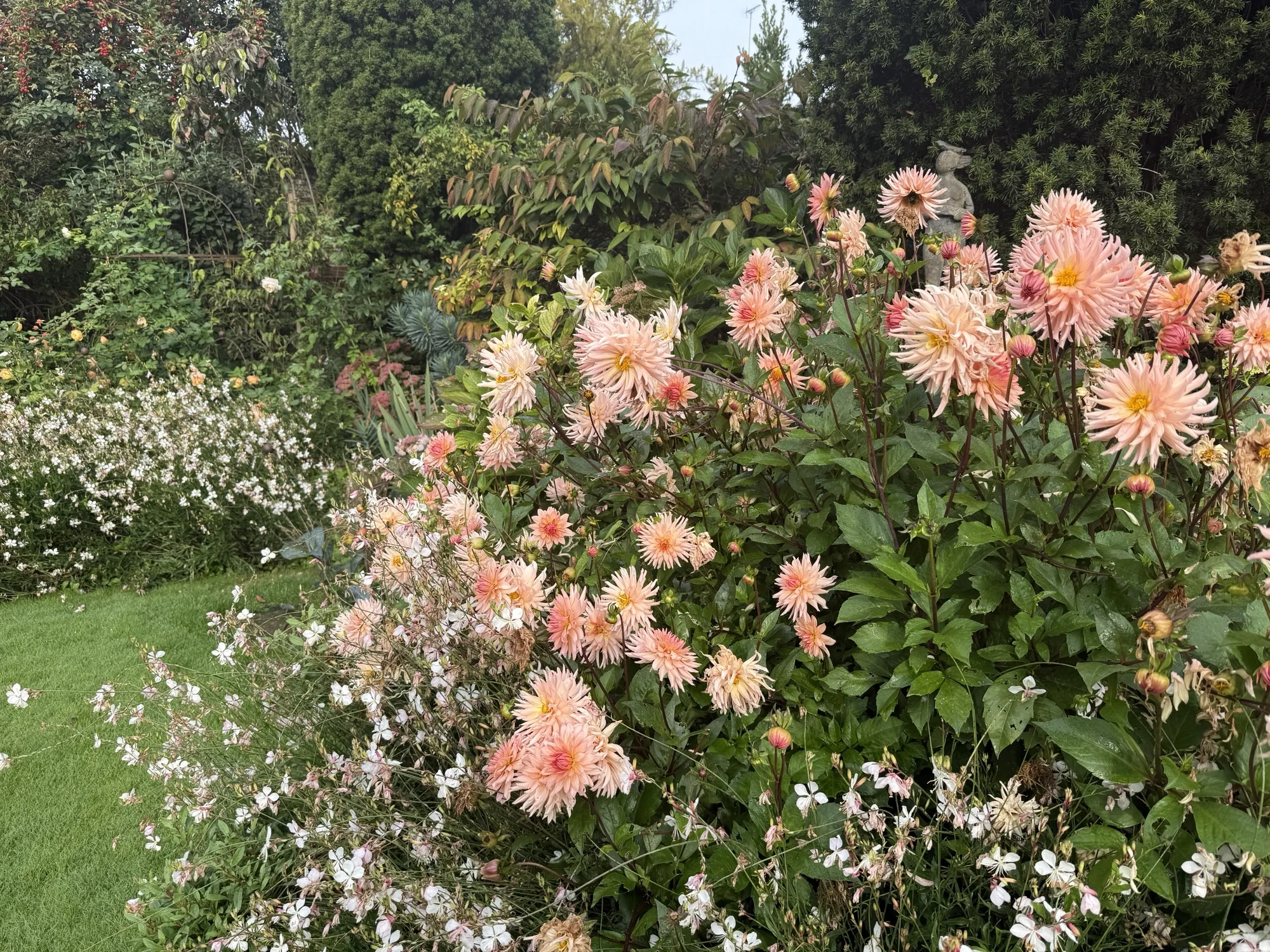
- Cactus and semi-cactus. Spiky, quilled petals giving a more architectural, almost firework-like flower. The drama option.
The cultivars we plant most often
Dark-leaved and richly coloured
- Dahlia ‘Bishop of Llandaff’ – scarlet single flowers over near-black foliage. Holds an RHS Award of Garden Merit (AGM) and is the dahlia we plant most often. 900 mm to 1.2 m tall.
- Dahlia ‘Karma Choc’ – deep oxblood-red decorative flowers, brilliant for cutting and for dark, dramatic schemes. Holds an RHS AGM.
- Dahlia ‘David Howard’ – warm apricot-orange decoratives over dark bronze foliage. An RHS AGM holder and the standout warm-tone dahlia.
- Dahlia ‘Twyning’s After Eight’ – pure white singles over chocolate-black foliage. The cleanest white in the dark-leaved camp.
Soft tones for naturalistic and cottage schemes
- Dahlia ‘Café au Lait’ – vast (200 mm), shifting cream-blush dinner-plate flowers. The most photographed dahlia of the last decade and the standout cut-flower cultivar.
- Dahlia ‘Mystery Day’ – deep purple-pink and white bicolour decorative flowers. Holds an RHS AGM.
- Dahlia ‘Happy Single Wink’ – soft pink and cream singles over bronze foliage. Bee-friendly and compact at around 600 mm.
- Dahlia ‘Honka Pink’ – loose star-shaped pink flowers with widely spaced petals. Reads as a naturalistic, almost wild plant rather than a classic dahlia.
Compact dahlias for pots and small gardens
- The Gallery Series – bred specifically as patio dahlias, all under 500 mm. Dahlia ‘Gallery Art Deco’ (warm orange) and Dahlia ‘Gallery Pablo’ (soft pink) are reliable choices.
- Dahlia ‘Bishop’s Children’ – seed-grown singles in mixed jewel colours, all with dark foliage. The most affordable way to get a generous planting going.
Dahlias and pollinators: not all are equal
Worth being clear about this, because it is one of the most common misunderstandings. Only single, collerette and anemone-flowered dahlias are useful to bees and other pollinators, because they have an accessible central disc carrying nectar and pollen. The fully double types (decorative, ball, pompon, dinner-plate, most cactus) carry their reproductive parts so deep inside the petals that pollinators cannot reach them. If pollinator value is part of the brief, choose the single-flowered types. If pure cut-flower volume is the goal, the doubles are unbeatable. The honest answer is to plant some of both.
Growing dahlias well
When and how to plant
Tubers are planted in late April or May in Surrey, once the soil has warmed and the last frosts are past. For a head start, pot the tubers up indoors in March in a frost-free greenhouse or porch, then plant out the well-grown plants in May. Choose a sunny spot (south or west facing is best, see our guide to south-facing planting) with deep, well-prepared soil. On heavy clay, dig in plenty of well-rotted compost before planting and consider raising the bed slightly to improve drainage.
Staking and pinching
Stake any dahlia growing over 600 mm at the time of planting, not after it has flopped. A single hazel pole or three canes round the plant with twine works well. When the plant reaches around 300 mm, pinch out the top growing tip just above a leaf pair. This produces a bushier, stronger plant with more flowers, and is the single most-skipped step in the dahlia gardener’s year.
Feeding, deadheading and watering
From the moment buds start forming, switch to a high-potash feed (a standard tomato food is ideal) once a fortnight. Deadhead religiously: the difference between a pricked-off and a deadheaded dahlia is the difference between a steady supply of new buds and a plant that goes over. Identify spent flowers by feel as much as sight, the closed pointed bud is what you want, the rounded soft seedhead is what to remove. Dahlias are thirsty in dry spells, particularly in containers, where daily watering may be needed in high summer.
Slugs and earwigs: the two real pests
Slugs and snails will demolish a young dahlia shoot overnight in May and June. Wool pellets, copper rings, nematodes (the Phasmarhabditis hermaphrodita biological control) or a beer trap at the base of the plant are all effective. Earwigs arrive later in the season and chew petals, particularly on the lighter-coloured cultivars. The classic deterrent is an upturned terracotta pot stuffed with straw on top of a cane, which the earwigs use as a daytime shelter and can then be emptied. For a wider treatment of garden pests, see our guide to garden pests and diseases.
Lifting or leaving tubers over winter
Surrey winters are mild enough that most dahlias can be left in the ground if the soil drains freely. On heavy clay, particularly in low-lying gardens, the risk of tuber rot through a wet winter is real, and lifting is the safer option. After the first frost blackens the foliage, cut the stems to 100 mm, lift the tubers with a fork, brush off the soil, and store them upside-down in a cool, dry, frost-free place (a garage or shed) in slightly damp sand or vermiculite. Replant in May. If you choose to leave them in the ground, cover the crown with a 100 mm layer of bark or straw mulch in late October.
Designing with dahlias
The trick to using dahlias well in a mixed border (as opposed to a dedicated cutting bed) is to place them among plants that take over the visual interest before the dahlias start and after they finish. The combinations that consistently work in our schemes:
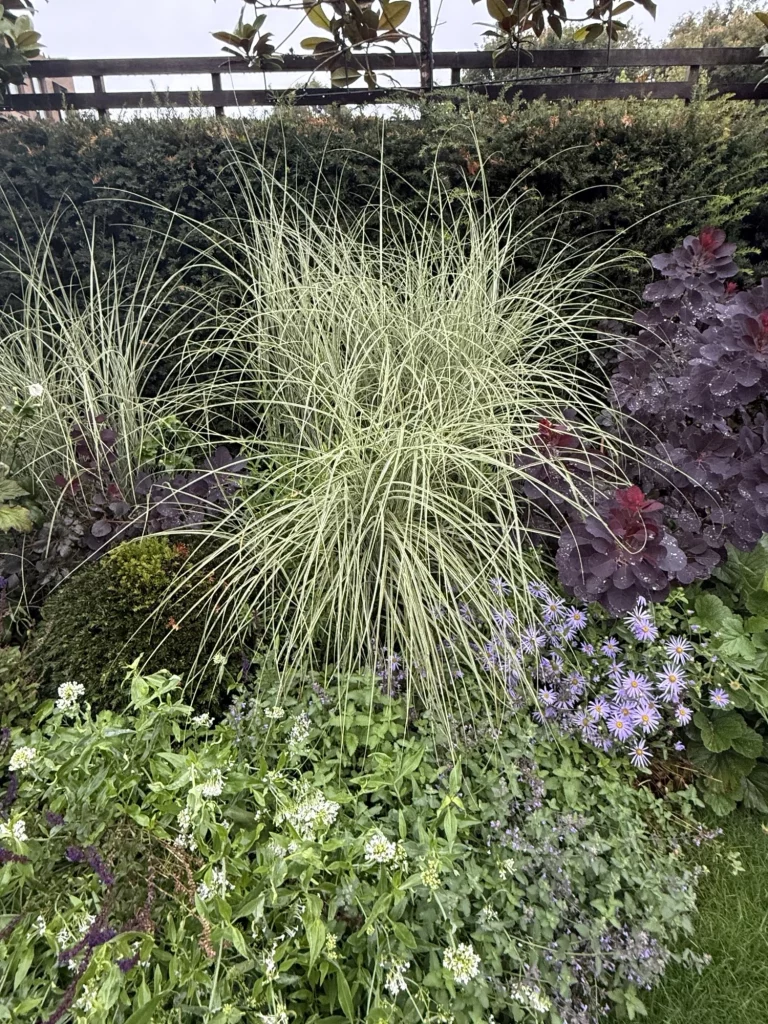
- Dahlias and ornamental grasses. The standard Sarah Raven combination. Dahlia ‘Bishop of Llandaff’ or ‘Karma Choc’ rising through a mass of Stipa tenuissima or Calamagrostis × acutiflora ‘Karl Foerster’ gives blaze of colour against soft movement. See our ornamental grasses guide.
- Dahlias and late perennials. Verbena bonariensis, Salvia nemorosa ‘Caradonna’, Rudbeckia fulgida ‘Goldsturm’ and Echinacea purpurea all flower into the same window and weave together comfortably.
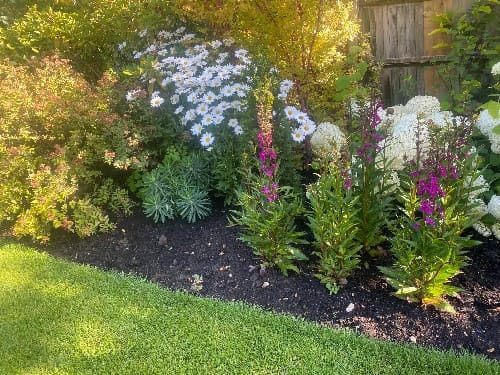
- Dahlias in a cottage garden mix. Pompons and singles dropped into a planting of Phlox, Aster, Helenium and roses for full late-summer abundance.
- Dahlias in large containers. Compact Gallery series cultivars planted three to a generous pot, with trailing foliage and a light second plant for early summer cover. See our notes on container planting.
- Dahlias as a dedicated cutting bed. Rows in a vegetable garden or in their own dedicated bed, picked weekly through the season. This is how Sarah Raven at Perch Hill, the team at Great Dixter and many private cutting gardeners actually grow them.
What to avoid
- Planting unprepared tubers into cold, wet clay. They will rot before they grow. Wait for warmer soil, or start them in pots indoors.
- Skipping the pinch. A dahlia that has not been pinched out at 300 mm grows tall, sparse and floppy, with fewer flowers.
- Forgetting to stake until the plant has fallen. Dahlia stems are brittle. Once a plant has gone over in the wind, it rarely recovers fully. Stake at planting.
- Stopping deadheading in September. They will flower until first frost if you keep removing spent blooms. Stop and they stop.
- Assuming all dahlias help pollinators. Only the open-centred types (single, collerette, anemone-flowered) do. Plant some of these alongside any doubles.
Frequently asked questions
When should I plant dahlia tubers in Surrey?
Direct into the ground in late April or May, once the soil has warmed and the risk of frost has passed. For an earlier start, pot tubers up indoors in March in a frost-free greenhouse, conservatory or porch, then plant the established plants out in May. Mid-summer planting is possible if you can keep the plants well watered, but the autumn-flowering window is shorter.
Do I need to lift dahlia tubers in winter?
It depends on your soil. On free-draining soil in mild Surrey winters, dahlias can usually be left in the ground with a thick mulch over the crown. On heavy clay, particularly in low-lying or wet gardens, lifting the tubers in November and storing them dry in a frost-free place is safer. Tuber rot in cold, wet soil is the main risk, not frost.
Which dahlias are best for bees?
The single-flowered, collerette and anemone-flowered types, because they have an open central disc carrying accessible nectar and pollen. The fully double types (decorative, ball, pompon and dinner-plate) are essentially closed to pollinators. Dahlia ‘Bishop of Llandaff’, ‘Bishop’s Children’, ‘Happy Single Wink’ and ‘Twyning’s After Eight’ are reliable pollinator-friendly choices.
How do I stop slugs eating my dahlia shoots?
The first six weeks of growth are the most vulnerable. The most reliable approach is a combination: a copper ring or wool pellets around the emerging shoot, regular nematode treatments through April to June, and a daily check at dusk if you are losing plants. Slug pellets containing metaldehyde have been banned in the UK since 2022; ferric phosphate pellets are an effective and pet-safe alternative.
Are dahlias low-maintenance plants?
Honestly, no. Dahlias need staking, regular deadheading, weekly feeding once in bud, slug protection in spring, earwig management in late summer, and either lifting or mulching in autumn. They are a high-reward, medium-effort plant. If genuinely low-maintenance is the priority, see our guide to low-maintenance gardens; if peak late-season colour is the priority, dahlias are worth the work.
Can I grow dahlias in pots?
Yes, and they are one of the best late-summer container plants. Choose compact cultivars (the Gallery series, Happy Single series, or any cultivar listed under 600 mm), use a generous pot (minimum 35 cm diameter), a good loam-based compost, and be prepared to water daily through summer and feed weekly. Container dahlias will need lifting and storing dry over winter because the tubers in a pot are more vulnerable to frost than in the ground.
Let’s build the late-summer garden you want
If you would like a garden that carries full colour from August into November, with dahlias playing the leading role, we’d be glad to talk it through. Flourish Landscaping designs and installs planting schemes across Kingston, Surbiton, Richmond and the wider Surrey area. See our planting design and installation service for the full range, or read our companion guides on cottage gardens and naturalistic gardens for the wider context.
Contact us to arrange a consultation and start the conversation.
Good to know
Frequently asked questions
Direct into the ground in late April or May, once the soil has warmed and the risk of frost has passed. For an earlier start, pot tubers up indoors in March in a frost-free greenhouse, conservatory or porch, then plant the established plants out in May. Mid-summer planting is possible if you can keep the plants well watered, but the autumn-flowering window is shorter.
It depends on your soil. On free-draining soil in mild Surrey winters, dahlias can usually be left in the ground with a thick mulch over the crown. On heavy clay, particularly in low-lying or wet gardens, lifting the tubers in November and storing them dry in a frost-free place is safer. Tuber rot in cold, wet soil is the main risk, not frost.
The single-flowered, collerette and anemone-flowered types, because they have an open central disc carrying accessible nectar and pollen. The fully double types (decorative, ball, pompon and dinner-plate) are essentially closed to pollinators. Dahlia 'Bishop of Llandaff', 'Bishop's Children', 'Happy Single Wink' and 'Twyning's After Eight' are reliable pollinator-friendly choices.
The first six weeks of growth are the most vulnerable. The most reliable approach is a combination: a copper ring or wool pellets around the emerging shoot, regular nematode treatments through April to June, and a daily check at dusk if you are losing plants. Slug pellets containing metaldehyde have been banned in the UK since 2022; ferric phosphate pellets are an effective and pet-safe alternative.
Honestly, no. Dahlias need staking, regular deadheading, weekly feeding once in bud, slug protection in spring, earwig management in late summer, and either lifting or mulching in autumn. They are a high-reward, medium-effort plant. If genuinely low-maintenance is the priority, look at other late-season plants; if peak late-season colour is the priority, dahlias are worth the work.
Yes, and they are one of the best late-summer container plants. Choose compact cultivars from the Gallery or Happy Single series, or any cultivar listed under 600 mm. Use a generous pot (minimum 35 cm diameter), a good loam-based compost, and be prepared to water daily through summer and feed weekly. Container dahlias will need lifting and storing dry over winter because tubers in a pot are more vulnerable to frost than in the ground.