Garden paving trends
The materials, finishes and layouts shaping patios, paths and driveways in 2026.
Paving sets the tone of the whole garden. It is the most permanent decision you will make in a build, the most expensive square metre, and the one that ages most visibly when it is wrong. The good news is that 2026 is a strong year for paving: porcelain has matured into a credible long-term material, natural stone is back where it belongs at the high end, and the regulatory shift around permeable surfaces is finally pushing the market towards specifications that genuinely work on a wet UK garden.
We design and install paving across Kingston, Surbiton, Esher, Richmond and the wider Surrey area. Most of our projects sit on heavy London clay, with all the drainage and movement issues that brings. The trends below are the ones we are specifying most often in 2026, with honest notes on what works, what does not, and the technical detail that decides whether a patio still looks good in fifteen years.
For the fundamentals of choosing paving by material and layout, see our companion guide to garden paving ideas, materials, layout and design. This piece focuses on what has changed this year.
The eight trends shaping garden paving in 2026
1. Large-format porcelain has become the default for modern patios
The single clearest shift over the last few years has been porcelain displacing natural stone in mid-market and high-volume installations. Fired at around 1,200°C with a water absorption rate below 0.5 per cent, outdoor porcelain is stain-resistant, frost-resistant and effectively maintenance-free. The Landscape Institute and most major UK suppliers (including London Stone, who we work with regularly) report porcelain as the leading specified material for 2026 patio work. Large-format slabs at 900 x 600 mm or 1,200 x 600 mm reduce joint lines, create a cleaner contemporary finish, and suit modern extensions where the floor is meant to read as a single plane.
2. Warm tones are quietly replacing cool greys
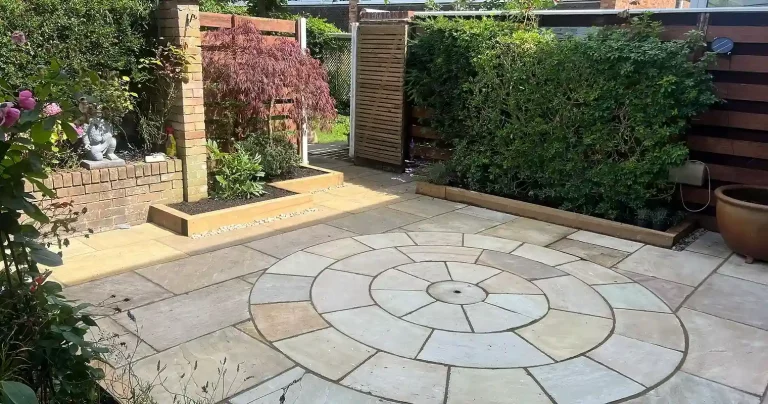
The mid-grey porcelain that defined 2018 to 2023 has not gone away, but the briefs coming through now are noticeably warmer. Buff sandstone tones, honey limestones, soft beige porcelain and gentle terracotta finishes are the dominant palette for new installations. The reason is partly cyclical and partly practical: warm tones sit more comfortably alongside planting, age more gracefully through the wet seasons, and feel less corporate in a domestic garden. Cool grey is still the right answer in some contemporary settings, but it is no longer the default.
3. Tumbled-edge and textured porcelain reading as natural stone
The biggest technical development in porcelain over the last two seasons has been the arrival of convincing weathered finishes: tumbled edges, hand-cut profiles, riven surface textures and worked-in colour variation that genuinely passes for natural stone. This opens porcelain up to traditional and cottage gardens where the sharp-edged contemporary slabs always looked wrong. For clients who want the look of weathered York stone with porcelain’s low maintenance, the option is now real.
4. Indoor-outdoor continuity using the same material
With most new extensions opening onto the garden through large bi-fold or sliding doors, the visual continuity between the floor inside and the patio outside has become an important design move. Porcelain manufacturers now produce matched 10 mm interior and 20 mm exterior versions of the same tile, with identical colour and finish. When laid with a thin threshold, the floor reads as continuous and the garden feels like an extension of the room. This is the most-requested move in our 2026 patio briefs.
5. Zoned terraces over a single large patio
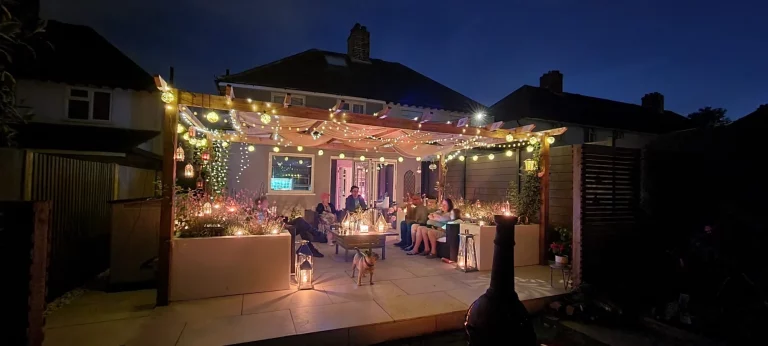
The single rectangular patio attached to the back of the house is being broken up into smaller, defined zones: a dining terrace by the door, a separate lounge area further into the garden, often a third zone for an outdoor kitchen or fire pit. Each zone is sized to the activity, separated by a step, a change of material or a planted band, and connected by a path. The garden reads as a series of outdoor rooms rather than one big slab. It also costs more, and for a longer-term residence it is usually worth it.
6. Permeable surfaces driven by SuDS regulations
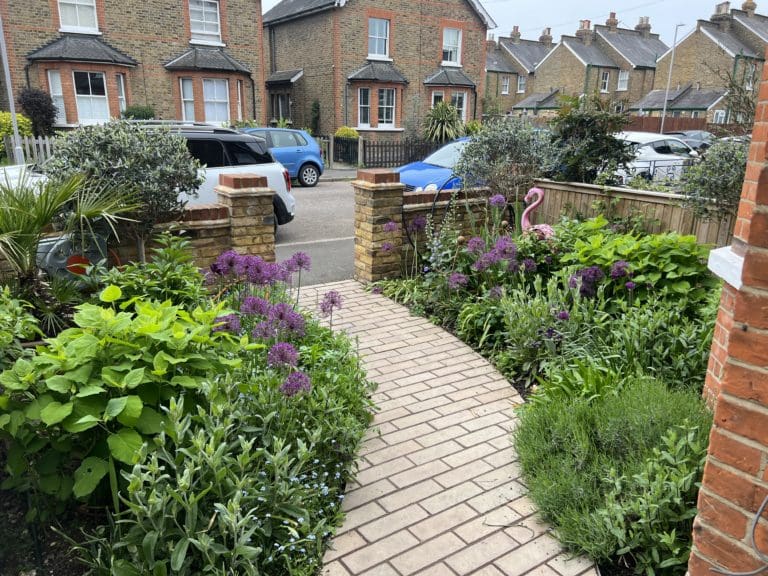
Front-garden paving rules under permitted development require any new paved area over 5 sq m to either be made of permeable material or to drain to a permeable area within the property. The same logic is increasingly being applied voluntarily in rear gardens, both because of more intense summer rainfall and because clients now expect their garden to work with the wider drainage of the site rather than against it. Resin-bound surfaces, permeable block paving, gravel grids, planted joints and broken-bond layouts that let water through the gaps are all genuinely in demand for the right reason. See our guide to flooded garden solutions and drainage for the technical side.
7. Statement Victorian and patterned tiles in front gardens
Geometric Victorian and Edwardian tiles continue to surge in front gardens of period properties, and the work is some of the most rewarding we do. Original encaustic and geometric tiles, restored or laid new in period-correct patterns, transform the kerb appeal of a Victorian terrace in a way nothing else will. The classic black-and-white chequerboard, the small octagon-and-square borders, and richer four- or six-colour Minton-style geometric designs all sit comfortably alongside modern planting. For a full treatment of the topic see our Victorian tiled paths guide.
8. Reclaimed and weathered materials with provenance
Reclaimed York stone, weathered brick, original London stock setts and salvaged cobbles are increasingly specified where the client wants the patio to feel as if it has been there longer than the house. The trend was reinforced at Chelsea 2026 by Tom Stuart-Smith’s Tate Garden, which incorporated a curved path of reclaimed garden stone. Costs vary widely depending on source and condition, but the result is a level of character no new material can replicate, and the environmental credentials are genuine.
The technical details that actually decide longevity
No paving choice survives a bad build. The trends matter, but these specification details matter more.
- Slip rating. Outdoor porcelain should be rated R11 (the slip resistance class for wet external surfaces). R10 is for interiors only. Always check the manufacturer’s data sheet.
- Thickness. 20 mm is the standard for outdoor porcelain, 22 mm for premium grades. Anything thinner is interior tile and will fail outdoors.
- Sub-base. A minimum of 100 mm of compacted MOT Type 1 for patios, more for driveways. Skipping or thinning the sub-base is the single most common reason for paving to fail within five years.
- Full mortar bed and slurry primer. Porcelain must be laid on a full mortar bed (no spot bedding) with a slurry primer brushed onto the back of each slab. Spot bedding lets water sit under the slab, which leads to frost damage and movement.
- Falls. A minimum gradient of 1:80 away from the house, taking water to a planted area, soakaway or drain. Without falls, water pools and surfaces stain.
- Movement joints. Long runs of porcelain or natural stone need movement joints to absorb thermal expansion. Skipped joints lead to cracking over time.
Front garden paving and the SuDS rules
This is the question we are asked most about front gardens. Under permitted development rights, you can pave a front garden without planning permission only if the new paving meets one of two conditions:
- The paved area is 5 sq m or less, or
- The paving is made of porous or permeable material (gravel, permeable block paving, porous resin-bound, planted joints), or
- Rainwater from the paved area drains to a permeable area within the curtilage of the property (a border, lawn, soakaway or rain garden).
Solid impermeable paving more than 5 sq m draining to the street requires a full planning application. This is not a new rule (it has been in force since October 2008 under the SuDS provisions) but local authorities are enforcing it more actively. Designing the front garden with a permeable surface or with a clear drainage route to a border is the practical answer, and almost always looks better than a solid block of impermeable paving anyway.
What to avoid in 2026
- Cheap Indian sandstone laid on spot bedding. The most common cause of patio failure within five years. A budget natural stone laid properly will outlast a premium stone laid badly.
- Interior-rated porcelain used outside. 10 mm tile or R10 slip rating tile installed in a garden will fail. Always check the data sheet for outdoor certification.
- Solid impermeable front-garden paving without drainage. Increasingly likely to attract enforcement action from the council, and contributes to surface flooding on a wider scale.
- Black or very dark patios on north-facing gardens. Hold moisture, grow algae faster, and feel colder. Use lighter tones where light is already in short supply.
- Painted concrete and stencilled finishes. They look acceptable for a season, then weather unevenly and become hard to recoat.
- Treating paving as the cheapest line in the budget. It is the most permanent and visible surface in the garden, and the part it is most painful to redo.
Frequently asked questions
Is porcelain or natural stone better for a UK garden?
Both are valid choices in 2026. Porcelain is the right answer when low maintenance, stain resistance, dimensional consistency and indoor-outdoor matching are the priorities. Natural stone is the right answer where character, weathering and the patina of age are wanted, and where some seasonal maintenance is acceptable. The decision used to be largely about cost, but premium porcelain and good-quality natural stone now sit at similar price points and the choice is genuinely about how you want the surface to feel.
Do I need planning permission to pave my front garden?
Only if the paved area is more than 5 sq m and the surface is impermeable with no drainage to a permeable area within the property. Permeable surfaces (gravel, permeable block paving, porous resin-bound) and any layout that drains rainwater to a border, lawn or soakaway are permitted development. These SuDS rules have been in force since 2008 and are being more actively enforced.
How thick should outdoor porcelain be?
20 mm is the standard for outdoor porcelain in the UK, with 22 mm available for premium and heavily trafficked applications. Anything thinner is interior tile and is not suitable for a patio, regardless of how it is bedded. 10 mm interior porcelain is also produced in matched colour to allow seamless indoor-outdoor schemes, but the indoor and outdoor versions are two different specifications.
What slip rating should an outdoor patio have?
R11 is the standard slip rating for outdoor patio surfaces in the UK. R10 is for interior tiles only and should never be used for an external patio because it becomes slippery when wet. Every reputable supplier publishes the slip rating on the product data sheet. If it is not stated, do not buy it.
How long should a well-built patio last?
A properly built porcelain or natural-stone patio on a 100 mm MOT Type 1 sub-base, full mortar bed, slurry primer and the right falls should last 25 years or more without significant intervention. The most common cause of premature failure is not the material but the build: spot bedding, inadequate sub-base, missing falls or absent movement joints will take any patio out within five to ten years.
Can I lay a new patio over an existing one?
Sometimes, but rarely a good idea. The existing patio almost always has settled unevenly, the falls are usually wrong, and the new surface inherits every fault of the old one. The exception is a sound, well-built existing slab in good condition where the height build-up is acceptable at the threshold. In most cases, lifting the existing paving and starting again from the sub-base is the only route to a long-lasting result.
Let’s design a patio that earns its place
If you are planning a new patio, path or driveway, or you would like an honest opinion on whether your existing surface is worth keeping, we’d be glad to talk it through. Flourish Landscaping designs and installs paving across Kingston, Surbiton, Esher, Richmond and the wider Surrey area. See our patios, paths and driveways service page for an overview, or our garden landscaping costs guide for a sense of where paving sits in a wider garden budget.
Contact us to arrange a consultation and start the conversation.
Good to know
Frequently asked questions
Both are valid choices in 2026. Porcelain is the right answer when low maintenance, stain resistance, dimensional consistency and indoor-outdoor matching are the priorities. Natural stone is the right answer where character, weathering and the patina of age are wanted, and where some seasonal maintenance is acceptable. Premium porcelain and good-quality natural stone now sit at similar price points, so the choice is genuinely about how you want the surface to feel.
Only if the paved area is more than 5 sq m and the surface is impermeable with no drainage to a permeable area within the property. Permeable surfaces such as gravel, permeable block paving and porous resin-bound, and any layout that drains rainwater to a border, lawn or soakaway, are permitted development. These SuDS rules have been in force since 2008 and are being more actively enforced.
20 mm is the standard for outdoor porcelain in the UK, with 22 mm available for premium and heavily trafficked applications. Anything thinner is interior tile and is not suitable for a patio. 10 mm interior porcelain is also produced in matched colour to allow seamless indoor-outdoor schemes, but the indoor and outdoor versions are two different specifications.
R11 is the standard slip rating for outdoor patio surfaces in the UK. R10 is for interior tiles only and should never be used for an external patio because it becomes slippery when wet. Every reputable supplier publishes the slip rating on the product data sheet.
A properly built porcelain or natural-stone patio on a 100 mm MOT Type 1 sub-base, full mortar bed, slurry primer and the right falls should last 25 years or more without significant intervention. The most common cause of premature failure is not the material but the build: spot bedding, inadequate sub-base, missing falls or absent movement joints will take any patio out within five to ten years.
Sometimes, but rarely a good idea. The existing patio almost always has settled unevenly, the falls are usually wrong, and the new surface inherits every fault of the old one. The exception is a sound, well-built existing slab in good condition where the height build-up is acceptable at the threshold. In most cases, lifting the existing paving and starting again from the sub-base is the only route to a long-lasting result.