
Water features
Is a water feature right for your garden, and what are your options?
A water feature does more for a garden than almost any other intervention. It brings sound, movement, reflection and wildlife into a space that would otherwise be still. The sound of running water masks traffic noise, the surface of a pool catches light and sky, and a wildlife pond can transform the ecological richness of a garden within a single season. This guide sets out the options that genuinely work, the practical considerations that have to be settled first (power, water, safety and planning), and the maintenance reality that no glossy brochure mentions.
We design and install water features across Kingston, Surbiton, Esher, Richmond and the wider Surrey area, from small bubble fountains on courtyards to wildlife ponds on larger properties. The categories below cover almost every realistic option for a domestic UK garden.
Practical considerations to settle first
Before specifying any feature, five questions need answering:
- Children under 5. The most important consideration. Any standing water deeper than 50 mm presents a drowning risk for very young children. A pondless water feature (where the water disappears into a hidden reservoir beneath pebbles) gives the sound and movement of water with no exposed standing water. If a traditional pond is the brief, a lockable metal mesh cover over the surface is the standard safety solution while children are small.
- Power supply. All but the smallest solar-powered features need a mains electrical supply, run from the house through armoured cable to an outdoor IP-rated, RCD-protected socket. A 12 V or 24 V transformer drops the voltage to the pump for safety. New circuits need to be tested and certified by a qualified electrician under Part P of the Building Regulations.
- Water supply and top-up. Even sealed-reservoir features lose water to evaporation in summer. Plan a top-up route: a nearby outdoor tap, or a buried fill line. Larger ponds benefit from an automatic float-valve top-up.
- Planning permission. Most domestic water features need no permission. The exceptions: very large ponds (over 1.5 m deep and over 5 sq m surface area can trigger building control), Conservation Areas (any major change to the garden character), and listed properties (separate consent regime). Ponds adjacent to neighbour boundaries also need consideration for water-leakage liability.
- Maintenance. Every water feature needs maintenance. Be honest about how much time you can give it. A pondless bubble fountain needs an annual reservoir clean and a pump check. A koi pond needs weekly filter maintenance, monthly water testing and annual deep clean. A wildlife pond is the lowest-maintenance once established. The right feature is the one whose maintenance demands match the time you actually have.
1. Wildlife ponds
The single most ecologically valuable feature you can add to a UK garden. The Freshwater Habitats Trust estimates that small garden ponds now support a significant share of the country’s declining freshwater biodiversity, as agricultural and farm ponds have been progressively lost. A well-designed wildlife pond will be colonised by frogs, common newts, dragonflies, water beetles, pond skaters and birds within a single season; great crested newts (a protected species) may follow in subsequent years.
How to design one properly
- Depth profile. A wildlife pond needs three depth zones: a deep central area at 600 to 900 mm (provides frost-free overwintering for aquatic invertebrates), a marginal shelf at 200 to 300 mm (for emergent marginal plants), and a gently sloping shallow edge falling to 0 mm at the bank (essential for amphibians to enter and leave, and for hedgehogs that may fall in).
- Sides at no steeper than 1 in 3. Steep-sided ponds drown wildlife.
- No fish. Goldfish and koi eat amphibian larvae, dragonfly larvae and water beetle larvae. A pond with fish cannot also be a wildlife pond. Choose one or the other.
- No pump in the wildlife section. Wildlife ponds work best as still water. A bubbling waterfall or fountain in a separate adjacent section is fine; pump-driven turbulence in the main wildlife body is not.
- Rainwater filling. Tap water introduces chlorine and nutrient loads that encourage algal blooms. Where tap water is unavoidable for initial filling, leave the pond to stand for 48 hours before introducing plants.
- Position. Some direct sun (4 to 6 hours of summer sun is ideal); not under deciduous trees, where autumn leaf fall causes oxygen problems.
Marginal and aquatic planting
A balanced wildlife pond combines submerged oxygenators, surface-leaved plants and emergent marginals. UK native species are best for wildlife value:
- Submerged oxygenators (in the deep zone): Ceratophyllum demersum (hornwort) and Hottonia palustris (water violet). Critical for water clarity and oxygenation; one bunch per square metre of pond surface is the standard rate.
- Surface-leaved plants (deep zone): native Nuphar lutea (yellow water lily) or smaller Nymphaea ‘Pygmaea Helvola’ for smaller ponds. Leaf cover should reach 30 to 50% of the pond surface in summer (shade reduces algae, but full coverage reduces wildlife value).
- Marginals (the 200 to 300 mm shelf): Iris pseudacorus (yellow flag iris, native), Caltha palustris (marsh marigold), Mentha aquatica (water mint), Myosotis scorpioides (water forget-me-not), Lythrum salicaria (purple loosestrife), Butomus umbellatus (flowering rush, AGM), Pontederia cordata (pickerel weed) and Juncus effusus (soft rush).
- Bog and waterside (just above the water line): Iris sibirica, Astilbe, Filipendula ulmaria (meadowsweet), Lobelia cardinalis.
Avoid invasive non-native pond plants: Crassula helmsii (New Zealand pigmyweed), Hydrocotyle ranunculoides (floating pennywort), Myriophyllum aquaticum (parrot’s feather) and Lagarosiphon major (curly waterweed) are now banned from sale and have caused ecological devastation in UK waterways. Buy from reputable UK aquatic nurseries that comply with the Invasive Alien Species Regulations.
2. Formal reflective pools
Still, geometric pools belong to the formal garden tradition that runs from the Mughal gardens through Italian Renaissance to Edwin Lutyens and Gertrude Jekyll’s collaborations at Hestercombe and beyond. A reflective pool catches sky, cloud and overhanging architecture, doubling the visual depth of the garden.
Related articles
Shade plants
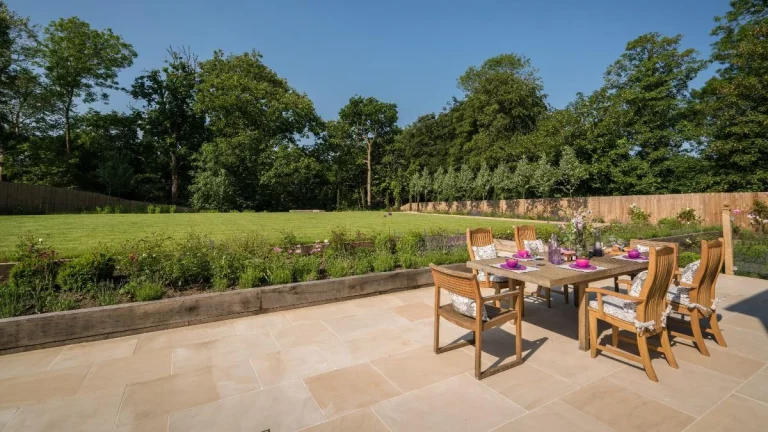
Most disappointing shade plantings are not failures of plant choice but failures of shade assessment. The difference between partial shade beneath deciduous trees and deep shade against a north-facing wall is larger than the difference between partial shade and full sun.
Multi-stem trees
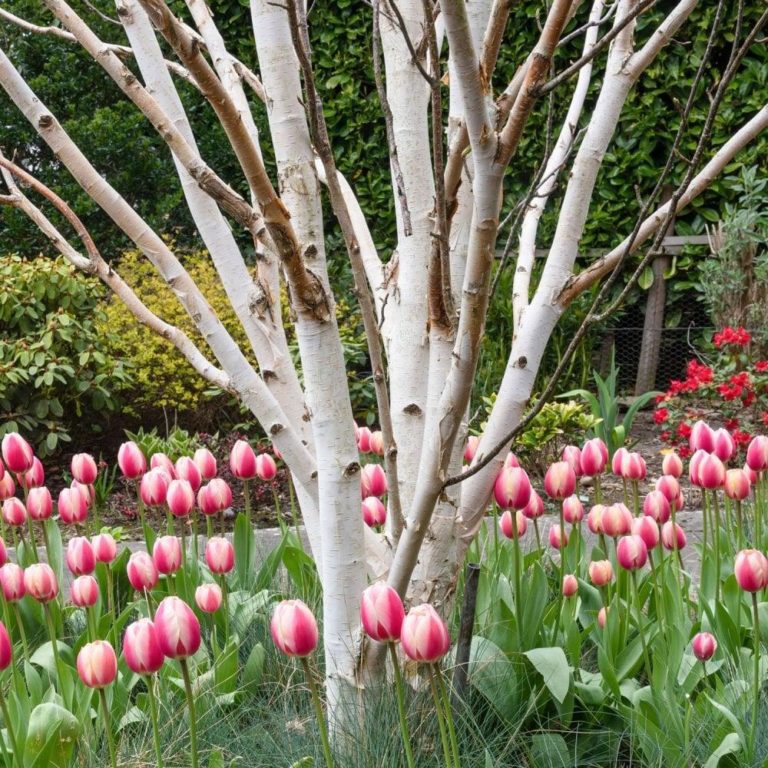
Multi-stem trees Structure, beauty and year-round interest in the garden Multi-stem trees are one of the most elegant planting choices you can introduce into a garden. They combine sculptural beauty, seasonal interest, wildlife value and practical design benefits, all without dominating the space. At Flourish Landscaping we use multi-stem trees regularly in planting schemes across…
Refreshing a garden with new planting
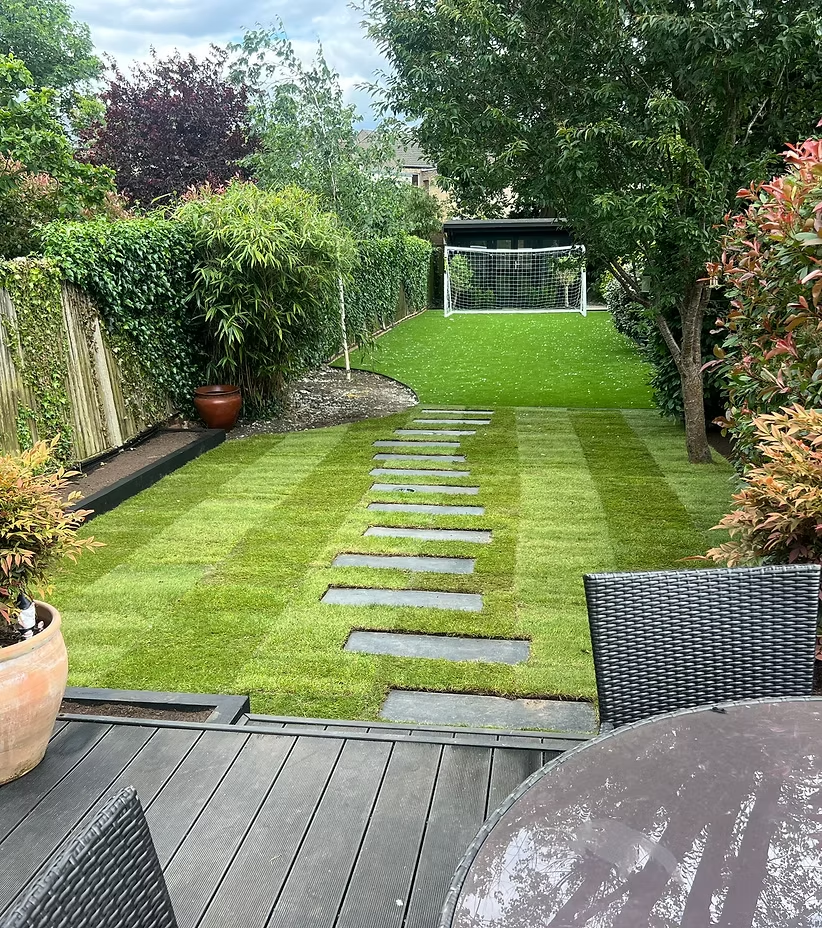
Refreshing a garden with new planting How to transform a long suburban garden without rebuilding everything. Many gardens already have a layout that works reasonably well. The patio sits outside the house, there is a stretch of lawn through the middle, and somewhere towards the end of the garden there is often a shed, trampoline…
Gardening is good – and does good
Gardening is good, and does good What the RHS State of Gardening Report 2025 means for UK gardens. Gardening is often described as a hobby, but the Royal Horticultural Society’s first ever State of Gardening Report 2025 confirms something much bigger. For the first time, the true scale and impact of gardening across the UK…
Garden centres
Garden centres How to get the best out of your local garden centre visits. If you enjoy gardening, whether that means planting out borders, refreshing containers or just browsing for something new, a good garden centre is one of the most useful resources you have. Here in South West London and Surrey, we are well…
Garden pests and diseases
Garden pests and diseases A practical UK guide to the pests and diseases that actually affect gardens in our area, and the plants that resist them. Almost every garden in Kingston, Surbiton, Esher and Coombe will see some pest or disease pressure across the year. The aim is not to eliminate it, which is neither…


Do we work near you?
Based in Kingston and Surbiton, we work within a five–mile radius — covering a focused patch of South West London and North Surrey.