
Wildlife ponds
The single most transformative feature you can add to a wildlife garden
No single feature does more for garden wildlife than a pond. A patch of water, however modest, draws in life from the moment it is filled – frogs, newts, dragonflies, water beetles, bats at dusk, birds at the edge, hedgehogs in the small hours. It creates a depth of habitat that no amount of planting alone can replicate.
Britain has lost around half its ponds since the start of the twentieth century. Garden ponds are now one of the most significant remaining freshwater habitats in the country. Building one, and building it well, is a genuine act of conservation. We design and build wildlife ponds as part of our garden design and build service across Surrey and South West London.
Wildlife pond or ornamental pond?
The distinction is simple and the differences are consequential. An ornamental pond is designed around clear water, formal edges and perhaps a fountain. A wildlife pond is designed around the creatures that will use it. Get the following right and wildlife finds you quickly – often within weeks of filling.
No fish
Fish eat frog spawn, tadpoles, newt larvae and aquatic invertebrates. A pond without fish fills with life; a pond with fish empties of it. This is the single most consequential decision.
Gently sloping beach
A hedgehog that falls into a steep-sided pond will drown. Frogs, newts and birds need to get in and out freely. A sloping cobble or bare-earth beach at one end is not optional.
Native plants, no chemicals
Native aquatic plants are the foundation of a productive pond ecosystem. No filtration, no treatments. A wildlife pond finds its own balance – the green algae of the first season is normal, not a problem to solve.
Sun and nearby cover
Six or more hours of direct sun daily. Away from overhanging trees whose leaves acidify the water. Near rough grass, a log pile or a hedge so amphibians can shelter safely once they leave the water.
What will arrive
Build it correctly and you will not need to stock it. Common frogs, common toads and smooth newts typically arrive within the first season. Dragonflies and damselflies – Surrey and South West London support a good range of species including the emperor dragonfly, broad-bodied chaser and common darter – begin patrolling new ponds quickly. Water beetles, pond skaters and water boatmen often appear within weeks. Bats drink and hunt over the water at dusk. House martins skim the surface. Birds bathe and drink at the shallow edge.
Newts are only in the water for the breeding season in spring and early summer. They spend most of the year on land, under logs, stones and dense vegetation, which is why the cover around a pond matters as much as the pond itself.
Parts of Surrey and South West London still support great crested newts, and a new wildlife pond is a genuine asset to them. For the legal position on great crested newts and construction, see our garden law page.
Size, depth and the beach
Any size helps. A half-barrel attracts frogs; a washing-up bowl sunk into the ground hosts water beetles. Larger ponds support greater diversity, but even the smallest delivers wildlife value that almost no other feature can match.
Whatever the size, include at least one zone of deeper water – around 60 centimetres – that will not freeze solid in a hard winter, so aquatic invertebrates and plants come through safely. The rest can be shallower, shelving gradually from deep to mid-depth to the margins and then to the beach.
The beach is the single most useful design feature in a wildlife pond. A gently sloping area of bare soil, cobbles or gravel at one end costs nothing, needs no planting and saves lives. Hedgehogs drink there. Frogs and newts emerge there after breeding. Birds paddle there.
Construction on London Clay
London Clay has an unexpected advantage: it holds water. A pond dug into undisturbed clay subsoil often seals itself as the clay particles swell and compact, which can reduce or eliminate the need for a liner.
In practice, most gardens in Kingston, Surbiton and the surrounding area use a butyl rubber or EPDM liner for security, as the topsoil layer above the clay varies and a liner failure in an established planting is expensive to fix. We assess this at survey stage. On suitable sites where clay is close to the surface, a puddled clay liner or no liner at all is the right answer.
A layer of washed gravel or sharp sand between the liner and soil prevents root puncture and gives pond plants a medium that does not cloud the water with silt. Fill with rainwater, not tap water – mains water is treated and often too alkaline for aquatic life. For broader drainage and clay-soil context, see our flooded gardens service and our guide to improving clay soil.
Planting your wildlife pond
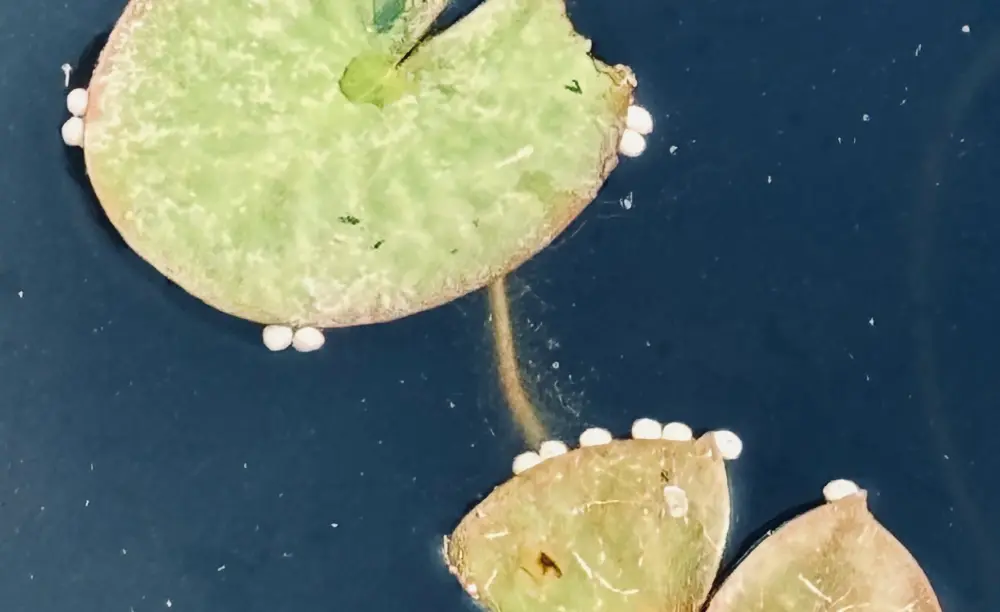
Use native plants, plant in zones, and let the pond find its own balance. A well-planted wildlife pond has three layers: oxygenating plants below the surface, floating plants that shade the water, and emergent marginals at the edges. Each plant links to its RHS plant profile.
| Plant | Zone | Notes |
|---|---|---|
| Ceratophyllum demersum – Hornwort | Submerged | The most reliable native oxygenator. Free-floating, no soil needed – simply drop bunches into the pond. Dense cover for tadpoles and invertebrates. |
| Hydrocharis morsus-ranae – Frogbit | Floating | Native floating plant for smaller ponds. Rosettes of glossy leaves, small white flowers in summer. Sinks as overwintering buds in autumn, returns in spring. |
| Nymphaea alba – White water lily | Floating | For larger ponds only (4 m+ diameter). Surface shade keeps water cool and discourages algae. For smaller ponds use a compact cultivar – the native species fills a modest pond in a few seasons. |
| Caltha palustris – Marsh marigold | Marginal | Native. Golden flowers open in spring when the first bees emerge – one of the earliest and most valuable nectar sources of the year. Happy at the water’s edge or in a few centimetres of water. |
| Iris pseudacorus – Yellow flag iris | Marginal | Bold native, loved by damselflies and dragonflies. Vigorous – suits larger margins or a submerged container to limit spread. Thoroughly at home on London Clay. |
| Menyanthes trifoliata – Bogbean | Marginal | Distinctive fringed white flowers in late spring. Spreads across the surface from a marginal position and provides valuable cover. Plant in baskets at 15 to 25 cm depth. |
| Mentha aquatica – Water mint | Marginal | Whorls of lilac flowers in late summer – excellent for bees and butterflies at a time when many marginals have finished. Keep in a submerged container; it spreads vigorously. |
| Veronica beccabunga – Brooklime | Marginal | Vivid blue flowers, bright green leaves. Grows in up to 10 cm of water. Excellent for stabilising margins, provides egg-laying sites for aquatic invertebrates. |
| Lythrum salicaria – Purple loosestrife | Pond edge | Tall magenta spikes all summer, alive with bees, butterflies and hoverflies. Foliage is a foodplant for moth caterpillars. Native, fully hardy and spectacular reflected in still water. |
Plants to avoid: Schedule 9 invasives
These three have been banned from sale since 2014 and must never be planted or spread. All are listed on Schedule 9 of the Wildlife and Countryside Act 1981 and have become serious problems in waterways and natural ponds across Britain.
New Zealand pygmyweed (Crassula helmsii) – forms dense choking mats, extremely difficult to eradicate.
Floating pennywort (Hydrocotyle ranunculoides) – can grow up to 20 cm a day, clogging the pond surface within weeks.
Parrot’s feather (Myriophyllum aquaticum) – similar rapid-growth problem across southern England.
If you find any of these in a pond, do not compost them – bag the material and put it in general waste. Even small fragments regenerate. Buy pond plants from a reputable native-plant specialist rather than a general garden centre and you are unlikely to encounter them.
Maintenance through the year
A well-designed wildlife pond largely manages itself. The key tasks are light and infrequent. In summer, remove excess blanketweed by winding it onto a stick or rake, then leave the removed vegetation at the pond edge for 24 hours so trapped invertebrates can crawl back in. In autumn, net the pond briefly to catch falling leaves and thin excess vegetation if it covers more than half the surface. In late winter, cut back marginals before new growth begins, but leave a generous strip of rough vegetation nearby as amphibian habitat. The less you intervene, the better.
Common mistakes
Adding fish
Goldfish and koi eat everything that makes a pond alive: spawn, tadpoles, larvae, invertebrates. A wildlife pond and a fish pond are incompatible. This is the most common and most damaging mistake.
Steep or vertical sides
Vertical banks trap hedgehogs, prevent frogs from climbing out and make the pond inaccessible to birds. A gently sloping beach at one end is structural, not decorative.
Shade and leaf fall
Decomposing leaves create methane and hydrogen sulphide that can kill pond life over winter. A pond under a large tree is a maintenance problem year after year. Full sun is essential.
Using tap water
Mains water is treated with chlorine and often too alkaline for aquatic life. Collect rainwater to fill and top up. If tap water is unavoidable, let it stand uncovered for several days first.
Related pages
Related services
Frequently asked questions
Written by Craig Davis BSc (Hons) Horticulture MCIHort. This page was created with AI assistance and reviewed for accuracy by Craig Davis, BSc (Hons) Horticulture.
Build a wildlife pond with Flourish
A properly built wildlife pond brings more life to a garden than almost anything else, and it does so quickly.
Craig Davis BSc (Hons) Horticulture, member of the Chartered Institute of Horticulture, over 40 years in the industry · APL · TrustMark · Surrey Trading Standards · HTA
Arrange a consultation