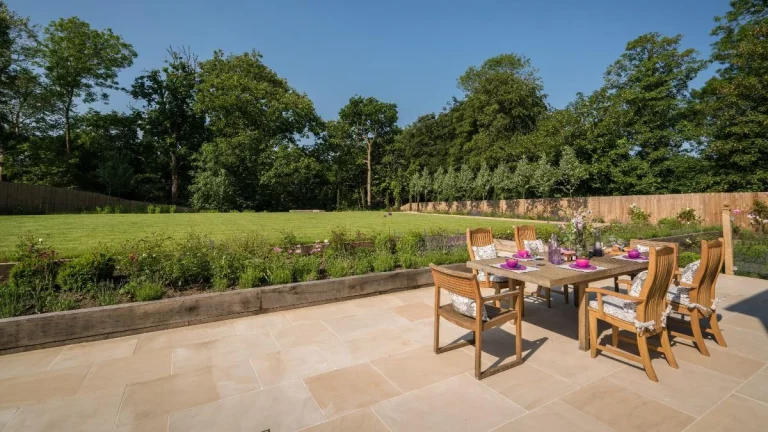
Wooden pergolas
Add structure, shade and style to your garden with a pergola.
A well-designed wooden pergola is one of the most transformative additions you can make to a garden. The right pergola creates a defined outdoor room, provides shelter from sun and light rain, supports beautiful climbing plants, and turns an underused corner of the garden into the place everyone wants to sit. This guide covers what makes a pergola work: the timber options, the structural dimensions that look right, the planting that lifts the structure into something beautiful, and realistic costs for design-and-build work across Kingston, Surbiton and the wider Surrey area.
Pergolas have moved from optional decoration to near-essential infrastructure in serious garden design over the last decade. In a UK climate of unpredictable weather, an overhead structure transforms how often a garden is actually used. The shift is most visible in our Surrey commissions, where almost every full design now includes some form of overhead structure as a defined outdoor dining or seating room.
Why a bespoke wooden pergola
Off-the-shelf pergola kits exist at every price point but they rarely look right in the gardens they end up in. The proportions are usually wrong (too low, too narrow), the timber is light-section softwood that twists within a season or two, and the joinery is often nailed butt joints that fail at the connections. A properly designed bespoke wooden pergola differs in five ways:
- Proportions are designed for the space. Heights, post spacings, beam projections and rafter spacing are set to work with the patio, the garden width and the house behind, not to fit a flat-packed box.
- Substantial timber sections. 150 mm by 150 mm posts (or larger for big structures), 100 mm by 200 mm beams, 50 mm by 100 mm rafters as a starting point. Heavier sections cost more but they look right and they don’t twist.
- Proper joinery. Mortise-and-tenon connections with peg pins, half-laps where beams cross posts, dovetailed rafter feet. The structure reads as joinery rather than nailed timber.
- Engineered foundations. Concrete post bases at 600 mm depth minimum (deeper on soft sites), galvanised steel post anchors above ground level so timber never sits in soil moisture, properly graded sub-base under any new paving introduced underneath.
- Integration with the garden. A bespoke pergola is designed in relation to existing planting, sightlines from the house, paving, lighting and irrigation, so it becomes part of the garden rather than dropped onto it.
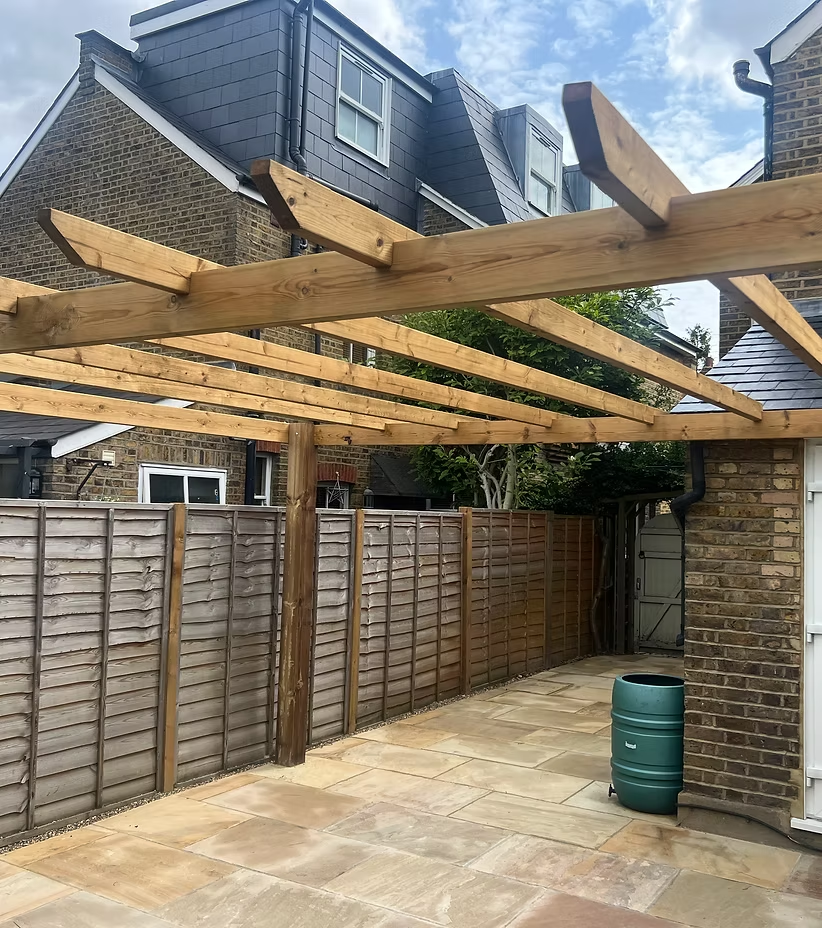
Timber options
Three timber options cover most domestic pergola projects, each with a distinct character, cost and lifespan.
- European oak (FSC certified). The premium option. Dense, naturally durable, weathers to a beautiful silver-grey or can be oiled to retain its warm honey tone. Heavy, structural-grade sections used green (unseasoned) move and check as they dry, which is part of the character; the structure tightens over the first two years. Expected lifespan 60+ years. Used for our highest-specification projects.
- Western red cedar. Lighter, naturally rot-resistant (the oils in the wood are toxic to most timber-decay fungi), beautiful red-brown colour silvering to grey when left untreated. Lighter sections feasible thanks to the rot resistance. More expensive than treated softwood, less than oak. Expected lifespan 30-40 years. Excellent middle option.
- Pressure-treated softwood (Scandinavian spruce or larch). The most affordable option. Pressure-treated to Use Class 4 (suitable for direct ground contact) with copper-based preservative. Either stained, painted or left to grey naturally. Expected lifespan 20-25 years if specified and detailed correctly. Be wary of cheaper treatments and lighter timber sections from non-specialist suppliers; the lifespan drops sharply.
For sustainability, FSC or PEFC certified timber should be specified as standard on any new project. Oak from European managed forests has a far lower transport footprint than oak shipped from further afield. We work with local timber yards for most of our supplied stock.
Dimensions that look right
Pergola proportions are the single biggest visual problem with off-the-shelf kits. The minimum dimensions for a domestic pergola to feel generous rather than cramped:
- Internal headroom. 2.4 m minimum to the underside of the beams. 2.6 to 2.8 m for a more generous feel. Lower than 2.4 m feels claustrophobic, particularly with people standing under the rafters.
- Plan footprint for dining. 3.0 m by 3.0 m minimum for a four-seat round table; 3.5 m by 4.5 m for a six-to-eight-seat rectangular table with chair pull-out clearance; 4.5 m by 5.0 m or larger for an eight-to-ten-seat dining area with circulation space around the table.
- Post spacing. 2.5 to 3.5 m between posts works well in heavier 150 mm by 150 mm sections; wider spans require deeper beams and start to look heavy.
- Beam projection. Beams projecting 200-300 mm beyond the posts (with shaped or chamfered ends) read as designed; flush-cut beams look budget.
- Rafter spacing. 400-450 mm between rafter centres gives the right rhythm of shadow across the floor below; wider spacings (500-600 mm) work for plant-heavy pergolas where climbers will fill the gaps.
Climbing plants that suit a pergola
The pergola is hardware; the climbing plants are what make it beautiful. The right plant choice depends on what you want from the structure: full canopy of foliage, scented flowers, fast cover, autumn colour or quiet evergreen coverage. The reliable options for UK pergolas:
- Wisteria sinensis or Wisteria floribunda. The pergola plant. Long lilac, white or pink flower racemes in May. AGM. Requires a substantial structure; mature wisteria is heavy. Needs proper twice-yearly pruning (summer cut back of new growth, winter spur pruning) to flower well.
- Vitis vinifera ‘Purpurea’ (claret vine). Deciduous vine with purple-grey foliage turning crimson in autumn. AGM. The most beautiful pergola foliage option in autumn light.
- Vitis coignetiae (crimson glory vine). Huge heart-shaped leaves turning scarlet and crimson in autumn. AGM. Vigorous; needs a generous pergola.
- Trachelospermum jasminoides (star jasmine). Evergreen, glossy foliage, intensely fragrant white pinwheel flowers June to August. AGM. The contemporary go-to for year-round coverage. Slower to establish than wisteria but more manageable long-term.
- Climbing roses. Rosa ‘New Dawn’ (pale pink, repeat-flowering, AGM), Rosa ‘Madame Alfred Carrière’ (creamy-white, north-wall tolerant), Rosa ‘The Generous Gardener’. Need annual training and pruning; not for the maintenance-averse.
- Clematis armandii. Evergreen clematis with fragrant white flowers in early spring. Sheltered positions only; cuts back hard after a severe winter but recovers.
- Late-flowering clematis. Clematis ‘Étoile Violette’ (deep purple, AGM), Clematis viticella ‘Madame Julia Correvon’. Group 3, hard-pruned in February. Brilliant for weaving through other climbers for layered flowering.
- Lonicera periclymenum ‘Serotina’ (late Dutch honeysuckle). Cream-and-red flowers July to September, fragrant. Excellent for evening fragrance and pollinators.
Many of our best pergolas combine two climbers: typically a structural deciduous plant (wisteria, claret vine) covering the main framework, with a lighter flowering or evergreen climber (clematis, honeysuckle, jasmine) weaving through. For year-round interest, include at least one evergreen.
Planning permission and rules
Most domestic pergolas in rear gardens are permitted development under Class E of the General Permitted Development Order, but several conditions apply:
- Height. Maximum 2.5 m if any part is within 2 m of a boundary; otherwise up to 4 m for ridged-roof structures or 3 m for flat-roof structures. Pergolas are typically flat-topped so the 3 m and 2.5 m limits apply.
- Coverage. The structure (together with any other outbuildings) must not cover more than 50% of the curtilage of the property excluding the original house.
- Forward of the principal elevation. Structures forward of the principal elevation (typically the front of the house) are not permitted development and require planning permission.
- Conservation areas, AONBs, National Parks. Stricter rules apply. Many Surbiton conservation areas have Article 4 directions that remove some permitted development rights. Check with the local planning authority.
- Listed buildings. Listed Building Consent is required for any pergola attached to or in the curtilage of a listed building.

What it costs
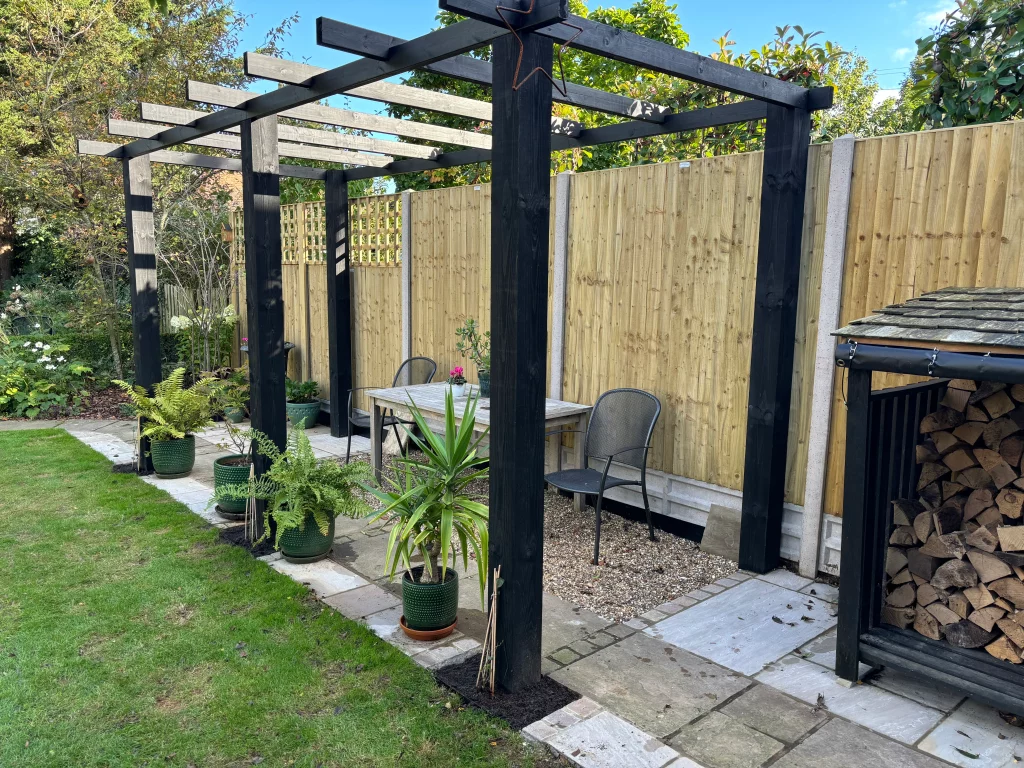
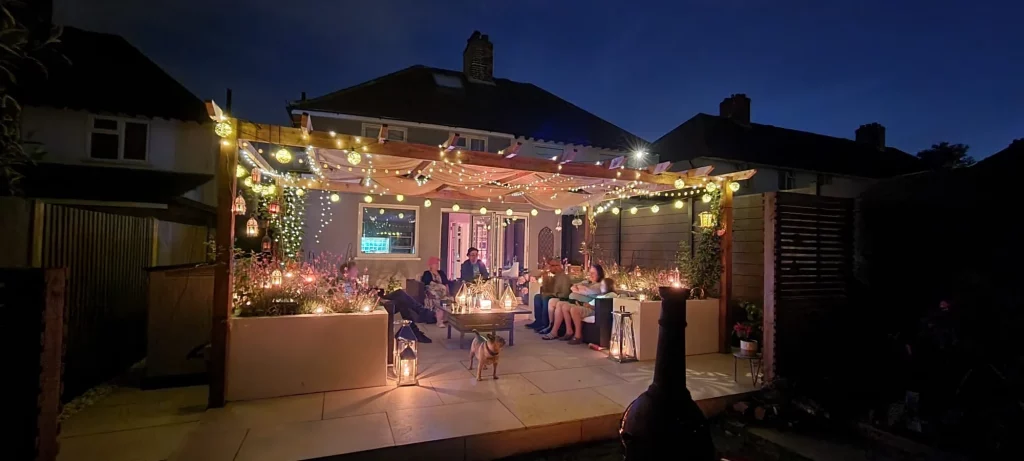
A guide to 2026 Surrey costs for a properly built bespoke pergola (excluding the paving or deck below, climbing plants and irrigation):
- Pressure-treated softwood pergola, 3 m by 3 m: approximately £2,500 to £4,500 supplied and installed including concrete foundations and a basic stain or paint finish.
- Western red cedar pergola, 4 m by 4 m: approximately £5,500 to £9,000 supplied and installed.
- European oak pergola, 4 m by 5 m with proper joinery: approximately £9,000 to £18,000 supplied and installed.
- Large oak pergola with integrated seating and lighting, 5 m by 6 m or larger: £15,000 to £30,000+.
These are the pergola structure costs only. A full outdoor dining area typically also includes new paving (£100-200/sq m installed), planting (£500-3,000), low-voltage lighting (£800-2,500), and sometimes irrigation for the climbers (£300-800). For louvred-roof pergolas (Renson, Corradi and similar contemporary aluminium systems with adjustable slats) costs typically run £8,000 to £25,000 installed depending on size and specification.
Long-term care
- Annual inspection. Check post bases for any signs of softening at ground level (where most timber failures start), inspect joints for movement, check climbing plant weight isn’t pulling the structure.
- Annual cleaning. A gentle wash with soapy water removes algae, grime and the powdery mildew that sometimes affects climbing plants. Avoid high-pressure jet washing on timber; it raises the grain and accelerates weathering.
- Treatment every 2-3 years. For oak left to silver, no further treatment is required. For oak being kept honey-coloured, an oil treatment every two years. For cedar and pressure-treated softwood, a quality penetrating stain or oil (Osmo, Sikkens, Cuprinol Garden Shades) applied to dry timber on a dry day.
- Wisteria pruning. Twice yearly: long whippy summer growth cut back to 5-6 buds in July or August, then those shoots cut back to 2-3 buds in January or February. Failure to summer-prune is the single most common reason for wisteria not flowering.
- Rose pruning. Annual hard prune in February for repeat-flowering climbers; train new shoots horizontally to encourage flowering side shoots.
What to avoid
- Light timber sections. 100 mm by 100 mm posts and 50 mm by 100 mm beams look thin under any meaningful climbing plant. Specify 150 mm by 150 mm minimum for the posts.
- Posts set straight into concrete without a metal anchor. Timber sitting in concrete or soil absorbs moisture and rots from the bottom up, often within 5-10 years. Use galvanised steel post anchors (e.g. Simpson Strong-Tie EAB or proprietary equivalents) with the timber raised above ground level.
- Low headroom. Anything under 2.4 m feels claustrophobic. The temptation is to lower the structure to fit under permitted-development heights or to keep it ‘in scale’; both usually produce a worse result.
- Wisteria on a flimsy structure. Mature wisteria is genuinely heavy: a 20-year-old plant can weigh several hundred kilograms. Light pergolas collapse under it. Either go heavy or pick a lighter climber.
- Skipping foundations. Surface-fixed pergolas without proper concrete bases shift over a winter or two and split joinery. The foundations are not the place to save money.
- Trellis-grade timber. The light, mass-produced softwood used for fence trellis is not structural-grade. It’s fine for vertical wall-mounted trellis; it’s not fine for a free-standing pergola.
Frequently asked questions
Do I need planning permission for a pergola?
Most domestic pergolas in rear gardens are permitted development under Class E of the General Permitted Development Order, provided: the height is no more than 2.5 m if any part is within 2 m of a boundary, no more than 3 m for a flat-topped structure otherwise; the total area of outbuildings doesn’t exceed 50% of the curtilage; and the pergola is behind the principal elevation of the house. Conservation areas, Article 4 directions and listed buildings have stricter rules. Check with the local planning authority (Kingston, Elmbridge or Richmond Council) if in doubt.
What is the best wood for a UK pergola?
For the longest life and the best look, European oak (FSC certified): naturally durable, weathers beautifully, lasts 60+ years. The premium choice. Western red cedar is the excellent middle option: naturally rot-resistant, lighter, 30-40 year lifespan, more affordable than oak. Pressure-treated Scandinavian softwood (spruce, larch) is the most affordable option at 20-25 years lifespan if specified to Use Class 4 with proper detailing. Avoid lighter mass-market kit timber, which often lasts under 10 years before twisting or rotting.
What climbing plants are best for a pergola?
The classic is wisteria (Wisteria sinensis or Wisteria floribunda) for its long lilac flower racemes in May, though it needs a substantial structure to take its mature weight and proper twice-yearly pruning to flower well. Vitis vinifera ‘Purpurea’ (claret vine) gives beautiful autumn foliage colour. Trachelospermum jasminoides (star jasmine) is the modern go-to for year-round evergreen coverage with summer fragrance. Climbing roses (‘New Dawn’, ‘Madame Alfred Carrière’) work for traditional schemes with annual maintenance. The best pergolas usually combine two climbers: a structural deciduous one and a lighter flowering or evergreen one weaving through.
How big should a pergola be?
For dining, 3.0 m by 3.0 m is the minimum for a four-seat round table; 3.5 m by 4.5 m for a six-to-eight-seat rectangular table with chair pull-out clearance; 4.5 m by 5.0 m or larger for eight to ten people with circulation around the table. Headroom should be 2.4 m minimum to the underside of the beams, with 2.6 to 2.8 m feeling more generous. Post spacing of 2.5 to 3.5 m works well with 150 mm by 150 mm timber sections; wider spans need deeper beams.
How much does a bespoke wooden pergola cost?
2026 Surrey guide prices for the pergola structure only (excluding paving below, planting and lighting): pressure-treated softwood 3 m by 3 m, £2,500-4,500 installed; western red cedar 4 m by 4 m, £5,500-9,000; European oak 4 m by 5 m with proper joinery, £9,000-18,000; large oak pergola 5 m by 6 m or larger with integrated seating and lighting, £15,000-30,000+. A full outdoor dining area including new paving, planting, lighting and irrigation typically adds £2,000-7,000 to these figures. Louvred-roof aluminium pergolas (Renson, Corradi) run £8,000-25,000.
How long does a wooden pergola last?
It depends on the timber and the detailing. A properly built European oak pergola with mortise-and-tenon joinery, posts on galvanised steel anchors above ground level, and proper concrete foundations, will last 60 years or more. Western red cedar lasts 30-40 years. Pressure-treated softwood properly detailed and treated lasts 20-25 years. The single most important detail is keeping timber out of direct ground contact: galvanised steel post anchors raise the timber above the concrete base, which extends lifespan by decades.
Related pages
- Garden features: pergolas, arbours and other structures we design and build
- Growing climbers: choosing and training climbers to cover a pergola
- Patio design: planning the paving that sits under a pergola
- Garden privacy: using pergolas and planting to screen overlooked spots
Let’s design your pergola
If you would like a bespoke wooden pergola designed and built properly for your garden, we’d be glad to help. Flourish Landscaping designs and builds pergolas, outdoor dining areas and complete garden transformations across Kingston, Surbiton, Richmond, Esher and the wider Surrey area. See our garden design and build service for the way we work.
Contact us to arrange a consultation and start the conversation.
Written by Craig Davis BSc (Hons) Horticulture, member of the Chartered Institute of Horticulture. Craig has over 40 years in horticulture: in the family business since the age of 13 and a horticulture graduate since 1992, he designs, builds and plants gardens across Kingston, Surrey and South West London.
Good to know
Frequently asked questions
Most domestic pergolas in rear gardens are permitted development under Class E of the General Permitted Development Order, provided: the height is no more than 2.5m if any part is within 2m of a boundary, no more than 3m for a flat-topped structure otherwise; the total area of outbuildings doesn't exceed 50% of the curtilage; and the pergola is behind the principal elevation of the house. Conservation areas, Article 4 directions and listed buildings have stricter rules.
For the longest life and the best look, European oak (FSC certified): naturally durable, weathers beautifully, lasts 60+ years. Western red cedar is the excellent middle option: naturally rot-resistant, lighter, 30-40 year lifespan, more affordable than oak. Pressure-treated Scandinavian softwood (spruce, larch) is the most affordable option at 20-25 years lifespan if specified to Use Class 4 with proper detailing. Avoid lighter mass-market kit timber, which often lasts under 10 years before twisting or rotting.
The classic is wisteria (Wisteria sinensis or floribunda) for its long lilac flower racemes in May, though it needs a substantial structure to take its mature weight and proper twice-yearly pruning to flower well. Vitis vinifera 'Purpurea' (claret vine) gives beautiful autumn foliage colour. Trachelospermum jasminoides (star jasmine) is the modern go-to for year-round evergreen coverage with summer fragrance. Climbing roses ('New Dawn', 'Madame Alfred Carriere') work for traditional schemes with annual maintenance. The best pergolas usually combine two climbers.
For dining, 3.0m by 3.0m is the minimum for a four-seat round table; 3.5m by 4.5m for a six-to-eight-seat rectangular table with chair pull-out clearance; 4.5m by 5.0m or larger for eight to ten people with circulation around the table. Headroom should be 2.4m minimum to the underside of the beams, with 2.6 to 2.8m feeling more generous. Post spacing of 2.5 to 3.5m works well with 150x150mm timber sections.
2026 Surrey guide prices for the pergola structure only: pressure-treated softwood 3x3m, £2,500-4,500 installed; western red cedar 4x4m, £5,500-9,000; European oak 4x5m with proper joinery, £9,000-18,000; large oak pergola 5x6m or larger with integrated seating and lighting, £15,000-30,000+. A full outdoor dining area including new paving, planting, lighting and irrigation typically adds £2,000-7,000 to these figures. Louvred-roof aluminium pergolas (Renson, Corradi) run £8,000-25,000.
It depends on the timber and the detailing. A properly built European oak pergola with mortise-and-tenon joinery, posts on galvanised steel anchors above ground level, and proper concrete foundations, will last 60 years or more. Western red cedar lasts 30-40 years. Pressure-treated softwood properly detailed and treated lasts 20-25 years. The single most important detail is keeping timber out of direct ground contact: galvanised steel post anchors raise the timber above the concrete base, which extends lifespan by decades.