2026 garden lighting trends
Eight contemporary directions in garden lighting, plus the technical and ecological detail behind a scheme that actually works.
Lighting is the element that most often separates a garden you use into the evening from one you only look at by day. Done thoughtfully, it shapes mood, defines structure, and extends the usable hours of the garden through three seasons. Done badly, it floods the space with cold glare, irritates the neighbours, disrupts wildlife and wastes power. The 2026 direction in serious garden lighting is towards layered, warm, low-level schemes that work with the surroundings rather than against them — and the technology has finally caught up with the design ambition.
This guide covers the eight directions we’re seeing most in client gardens across Kingston, Surbiton and the wider Surrey area, the technical specifications behind them (IP ratings, colour temperatures, voltages), and the responsible lighting principles that make a scheme work for the wider environment as well as the household.
The technical basics that determine results
Before looking at styles, four technical specifications separate good outdoor lighting from poor:
- IP rating. Outdoor fittings must be rated IP65 minimum (dust-tight and water jet resistant); IP67 for fittings exposed to direct heavy rain or sited near water features; IP68 for fully submerged underwater use. Indoor fittings used outdoors fail within a couple of British winters regardless of how well they look.
- Colour temperature. Measured in kelvin (K). 2700-3000 K (warm white) is the only sensible choice for ambient and feature lighting — it reads as inviting, complements timber and stone, and doesn’t disrupt wildlife. 4000 K+ (cool white) is glaring and clinical in domestic gardens; reserve it for security floodlights only.
- Voltage. Low-voltage 12V or 24V systems are now the standard for garden lighting — safer to install, lower running cost, easier to extend or modify. Mains-powered (240V) outdoor lighting requires a Part P-qualified electrician and is overkill for almost all domestic garden work.
- Lumens and beam angle. Path lights typically need 50-200 lumens; uplighters for trees 200-400 lumens; floodlights 800+. Narrow beam angles (15-30°) for spotlighting specimens; wide (60-120°) for wash effects across walls or planting.
1. Smart lighting for convenience and efficiency
App-controlled and integrated home systems have moved from novelty to mainstream. The 2026 picture:
- App control and scenes. Philips Hue Outdoor, Lutron, and similar systems allow scene-based control from a phone — one button for an “evening dining” setting, another for “security only”, a third for “party”.
- Astronomical timers. Self-adjusting schedules that follow sunset and sunrise through the year — no quarterly reprogramming. Standard now in any decent low-voltage transformer.
- Motion sensors used carefully. Sensor-triggered lighting is excellent for paths, drives and security positions but distracting at the back of a planted garden. Use selectively rather than universally.
- Voice control integration. Alexa, Google Home and Apple HomeKit all integrate with major outdoor lighting systems; useful but not essential.
- Dimming as the most-used feature. The single best smart investment is full dimming on every circuit. Bright is rarely the right answer in evening planting; the ability to dial back to 20-30% transforms ambient quality.
2. Warm, layered ambient lighting
The defining 2026 shift is away from any single bright source towards multiple warm low-level points of light. The eye reads multiple soft sources as atmospheric; a single bright source reads as functional.
- Festoon lights. Looped overhead between pergola posts, around terraces and across seating areas. Use commercial-grade IP65 strings (not Christmas-quality), 2700 K warm white LED, dimmable on the circuit.
- Wall-mounted up/down fixtures. Architecture-led pieces casting light up the wall and down to the ground, framing doorways and seating zones. Look for IP65 fittings in finishes that suit the property — black, brass, copper or stainless.
- Lanterns and candle-effect lighting. LED candles in real metal lanterns deliver the warmth of flame without the wax mess or wind risk; runs for 6-8 hours per charge.
- Multiple small uplighters. Six 200-lumen uplighters spread across a planting scheme look infinitely better than one 1200-lumen floodlight.
3. Statement lighting for focal points
A few well-placed feature lights deliver more than a garden filled with uniform glow. The pieces that read as design statements in 2026:
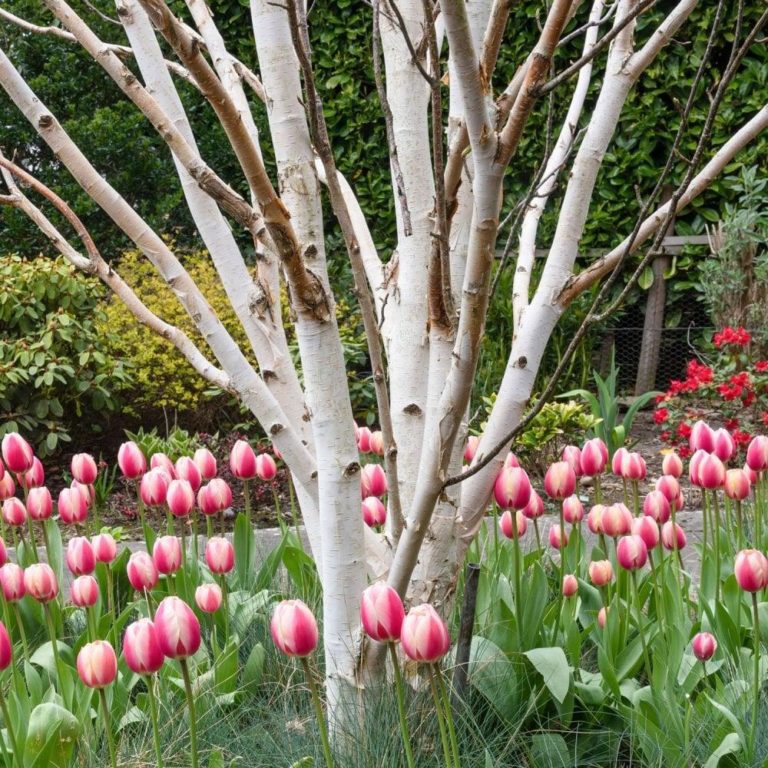
- Architectural uplighting on specimen trees. Two or three IP65 spike-mounted spots placed at 1-2 m from the trunk, angled up through the canopy. Outstanding on multi-stem birches (Betula utilis var. jacquemontii) and snake-bark maples (Acer griseum) where the bark texture itself becomes the feature.
- Water-feature lighting. Submerged IP68 LED rings or spots in ponds and rills bring evening drama. See our water features guide for more on integrated water lighting.
- Sculpture and ornament lighting. Narrow-beam IP65 spots picking out a single piece — pot, sculpture, or specimen plant. The contrast against unlit surroundings does the work.
- Suspended pendant lighting. Hanging pendants beneath pergolas and over outdoor dining tables. Commercial outdoor-rated pendants with IP65 ratings; warm white.
- Globe and orb lights. Floor-standing illuminated orbs in planting groups; reads as floating spheres at dusk. Available in 12V LED versions.
4. Layered lighting for depth
A complete scheme combines three functional types of light. None alone is enough; together they read as natural and rich:
- Task lighting. Functional light for activity zones — outdoor cooking surfaces, dining tables, reading positions on a seating bench. Should be brightest of the three layers but still warm-toned.
- Accent lighting. Directional light picking out planting, trees, sculpture, water and architectural details. Where most of the design interest lives.
- Ambient lighting. Low-level overall wash from festoon, lantern or wall fittings, providing the base layer of soft glow that ties everything together.
The single most common lighting mistake is using one layer alone — typically the brightest single floodlight available. The fix is always: more lights, dimmer each, with multiple switching circuits.
5. Solar-powered and energy-efficient lighting
Solar lighting has improved significantly with better panels and lithium batteries, but realistic expectations still matter:
- Where solar works well. Path edging, marker lights, decorative installations, and locations where running cable would be disproportionately disruptive. Good-quality solar lanterns (with lithium batteries and replaceable LEDs) now run 6-8 hours from a sunny day’s charge.
- Where solar still struggles. Serious feature lighting, deep planting (panels in shade don’t charge), short winter days (when the lights are most wanted), and any application where consistent brightness matters. UK winter daylight charges most panels to 30-50% of summer levels.
- LED everywhere. Modern LEDs use approximately 80-90% less power than halogen for the same lumen output, and last 15-25 years rather than 1-2. Even mains-powered LED schemes have minimal running cost — a typical full garden scheme of 20-30 LED fittings consumes around 100-150 watts total when on.
- Low-voltage transformers. A single 100-300 W transformer can run a complete garden lighting scheme, with cabling installed by a competent DIY-er or non-Part P installer in most cases.
6. Recessed and integrated lighting
Built-in lighting integrated into hard landscape during construction reads as much more polished than retrofitted surface fittings:
- Decking lights. Recessed 30-60 mm LED spots installed flush in timber or composite decking. Ideal at the perimeter, around seating cut-outs, and at decking edge transitions.
- Paving lights. Walk-over LED units flush-set in paving for paths and driveways. Specify minimum IK10 impact rating for vehicle-bearing locations.
- Step lights. Recessed into riser faces for safety as well as effect. Critical on any garden steps used after dark.
- Wall-recessed niche lights. Lights set flush into retaining walls or planter walls, often beneath cap stones, casting light downward to highlight paving texture and create a floating-wall effect.
- Underwater pool and rill lights. Fully submerged IP68 LEDs in water features — soft, shimmering effect that the surface reflection doubles.
Critical: integrated lighting must be specified at the design stage. Cable runs, transformer location and switching arrangements all need to be in place before paving is laid or decking installed. Retrofitting after the event is significantly more expensive and rarely as neat. For more on hard landscape integration see our garden paving guide and wooden pergolas guide.
7. Moonlighting — natural soft illumination
Moonlighting is the technique of mounting soft warm fittings high in mature trees, angled downward through the canopy. The result mimics natural moonlight — dappled shadows on the ground beneath, with the canopy itself glowing softly. It’s the most sophisticated effect in domestic garden lighting and the hardest to fault when done well.
- Fixture type. Tree-mounted IP65 downlights with narrow-medium beam (30-45°), 2700 K warm white, 200-400 lumens each.
- Tree health. Use proper tree-mounting brackets that allow trunk movement and growth without strangulation. Never nail or screw fittings directly into trunks; bracket-and-strap systems that wrap rather than penetrate are the industry standard.
- Suitable trees. Mature trees with substantial branch structure 4-8 m up: established Quercus, Fraxinus, Tilia, Acer and similar. Smaller garden trees rarely have the height to make moonlighting work properly.
- Placement. Two to four fittings positioned in different branches angled to cross-cast across the canopy below. The shadows are as much the point as the lit ground.
8. Firelight and natural glow features
No electric light replicates the warmth and movement of actual flame. As gardens become outdoor rooms, real fire features carry as much weight as the electric scheme around them:
- Fire pits and bowls. Steel or Corten weathering-steel pits burning logs or smokeless coal. Always sited on non-combustible base 1.5-2 m clear of overhanging trees, structures and seating.
- Gas fire tables. Mains-gas or LPG dining tables with central fire elements — controllable, instant, no smoke. Good for tighter urban gardens where wood smoke causes neighbour issues.
- Real candles in proper holders. Storm lanterns, hurricane lamps and grouped pillar candles — the cheap option that often outperforms LED candle effects.
- Outdoor fireplaces. Structural masonry or insert-style outdoor fireplaces, increasingly built into garden room or pavilion structures. Significant investment but transforms how the garden is used into autumn and winter.
Responsible lighting — dark skies and wildlife
The strongest 2026 trend in serious garden lighting is responsible specification — schemes designed not just for the household but for the wider environment they sit within. Light pollution affects neighbours, the night sky and (more seriously than most people realise) wildlife:
- Direct light downward. Fittings should illuminate the surface or feature, not spill light upward into the sky. Capped or shielded fittings (rather than open lanterns or globe lights) drastically reduce skyglow.
- Use warm colour temperatures. 2700-3000 K disrupts wildlife (bats, moths, hedgehogs) significantly less than cooler 4000 K+ white light. Avoid ‘daylight’-spec LEDs anywhere outdoors.
- Switch off when not in use. All-night security floodlights are environmentally costly and rarely necessary. Astronomical timers and PIR sensors deliver security lighting only when needed.
- Dim everything. Most outdoor lighting is brighter than it needs to be. Specifying dimmable circuits and running at 30-50% transforms ambient quality and reduces wildlife disruption.
- Mind the boundary. Position fittings and choose beam angles that don’t spill into neighbouring gardens. The Anti-Social Behaviour, Crime and Policing Act 2014 covers excessive light nuisance, and councils can serve abatement notices.
- Bat awareness. Bats are protected by law in the UK. If your garden borders a roost, tree-line or mature hedge, avoid uplighting that area and consult a bat-aware lighting consultant for substantial schemes.
Planning a garden lighting scheme — the Flourish approach
- Walk the garden at dusk. Note what you can already see (white-stemmed birches, light-coloured walls, water surfaces), what disappears entirely, and where you actually want to spend evenings. The scheme follows from the use, not the other way round.
- Identify three or four focal points. Maybe one tree, the water feature, the pergola seating area, the path to the back gate. These get accent lighting. Everything else stays dark or ambient.
- Plan the three layers. Task light for activity zones; accent light for focal points; ambient light tying the scheme together.
- Lay out cabling and transformer position before any hard landscape goes in. Cable should run in conduit at safe depths (500 mm minimum under paths) with warning tape above.
- Specify dimming on every circuit. Most schemes are over-lit by 50-100%. Dimming gives the flexibility to dial back without re-buying fittings.
- Test at dusk, adjust, return next evening. Most schemes need a second visit after installation to fine-tune angles, beam spreads and dimming levels.
Cost guide: a complete low-voltage scheme for a typical residential garden runs £1,500-5,000 supply and install, depending on garden size, fixture choice and complexity. Premium schemes with bespoke fittings, complex switching and integrated smart control can run £8,000-15,000+. Solar-only schemes start around £200-500 for the basics but rarely deliver the impact of a designed mains-low-voltage scheme.
Frequently asked questions
Do I need an electrician for garden lighting?
For low-voltage (12V or 24V) systems, no. A competent DIY-er can install a transformer fed from an outdoor socket and run the low-voltage cabling to all the fittings. For mains-powered (240V) outdoor lighting, yes — work is notifiable under Part P of the Building Regulations and must be carried out by a registered electrician (or signed off by Building Control). For almost all domestic garden schemes, low-voltage is the better answer regardless — safer, easier to extend, lower running cost, and entirely sufficient for the brightness levels gardens actually need.
What IP rating do I need for outdoor lights?
IP65 minimum for any standard outdoor fitting (dust-tight and protected against water jets). IP67 for fittings sited where direct heavy rain or temporary submersion is likely — close to water features, in low-lying spots that puddle, or in particularly exposed positions. IP68 for fully submerged underwater applications. Don’t rely on “outdoor” or “weatherproof” descriptions without an IP rating; the rating is the only meaningful standard.
What colour temperature works best in a garden?
2700-3000 K (warm white). It’s flattering to skin tones, complements timber and stone, and reads as inviting rather than clinical. Cooler temperatures (4000 K+) appear glaring and unnatural in domestic settings — reserve for security floodlights where deterrent is the only goal. The single colour-temperature mistake we see most often is over-specifying brightness and cool temperature together, which produces a garden that looks like a car park.
How much does a garden lighting scheme cost?
2026 supply-and-install rates for a typical Surrey residential garden: basic low-voltage scheme with 8-15 fittings £1,500-3,000; comprehensive scheme with 20-30 fittings and integrated smart control £3,000-5,000; premium scheme with bespoke fittings, complex switching, integrated smart home control £8,000-15,000+. DIY solar-only schemes can start at £200-500 but rarely deliver the impact of a designed mains-low-voltage approach. Running costs for a modern LED scheme are minimal — typically £20-50 per year of electricity for a full residential garden.
How do I avoid annoying neighbours with my lighting?
Direct all fittings downward (not skywards), use warm 2700 K LEDs not cool white, choose narrow beam angles for spotlighting (so the light goes where intended, not across the boundary), and use dimmers, timers and motion sensors so lights aren’t on unnecessarily. Avoid all-night security floodlights — they’re the single most common cause of neighbour complaints. Under the Anti-Social Behaviour, Crime and Policing Act 2014, excessive light nuisance can be subject to council abatement notice. If a planned scheme might be borderline, talk to neighbours before installation rather than after.
Is solar lighting good enough for a serious scheme?
Honest answer: usually no, for the principal lighting. Solar works well for marker lights, path edging and decorative pieces where moderate brightness is fine and the run-time is short. For serious accent lighting, integrated hard-landscape lights, water features and any moonlighting, mains low-voltage delivers consistent brightness, longer fitting life and reliable winter performance that solar can’t match. The combination most schemes settle on: mains low-voltage for the main lighting design, with solar units in specific decorative positions where cabling would be disproportionate.
Let’s plan your garden lighting
Flourish Landscaping designs and installs garden lighting as part of complete schemes across Kingston, Surbiton, Richmond, Esher and the wider Surrey area. See our kerb appeal guide for front-garden lighting, our water features guide for submerged lighting integration, or our fencing ideas guide for boundary lighting integration.
Contact us to arrange a consultation and start transforming your garden into the perfect outdoor space for you and your family.
Good to know
Frequently asked questions
For low-voltage (12V or 24V) systems, no. A competent DIY-er can install a transformer fed from an outdoor socket and run the low-voltage cabling. For mains-powered (240V) outdoor lighting, yes - work is notifiable under Part P of the Building Regulations and must be carried out by a registered electrician or signed off by Building Control. For almost all domestic garden schemes, low-voltage is the better answer regardless - safer, easier to extend, lower running cost, and entirely sufficient for the brightness levels gardens actually need.
IP65 minimum for any standard outdoor fitting (dust-tight and protected against water jets). IP67 for fittings sited where direct heavy rain or temporary submersion is likely. IP68 for fully submerged underwater applications. Don't rely on 'outdoor' or 'weatherproof' descriptions without an IP rating; the rating is the only meaningful standard.
2700-3000 K (warm white). It's flattering to skin tones, complements timber and stone, and reads as inviting rather than clinical. Cooler temperatures (4000K+) appear glaring and unnatural in domestic settings - reserve for security floodlights where deterrent is the only goal.
2026 supply-and-install rates for a typical Surrey residential garden: basic low-voltage scheme with 8-15 fittings £1,500-3,000; comprehensive scheme with 20-30 fittings and integrated smart control £3,000-5,000; premium scheme with bespoke fittings and integrated smart home control £8,000-15,000+. Running costs for a modern LED scheme are minimal - typically £20-50 per year of electricity for a full residential garden.
Direct all fittings downward, use warm 2700K LEDs not cool white, choose narrow beam angles for spotlighting, and use dimmers, timers and motion sensors so lights aren't on unnecessarily. Avoid all-night security floodlights - they're the most common cause of neighbour complaints. Under the Anti-Social Behaviour, Crime and Policing Act 2014, excessive light nuisance can be subject to council abatement notice.
Honest answer: usually no for principal lighting. Solar works well for marker lights, path edging and decorative pieces. For serious accent lighting, integrated hard-landscape lights, water features and moonlighting, mains low-voltage delivers consistent brightness, longer fitting life and reliable winter performance that solar can't match. Most schemes settle on mains low-voltage for the main lighting design with solar units in specific decorative positions where cabling would be disproportionate.