Eco-friendly alternatives to traditional bedding plants
Sustainable planting choices that bring colour, support wildlife and last for years.
The traditional summer bedding scheme — trays of petunias, busy Lizzies and begonias bought from the garden centre each May, watered daily through July and August, composted at the first frost — has been the British garden standard for decades. Modern garden thinking has moved on. Long-lived perennials, native wildflowers, drought-tolerant Mediterranean planting and naturalising bulbs deliver the same colour with a fraction of the water, none of the annual replanting cost, and real benefit to bees, butterflies and the wider ecosystem.
This guide looks at the alternatives we plant most often in client gardens across Kingston, Surbiton, Richmond and the wider Surrey area. None of it requires abandoning summer colour; it’s a different way of achieving it.
Why move away from annual bedding
- Water use. Annual bedding planted into shallow border soil typically needs daily summer watering. Established perennials and Mediterranean planting need watering only in the first season; from year two they fend for themselves through normal UK summers.
- Pollinator value. Many F1 hybrid bedding plants are bred for double flowers, prolonged display and uniform colour, often at the cost of accessible nectar and pollen. Single-flowered perennials and native wildflowers deliver far more for bees, butterflies and hoverflies.
- Neonicotinoid concerns. A significant proportion of commercial bedding-plant production has historically used neonicotinoid pesticides on the growing-on stage. The RHS and ethical growers have moved away from this; gardeners buying from supermarket and big-box garden centres often can’t verify the treatment history. Growing your own from seed or buying from explicitly bee-friendly nurseries avoids the issue.
- Plastic waste. The single-use black plastic tray containing 6 or 12 bedding plants is widely unrecyclable through kerbside collection. Most local schemes don’t accept it because the black pigment can’t be sorted by automated equipment.
- Replanting cost. A modest bedding scheme costs £80-200 in plants twice a year (spring bedding + summer bedding). Over a decade that’s £1,600-4,000. A one-off perennial planting at a similar initial cost lasts that whole period and improves each year.
- Resilience. Native and well-chosen non-native perennials are far better suited to the UK climate, particularly the increasingly hot and dry summers we’ve seen since 2018.
None of this is to dismiss bedding plants entirely. Window boxes, hanging baskets, summer tubs by a front door, civic planting schemes — bedding has its place. The case is simply that as the default approach to a domestic border, perennials and naturalistic planting deliver more for less.
Perennials for long-lasting colour
Herbaceous perennials die back each winter and return stronger each spring, building up over three to five years into substantial clumps. The reliable performers we plant most often:
- Echinacea purpurea (purple coneflower). Daisy-like pink-purple flowers with prominent orange-brown central cones, June to September. Drought-tolerant once established. Bees and butterflies love them; the spent seed heads feed goldfinches into autumn. AGM cultivars include ‘Magnus’ (deep pink, AGM) and ‘White Swan’ (white).
- Rudbeckia fulgida var. sullivantii ‘Goldsturm’ (AGM). Golden yellow daisy flowers with black centres, July to October. Reliable, long-flowering, copes with most soils. Probably the most useful late-summer perennial in any UK garden.
- Salvia nemorosa ‘Caradonna’. Deep purple-violet vertical spires, June to August, with a second flush after cutting back. Black stems give architectural contrast. Bees adore it. Other excellent salvias: ‘Mainacht’ (AGM, dark blue) and ‘Amethyst’ (rose-pink).
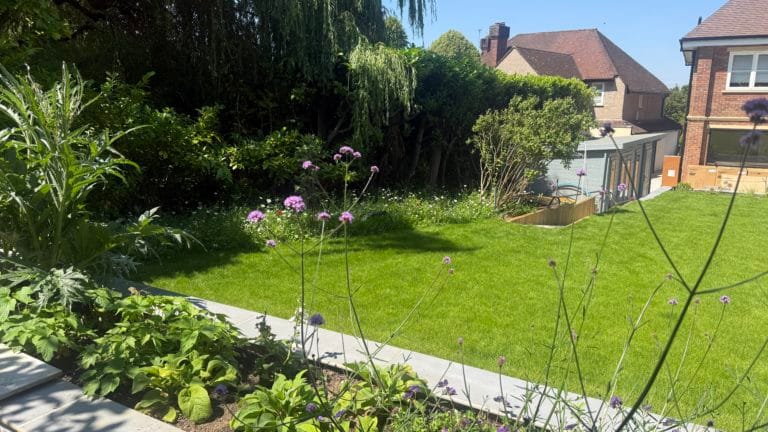
- Verbena bonariensis (AGM). Tall (1.5-2 m) wiry stems with purple flowerheads from July to first frosts. See-through structure, butterfly magnet. Self-seeds gently. Excellent through naturalistic plantings.
- Geranium ‘Rozanne’ (AGM). Violet-blue saucer flowers from late spring to first frosts. Probably the longest-flowering perennial in cultivation. Spreads gently to fill a square metre.
- Achillea millefolium cultivars. Flat plates of small flowers in pinks, yellows, oranges and reds depending on variety. ‘Moonshine’ (AGM, sulphur yellow), ‘Terracotta’ (warm orange ageing to cream). Drought-tolerant, valuable to hoverflies and beetles.
- Knautia macedonica. Pincushion crimson flowers June to September on wiry stems. Loved by bees. Self-seeds delightfully through gravel and informal borders.
- Erigeron karvinskianus (AGM). The Mexican fleabane or wall daisy. Tiny pink-white daisies all summer. Spreads across paving cracks, walls and steps. Almost impossible to kill once established.
Native wildflowers and meadow planting
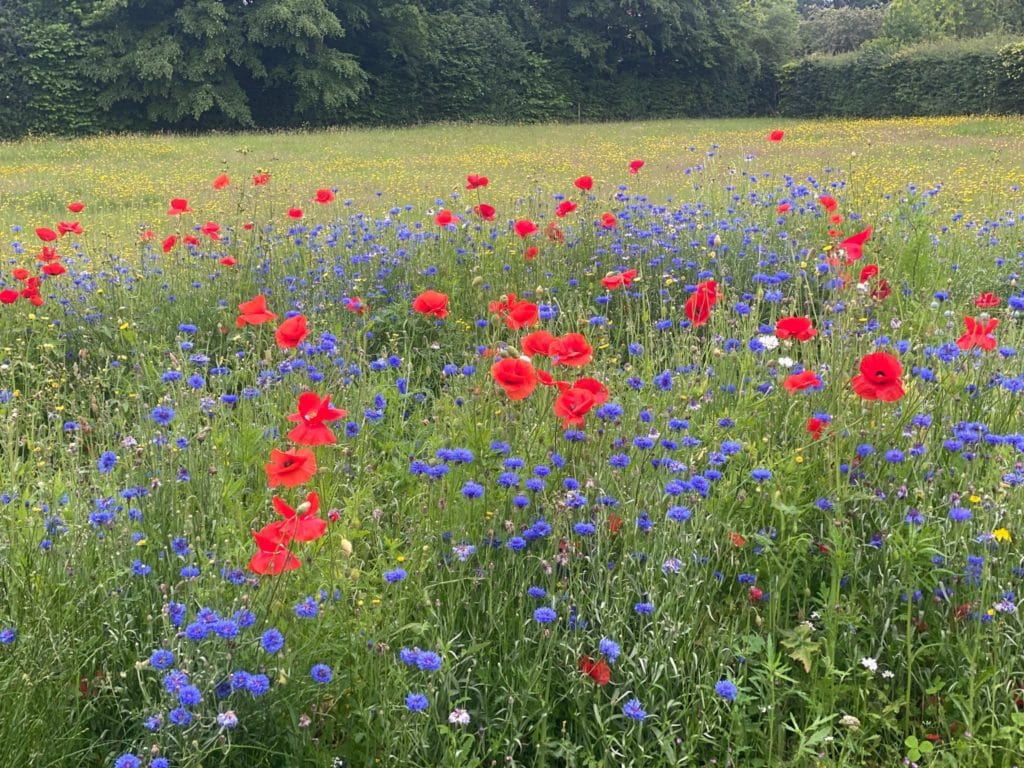
UK native wildflowers support insect species that have evolved alongside them. A patch of native planting, even a small one, supports significantly more wildlife than the same area of imported bedding. Reliable choices:
- Leucanthemum vulgare (oxeye daisy). Classic meadow daisy, May to September. Spreads gently, copes with poor soil. The backbone of any English meadow planting.
- Centaurea cyanus (cornflower). Vivid pure blue, an annual but a generous self-seeder. Now rare in the wild due to modern arable farming; growing them in gardens contributes to recovery.
- Geranium pratense (meadow cranesbill). Soft violet-blue saucer flowers in June. Native perennial that returns each year and gently spreads.
- Digitalis purpurea (foxglove). Tall pink-purple bell-shaped flowers in June. Biennial — produces leaves in year one and flowers in year two, then dies. Self-seeds prolifically, so the patch is self-perpetuating. Note: all parts are toxic if eaten; site away from areas used by very young children or pets.
- Papaver rhoeas (field poppy). Scarlet papery flowers in early summer. Annual but reliable self-seeder. Iconic, valuable to bees.
- Hesperis matronalis (sweet rocket). Lilac-purple or white flowers May to July, strongly scented at dusk. Excellent for moths.
For lawn-style wildflower areas, consider letting an existing lawn grow longer in summer (No Mow May and beyond) and overseeding with Trifolium repens (white clover), Lotus corniculatus (birds-foot trefoil) and Prunella vulgaris (selfheal). On bare ground, a wildflower mix from Emorsgate Seeds (the standard UK supplier) is the most reliable starting point.
Drought-tolerant Mediterranean planting
For sunny sites with sharp drainage (or improved gravel-based planting on top of heavy clay), Mediterranean perennials and shrubs need little to no summer water and flower generously. The contemporary garden-design movement of dry gardens (Beth Chatto’s gravel garden being the famous reference) has shown how rich these plantings can be.
- Lavandula angustifolia ‘Hidcote’ (AGM). English lavender — silver-grey foliage, deep purple flower spikes June to August, intense scent. Hardier and longer-lived than French lavender (L. stoechas). Grow as a clipped low hedge, in groups, or as drifts.
- Hylotelephium spectabile (formerly Sedum spectabile). Fleshy succulent leaves, flat plates of pink flowers August to October. The classic late-summer butterfly plant. ‘Brilliant’ (AGM) is the standard cultivar.
- Eryngium bourgatii. Sea holly — silvery-blue prickly thistle-like flowers from June to September. Architectural, drought-tolerant, valuable to bees.
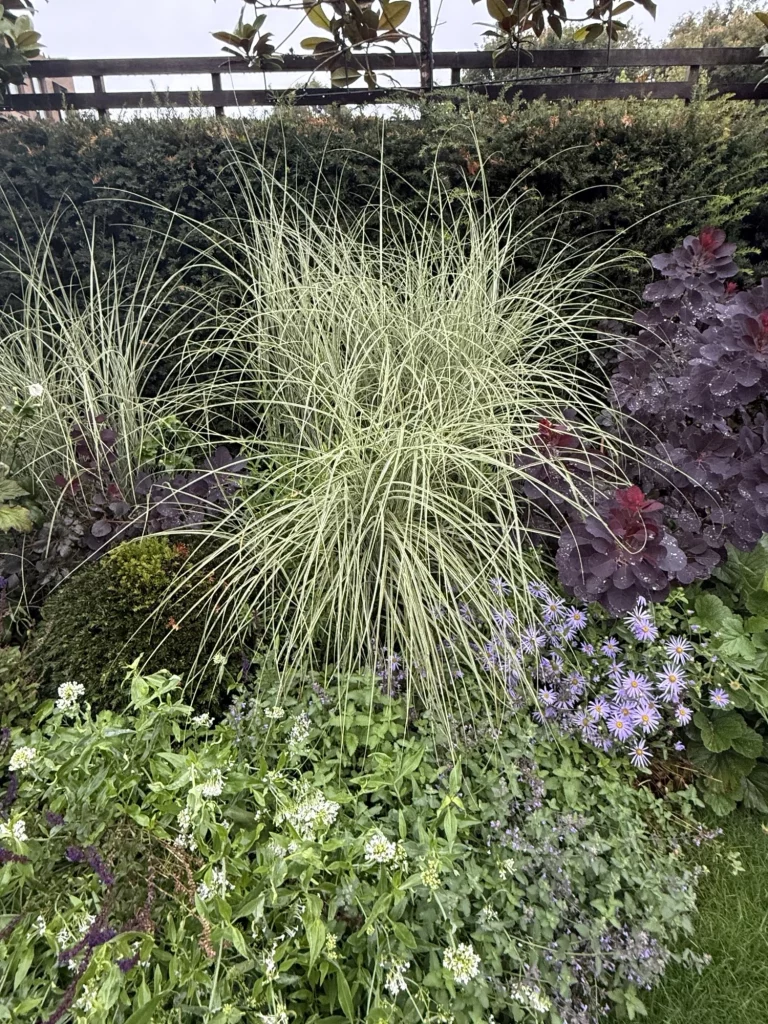
- Nassella tenuissima (formerly Stipa tenuissima). Mexican feather grass — soft hair-like silver-green grass, beautiful movement in the slightest breeze. Drought-tolerant. Cut back hard in late winter.
- Stipa gigantea (AGM). Golden oat grass — tall (2 m) airy panicles of golden flower-heads from June, catching low summer light beautifully. The signature grass of contemporary naturalistic planting.
- Phlomis russeliana. Whorls of soft yellow flowers on stout stems in summer, leaving sculptural seed heads through winter. Almost completely drought-tolerant.
- Cistus × argenteus ‘Sunset’. Compact rock rose with magenta-pink papery flowers in early summer. Drought-tolerant evergreen, brings useful structure.
- Calamintha nepeta. Tiny lavender-blue flowers in clouds from July to September. Bees love it. Drought-tolerant. The understated star of late-summer naturalistic borders.
Naturalising bulbs for spring colour
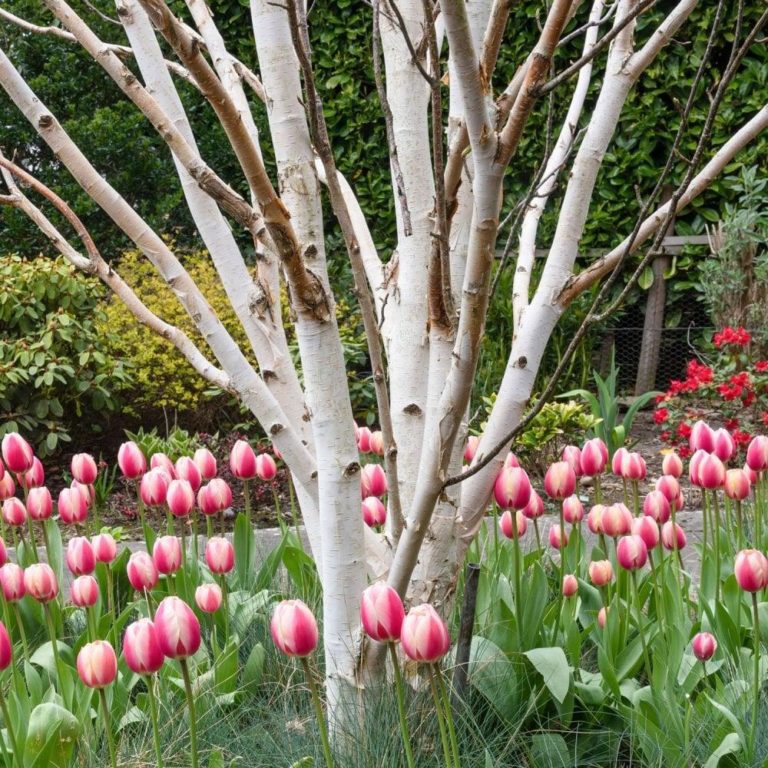
Spring bedding (wallflowers, pansies, polyanthus) does the same job that naturalising bulbs do for free year after year. Planted once in autumn, they multiply gently and reliably:
- Narcissus ‘Tête-à-tête’ (AGM), Narcissus ‘February Gold’ (AGM). Compact daffodils for the front of borders, lawns and pot displays. Increase year on year.
- Crocus tommasinianus (AGM). Early-flowering crocus naturalises beautifully into lawns and grass.
- Allium hollandicum ‘Purple Sensation’ (AGM). Drumstick purple flower heads in May-June. Bees and hoverflies love the flowers; the dried seed heads add structure for months after.
- Galanthus nivalis (AGM). Common snowdrop — flowers January-February, the earliest reliable colour of the year.
- Camassia leichtlinii. Tall blue spires May to June. Naturalises spectacularly in damp grass.
For more on bulb timing and technique see our autumn bulb planting guide.
How to make the transition
- Phase it. Don’t rip everything out at once. Replace one or two bedding areas with perennial planting each year. The transition feels less daunting and gives you time to see what works.
- Improve the soil first. Most domestic borders have been depleted by years of intensive bedding cycles. A generous autumn application of 50-75 mm of well-rotted compost makes a transformational difference to perennial establishment.
- Use peat-free compost. The UK’s peatlands store enormous amounts of carbon and host irreplaceable wildlife. Although the proposed ban on bagged peat sales to amateur gardeners stalled with the 2024 change of government, the RHS and major nurseries have moved to peat-free across most of their operations, and the environmental case is unchanged. Coir-based and bark-based composts perform well for most uses.
- Plant in drifts. Three, five or seven of the same plant grouped together looks intentional and provides a meaningful nectar resource. One of each of twenty different plants looks scattered and serves bees less well.
- Embrace self-seeders. Allow Verbena bonariensis, Digitalis purpurea, Knautia macedonica, Erigeron karvinskianus and Centaurea cyanus to scatter their seed and edit the seedlings the following spring. This is how the most beautiful naturalistic gardens are built up over time.
- Plant once in autumn or early spring. Late September to November is the ideal window for planting perennials and shrubs; the soil is still warm enough for root establishment but the plant isn’t under heat stress. Spring (March-April) is the second-best window.
- Mulch annually. A 50-75 mm autumn mulch of composted bark or well-rotted compost suppresses weeds, conserves moisture, feeds the soil, and removes the need for chemical fertilisers entirely.
Beyond planting
Sustainable planting is one part of a wider picture. Other measures that significantly increase a garden’s environmental value:
- A small pond. Even a 1 m diameter water feature with shallow margins supports frogs, newts, dragonflies and a host of invertebrates. The single most valuable wildlife addition to a typical garden.
- A rain garden or soakaway. Sustainable Urban Drainage features that capture roof runoff before it overwhelms drains. See our flooded garden guide for design principles.
- Compost on site. A simple New Zealand bin or compost tumbler turns garden and kitchen waste into excellent free soil improver. Closes the loop and removes the need to import compost.
- Native hedging instead of fencing. A mixed native hedge (Crataegus monogyna, Prunus spinosa, Acer campestre, Corylus avellana) provides nesting habitat, food for invertebrates and structure for the garden.
- Reduce lawn area. The traditional close-mown lawn has little ecological value. Reducing its size, mowing it less often, and overseeding with clovers and wildflowers can transform its contribution to garden biodiversity.
- Leave winter structure. Don’t cut perennials back in autumn; leave seed heads and hollow stems through winter to feed birds and shelter invertebrates. Cut back in late February instead.
Frequently asked questions
Are perennials really better for pollinators than bedding plants?
Generally yes, but it depends on the variety. Single-flowered perennials and native wildflowers offer accessible nectar and pollen. Some F1 hybrid bedding plants (particularly double-flowered varieties) have been bred for visual display at the expense of accessible reward, which means bees and other pollinators get little from them. Single-flowered bedding such as Lobularia maritima (sweet alyssum) and certain pelargoniums genuinely do support pollinators. As a rule of thumb: if you can see the centre of the flower easily, bees probably can too.
Is peat-free compost legally required now?
Not currently. The UK Government announced in 2022 that the sale of bagged peat compost to amateur gardeners would be banned by end of 2024. The legislation didn’t pass before the 2024 General Election and remains stalled. However, the RHS and most major UK nurseries have moved to peat-free across their operations, and the environmental case is unchanged regardless of legislation. UK peatlands are the country’s largest carbon store; extracting peat for horticulture releases significant amounts of stored CO2. Coir-based and bark-based peat-free composts perform well for most domestic uses.
Won’t my garden look bare in winter without bedding?
Not if the planting scheme is designed properly. Evergreen structure (Buxus sempervirens, Taxus baccata, Pittosporum, well-chosen Hebe), winter-flowering shrubs (Sarcococca confusa, Hamamelis, Viburnum × bodnantense), and the seed heads of perennials left standing through winter (Phlomis, Echinacea, ornamental grasses) carry the garden through. See our winter gardening guide for more on the planting that holds the garden together from November to March.
How long does it take to establish a perennial scheme?
The traditional rule is “year one they sleep, year two they creep, year three they leap”. Most perennials look modest in their first season after planting, fill out visibly in year two, and reach maturity in year three. By year five they need their first divisions to keep them vigorous. This contrasts with bedding, which delivers full visual impact instantly but starts the cycle again every season.
Can I still have summer pots and hanging baskets?
Absolutely. Pots and hanging baskets are exactly where bedding plants make most sense: short-term, contained, easy to manage. The case in this guide is against using bedding as the default approach to a whole garden border, not against bedding entirely. If you want a more sustainable approach to your pots, use peat-free compost, prioritise single-flowered pollinator-friendly bedding (single petunias, Lobularia, single dahlias), and consider perennial bedding alternatives such as Erigeron karvinskianus, perennial geraniums, and small ornamental grasses that can be planted out into the garden at the end of the season rather than composted.
Are wildflowers really easy to grow, or is that a myth?
Mostly easy, with some caveats. Wildflower meadows need low-fertility soil — the opposite of what most domestic borders have, which is rich, fed soil. On rich soil, the vigorous grasses outcompete the wildflowers within a couple of seasons. The standard fix is to remove the top 15 cm of topsoil from the area you want as wildflower meadow, or to sow yellow rattle (Rhinanthus minor) which parasitises grasses and reduces their vigour. On a small scale, a wildflower border within a managed garden is much easier than a meadow, but still benefits from being on the leaner part of the plot. Or simply embrace self-seeders within an otherwise traditional border, which is how most informal English gardens have always worked.
Related pages
- Low-maintenance gardens: garden design that needs less watering, replanting and upkeep
- Summer flowering plants: perennials that keep borders in colour through the summer
- Refreshing your borders: a naturalistic planting approach for tired borders
- Planting design and installation: planting plans, plant supply and planting carried out for you
Let’s plan a planting scheme that lasts
Flourish Landscaping designs and plants gardens across Kingston, Surbiton, Richmond, Esher and the wider Surrey area, with sustainable perennial schemes at the heart of how we work. See our planting design and installation service, our drought-tolerant planting guide, or our low-maintenance gardens service for related reading.
Contact us to arrange a consultation.
Written by Craig Davis BSc (Hons) Horticulture, member of the Chartered Institute of Horticulture. Craig has over 40 years in horticulture: in the family business since the age of 13 and a horticulture graduate since 1992, he designs, builds and plants gardens across Kingston, Surrey and South West London.
Good to know
Frequently asked questions
Generally yes, but it depends on the variety. Single-flowered perennials and native wildflowers offer accessible nectar and pollen. Some F1 hybrid bedding plants (particularly double-flowered varieties) have been bred for visual display at the expense of accessible reward, which means bees and other pollinators get little from them. Single-flowered bedding such as Lobularia maritima (sweet alyssum) and certain pelargoniums genuinely do support pollinators. As a rule of thumb: if you can see the centre of the flower easily, bees probably can too.
Not currently. The UK Government announced in 2022 that the sale of bagged peat compost to amateur gardeners would be banned by end of 2024. The legislation didn't pass before the 2024 General Election and remains stalled. However, the RHS and most major UK nurseries have moved to peat-free across their operations, and the environmental case is unchanged regardless of legislation. UK peatlands are the country's largest carbon store; extracting peat for horticulture releases significant amounts of stored CO2. Coir-based and bark-based peat-free composts perform well for most domestic uses.
Not if the planting scheme is designed properly. Evergreen structure (Buxus sempervirens, Taxus baccata, Pittosporum, well-chosen Hebe), winter-flowering shrubs (Sarcococca confusa, Hamamelis, Viburnum x bodnantense), and the seed heads of perennials left standing through winter (Phlomis, Echinacea, ornamental grasses) carry the garden through.
The traditional rule is 'year one they sleep, year two they creep, year three they leap'. Most perennials look modest in their first season after planting, fill out visibly in year two, and reach maturity in year three. By year five they need their first divisions to keep them vigorous. This contrasts with bedding, which delivers full visual impact instantly but starts the cycle again every season.
Absolutely. Pots and hanging baskets are exactly where bedding plants make most sense: short-term, contained, easy to manage. The case in this guide is against using bedding as the default approach to a whole garden border, not against bedding entirely. If you want a more sustainable approach to your pots, use peat-free compost, prioritise single-flowered pollinator-friendly bedding (single petunias, Lobularia, single dahlias), and consider perennial bedding alternatives such as Erigeron karvinskianus, perennial geraniums, and small ornamental grasses.
Mostly easy, with some caveats. Wildflower meadows need low-fertility soil - the opposite of what most domestic borders have, which is rich, fed soil. On rich soil, the vigorous grasses outcompete the wildflowers within a couple of seasons. The standard fix is to remove the top 15 cm of topsoil from the area, or to sow yellow rattle (Rhinanthus minor) which parasitises grasses and reduces their vigour. On a small scale, a wildflower border within a managed garden is much easier than a meadow.