Planning your perfect garden
How to plan a garden that really works for your space and lifestyle.
Every garden project starts with the same handful of questions, and the clients who get the most from their gardens are usually the ones who’ve thought through these answers before the first site visit. This guide covers the five questions worth working through in advance, plus realistic context on budgets, timelines and what to expect from the design process. For a wider look at the design fundamentals themselves, see our garden styles guide; this post is about preparing for your first conversation with a landscape designer.
A good designer or landscaping team will walk you through these questions in any case. Coming with answers in mind makes the first site visit far more productive and lets the conversation focus on what’s possible rather than what you want.
1. What do you want to use the garden for?
The most important question. A garden designed for entertaining looks very different to one designed for quiet reflection, and trying to combine every use case in a small London garden produces compromises everywhere. Pick the two or three uses that genuinely matter to you:
- Outdoor dining and entertaining. A defined dining area large enough for the table you actually want (3.5 x 4.5 m for 6-8 people including chair pull-out), proper paving, sometimes a pergola or louvred roof for weather protection, lighting and often a fridge or grill.
- Quiet relaxation. A sheltered corner with comfortable seating, deeper planting around it for enclosure, perhaps the sound of moving water, lower lighting levels.
- Children and pets. Robust lawn, sightlines from the house, no toxic plants near play areas, durable hard landscape, and a clear distinction between play zones and adult planting areas.
- Growing vegetables, herbs or cut flowers. Raised beds in the sunniest position (ideally south-facing), water within easy reach, and proximity to the kitchen door.
- Wildlife and nature. Native and pollinator-friendly planting, a small pond or wildlife pool, log piles, areas left deliberately less tidy.
- A view from the house. Most UK gardens are looked at from indoors more than they’re used. The view from the kitchen window and main living spaces deserves dedicated thought.
Be honest about how you actually live. Many clients design for the entertaining they imagine doing rather than the morning coffee, dog walks and afternoon-with-a-book that fill most days.
2. Who uses the garden and how does that change over time?
- Young children. Visibility from the kitchen, soft fall-zone surfaces under play equipment, robust lawn, avoiding toxic plants (Taxus baccata, Digitalis purpurea, Aconitum, Euphorbia) near play zones, and built-in flexibility for the next decade as the children grow.
- Older children and teenagers. Trampolines, basketball hoops, hammocks, a corner of their own. A sunken trampoline is far less visually intrusive than an above-ground one.
- Dogs. Durable lawn or artificial turf in heavy-use zones, low planting that won’t be flattened, a sheltered spot, no toxic plants, and (if your dog likes to dig) a designated digging area filled with sand.
- Older relatives or accessibility needs. Gentle gradients of 1:20 or less, level paths at least 1.2 m wide with non-slip surfaces, generous handrails on steps, raised beds at 600-750 mm height for accessible gardening, and lighting that handles reduced night vision.
- Year-round use. Pergolas or louvred roofs for shelter, an outdoor fireplace or fire pit, low-voltage lighting throughout, evergreen structure to carry winter, and patio heaters where genuinely useful.
Garden design should also accommodate change. A play space for under-fives needs to evolve into a teenager-friendly space, and eventually into something more adult. The best designs build that adaptability in from the start.
3. What style suits you and the house?
A garden style works when it sits well alongside the house it’s attached to. A contemporary minimalist scheme against a Victorian terrace usually looks awkward; a soft cottage planting against a sharp-edged modern extension can read as a mismatch. The strongest projects find common ground between what you love and what the house naturally supports. Common style directions:
- Contemporary clean-lined. Porcelain or smooth-sawn natural stone paving, rendered walls in soft greys, crisp clipped evergreens (Buxus sempervirens, Taxus baccata, Pittosporum tobira), restrained planting palette, integrated low-voltage lighting. Works particularly well with modern extensions and contemporary houses.
- Classic English / cottage. Curved beds spilling onto stone or brick paving, overflowing planting, mixed roses, perennials and biennials with self-seeders adding informality (Geranium, Alchemilla mollis, Digitalis purpurea, Aquilegia), occasional standing-stone features. Suits period properties and softens harder architecture.
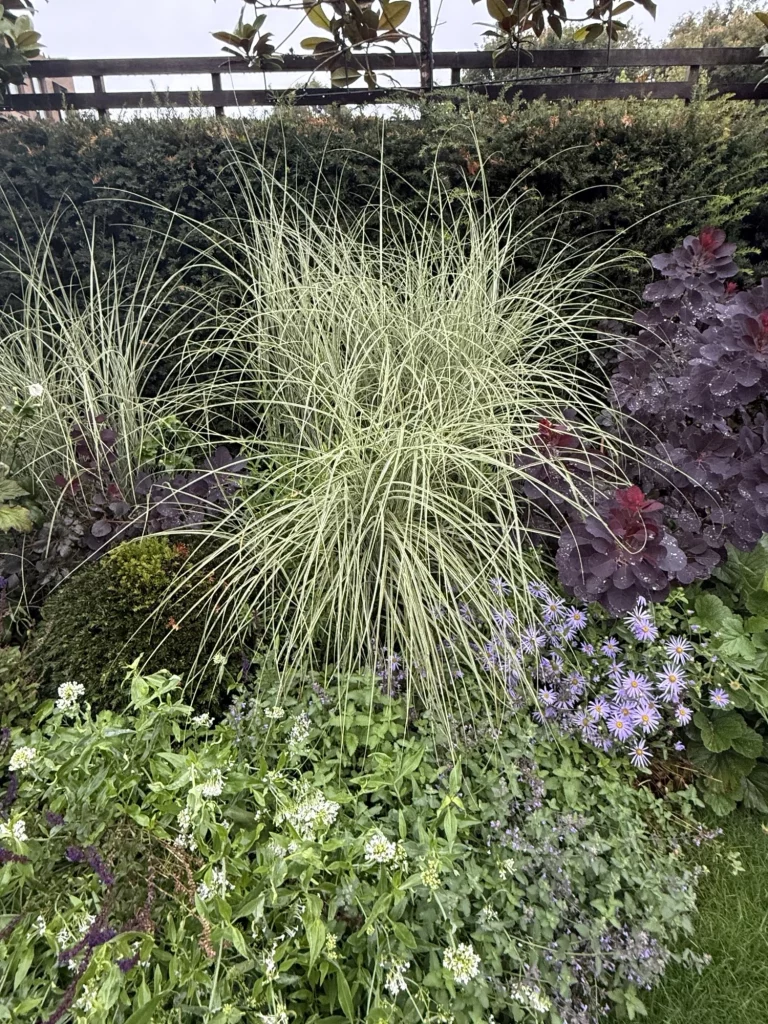
- Naturalistic / prairie. Drifts of ornamental grasses (Calamagrostis × acutiflora ‘Karl Foerster’, Stipa gigantea, Miscanthus) interwoven with bold perennials (Echinacea, Rudbeckia, Verbena bonariensis, Echinops), gravel or buff-coloured paving. Long flowering season, exceptional wildlife value, beautiful in winter.
- Mediterranean / dry-garden. Gravel surfaces, terracotta, drought-tolerant Mediterranean planting (Lavandula, Rosmarinus, Cistus, Phlomis, Salvia rosmarinifolia, Stipa tenuissima), sun-baked corners. Requires sharp drainage; not for shady or wet sites.
- Japanese-inspired. Restraint, considered placement, evergreen structure, raked gravel, water, Acer palmatum, Phyllostachys bamboos, moss. Suits small contemplative gardens and courtyards particularly well.
If you’re not sure, a Pinterest board, Instagram saved-posts collection, or a folder of phone photographs of gardens you’ve liked is invaluable. Save not only the images you love but also a few you actively dislike. A good designer learns as much from what to avoid as from what to include.
4. How much maintenance are you genuinely up for?
The single most common reason gardens disappoint over time is a mismatch between the design ambition and the realistic maintenance commitment. Be honest:
- Low-maintenance lover (under 2 hours a week). Evergreen structure, drought-tolerant planting, mulched borders, robust hard landscape, automated irrigation. Mediterranean and contemporary minimalist gardens work well; cottage gardens really don’t.
- Moderate gardener (3-5 hours a week). Most styles workable. Mixed borders with shrubs, perennials and bulbs; modest lawn; pots that you enjoy refreshing seasonally.
- Keen gardener (5+ hours a week). Full cottage gardens, vegetable beds, traditional rose gardens, mixed deep borders that need constant editing – all open to you, with the right plants delivering year-round interest.
- Will hire help. A maintenance contract from a landscaping company (typically £80-200 per visit depending on garden size and frequency) means you can have a more ambitious garden than your own hours would allow.
Specific decisions worth thinking through:
- Real lawn or artificial turf? Real lawn is better for wildlife, drainage, microclimate and most properties’ look. Artificial turf is durable and low-maintenance but doesn’t support wildlife, contributes microplastic shedding, becomes hot in summer, and ages noticeably over 8-10 years. We generally prefer real lawn except in specific high-traffic zones where it genuinely fails.
- Seasonal-interest borders or evergreen structure? Most gardens need both. Evergreens carry winter; seasonal planting carries the rest of the year. The right balance depends on style and maintenance preference.
- Composite or natural materials? Composite decking is durable and low-maintenance but reads as plastic close up; natural stone and timber age beautifully but need more care. Mixed approaches work: composite where heavy use, natural where seen.
- Irrigation system. An automated drip system serving borders and pots adds £1,500-4,000 to a typical project but means established plants stay healthy in summer without daily watering. Increasingly essential as UK summers grow hotter.
5. What is your budget range?
The question clients are most reluctant to engage with, and the one that most affects everything else. Honest budget conversations early on save time and avoid disappointment for both parties. As a 2026 Surrey guide for typical residential gardens of around 100-150 sq m:
- £5,000-15,000. Targeted improvements: a new patio, a section of fencing, planting overhaul on existing beds, lawn renovation. Best approached as one or two clearly-defined projects rather than a whole-garden redesign.
- £15,000-35,000. Significant transformation of part of the garden: new patio, structure or pergola, fencing, planting and lighting in a coherent scheme.
- £35,000-75,000. Full small-to-medium garden redesign including hard landscaping, new structures, comprehensive planting, lighting and irrigation. The most common range for ambitious whole-garden Kingston and Surbiton projects.
- £75,000-150,000+. Larger gardens, bespoke joinery, substantial water features, mature specimen planting, premium materials throughout, integration with house extensions or basement light wells.
These are guide figures only; every project is different. The factors that move costs are: specification of paving materials (Indian sandstone vs porcelain vs natural Yorkstone), level of bespoke joinery (off-the-shelf vs purpose-made pergolas and screens), size of specimen plants (small whips vs mature instant-impact specimens), site access (rear-garden access through a narrow side passage adds significant labour), and ground conditions (heavy clay or high water table requires more sub-base and drainage work).
Phasing is the standard route for larger ambitions on tighter budgets. Year one: hard landscape and structure. Year two: planting and lighting. Year three: refinements and additions. The garden grows with the investment rather than waiting for the full budget to be available.
What to expect from the design process
- Site visit and brief discussion. Usually free for an initial conversation. We walk the garden, talk through the five questions above, and discuss whether we’re likely to be the right fit. Allow 60-90 minutes.
- Survey and design. An accurate measured survey, scale drawings, planting plans, materials specifications. Design fees for a residential project typically run £1,500-6,000 depending on garden size and complexity. Allow 4-8 weeks for the design stage.
- Detailed quotation. Once the design is signed off, a fully-itemised quotation for the build. Allow 1-3 weeks.
- Build. Hard landscape, structures, planting and lighting installed in sequence. A typical full-garden project takes 4-12 weeks on site depending on scope and weather. Spring and summer are busy seasons; winter slots are usually available with shorter lead times.
- Aftercare. Planting establishment usually takes a full year. A maintenance contract for the first 12-24 months protects the investment while the garden settles.


Frequently asked questions
How much does a full garden redesign cost?
For a typical Kingston or Surbiton garden of 100-150 sq m, a full design-and-build project most commonly runs £35,000-75,000 in 2026, covering hard landscaping, new structures, comprehensive planting, lighting and irrigation. Smaller targeted projects (a new patio, fencing overhaul, planting refresh) work from £5,000-15,000. Larger gardens, bespoke joinery, mature specimen planting and premium materials push projects into the £75,000-150,000+ range. The biggest cost drivers are paving specification, site access, ground conditions, and the size of specimen plants.
Do I need to know exactly what I want before contacting a designer?
Not at all. You need a sense of direction across the five questions: what you want to use the garden for, who uses it, what styles you’re drawn to, your realistic maintenance commitment, and your budget range. Specifics emerge through the design process. A good designer will translate your preferences into a coherent scheme; what you need to provide is honest input on priorities and constraints.
Should I have real lawn or artificial turf?
We generally recommend real lawn for most domestic gardens. Real lawn is better for wildlife, supports soil ecology, helps drainage and cooling, and looks right for most properties. Artificial turf is durable and low-maintenance but doesn’t support wildlife, contributes microplastic shedding, becomes uncomfortably hot in summer sun, and visibly ages over 8-10 years. The exceptions where artificial turf can make sense are specific high-traffic zones (small heavily-used areas in shade where real lawn genuinely fails) or rooftop and balcony installations where soil isn’t practical.
How long does a garden redesign take from first contact to finished garden?
Typically 6-12 months end to end. The design stage is 4-8 weeks; detailed quotation 1-3 weeks; a build of 4-12 weeks on site depending on scope. The biggest variable is when in the year you start. Projects starting in winter (November-February) can be designed in the quiet months and built in spring with optimal planting and finishing conditions. Projects starting in late spring or summer often run into the following autumn. Planning ahead is the single best thing you can do to control timing.
Can I do the project in phases?
Yes, and many ambitious gardens are built this way. A typical phasing is: year one for the hard landscape and structures (patio, walls, fencing, pergola, lighting infrastructure), year two for the planting and lighting installation, year three for refinements and additional features. Phasing means you spread the cost without compromising the eventual result, and lets the garden grow with the investment. Critical: the design must be developed as a single coherent vision before any phase begins, otherwise later phases tend not to integrate well.
When is the best time to start a garden project?
For design and planning conversations, winter (November-February) is the best time. Designers and landscape contractors are less booked; you have time for the design stage; materials and specimen plants can be ordered ahead of the spring rush; and the underlying structure of the garden is visible. For the build, late winter to early spring is ideal: hard landscape is built when planting is dormant, then planting goes in just as the new growing season starts. Late autumn (October-November) is also strong for planting, with bare-root opportunities and soil still warm enough for root establishment.
Related pages
- Garden designs and plans: how our design stage turns your answers into a measured plan
- Awkward garden types: layout ideas for long, narrow, sloping and other tricky plots
- Garden costs: what affects the price of a garden project in Kingston and Surbiton
- Flourish Sun Planner: check how sun and shade move across your plot before you plan
- Our landscaping projects: finished gardens across Kingston, Surbiton and Surrey
Let’s talk about your project
If the five questions in this post are getting you thinking about your own garden, we’d be glad to take the conversation further. Flourish Landscaping handles design, build, planting, lighting and aftercare in-house, working across Kingston, Surbiton, Richmond, Esher and the wider Surrey area. See our garden design and build service for the way we work, our garden styles guide for the fundamentals of garden design, or our garden design and planning service for the longer view.
Contact us to arrange a consultation and start the conversation.
Written by Craig Davis BSc (Hons) Horticulture, member of the Chartered Institute of Horticulture. Craig has over 40 years in horticulture: in the family business since the age of 13 and a horticulture graduate since 1992, he designs, builds and plants gardens across Kingston, Surrey and South West London.
Good to know
Frequently asked questions
For a typical Kingston or Surbiton garden of 100-150 sq m, a full design-and-build project most commonly runs £35,000-75,000 in 2026, covering hard landscaping, new structures, comprehensive planting, lighting and irrigation. Smaller targeted projects (a new patio, fencing overhaul, planting refresh) work from £5,000-15,000. Larger gardens, bespoke joinery, mature specimen planting and premium materials push projects into the £75,000-150,000+ range. The biggest cost drivers are paving specification, site access, ground conditions, and the size of specimen plants.
Not at all. You need a sense of direction across the five questions: what you want to use the garden for, who uses it, what styles you're drawn to, your realistic maintenance commitment, and your budget range. Specifics emerge through the design process. A good designer will translate your preferences into a coherent scheme; what you need to provide is honest input on priorities and constraints.
We generally recommend real lawn for most domestic gardens. Real lawn is better for wildlife, supports soil ecology, helps drainage and cooling, and looks right for most properties. Artificial turf is durable and low-maintenance but doesn't support wildlife, contributes microplastic shedding, becomes uncomfortably hot in summer sun, and visibly ages over 8-10 years. The exceptions where artificial turf can make sense are specific high-traffic zones (small heavily-used areas in shade where real lawn genuinely fails) or rooftop and balcony installations where soil isn't practical.
Typically 6-12 months end to end. The design stage is 4-8 weeks; detailed quotation 1-3 weeks; a build of 4-12 weeks on site depending on scope. The biggest variable is when in the year you start. Projects starting in winter (November-February) can be designed in the quiet months and built in spring with optimal planting and finishing conditions. Projects starting in late spring or summer often run into the following autumn. Planning ahead is the single best thing you can do to control timing.
Yes, and many ambitious gardens are built this way. A typical phasing is: year one for the hard landscape and structures (patio, walls, fencing, pergola, lighting infrastructure), year two for the planting and lighting installation, year three for refinements and additional features. Phasing means you spread the cost without compromising the eventual result. Critical: the design must be developed as a single coherent vision before any phase begins, otherwise later phases tend not to integrate well.
For design and planning conversations, winter (November-February) is the best time. Designers and landscape contractors are less booked; you have time for the design stage; materials and specimen plants can be ordered ahead of the spring rush; and the underlying structure of the garden is visible. For the build, late winter to early spring is ideal: hard landscape is built when planting is dormant, then planting goes in just as the new growing season starts. Late autumn (October-November) is also strong for planting.