Garden privacy
Smart ways to screen your garden without blocking out light.
Garden privacy is the single most-requested brief we receive across the Kingston, Surbiton, Richmond and Coombe area. Densely built Edwardian and Victorian streets, neighbouring loft conversions, and the slow creep of overlooking first-floor extensions have made the question urgent. The honest answer is that there is no single ‘best’ privacy solution. The right approach depends on what you are screening, how soon you need it, your budget, and whether you can live with planning permission limits.
This guide sets out the practical privacy options that actually work, in the order they should be considered. We have intentionally left out the gimmicks (smart glass fencing, coloured acrylic panels, motorised retractable screens) and focused on what good gardens use: hedges, pleached trees, slatted timber, climbers, pergolas, and the layered combinations that work best.
Start by asking the right question
Before specifying anything, work out precisely what you are screening. The answer changes the solution entirely:
- Ground-level views from a neighbouring garden. A 1.8 to 2 m fence solves this entirely. The simplest case.
- First-floor overlooking from a neighbouring house. A fence cannot reach this; you need a hedge, pleached tree or strategically placed standard tree at around 3 to 4 m clear stem.
- Second-floor overlooking from a loft conversion. The hardest case. Pleached trees with 2 m clear stem and dense canopy, or evergreen trees positioned in the right line of sight, are the only realistic answers.
- Traffic or street noise. Visual screens do almost nothing for noise. Acoustic privacy requires either mass (a solid wall) or distraction (a moving water feature). More on both below.
- Front garden privacy from passers-by. Different rules apply (1 m fence height limit near the highway), and the solution is usually planting plus a low boundary.
Planning permission and boundary rules
The single most important number to know: fences and walls can be built up to 2 m on rear and side boundaries without planning permission, and up to 1 m where the boundary fronts a highway. Anything higher needs consent from the local planning authority. Trellis on top of a 2 m fence counts toward the total height. Trees, by contrast, have no statutory height limit and need no permission, which is why pleached trees and standard trees are the standard solution for first-floor overlooking.
A separate consideration: the High Hedges Act 2005 allows neighbours to complain to the council about evergreen hedges over 2 m where they cause loss of light. Worth being neighbourly about hedge height in tight London plots.
Living screens: evergreen hedges
A well-chosen hedge is the most beautiful and durable privacy solution, but the right species varies enormously by site, aspect and soil. Common UK options, with honest notes:
- Taxus baccata (English yew). The gold-standard formal evergreen hedge. Tolerates clipping into precise lines, lives for centuries, copes with shade. Slow-growing (200 to 250 mm a year), so it’s an investment plant, not a quick fix. Toxic to grazing animals so unsuitable next to paddocks.
- Carpinus betulus (Hornbeam). The default in our area. Technically deciduous but marcescent (holds dead bronze leaves through winter), so retains screening year-round. Faster than yew (around 400 mm a year) and tolerates heavy London clay better than beech.
- Fagus sylvatica (Beech). Similar marcescent winter cover with richer copper-bronze winter leaves. Needs better drainage than hornbeam; struggles on waterlogged clay.
- Prunus laurocerasus (Cherry laurel). Fast (500 to 600 mm a year), reliable, large glossy leaves, tolerates shade and clay. The right hedge when speed is the priority. The downside is a slightly suburban look in some cultivars; specify ‘Caucasica’ or ‘Genolia’ for a more refined appearance.
- Prunus lusitanica (Portuguese laurel). The more elegant laurel: smaller leaves, darker green, neater form. Holds an RHS Award of Garden Merit and one of our most-specified hedges.
- Ligustrum ovalifolium (Garden privet). The traditional London hedge. Semi-evergreen rather than fully evergreen, fast-growing, takes hard pruning. Often dismissed as old-fashioned, but the right choice in many classic London settings.
- Photinia × fraseri ‘Red Robin’. Scarlet-red new growth on glossy evergreen foliage. A more decorative choice. Needs good drainage; struggles on heavy clay without amendment.
- Elaeagnus × ebbingei. Tough, fast, evergreen, with subtle silver undersides and fragrant autumn flowers. The reliable workhorse for difficult sites.
- Griselinia littoralis. Apple-green, soft-textured evergreen. Reads as a more contemporary, coastal alternative to laurel. Less hardy than the others; needs a sheltered position in cold winters.
For instant-effect hedging, root-balled or container-grown plants at 1.5 to 2 m can be supplied at planting; expect to pay a premium per metre for instant hedge versus three years of cheaper bare-root growth.
Living screens: pleached trees for first-floor overlooking
When the problem is a first-floor window looking into your garden, a fence cannot help and a hedge takes too long. Pleached trees solve this. A pleached tree has a clear trunk to 1.8 to 2.2 m, with branches trained flat onto a rectangular frame above, giving a continuous green panel between roughly 2 m and 4 m above ground. Think of it as a hedge on stilts. The standard species are Carpinus betulus, Quercus ilex (holm oak, evergreen), Tilia cordata (small-leaved lime) and Photinia × fraseri. For the full guide see our pleached trees post.
Living screens: climbers and vertical greening
A trellis or wire system on a 2 m fence, clothed with climbers, can lift the visual barrier to 3 m or more (provided the structure itself is not above 2 m of solid panel). The climbers that work hardest for privacy:
- Trachelospermum jasminoides (star jasmine). Evergreen, fragrant white summer flowers, tolerant of London conditions. The contemporary go-to evergreen climber.
- Clematis armandii. Evergreen, scented spring flowers, vigorous. A fast-establishing climber that covers a trellis in two seasons.
- Hedera helix (common ivy). Truly evergreen, self-clinging on walls (so trellis is optional), shade-tolerant. Native, and excellent for wildlife. The single most reliable green-wall plant in UK gardens.
- Wisteria sinensis. Deciduous but architecturally spectacular. Best on substantial structures (pergolas, walls); not ideal on a flimsy trellis as it gets very heavy with age.
- Lonicera periclymenum (native honeysuckle). Deciduous but extremely wildlife-friendly. Scented summer flowers, autumn berries for birds.
- Climbing roses. Rosa ‘Madame Alfred Carrière’ (creamy white, repeat-flowering) and Rosa ‘New Dawn’ (pale pink) are both reliable choices on north-facing walls. Deciduous, but the structure of the canes provides some winter screening.
A note on bamboo (and which to avoid)
Bamboo gives instant tropical-looking screening, but it comes with a critical caveat. Bamboos fall into two categories:
- Clumping bamboos (Fargesia species). Safe. They form a tidy clump and stay put. Fargesia rufa and Fargesia murielae are the reliable garden choices. Hardy, evergreen, well-behaved.
- Running bamboos (Phyllostachys, Pleioblastus, Pseudosasa). A serious problem. Their underground rhizomes spread aggressively, can damage building foundations and drainage, and have been treated by the courts as analogous to Japanese knotweed in some neighbour disputes. Never plant a running bamboo without a properly installed root barrier 600 mm deep, and even then with caution.
If the nursery cannot confirm which genus a bamboo belongs to, do not plant it. The advice we give clients is simple: clumping Fargesia or nothing.
Built screens: fencing options
Slatted hardwood fencing
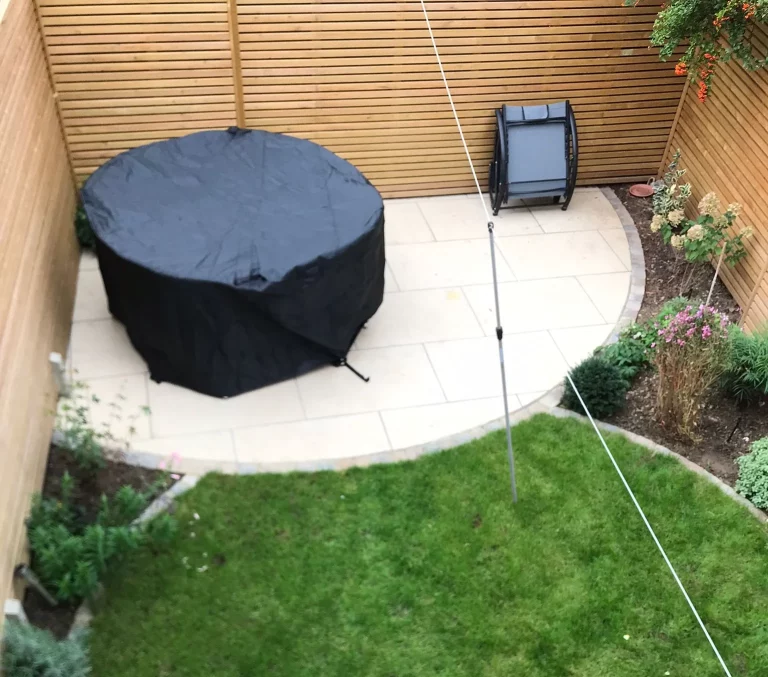
The dominant contemporary boundary style. Horizontal cedar, larch or thermally modified ash battens fixed at a small spacing (typically 10 to 20 mm gaps) to a vertical structural frame. The visual effect is a rhythmic, contemporary panel that filters rather than fully blocks views, allows airflow, and reads beautifully when stained dark or left to silver naturally. Substantially more expensive than closeboard but pays back in longevity and visual quality.
Closeboard and feather-edge
The traditional and most affordable solid-fence option. Vertical feather-edge boards on horizontal arris rails between concrete or timber posts. Gives complete ground-level privacy. Specify concrete gravel boards (the bottom 150 mm rotting first is the most common failure mode) and pressure-treated timber for longevity. A well-built closeboard fence on concrete-posted foundations lasts 15 to 20 years.
Trellis topping
A 300 to 450 mm trellis topping on a 2 m fence raises the visual barrier to around 2.4 m at most (within planning rules, since trellis counts toward total height). Clothed with climbers, this raises the effective screen to 3 m or more without breaching the planning limit on solid mass.
Decorative panels
For accent panels (typically beside dining areas, water features or focal points), laser-cut Corten steel or powder-coated steel screens add architectural interest with partial transparency. Woven willow hurdles, hazel hurdles and reed panels provide a softer, traditional alternative. Both work best in moderation; a whole garden enclosed in patterned panels reads as fussy.
For more detail on fence styles, planning permission and construction, see our fencing and screening service page.
Built screens: walls
For maximum durability and acoustic insulation, a built wall outperforms any fence. London stock brick (sympathetic to most of the local Victorian and Edwardian housing) and rendered blockwork are the two standard choices. A wall takes a serious foundation (typically 450 mm wide concrete strip footings, 600 mm deep below finished ground level on clay) and proper engineering above 1.2 m. Cost roughly four to five times a closeboard fence per linear metre, but lifespan is essentially permanent. Walls also support climbers, espaliered fruit trees and wall shrubs better than any fence.
Overhead privacy: pergolas and structures
For overlooked dining or seating areas, an overhead structure (pergola, sail or canopy) deals with the line of sight from above. A timber or steel pergola clothed in Wisteria, Vitis vinifera ‘Purpurea’, or grape vines gives substantial mid-summer screening overhead while remaining open enough to feel inviting. Outdoor curtains on a pergola add lateral privacy when wanted and pull back when not. Louvred pergolas with adjustable slats (Renson, Corradi and similar systems) offer instant, controllable privacy and have become a popular choice on contemporary projects.
Sound privacy: managing noise
Be honest about what is achievable. A fence or hedge does very little for traffic noise. Mass (a solid brick wall) gives roughly 10 to 15 dB of attenuation; a dense planted hedge gives 2 to 5 dB at most. The genuinely effective acoustic intervention in a domestic garden is distraction: a moving water feature provides a pleasant masking sound that draws attention away from background traffic noise.
- Bubbling fountains and pebble pools. The lowest-maintenance option; a small sealed reservoir with a recirculating pump.
- Wall-mounted spouts. Discreet, contemporary, ideal for courtyards and patios.
- Cascading rills. Linear water features running along the edge of a terrace; architectural and visually striking.
- Ponds and reflective pools. Quieter (still water, not flowing), so contribute little to acoustic masking; their privacy benefit is visual and ornamental rather than acoustic.
The layered approach
The best privacy solutions are almost always layered. A typical specification for a heavily overlooked Surrey garden:
- A 1.8 m closeboard or slatted fence on the boundary (handles ground-level overlooking)
- A 300 mm trellis topping clothed with Trachelospermum jasminoides (lifts the effective barrier to about 2.5 m with greenery)
- A line of pleached Carpinus betulus set 1.5 m inside the boundary (handles first-floor overlooking, reaches 4 m)
- A multi-stem Amelanchier lamarckii or Betula utilis var. jacquemontii positioned to break the precise line of sight from any second-floor windows
- A pergola over the main dining area for the overhead view
- A water feature near seating to mask the residual sound from neighbouring gardens
No single element does the job; the combination is what works.
Front garden privacy
Different rules apply at the front. The 1 m height limit on fences and walls next to a highway means the answer is almost always planting-based: a low brick wall (or no wall at all), with hedging or layered shrubs behind to screen the ground floor of the house from the pavement. Classic London choices are clipped Buxus sempervirens (or its disease-resistant alternative Ilex crenata) at low level, with taller Pittosporum, Choisya ternata or Viburnum tinus behind. Avoid solid screens at the front: they tend to look hostile, increase break-in risk (by hiding the front door from the street) and date quickly.
What to avoid
- Running bamboos. The structural and legal risk is real. Clumping Fargesia or nothing.
- Cupressus × leylandii (Leylandii). Yes, it grows fast. It also grows to 20 m within twenty years, falls foul of the High Hedges Act regularly, and is the most common cause of long-running neighbour disputes in suburban gardens. Nearly always the wrong answer.
- Cheap concrete-panel fences. Long-life but visually grim. The view they give your garden every day is worse than the overlooking they prevent.
- Building above 2 m without checking permission. The 2 m limit is real. A retrospective enforcement notice can require an over-height fence to be removed at the owner’s expense.
- Coloured acrylic or perspex panels. The lifespan is short, they yellow in UV, and the look dates faster than any other material.
- Trying to fix first-floor overlooking with a fence. It cannot work. The geometry simply doesn’t allow it. Pleached trees are the answer.
Frequently asked questions
How high can my garden fence be without planning permission?
2 m on rear and side boundaries. 1 m where the boundary fronts a highway, footpath or public right of way. Trellis on top counts toward the total, so a 2 m fence with 300 mm of trellis is 2.3 m and needs permission. The rules are slightly different in Conservation Areas and on listed properties; check with your local planning authority if in doubt.
What is the fastest-growing hedge for privacy in the UK?
Cherry laurel (Prunus laurocerasus) at around 500 to 600 mm of growth per year is the fastest reliable evergreen. Cupressus × leylandii grows faster still (a metre or more annually) but is almost never advisable in domestic gardens because of how quickly it becomes uncontrollable. For an honest fast-growing answer, we specify cherry laurel; for a fast-growing deciduous option with winter cover, hornbeam (Carpinus betulus) at around 400 mm a year is a reliable choice on London clay.
How do I screen a first-floor or upstairs window that overlooks my garden?
A fence cannot reach the height needed and a hedge takes years. Pleached trees are the standard solution: a clear trunk to about 2 m with a flat-trained canopy above, giving a continuous screen between roughly 2 m and 4 m above the ground. Evergreen pleached species (Quercus ilex, Photinia × fraseri) screen year-round; hornbeam and lime provide screening from spring through to winter with bare branches for two or three months.
Can I plant bamboo as a privacy screen?
Only if it is a clumping bamboo (Fargesia species). Running bamboos in the Phyllostachys, Pleioblastus and Pseudosasa genera spread aggressively via underground rhizomes, can damage foundations and drainage, and have been the subject of significant neighbour disputes. If the source cannot confirm the genus, do not buy it. A correctly identified clumping bamboo such as Fargesia rufa or Fargesia murielae is a perfectly safe and very attractive privacy plant.
Will a hedge block traffic noise?
Largely no. A dense hedge provides only 2 to 5 dB of acoustic attenuation, which is not enough to noticeably reduce road noise. A solid masonry wall is significantly more effective at around 10 to 15 dB. The most practical approach in a domestic garden is acoustic masking with a moving water feature: the gentle sound of running water draws attention away from background traffic noise without requiring physical noise reduction.
What is the best privacy plant for a north-facing garden?
For hedging, Taxus baccata (yew), Prunus lusitanica (Portuguese laurel) and Ilex aquifolium (English holly) all tolerate shade well and stay evergreen. For climbers on north-facing walls, Hedera helix (common ivy), Hydrangea anomala subsp. petiolaris (climbing hydrangea) and Rosa ‘Madame Alfred Carrière’ (the classic north-wall rose) are reliable. See our north-facing planting guide for the wider picture.
Let’s solve the privacy question properly
If your garden is overlooked, exposed or just doesn’t feel like a sanctuary yet, we’d be glad to talk through the options. Flourish Landscaping designs and installs privacy solutions across Kingston, Surbiton, Richmond, Esher and the wider Surrey area. See our companion guides on pleached trees and our fencing and screening service for related detail.
Contact us to arrange a consultation and start the conversation.
Good to know
Frequently asked questions
2 m on rear and side boundaries. 1 m where the boundary fronts a highway, footpath or public right of way. Trellis on top counts toward the total, so a 2 m fence with 300 mm of trellis is 2.3 m and needs permission. The rules are slightly different in Conservation Areas and on listed properties; check with your local planning authority if in doubt.
Cherry laurel (Prunus laurocerasus) at around 500 to 600 mm of growth per year is the fastest reliable evergreen. Cupressus x leylandii grows faster still but is almost never advisable in domestic gardens because of how quickly it becomes uncontrollable. For an honest fast-growing answer we specify cherry laurel; for a fast-growing deciduous option with winter cover, hornbeam (Carpinus betulus) at around 400 mm a year is a reliable choice on London clay.
A fence cannot reach the height needed and a hedge takes years. Pleached trees are the standard solution: a clear trunk to about 2 m with a flat-trained canopy above, giving a continuous screen between roughly 2 m and 4 m above the ground. Evergreen pleached species like Quercus ilex and Photinia x fraseri screen year-round; hornbeam and lime provide screening from spring through to winter with bare branches for two or three months.
Only if it is a clumping bamboo (Fargesia species). Running bamboos in the Phyllostachys, Pleioblastus and Pseudosasa genera spread aggressively via underground rhizomes, can damage foundations and drainage, and have been the subject of significant neighbour disputes. If the source cannot confirm the genus, do not buy it. A correctly identified clumping bamboo such as Fargesia rufa or Fargesia murielae is a perfectly safe and very attractive privacy plant.
Largely no. A dense hedge provides only 2 to 5 dB of acoustic attenuation, which is not enough to noticeably reduce road noise. A solid masonry wall is significantly more effective at around 10 to 15 dB. The most practical approach in a domestic garden is acoustic masking with a moving water feature: the gentle sound of running water draws attention away from background traffic noise without requiring physical noise reduction.
For hedging, Taxus baccata (yew), Prunus lusitanica (Portuguese laurel) and Ilex aquifolium (English holly) all tolerate shade well and stay evergreen. For climbers on north-facing walls, Hedera helix (common ivy), Hydrangea anomala subsp. petiolaris (climbing hydrangea) and Rosa 'Madame Alfred Carriere' (the classic north-wall rose) are reliable.