Garden colour trends 2026
The colours and combinations that will define gardens this year and beyond.
Colour is the design language gardeners argue about most and understand least. Beyond ‘what looks nice’, colour decides mood, depth, structure and how a garden reads from inside the house. The 2026 picture continues a clear, several-year shift away from cool greys and pastel English-garden tradition toward warmer, earthier, more saturated planting, with a growing taste for restrained monochrome schemes and dark-foliage drama. This guide sets out the seven directions we’re working in across our 2026 projects, with the plants and combinations that make them work.
Colour trends in gardens move slowly. The Christopher Lloyd hot-border revolution at Great Dixter and the new-perennial movement at Pensthorpe and Hauser & Wirth have shaped UK domestic gardens for a generation now. What we’re seeing in 2026 is not a new direction so much as a maturing of the warmer, more saturated, more confidently coloured palette that dominated the RHS Chelsea Flower Show gardens in 2024 and 2025.
The language of garden colour
Three basic schemes underpin almost every successful planting:
- Analogous schemes use neighbouring colours from the colour wheel (red-orange-yellow, or blue-purple-pink). They feel harmonious and gentle on the eye. Almost every classic cottage garden uses analogous planting.
- Complementary schemes use opposite colours (blue and orange, purple and yellow, red and green) for high contrast and visual energy. The hot borders at Great Dixter are essentially complementary.
- Monochrome schemes use tonal variations of a single colour (the white garden at Sissinghurst, all-green courtyards, an all-white-and-cream border). The most sophisticated and the most difficult to do well.
Green is the most important colour in any garden. It is also a neutral, which is why monochrome and analogous schemes work: the green of the foliage is doing the contrast work for you. Light matters too: pale colours read brilliantly in dappled shade and shimmer at dusk; hot colours need direct sun to sing. North-facing gardens favour cool blues, whites and silvers; south-facing borders take the full saturation of reds, oranges and golds.
1. Earthy neutrals: terracotta, rust and warm putty
The dominant 2026 direction. The cool greys that ruled garden materials for a decade have lost ground to warmer earth tones across paving, fencing and planting. The look is rooted in the Mediterranean and the dry-garden tradition that Beth Chatto championed at her Essex gardens, and it works particularly well on London Clay where ochres and rusts harmonise with the natural soil tone.
How to use it
- Specify warm porcelain paving in cream, putty or sandstone tones rather than the cooler greys
- Terracotta planters and aged-clay pots (we use long-tom shapes for height and stability on patios)
- Plant Achillea ‘Walther Funcke’ (rust-orange) and Achillea ‘Terracotta’ for late-summer earth-tone flowering
- Geum ‘Totally Tangerine’ for a long-flowering apricot accent
- Helichrysum italicum (curry plant) and Stachys byzantina (lamb’s ears) for silver-green foliage
- Verbascum ‘Helen Johnson’ for vertical buff-pink spires
2. Sunset hot borders: red, orange and deep yellow
Christopher Lloyd’s hot border at Great Dixter set the template for this 30 years ago and it has never gone out of fashion. The 2026 version uses denser, prairie-influenced planting at the base of the borders with grasses weaving through, and large dahlia heads, cannas and crocosmias rising above. The look needs full sun and resolves itself into glory from August to first frost.
The hot-border plant list
- Dahlia ‘Bishop of Llandaff’ (scarlet) and Dahlia ‘David Howard’ (apricot-orange) – see our dahlias guide
- Crocosmia ‘Lucifer’ (the definitive UK hot-red perennial)
- Helenium ‘Moerheim Beauty’ (orange-bronze) and Helenium ‘Sahin’s Early Flowerer’
- Rudbeckia fulgida ‘Goldsturm’ (deep gold) and Rudbeckia ‘Henry Eilers’ (quilled-petal cultivar, late favourite)
- Kniphofia ‘Tawny King’ for architectural late-summer red-hot pokers
- Canna ‘Purpurea’ for tropical-leaved height
- Stipa tenuissima or Calamagrostis × acutiflora ‘Karl Foerster’ weaving through for movement
3. Cool jewel tones: violet, deep blue and plum
For shaded, woodland-edge or north-facing gardens, the cool jewel palette delivers sophisticated depth that hot borders cannot in those conditions. The look uses saturated purples, violets and indigos with silver foliage as a foil. Sarah Price’s Chelsea gardens have made this palette particularly fashionable.
- Allium ‘Purple Sensation’ and the larger Allium ‘Globemaster’
- Salvia nemorosa ‘Caradonna’ (deep violet, black stems)
- Agapanthus ‘Headbourne Hybrids’ (mid-blue) and the deeper Agapanthus ‘Black Pantha’
- Geranium phaeum ‘Samobor’ for darker chocolate-marked leaves and burgundy flowers
- Verbena bonariensis for transparent height
- Aconitum ‘Spark’s Variety’ (deep violet, late summer)
4. Dark foliage and black accents
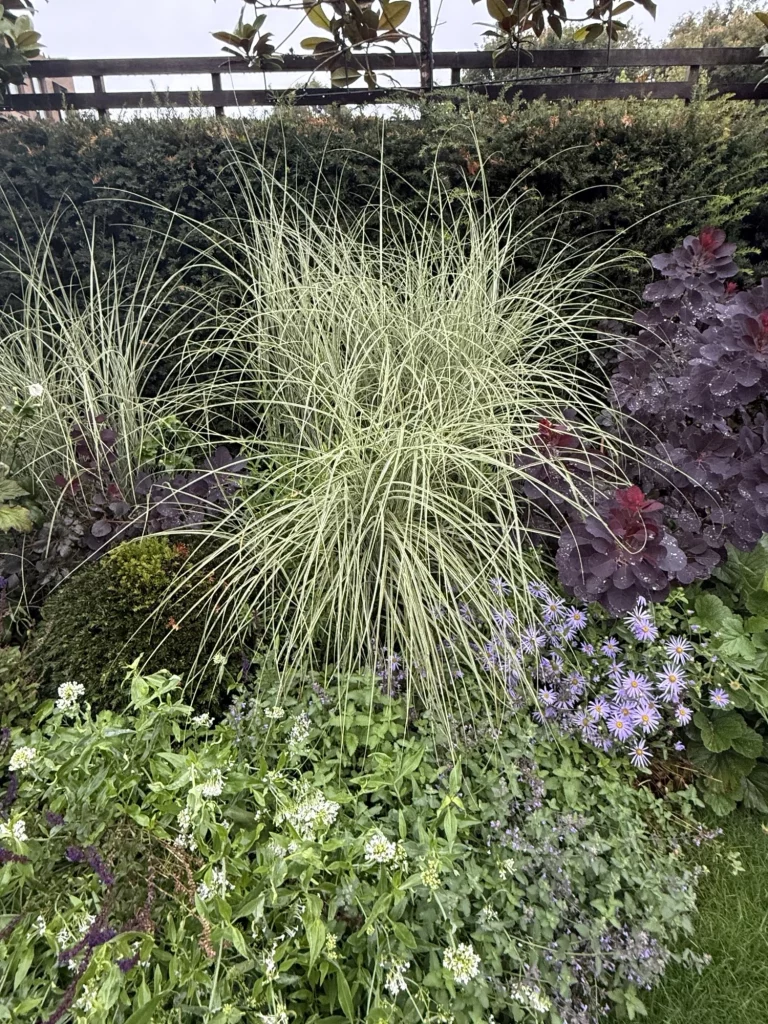
The dark-foliage movement has been building for years and is now firmly established. True black does not exist in plants (all ‘black’ plants are in fact very dark purple, bronze or maroon), but the visual effect is dramatic. Dark foliage makes every neighbouring colour read more vividly, which is why it is one of the most useful tools in the designer’s vocabulary. Combine dark foliage with apricot, orange or hot pink for the most striking results.
- Sambucus nigra ‘Black Lace’ (deep purple-black filigree foliage on a substantial shrub)
- Cotinus coggygria ‘Royal Purple’ (smoke bush) holds RHS Award of Garden Merit
- Heuchera ‘Obsidian’ (deep glossy near-black perennial groundcover)
- Aeonium arboreum ‘Zwartkop’ for containers (Mediterranean rosette of black leaves)
- Phormium tenax ‘Platt’s Black’ for architectural sword-leaved structure
- Tulipa ‘Queen of Night’ for spring drama
- Ophiopogon planiscapus ‘Nigrescens’ (black mondo grass) for the boundary edge
In hard landscaping, charcoal and near-black surfaces (slatted fencing, dark Corten or powder-coated steel raised beds, dark-stained pergolas) provide architectural contrast to bright planting. The look is most striking when it reads as a deliberate decision rather than a default.
5. Restrained monochrome: the white garden and beyond
The most sophisticated of all the trends, and the hardest to execute. Vita Sackville-West’s White Garden at Sissinghurst (planted 1949, opened 1950) remains the touchstone for any single-colour scheme. The 2026 update sees the same restraint applied to other single colours: green-on-green minimalist courtyards, all-cream borders, even all-purple schemes. The art is in the variation of form, texture and tone within the single colour.
The white border
- Rosa ‘Iceberg’ (the white rose of choice for the Sissinghurst tradition)
- Hydrangea arborescens ‘Annabelle’ (vast white flowerheads)
- Anemone × hybrida ‘Honorine Jobert’ for late-summer white
- Astrantia major ‘Shaggy’ (large pure-white pincushion flowers)
- Tulipa ‘Spring Green’ (viridiflora white-green-tinged)
- Silver and grey foliage as the connecting element: Artemisia ‘Powis Castle’, Stachys byzantina
The green-on-green courtyard
An increasingly popular minimalist choice for small London courtyards. The whole interest comes from variation of foliage form: glossy Fatsia japonica, the broad blades of Hosta, the fronds of Dryopteris filix-mas and Asplenium scolopendrium, the strap leaves of Iris germanica, the thin filaments of Stipa tenuissima. Architectural, calm, contemporary.
6. Warm tones in hard landscaping
The cool grey porcelain that dominated the 2015 to 2022 period is being replaced by warmer tones: putty, cream, sandstone, honey and the modern travertine-effect porcelains. The new generation of warm-tone porcelains harmonises better with traditional London brick and Edwardian housing stock, and matches the warmer planting palette above. See our garden paving guide for the full picture on 2026 paving directions.
The same shift is visible in fencing (warm-stained cedar and larch over cold pressure-treated softwood), Corten weathering steel (the rust-orange aging is now a design statement, not a fault), and timber pergolas (oiled hardwood instead of painted black or grey).
7. Painted garden walls: outdoor colour as backdrop
One of the most under-used techniques in domestic gardens and one of the most transformative when used well. Painted boundary walls (or sections of fence) act as the backdrop that frames the planting in front. Farrow & Ball and Little Greene have both released exterior masonry paint ranges, and the most-used colours in 2026 design schemes are:
- Studio Green and Calke Green (Farrow & Ball) – deep, smoky greens that disappear behind planting and intensify the foliage in front
- Hague Blue and Inchyra Blue (Farrow & Ball) – dark, atmospheric blues that work beautifully with white and silver planting
- Down Pipe and Railings (Farrow & Ball) – the warm dark greys that read as charcoal in the garden
- Light Bronze Green (Little Greene) – a softer green that suits traditional London settings
- Mid-tone putty and clay tones for warm Mediterranean schemes
A single painted wall transforms a garden more cost-effectively than almost any other intervention. Allow the masonry to be sound and dry before painting, use proper masonry paint with primer where the substrate is new render or repaired brick, and expect to refresh the colour every five to seven years on a south-facing wall.
Reference gardens worth visiting
The best way to understand garden colour is to see it. Five UK gardens that are master classes in colour technique, all within reasonable distance of Surrey:
- Great Dixter, East Sussex. Christopher Lloyd’s hot border and the legacy team under Fergus Garrett continue to set the UK benchmark for confident colour planting.
- Sissinghurst, Kent. The White Garden remains the most influential single-colour scheme in horticulture.
- Beth Chatto Gardens, Essex. The gravel garden (a foundational example of right-plant-right-place dry gardening) and the warm Mediterranean palette that defined a generation of UK design thinking.
- Hidcote Manor, Gloucestershire. The Red Borders, the Pillar Garden and the famous garden ‘rooms’ each themed around a colour family.
- RHS Wisley, Surrey. The mixed borders and the new perennial trial beds change every year and are the best place locally to see contemporary colour combinations in practice.
What to avoid
- Too many colours at once. Three colour families in a border is usually the maximum that holds together. The temptation to plant one of every favourite colour produces a busy, restless garden.
- Pure white in shade. A bright white in deep shade reads as a hole punched in the planting. Cream and ivory work better; pure white is for sunnier positions.
- Hot colours in north-facing borders. They look muddy and dull without direct sun. Cool jewel tones and silvers work much better.
- Mirrored panels and reflective surfaces. A genuine bird strike hazard (around 100 million bird deaths per year are caused by collisions with reflective glass and mirrors in the UK and US combined). Avoid in gardens that support wildlife, which is essentially every garden.
- Neon and glow-in-the-dark accents. The visual life of these is roughly a season; the dating effect is immediate. The 24 V garden lighting alternative is dramatically more effective.
- Trend-chasing. The hot border, the white garden, the dry garden, the new perennial movement: all have outlasted decades because they are based on horticultural principles, not seasonal fashion. Choose the palette that matches your light, soil and brief, not the one that’s on the cover of the magazine.
Frequently asked questions
How many colours should I use in a garden border?
Three colour families is usually the practical maximum that holds together as a single design. That can mean three colours (red, orange, yellow for a hot border) or three colour types (purple, silver and white for a cool scheme). Green is not counted because it is doing the structural work behind the scenes. A border that contains too many colour families reads as restless and busy, however good the individual plants are.
What is the difference between analogous and complementary colour schemes?
Analogous schemes use neighbouring colours on the colour wheel (red-orange-yellow, or blue-purple-pink) and feel calm and harmonious. Complementary schemes use opposite colours (blue and orange, purple and yellow) and create high contrast and visual energy. Cottage gardens are usually analogous; the hot borders at Great Dixter are essentially complementary. Both work; the choice depends on the mood you want.
What colours work best in a north-facing or shaded garden?
Cool jewel tones (violet, deep blue, plum), pale colours that shimmer in low light (cream, ivory, soft yellow), and silver-grey foliage that catches what light there is. Pure white tends to read as a hole in the planting and is best avoided in deep shade. Hot reds, oranges and golds look muddy and dull without direct sun, so they are not the right choice for north-facing borders. See our north-facing planting guide.
Are there any truly black plants?
No. The plants sold as ‘black’ are in fact very dark purple, bronze or maroon. The cells of plants need pigments that absorb specific wavelengths of light for photosynthesis, and a truly black plant would absorb all visible light, which is biologically not viable. The visual effect of the dark cultivars is dramatic enough that the distinction matters only to a botanist. Sambucus nigra ‘Black Lace’, Heuchera ‘Obsidian’, Aeonium ‘Zwartkop’, Tulipa ‘Queen of Night’ and Ophiopogon planiscapus ‘Nigrescens’ are all reliably dark in domestic gardens.
Should I paint my garden wall?
For most gardens with a sound masonry wall or large fence run, yes – it is one of the most transformative single interventions in garden design. Deep greens like Farrow & Ball’s Studio Green or Calke Green disappear behind planting and intensify the colours in front; dark blues like Hague Blue work beautifully with white and silver schemes; warm putty tones complement Mediterranean planting. Use proper exterior masonry paint, allow the substrate to be dry, and expect to refresh the colour every five to seven years on a south-facing wall.
What is the ‘new perennial’ planting palette?
The naturalistic prairie-influenced style developed by Dutch designer Piet Oudolf, championed in the UK by Tom Stuart-Smith, Dan Pearson and Sarah Price. The palette uses warm saturated late-summer colours (russet, burnt orange, deep gold, plum) combined with ornamental grasses that weave through the planting and provide movement. Core plants include Echinacea purpurea, Rudbeckia, Helenium, Sedum, Salvia nemorosa, Eupatorium and Calamagrostis. The look peaks from July through to first frost.
Let’s design the colour scheme for your garden
If you would like a confident, considered colour scheme designed and installed by an experienced team, we’d be glad to help. Flourish Landscaping designs planting schemes across Kingston, Surbiton, Richmond, Esher and the wider Surrey area. See our planting design and installation service for the way we work.
Contact us to arrange a consultation and start the conversation.
Good to know
Frequently asked questions
Three colour families is usually the practical maximum that holds together as a single design. That can mean three colours (red, orange, yellow for a hot border) or three colour types (purple, silver and white for a cool scheme). Green is not counted because it is doing the structural work behind the scenes. A border that contains too many colour families reads as restless and busy, however good the individual plants are.
Analogous schemes use neighbouring colours on the colour wheel (red-orange-yellow, or blue-purple-pink) and feel calm and harmonious. Complementary schemes use opposite colours (blue and orange, purple and yellow) and create high contrast and visual energy. Cottage gardens are usually analogous; the hot borders at Great Dixter are essentially complementary. Both work; the choice depends on the mood you want.
Cool jewel tones (violet, deep blue, plum), pale colours that shimmer in low light (cream, ivory, soft yellow), and silver-grey foliage that catches what light there is. Pure white tends to read as a hole in the planting and is best avoided in deep shade. Hot reds, oranges and golds look muddy and dull without direct sun, so they are not the right choice for north-facing borders.
No. The plants sold as 'black' are in fact very dark purple, bronze or maroon. The cells of plants need pigments that absorb specific wavelengths of light for photosynthesis, and a truly black plant would absorb all visible light, which is biologically not viable. The visual effect of the dark cultivars is dramatic enough that the distinction matters only to a botanist. Sambucus nigra 'Black Lace', Heuchera 'Obsidian', Aeonium 'Zwartkop', Tulipa 'Queen of Night' and Ophiopogon planiscapus 'Nigrescens' are all reliably dark in domestic gardens.
For most gardens with a sound masonry wall or large fence run, yes - it is one of the most transformative single interventions in garden design. Deep greens like Farrow & Ball's Studio Green or Calke Green disappear behind planting and intensify the colours in front; dark blues like Hague Blue work beautifully with white and silver schemes; warm putty tones complement Mediterranean planting. Use proper exterior masonry paint, allow the substrate to be dry, and expect to refresh the colour every five to seven years on a south-facing wall.
The naturalistic prairie-influenced style developed by Dutch designer Piet Oudolf, championed in the UK by Tom Stuart-Smith, Dan Pearson and Sarah Price. The palette uses warm saturated late-summer colours (russet, burnt orange, deep gold, plum) combined with ornamental grasses that weave through the planting and provide movement. Core plants include Echinacea purpurea, Rudbeckia, Helenium, Sedum, Salvia nemorosa, Eupatorium and Calamagrostis. The look peaks from July through to first frost.