Stylish and practical fencing solutions
Eight contemporary fencing approaches that shape how a garden feels, how private it is, and how much you actually enjoy using it.
Fencing is no longer a functional afterthought. Treated as a design element rather than a boundary fixer, it shapes how every other part of the garden reads. The right approach can make a small garden feel larger, frame a planting scheme, and last 25 years rather than five. The wrong approach fails within a couple of British winters. This guide covers the contemporary fencing styles we use most often in client gardens across Kingston, Surbiton, Richmond and the wider Surrey area, plus the technical and planning detail that separates a fence that works from one that doesn’t.
What makes a fence last — and why most fail early
Before looking at styles, four technical points separate a 25-year fence from a 5-year one:
- Posts are everything. Most fence failures come from the posts, not the panels. Concrete or hardwood posts last 25-40 years; pressure-treated softwood posts 10-15 years; untreated softwood 3-7 years. Post depth matters too — 600 mm minimum, 900 mm in exposed sites — set in concrete with a sloped top to shed water.
- Gravel boards. The bottom 150-200 mm of any timber fence sits in the wet zone. Concrete or composite gravel boards lift the timber clear of ground contact, doubling or trebling panel life. Skipping these is the single most common cause of premature rot.
- Wind loading. Solid panels in exposed positions act like sails. In windy gardens, choose hit-and-miss or slatted designs that allow air through, or use shorter solid panels (1.5 m rather than 1.8 m) with proper bracing.
- Stainless or galvanised fixings. Standard bright steel nails and screws rust within two or three years and stain the timber. Stainless A2 or hot-dipped galvanised fixings cost a few pounds more per fence and last as long as the timber.
Planning permission and boundary essentials
Worth establishing before any fencing project begins:
- Height limits. Under permitted development, fences up to 2 m high are generally allowed between gardens and at the rear; 1 m is the limit alongside a highway used by vehicles. Anything taller needs planning permission from your local council. Conservation areas, listed buildings and properties with Article 4 directions have additional restrictions.
- Ownership. Most title deeds indicate which boundaries belong to which property (usually by a T-mark on the plan). A fence built on or close to a neighbour’s boundary needs their agreement; building on a shared boundary needs consultation. Boundary disputes are among the most expensive and bitter neighbour disagreements; clarifying ownership before quoting is worth the time.
- Party Wall Act. Where a new fence requires foundations within 3 m of a neighbour’s building (rare for fencing but possible for substantial masonry walls or large gateposts), the Party Wall Act 1996 applies and formal notice may be needed.
- Hedge protection. Trees and substantial hedges may be protected by Tree Preservation Orders or as part of a conservation area; the High Hedges (Anti-Social Behaviour) Act 2003 also gives councils powers around evergreen hedges over 2 m. Always check before removing established planting.
1. Slatted fencing for modern structure and light
The most-requested style in current contemporary garden work. Slatted fencing delivers a clean architectural look without completely blocking light to neighbouring planting, and the rhythm of horizontal slats visually widens narrow spaces.
- Horizontal slats emphasise width and make smaller gardens feel longer.
- Vertical slats emphasise height; good for short, wide gardens that need the eye lifted.
- Shadow gaps (15-20 mm gap between slats) add depth and a more premium finish. The gap allows partial visibility, partial light and full airflow, so the fence behaves better in wind than solid panels.
- Typical slat dimensions: 70-90 mm wide, 18-21 mm thick, with the gap calibrated to give around 70-80% solidity.
- Mixed timber and metal combinations (oak or thermo-treated timber on galvanised or powder-coated steel frames) give a contemporary edge and dramatically improve longevity.
Cost guide: £150-300 per linear metre installed, depending on timber specification and any metal framework. Higher than closeboard but visibly higher quality.
Build note: Always pressure-treated timber (Use Class 3 minimum, Use Class 4 if in ground contact), stainless steel fixings, and bracing every 1.8-2.4 m. Slatted designs in poorly-installed posts visibly bow within a couple of windy winters.
2. Closeboard fencing — done properly
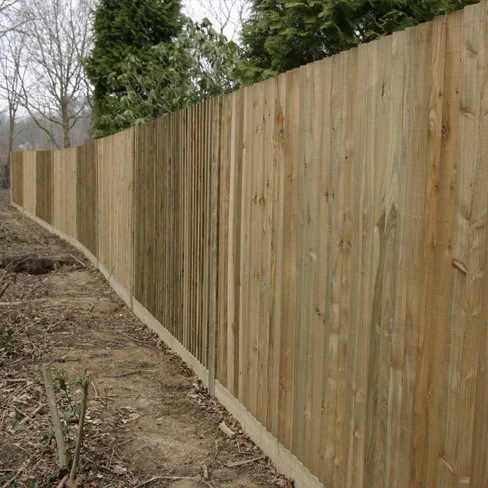
Closeboard remains the most reliable option for UK side and back boundaries, but the difference between a basic install and a properly-built one is dramatic.
- Posts. Concrete posts (with timber slats slotted in) for cost-effective longevity, or 100 x 100 mm hardwood or pressure-treated softwood for a timber look. Avoid spiked metal post anchors except for short runs in well-drained soil; concrete-set posts are far more durable.
- Panels. Standard sizes are 1.83 m (6 ft) wide x 1.5 / 1.65 / 1.83 m high (5 / 5’6” / 6 ft). Vertical close-board construction with overlapping feather-edge boards on a horizontal arris-rail framework is the standard format.
- Gravel boards. Concrete (long-lasting) or composite gravel boards 150-200 mm deep, lifting the timber out of the wet zone. Adds 10-15 years to panel life.
- Trellis tops. A 300-450 mm trellis or wave-top finish softens the appearance, reduces solidity (so reduces wind loading), and gives valuable height for climbing plants. Visually pushes the fence up to legal 2 m without it feeling oppressive.
Cost guide: £80-150 per linear metre installed for closeboard with concrete posts and gravel boards (the recommended specification). Cheaper installations with timber posts only and no gravel boards (£40-70/m) typically need replacement within 8-10 years.
Where it works best: Side boundaries, exposed gardens, anywhere maximum privacy and security matter, and as a structural backdrop for planting.
3. Living fences and planted boundaries
For a softer, more natural look and significantly better wildlife value, living boundaries are increasingly popular in contemporary garden design. The main options:
- Evergreen formal hedging for year-round privacy. Taxus baccata (yew, AGM) is the classic English hedging — slow-growing (15-30 cm a year) but holds shape for centuries and tolerates hard cutting back. Ligustrum ovalifolium (privet) is the traditional London hedging — fast, dense, semi-evergreen. Prunus lusitanica (Portuguese laurel, AGM) is a better-behaved alternative to common cherry laurel.
- Deciduous formal hedging. Carpinus betulus (hornbeam) holds russet leaves through winter; particularly good on heavy clay. Fagus sylvatica (beech) similar habit, preferring better-drained soil. Both clip beautifully and live for centuries.
- Pleached trees for raised boundaries. Trees with bare clear stems and a framework of foliage above eye level — ideal for screening upper windows of neighbouring buildings without losing ground-level light. Lime (Tilia), hornbeam, beech and Portuguese laurel are all commonly pleached. See our dedicated pleached trees guide.
- Mixed native hedging for biodiversity. A mixed planting of Crataegus monogyna (hawthorn), Prunus spinosa (blackthorn), Acer campestre (field maple), Corylus avellana (hazel) and Viburnum opulus (guelder rose) supports nesting birds and abundant insect life. Best suited to longer rural boundaries; less appropriate for tight urban side returns.
- Espalier fruit trees. Trained apples and pears (Malus domestica, Pyrus communis) along horizontal wires; productive and structural simultaneously. Suits sunny boundaries and walled gardens.
Reality check: living boundaries look exceptional and last for generations, but they aren’t a fit-and-forget solution. Formal hedges need clipping once or twice a year; pleached trees need annual reshaping; native mixed hedges need a rotation cut every 2-4 years. Factor in the maintenance commitment before specifying. For our service-side overview see our garden fencing and screening solutions.
4. Composite fencing for low maintenance
Wood-plastic composite fencing (made from recycled wood fibres and HDPE) has grown significantly in popularity for clients who want a clean finish with minimal ongoing upkeep.
- Doesn’t rot, warp, splinter or need painting.
- Consistent appearance over 25+ years (the colour does fade slightly in the first 6-12 months as UV stabilisers settle, then remains stable).
- Genuine recycled content — typically 60-95% recycled timber and plastic by mass.
- Range of finishes: smooth, brushed, embossed wood-grain.
Cost guide: £150-280 per linear metre installed, roughly double the equivalent closeboard. Cost over 25 years often works out lower than two cycles of mid-range timber fencing, but the upfront investment is the larger barrier.
Best for: contemporary gardens, rental properties (where consistent appearance over years matters), and clients who’d rather pay once than maintain timber. Less appropriate for traditional or period-property settings, where the slight artificiality reads as inappropriate.
5. Decorative screens and feature panels
Fencing is increasingly used as a design feature rather than just a boundary — particularly within zoned gardens where it divides spaces without dividing the eye.
- Laser-cut metal panels. Geometric or organic patterns cut from 3-6 mm steel sheet, powder-coated or weathering. Used as focal points or short feature walls (typically 1.5-2 m wide), backlit at night for evening drama.
- Corten (weathering) steel. Steel that develops a stable rust patina over 6-18 months, providing a warm rust-orange architectural finish that doesn’t deteriorate further. Used for screens, raised-bed walls and statement boundaries. Note: run-off can stain pale paving for the first year; specify drip detail accordingly.
- Reclaimed materials. Old scaffold boards, reclaimed brick, salvaged railway sleepers — appropriate for industrial-style schemes and where character matters more than uniformity.
- Trellis or patterned timber inserts. Used to break up long solid runs and provide structure for climbing plants. Trachelospermum jasminoides (star jasmine, AGM) is the most-used contemporary climber for trellis — evergreen, intensely scented, controlled growth.
6. Integrated lighting within fencing
Lighting transforms fencing from something you see by day to something that defines the garden’s evening character. Three approaches we use most often:
- Recessed LED strips. Installed into the underside of cap rails or behind slats. Gives a clean modern indirect glow that emphasises the structure of the fence without producing glare.
- Post-cap lights. Discrete lights set into the top of fence posts at regular intervals (every 1.8-3.6 m) create rhythm and define the boundary at night.
- Backlighting. Concealed lights mounted behind perforated metal screens, slatted panels or trellis casting the pattern onto paving or planting. Excellent for focal features and zoned dining areas.
Always specify low-voltage (12V or 24V) outdoor-rated systems with IP65-rated fittings. Install the conduit and cable runs during the fence build, not afterwards — retrofitting lighting through a finished fence is significantly more expensive.
7. Multi-functional fencing for small gardens
In smaller London and Surrey town gardens, fencing is increasingly designed to do more than one job — recovering useful space where every square metre counts.
- Built-in seating along boundaries. Hardwood benches integrated into the fence framework, sometimes with hinged tops for storage beneath. Particularly effective in courtyard gardens.
- Vertical planting and green walls. Modular planted panels or simpler hanging-pot systems on a slatted backing turn a boundary into productive growing space. Good for herbs, salad leaves and trailing perennials.
- Storage integration. Slim cupboards built into the fence depth for tools, recycling, hose reels and bike racks. The exterior reads as fencing; the interior delivers practical storage that would otherwise consume garden floor space.
- Fold-down workspaces. Wall-mounted potting benches, drinks counters or work surfaces hinged to fold flat against the fence when not in use.
See our low-maintenance gardens guide for more on space-efficient design principles.
8. Colour and finish — beyond basic timber
Natural timber is still the default, but painted and stained finishes are increasingly used to create stronger visual identity. Three colour directions that work well:
- Charcoal and near-black. Recedes visually and makes planting stand out. Particularly powerful with bright perennials, ornamental grasses and white-flowered shrubs. Specific recommendations: Cuprinol Garden Shades ‘Black Ash’, Farrow & Ball ‘Off-Black’ (exterior), or Sadolin black wood-stain for traditional timber.
- Soft greys. Sit calmly within contemporary schemes; less stark than black, more sophisticated than natural orange-brown softwood. Try Cuprinol ‘Urban Slate’ or ‘Muted Clay’.
- Warm earthy tones. Deep ochre, terracotta and warm brown for Mediterranean-style gardens. Pairs beautifully with gravel paths and silver-leaved planting.
Application: Use a water-based exterior wood stain rather than gloss paint, which traps moisture and flakes. Reapply every 3-5 years on average. Pre-treat any cut ends with end-grain preservative before assembly.
Choosing the right fence for your garden
The best choice depends on five factors:
- Garden size and orientation. Small or shaded gardens benefit from lighter, more permeable styles; larger gardens can absorb solid boundaries.
- Wind exposure. Exposed sites need permeable styles or shorter solid panels with bracing. Solid 1.8 m closeboard in an exposed corner is a recipe for failure.
- Maintenance preference. Composite and metal screens for fit-and-forget; closeboard for moderate upkeep; living hedging for the most commitment but the greatest beauty.
- Architectural context. Period properties suit timber and traditional formats; contemporary extensions suit slatted, metal and composite finishes; cottage gardens suit mixed native hedging.
- Budget across the project lifespan. Cheap fencing is rarely the cheapest option. £150/m for a 25-year fence is better value than £60/m for a 6-year fence, and the disruption of replacement is significant.
In most projects the strongest results come from combining styles: closeboard for the long boundary runs, slatted feature panels for prominent positions, mixed native hedging for the back boundary, and one or two metal screens or trellis elements as design accents.
Frequently asked questions
How high can I build a garden fence without planning permission?
Under permitted development, fences up to 2 m high are generally allowed between gardens and at the rear; 1 m is the limit alongside a highway used by vehicles. Anything taller needs planning permission from your local council. Conservation areas, listed buildings and properties with Article 4 directions have additional restrictions — check with your council planning department before specifying a tall boundary.
How long should a good fence last?
A properly-built closeboard fence with concrete posts and gravel boards should last 20-25 years. Slatted timber fences with pressure-treated softwood and stainless fixings: 15-20 years. Hardwood (oak, iroko) fences: 25-30+ years. Composite fences: 25+ years, typically with manufacturer warranties of 25-30 years. Cheap untreated softwood fences with bright steel nails and no gravel boards: 5-8 years. The single biggest determinant is the post specification, not the panel material.
Who owns which boundary fence?
Boundary ownership is usually shown on the title deeds, normally by a T-mark on the plan against each boundary. The T-mark side of the boundary is responsible for it. If both sides show T-marks (a double-T), the fence is shared. If no T-marks are shown, there’s no automatic legal obligation on either party. In any case, sensible practice is to discuss replacement with neighbours before starting work — boundary disputes are among the most expensive and bitter neighbour disagreements. Land Registry title plans are available from the Land Registry website for a small fee.
Is composite fencing worth the extra cost?
Over 25 years, almost always yes. Composite at £150-280/m installed lasts 25+ years with no painting or staining. Mid-range timber at £80-150/m typically needs replacement at 15-20 years, plus periodic staining throughout. Two cycles of timber fencing costs more in total than one composite installation, and the disruption of replacement is significant. The case for timber is aesthetic — natural timber looks better in period and traditional settings, where composite can read as slightly artificial. For contemporary gardens, composite makes financial and practical sense in most cases.
How much should fencing cost?
2026 Surrey supply-and-install rates: basic closeboard with timber posts and no gravel boards £40-70 per linear metre (not recommended); proper closeboard with concrete posts and gravel boards £80-150/m; slatted timber fencing £150-300/m; composite fencing £150-280/m; bespoke metal and feature panels £250-500+/m. Hedging adds a different cost structure — establishing a hedge costs £20-80 per linear metre depending on size of plants, with ongoing annual maintenance of around £8-15/m.
Can I grow climbing plants on a fence?
Yes, with the right approach. Install proper horizontal wires (galvanised steel wire on vine eyes spaced 45 cm apart vertically) before planting; nailing direct to fence panels damages both. Recommended climbers for boundary fences: Trachelospermum jasminoides (star jasmine, AGM) for evergreen scent; Wisteria sinensis (with twice-yearly pruning); climbing and rambling roses; Clematis (group 3 for hard annual pruning); Lonicera periclymenum (native honeysuckle). Avoid Hedera helix (ivy) on timber fences — it holds moisture against the timber and shortens fence life significantly.
Let’s plan your fencing
Flourish Landscaping designs and installs fencing as part of complete garden schemes across Kingston, Surbiton, Richmond, Esher and the wider Surrey area. See our garden fencing and screening service for the way we work, our garden privacy guide for the wider context of screening choices, or our pleached trees guide for living boundary alternatives.
Contact us to arrange a consultation.
Good to know
Frequently asked questions
Under permitted development, fences up to 2 m high are generally allowed between gardens and at the rear; 1 m is the limit alongside a highway used by vehicles. Anything taller needs planning permission from your local council. Conservation areas, listed buildings and properties with Article 4 directions have additional restrictions - check with your council planning department before specifying a tall boundary.
A properly-built closeboard fence with concrete posts and gravel boards should last 20-25 years. Slatted timber fences with pressure-treated softwood and stainless fixings: 15-20 years. Hardwood (oak, iroko) fences: 25-30+ years. Composite fences: 25+ years, typically with manufacturer warranties of 25-30 years. Cheap untreated softwood fences with bright steel nails and no gravel boards: 5-8 years. The single biggest determinant is the post specification, not the panel material.
Boundary ownership is usually shown on the title deeds, normally by a T-mark on the plan against each boundary. The T-mark side of the boundary is responsible for it. If both sides show T-marks (a double-T), the fence is shared. If no T-marks are shown, there's no automatic legal obligation on either party. In any case, sensible practice is to discuss replacement with neighbours before starting work.
Over 25 years, almost always yes. Composite at £150-280/m installed lasts 25+ years with no painting or staining. Mid-range timber at £80-150/m typically needs replacement at 15-20 years, plus periodic staining throughout. Two cycles of timber fencing costs more in total than one composite installation. The case for timber is aesthetic - natural timber looks better in period and traditional settings, where composite can read as slightly artificial.
2026 Surrey supply-and-install rates: basic closeboard with timber posts and no gravel boards £40-70 per linear metre (not recommended); proper closeboard with concrete posts and gravel boards £80-150/m; slatted timber fencing £150-300/m; composite fencing £150-280/m; bespoke metal and feature panels £250-500+/m. Hedging adds a different cost structure - establishing a hedge costs £20-80 per linear metre depending on size of plants.
Yes, with the right approach. Install proper horizontal wires (galvanised steel wire on vine eyes spaced 45 cm apart vertically) before planting; nailing direct to fence panels damages both. Recommended climbers for boundary fences: Trachelospermum jasminoides (star jasmine) for evergreen scent; Wisteria sinensis with twice-yearly pruning; climbing and rambling roses; Clematis (group 3 for hard annual pruning); Lonicera periclymenum (native honeysuckle). Avoid Hedera helix (ivy) on timber fences - it holds moisture against the timber and shortens fence life significantly.