Patio design
How to design a patio that works for your home and garden.
A patio is the most-used space in most British gardens, the surface that gets walked over a thousand times a year and judged every time. Get it right and it lifts the entire garden. Get it wrong, wrong material, wrong sub-base, wrong falls, and it becomes the thing the client most regrets after twelve months.
At Flourish Landscaping we design and install patios and paving across Kingston, Surbiton, Esher and Coombe, from compact terraces in central Surbiton to the substantial entertaining areas built into the larger gardens of Coombe Hill and Esher Park Avenue. This page walks through what really matters: material choice and where each stone genuinely belongs, sub-base specification for the London Clay that underlies almost every garden in our area, drainage and SUDS, the planning rules worth knowing, realistic cost ranges, and the maintenance reality everyone forgets to ask about.
Choosing the right material
The choice of paving material sets the entire character of the garden. The right material depends on the architecture of the house, the style of the wider garden, the aspect, and how the patio will be used. These are the materials we specify most often, with honest commentary on where each genuinely belongs.
Indian sandstone
The default material for many British patios, and rightly so when chosen well. Hand-dressed riven sandstone in soft buffs, greys and silvers suits Victorian and Edwardian houses, the housing stock that dominates Surbiton, Berrylands and much of Kingston. Sawn sandstone in honed or smooth finishes works for cleaner contemporary schemes. Sandstone is warm underfoot, ages beautifully, and softens with weather. Annual sealing helps resist staining on lighter colours. Budget: typically £50 to £100 per square metre supplied; £150 to £250 installed including sub-base.
Limestone
More refined and uniform than sandstone, with subtle tones from cool grey-blues (Kota Blue) to warm honey (Jura). Limestone has a tighter grain than sandstone, which makes it less porous and slightly more stain-resistant out of the box. Particularly effective for properties where a cleaner, more architectural feel is wanted. Many of the contemporary houses we work on in Esher and Hinchley Wood specify limestone for exactly this reason. Budget: comparable to mid-range sandstone, often slightly higher.
Porcelain
Engineered slabs fired at extremely high temperatures, almost entirely non-porous, frost-proof, stain-resistant and dimensionally precise. The most popular contemporary patio material in our area, and for good reason: porcelain handles winter wet and summer UV better than any natural stone, the colour stays stable, and the consistent thickness allows for precise narrow joints. The trade-off is character. Porcelain looks deliberate where stone looks evolved. Excellent for contemporary architecture, swimming pool surrounds and kitchen-extension terraces where indoor floors flow outside. Sourcing matters; the best brands are Italian and Spanish (Levantina, Cotto d’Este, Coverlam, Strata). Budget: £60 to £140 per square metre supplied; £180 to £300 installed.
British Yorkstone
The benchmark material for period properties and listed buildings, quarried in Yorkshire, dense, weathered grey-buff, often saved or reclaimed from former pavements. The right material for Conservation Area properties in Coombe, listed houses across the borough, and the substantial Edwardian and Arts and Crafts homes of Kingston Hill and Coombe Lane West. Reclaimed Yorkstone in particular is irreplaceable in heritage settings. Budget: significantly higher than Indian sandstone; reclaimed Yorkstone can exceed £200 per square metre supplied alone.
Granite
The toughest natural stone, almost completely impervious, with a cool, mineral character that suits contemporary architecture. Honed silver-grey granite makes a striking surface against modern render or zinc cladding. Heavier and harder to cut than sandstone or limestone, which adds to installation cost. Best in moderation and on the right house. Wrong on a Victorian villa.
Clay paving brick
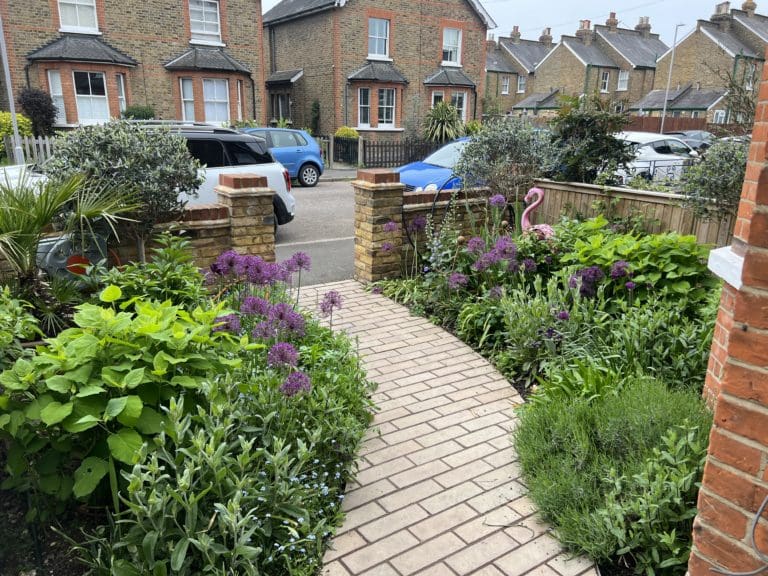
Often overlooked but quietly excellent. Clay brick paving such as Marshalls Sorrento or Wienerberger Penter Iron gives a warm, traditional surface that ages superbly. Particularly effective as an edge or banding around stone or porcelain, or as a complete patio in cottage-garden schemes. Pairs beautifully with the red-brick housing stock common throughout Surbiton and Norbiton.
Natural stone versus porcelain: an honest comparison
This is the question most clients ask first. The honest answer is that both can produce an outstanding patio. The choice depends on the architecture, the use, and what you want the surface to feel like underfoot in ten years.
Natural stone: strengths
- Genuine variation of colour and texture across the patio, no two slabs identical
- Ages beautifully, mellowing and weathering over decades
- The natural choice for period properties and conservation areas
- Warmer underfoot than porcelain in winter
- Can be repaired or replaced slab-by-slab without obvious mismatch
Natural stone: trade-offs
- Porous to varying degrees; lighter stones stain more easily
- Benefits from periodic sealing, typically every two to five years
- Algae and moss colonise faster on north-facing or shaded patios
- Slab thickness varies, which affects laying technique and joint widths
Porcelain: strengths
- Almost completely non-porous; effectively stain-proof
- Frost-resistant, UV-stable and dimensionally precise
- Minimal maintenance beyond occasional cleaning
- Allows the same floor surface to run from inside the kitchen to outside the patio
- Strong slip-resistance ratings available (R11 for terraces, R12 for pool surrounds)
Porcelain: trade-offs
- Looks consistent rather than weathered, wrong on a Victorian or Edwardian house
- Cooler underfoot than stone in winter
- Requires a slurry primer and the right adhesive bedding, not a job for inexperienced installers
- Cheap porcelain looks like cheap porcelain; budget brands fade visibly within five years
The sub-base: why most patio failures start here
Patios fail at the sub-base, not the surface. The slabs are the visible part; the engineering beneath them is what determines whether the patio looks the same in fifteen years or starts to dip, crack, lift or pond water within two.
London Clay is the defining issue across our area
The London Clay that underlies almost every garden from Norbiton through Surbiton, Esher and Coombe shrinks in dry summers and swells in wet winters. Patios laid on inadequate sub-base over clay move with these seasonal cycles, sometimes by tens of millimetres a year. Cracks open in joints, slabs lift, and water starts to pond. This is not a defect of the stone; it is a defect of the build.
The Flourish specification for patios on London Clay
- Excavate to 200mm minimum below finished patio level
- Lay a non-woven geotextile membrane over the subgrade to prevent the sub-base migrating into wet clay
- 150mm minimum of MOT Type 1 sub-base on clay sites (industry standard is 100mm; on London Clay we always go deeper)
- Compact in 50 to 75mm layers using a vibrating plate compactor, never as a single deep lift
- Full mortar bed for stone, slurry-primed full bed for porcelain, never spot-bedding
- A minimum fall of 1 in 80 (1.25 per cent) away from the house and below the damp-proof course by at least 150mm
The temptation to economise on the sub-base is the single biggest reason patios fail. We never do it, regardless of budget pressure.
Drainage, falls and SUDS
A patio that ponds water is a patio that has failed in design. Surface water management is fundamental, and on London Clay it is non-negotiable. The principles:
- Falls away from the house at a minimum of 1 in 80, directed to a planted border, soakaway, channel drain or rainwater garden.
- Linear drainage across thresholds where indoor floors meet outdoor patios, particularly important for level-access kitchen extensions.
- Permeable jointing options for the back edge of the patio, allowing water to soak away rather than running off into beds.
- SUDS-compliant build-ups for larger areas, MOT Type 3 open-graded sub-base instead of Type 1, permeable jointing, and a properly engineered soakaway.
Front gardens: the SUDS rule worth knowing
For front-garden paving over five square metres, non-permeable surfaces require planning permission. Either choose a permeable paving system, or design drainage that directs water into a permeable area such as a lawn or planted bed. This catches many homeowners out and is enforced across the Royal Borough of Kingston upon Thames and Elmbridge Borough Council areas. Rear-garden patios are not subject to this rule but still benefit from being designed to manage surface water sensibly.
Listed buildings and conservation areas
Properties in the Coombe Hill Conservation Area and the Esher Conservation Area, and listed buildings throughout the borough, may need additional consents for hard landscaping changes, particularly where reclaimed Yorkstone, traditional brick or other heritage materials are involved. We routinely manage these enquiries on behalf of our clients.
Matching the patio to the house
The single biggest design mistake is choosing a paving material that fights with the architecture. The same patio that looks superb on a clean white-rendered new-build will look entirely wrong against a Victorian villa, and vice versa.
- Victorian and Edwardian houses (much of Surbiton, Berrylands, central Kingston): hand-dressed sandstone, weathered Yorkstone, clay brick paving in herringbone or basket-weave patterns.
- Arts and Crafts and inter-war houses (Kingston Hill, Coombe, parts of Esher): Yorkstone, sandstone in larger random-rectangular patterns, considered use of clay brick edging.
- Mid-century and modernist houses: sawn limestone, honed granite, large-format porcelain in geometric layouts.
- Contemporary new-builds (much of newer Esher, Hinchley Wood, Long Ditton): large-format porcelain, sawn limestone, smooth granite, occasionally indoor-outdoor matching tiles.
Layout, falls and joint detail
The details that separate a good patio from a great one are usually invisible until you look for them. Joint widths matched to the material (narrow for sawn porcelain; generous for riven sandstone or Yorkstone). Cuts kept off the principal sightlines and absorbed into edges. Patterns that work with the proportions of the house, not against them. Step detailing that feels integral rather than added on. Edges defined by a contrast banding or change of orientation. Lighting recessed into risers or set into adjacent retaining walls. None of these is expensive in isolation; together they are what makes the difference.
Maintenance: the honest version
No patio is genuinely maintenance-free. A realistic picture of what each material needs:
- Sandstone and limestone: a brush-down twice a year, a gentle wash with fresh water and a soft-bristle brush each spring, and sealer reapplication every two to five years depending on traffic and aspect.
- Yorkstone: minimal, wash annually and accept that some algae and lichen will colonise shaded areas; that patina is part of the material’s appeal.
- Porcelain: wash annually with warm water and a non-acidic cleaner; never use pressure-washing at high settings against jointing.
- Granite: almost none, a wash twice a year keeps it looking fresh.
- Clay brick: annual brush, occasional weed control in joints; pointing inspection every few years.
Realistic cost ranges
Every patio is different, but as a guide for properly built patios on London Clay across our area:
- Indian sandstone, mid-range cultivar, full installation including sub-base: £150 to £250 per square metre
- Premium limestone or sawn sandstone: £200 to £300 per square metre
- Quality porcelain (named European brands), full installation: £200 to £350 per square metre
- Reclaimed Yorkstone or premium British natural stone: £400 to £600 per square metre and upwards
- Steps, retaining walls, edge banding, integrated lighting and drainage are additional
Patio design across Kingston, Surbiton, Esher and Coombe
Each part of our area brings its own design language. Surbiton and Norbiton are dominated by Victorian and Edwardian terraced and semi-detached houses where sandstone, weathered Yorkstone and clay brick banding sit most comfortably. Kingston Hill and Coombe include substantial Arts and Crafts and Edwardian properties, many in Conservation Areas, where reclaimed Yorkstone, hand-dressed sandstone and traditional jointing details are usually the right call. Esher and Hinchley Wood span everything from period properties around Esher village to substantial contemporary new-builds along the A3 corridor; the material choice differs accordingly. We tailor the specification to the property, not the other way around.
Final thoughts
The right patio is one that sits properly with the architecture of the house, drains intelligently away from it, has been built on a sub-base appropriate to the ground beneath, and uses a material whose maintenance demands match the owner’s appetite for upkeep. The wrong patio looks fine on day one and disappoints quietly thereafter. There is no need to choose between durability and character, both are available, in either natural stone or porcelain, if the design and the build are done properly.
Related pages
- Patios, paths and driveways: our paving service, from design through to installation
- Landscaping in Surbiton: local projects and what we build in Surbiton
- Outdoor cooking: planning a kitchen or barbecue area on your patio
- Wooden pergolas: adding shade and structure over a new patio
Let’s create your perfect garden
Flourish Landscaping designs and installs patios across Kingston, Surbiton, Esher, Coombe and the surrounding KT postcodes, from heritage Yorkstone restorations to large-format porcelain kitchen extensions. Every patio we build starts with the ground beneath it: a properly engineered sub-base, drainage that works with our local London Clay, and a material specification tailored to the house. We handle planning enquiries where Conservation Area consent applies, and our installations are warranted because of how they are built, not despite it.
Contact us today to arrange a consultation and start transforming your garden into the perfect outdoor space for you and your family.
Written by Craig Davis BSc (Hons) Horticulture, member of the Chartered Institute of Horticulture. Craig has over 40 years in horticulture: in the family business since the age of 13 and a horticulture graduate since 1992, he designs, builds and plants gardens across Kingston, Surrey and South West London.