Garden fencing
Styles, costs, planning rules and the construction details that decide how long a fence really lasts.
A garden fence does three jobs at once: defining the boundary, giving you privacy, and framing the garden visually. Get the style right and the fence becomes part of the design. Get it wrong and a good garden can feel hemmed in or unfinished.
This guide covers the eight fencing styles we specify and install most often across Kingston, Surbiton, Esher and Coombe gardens, with honest notes on cost, durability, planning rules, and the construction details that genuinely decide how long a fence lasts on heavy London Clay.
The fencing styles we work with
1. Closeboard fencing
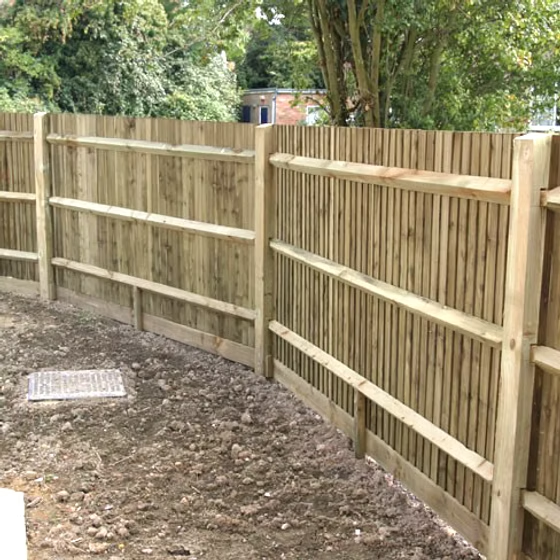
Closeboard is sturdy, durable and gives strong privacy and security. It is built up on site from vertical feather-edge boards that partially overlap onto horizontal arris rails, with a gravel board at the base and a capping rail on top. Because it is built board by board rather than dropped in as a pre-made panel, it copes well with uneven ground and sloping sites. Pressure-treated softwood is standard, with western red cedar or Siberian larch available for a longer-lasting, more refined finish. As with panel fencing, we install closeboard on concrete slotted posts on most of our sites because of London Clay and wet winter ground (see the panel section below). Expected lifespan: 15 to 20 years for treated softwood on concrete posts, longer for cedar and larch.
2. Picket fencing
Picket is the right choice when you want a traditional, charming boundary that defines without enclosing. It is a relatively low fence style, which makes it ideal for front gardens, cottage gardens and any setting where you want a clear edge but not a wall. Pickets come in various heights and profiles, including flat-top, round-top and pointed, fixed to horizontal rails. Pressure-treated softwood is standard, with oak or western red cedar available for premium installations. Picket is often painted white, though stained and natural finishes sit more comfortably in contemporary or naturalistic gardens. Front-garden picket fencing is particularly useful because it usually falls under the 1 metre planning limit for boundaries adjacent to a highway (see the planning section below).
3. Trellis fencing
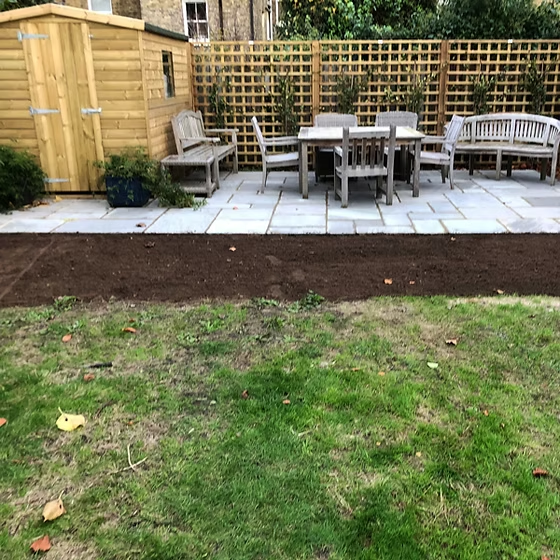
Trellis adds height and visual interest without blocking out light. It is built from a grid of horizontal and vertical slats spaced apart to create a lattice effect, and can either stand on its own as a boundary or sit on top of a solid panel for discreet extra height. It is also the go-to support for climbing plants such as Clematis, climbing roses, Trachelospermum jasminoides, Hydrangea petiolaris, Jasminum officinale and Wisteria sinensis. Trellis is available in treated softwood, western red cedar or oak, in diamond, square or lattice patterns. One important note: trellis added on top of an existing fence counts towards the overall boundary height for planning purposes, so a 1.8m fence with 300mm of trellis on top is treated as a 2.1m structure.
4. Panel fencing
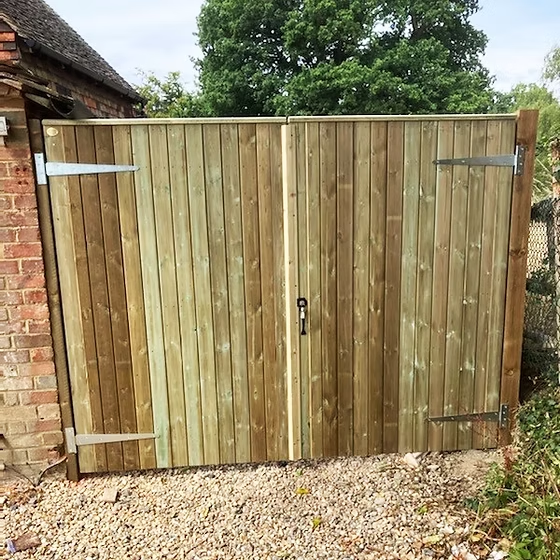
Panel fencing is the practical, versatile and cost-effective option. It is made up of pre-built panels (typically overlap, closeboard or tongue and groove) fixed between vertical posts. Cost rises in that order: overlap is the entry level, closeboard panels are a step up in durability, and tongue and groove sits at the top of the range with the cleanest finish. Standard panel size is 6ft x 6ft (1.83m x 1.83m), reducing in 1ft increments for lower fences.
Concrete slotted posts as standard. Across our area, with heavy London Clay and wet winter ground, we install panel fencing on concrete slotted posts rather than timber posts driven straight into the soil. Concrete posts do not rot at ground level, which is where the vast majority of panel-fence failures actually occur. Posts are set roughly 600mm into the ground on a postcrete or wet concrete foundation, with a concrete gravel board at the base to keep panel timbers clear of soil and standing water. Where the look of bare concrete is unwanted, we can fit timber fascia covers over the concrete posts to retain the appearance of a fully timber fence while keeping the longevity benefit. Expected lifespan: 15 to 20 years for the panels themselves; the posts and gravel boards will typically outlast two sets of panels.
5. Horizontal slat fencing and screening
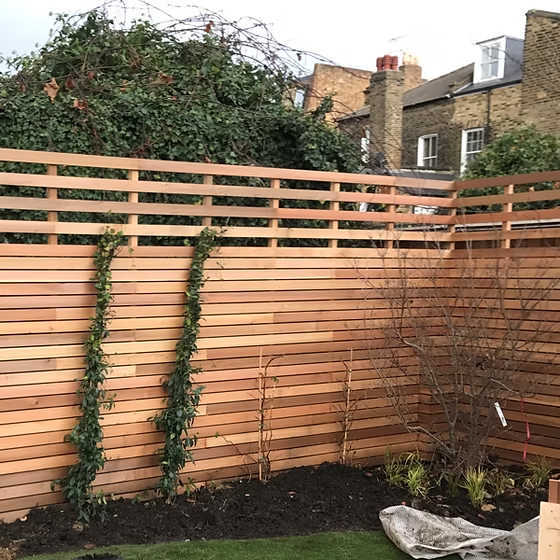
Horizontal slat fencing is the contemporary go-to for modern and minimalist gardens, including courtyard gardens where a clean architectural line matters. Narrow horizontal slats are fixed across a vertical frame with a controlled gap between them, which gives the fence a clean architectural line and allows a degree of light and air through. Western red cedar and Siberian larch are the most popular timbers because of their colour, longevity and resistance to movement. Hardwoods such as iroko sit at the top end for an even longer lifespan.
Specifying the gap. The gap between slats controls the balance between privacy and light. We install with gaps from around 20mm down to 5mm, depending on what the client wants. A 20mm gap reads as a screen and lets significantly more light through, while a 5mm gap is almost solid and gives much closer to full privacy. This is worth deciding before specification, not afterwards. Expected lifespan: 20 years or more for cedar and larch with regular oiling.
6. Hit and miss fencing
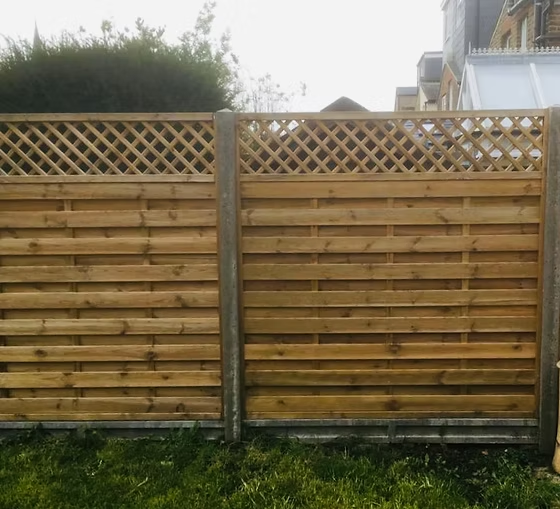
Hit and miss provides privacy while still allowing some light and air to pass through. It is built from vertical boards (or sometimes horizontal slats in a contemporary variant) fixed alternately to the front and back of the rails, so the boards overlap visually but leave a small gap when viewed at an angle. This makes the fence wind-resistant, which is genuinely useful on exposed sites, while still feeling solid. It is usually built in treated softwood, western red cedar or oak, with flat-top or arched-top profiles. Expected lifespan: 15 to 20 years for treated softwood, longer for cedar and oak.
7. Post and rail fencing
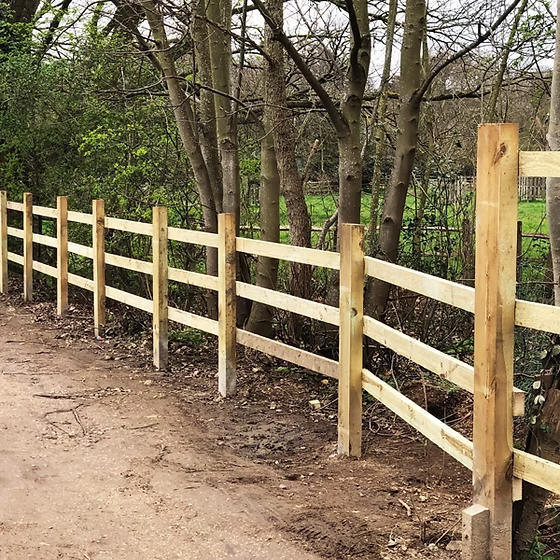
Post and rail is the choice for a rustic, natural look. Horizontal rails are fixed to vertical posts, and the fence reads as a marker of the boundary rather than a barrier. It works particularly well in larger plots, paddock-style gardens, or where the boundary itself is defined by mature hedging or planting and the fence is essentially structural backup. Stock netting can be added on the inner face to keep dogs in, without compromising the look. Available in treated softwood, western red cedar or oak, with half-round or square-section rails. Expected lifespan: 20 years or more for hardwood, 15 to 20 for treated softwood.
8. Composite fencing
Composite is the lowest-maintenance fence on the market. It is made from a mix of recycled wood fibres and polymer, which means it resists rot, warping and insect damage, and does not need staining, painting or sealing to keep its appearance. An occasional wash is all it needs. Composite is more expensive than timber upfront, but the lifetime cost can work out favourably because there is no ongoing treatment cost. Visually it has improved significantly in recent years and now reads as a credible timber alternative rather than an obvious plastic substitute. Most composite systems use galvanised steel or aluminium posts (the DuraPost system is a common example), which removes the rot point at ground level entirely. Expected lifespan: 25 years or more, with most manufacturers offering 20 to 25 year guarantees.
Planning permission and fence heights
This is the question we are asked most often. The headline rule in England is set out under permitted development rights and applies to most domestic gardens:
- Rear and side boundaries: maximum 2 metres without planning permission.
- Front boundaries adjacent to a highway: maximum 1 metre without planning permission (this includes any boundary alongside a road, footpath or shared driveway used by vehicles).
- Trellis counts. Trellis added on top of a solid fence is included in the total height. A 1.8m fence with 300mm of trellis on top is a 2.1m structure under the rules.
- Conservation areas and listed buildings: stricter rules usually apply. Parts of Kingston, Surbiton and Coombe sit within conservation areas, so it is worth checking before commissioning work.
- Sloping sites: height is measured from the higher ground level on the lower side of the boundary, not from your own ground level.
If you want extra height without applying for planning permission, pleached trees or trained hornbeam are a practical alternative because they are not governed by these limits. We can incorporate them into a planting scheme.
Which side of the fence is mine?
There is no legal default in England and Wales for which boundary belongs to which property. Ownership is set out in the title deeds and shown by T-marks on the Land Registry title plan: the T is drawn on the side of the boundary owned by that property. If the deeds are silent, ownership is unclear and a conversation with the neighbour is the sensible route. As a general convention, the “good” or smooth side of a fence faces outwards towards the neighbour, with the posts and rails on the owner’s side. This is convention rather than law, but it is worth following because it reduces the chance of a boundary dispute later on. For a more thorough treatment of the legal side, see our garden law and boundaries guide.
Hedgehog highways and wildlife-friendly fencing
UK hedgehog numbers have fallen sharply since 2000, and one of the main causes is solid garden fencing cutting off the routes they use to forage at night. A hedgehog needs to range 1 to 2 kilometres a night to find enough food and a mate. The fix is straightforward: a 13cm x 13cm gap at the base of a fence, ideally one on each side of the garden, lets hedgehogs pass through but is too small for dogs or foxes. This is the standard recommended by the Hedgehog Street campaign run by the British Hedgehog Preservation Society and the People’s Trust for Endangered Species. We can build hedgehog highways into a new fence as standard, either by cutting a notch in the gravel board or by specifying a pre-cast hedgehog gravel board on concrete-post installations. It costs almost nothing to do at build stage and is significantly easier than retrofitting. For wider thinking on supporting wildlife in the garden, see our notes on naturalistic planting.
How do I choose?
When choosing the right fence for your garden, there are a few things worth working through.
- Purpose. Are you looking primarily for privacy, security, decoration or boundary definition? These point to different styles.
- Garden style. A traditional cottage garden is at home with picket. A contemporary courtyard suits horizontal slat. A family garden needs a workable balance of privacy, durability and budget, which is where panel or closeboard usually lands.
- Aspect and wind exposure. Exposed gardens benefit from hit and miss because of its wind permeability. Sheltered gardens can run any style.
- Maintenance. Composite needs almost none. Timber needs annual or biennial treatment to stay looking its best. Be honest with yourself about what you will actually do. If low effort is the priority across the whole garden, our notes on low-maintenance gardens are a useful companion read.
- Budget. Overlap panels are the entry level. Closeboard, hit and miss and horizontal slat sit in the mid range. Composite, oak and full bespoke joinery sit at the top.
- Wildlife. Building in a hedgehog highway at the design stage costs nothing and is much easier than retrofitting later.
Frequently asked questions
How tall can a garden fence be without planning permission?
In England, 2 metres at the rear and side, and 1 metre where the boundary is adjacent to a highway, footpath or shared driveway used by vehicles. Trellis added on top counts towards the total. Conservation areas and listed buildings have stricter rules.
Which side of the fence is mine?
There is no legal default. Ownership is shown by T-marks on the Land Registry title plan, with the T drawn on the side of the owning property. By convention, the smooth side of a fence faces the neighbour.
How long does a garden fence last?
Treated softwood panel and closeboard fencing on concrete posts typically lasts 15 to 20 years. Western red cedar and Siberian larch generally last 20 years or more with regular oiling. Oak and composite both sit at 25 years or more. The single biggest factor is the post: timber posts driven into the ground are the usual failure point.
What is the best fence for a windy or exposed garden?
Hit and miss is the standard choice because the alternating boards let wind pass through without lifting the fence. Horizontal slat with a controlled gap performs similarly. Solid panel fencing is more likely to fail in high winds because it acts as a sail.
Can I paint my side of a fence my neighbour owns?
No, not without your neighbour’s permission. The fence belongs to them and any alteration, including painting, technically requires consent. In practice, a brief conversation usually resolves it.
Why are concrete posts better than timber posts on London Clay?
Heavy London Clay holds water through the winter and dries hard in summer. This wet-dry cycle accelerates rot at the base of timber posts, which is where most panel fences eventually fail. Concrete posts do not rot, so the structure outlasts the panels themselves, and panels can be replaced individually as they age.
In summary
Good fencing is not just a perimeter, it is part of the garden’s design. The right style, properly built on the right posts, will hold its shape and its looks for many years. The wrong specification can age a garden noticeably within a few seasons. Choosing carefully at the start saves money, time and frustration later.
For wider context, see our companion guides on patios, paths and driveways (fencing is often installed as part of these projects), our garden fencing and screening service page, our garden landscaping costs guide, and our service pages for garden design and installation across Kingston, Surbiton and Esher.
Let’s create your perfect garden
If your fence needs replacing, or if you are planning a wider garden project where fencing is part of the brief, Flourish Landscaping designs and installs across Kingston, Surbiton, Esher, Coombe and the surrounding KT postcodes. Our garden design and installation service covers everything from initial consultation through to build and aftercare.
Contact us today to arrange a consultation and start transforming your garden into the perfect outdoor space for you and your family.
Good to know
Frequently asked questions
In England, 2 metres at the rear and side, and 1 metre where the boundary is adjacent to a highway, footpath or shared driveway used by vehicles. Trellis added on top counts towards the total. Conservation areas and listed buildings have stricter rules.
There is no legal default. Ownership is shown by T-marks on the Land Registry title plan, with the T drawn on the side of the owning property. By convention, the smooth side of a fence faces the neighbour.
Treated softwood panel and closeboard fencing on concrete posts typically lasts 15 to 20 years. Western red cedar and Siberian larch generally last 20 years or more with regular oiling. Oak and composite both sit at 25 years or more. The single biggest factor is the post: timber posts driven into the ground are the usual failure point.
Hit and miss is the standard choice because the alternating boards let wind pass through without lifting the fence. Horizontal slat with a controlled gap performs similarly. Solid panel fencing is more likely to fail in high winds because it acts as a sail.
No, not without your neighbour's permission. The fence belongs to them and any alteration, including painting, technically requires consent. In practice, a brief conversation usually resolves it.
Heavy London Clay holds water through the winter and dries hard in summer. This wet-dry cycle accelerates rot at the base of timber posts, which is where most panel fences eventually fail. Concrete posts do not rot, so the structure outlasts the panels themselves, and panels can be replaced individually as they age.