Spring garden tidy
The essential tidy-up that gets your garden ready for the year ahead.
The spring tidy is the single most important week in the garden year. Done well, it sets up the next nine months of healthy growth, sharp edges and abundant flowering. Done badly (or, more often, done too early or too keenly) it damages emerging plants, breaks the law on hedge-cutting, and removes the wildlife cover that domestic gardens depend on. This guide sets out what the spring tidy actually involves, when to do each task, and the things to leave alone.
We carry out spring tidies across Kingston, Surbiton, Esher, Richmond and the wider Surrey area as part of our garden maintenance service. A thorough tidy on an average domestic garden of 100 to 200 sq m takes the team a full day, sometimes two. The list below is the one we work through, in this order.
Timing: when is the right moment?
The main spring tidy is best carried out in late February to mid-March in Surrey. The aim is to clear last year’s growth before the new growth starts pushing through, but not so early that the dead stems and seed heads (which protect crowns and provide invertebrate habitat through winter) are removed prematurely.
- Late February to mid-March: the main tidy window. Cut back grasses and herbaceous perennials, mulch borders, prune late-winter shrubs, last chance to cut hedges before nesting starts.
- Late March to early April: first lawn mow (when soil temperature reaches 8°C), edging, first feed.
- April: finishing tasks. Plant summer bulbs, sow hardy annuals, lift and divide overcrowded clumps.
A note on weather: Surrey clay needs to be workable. If you can dig a hole and the soil falls off the spade in clean clods rather than sticking in heavy lumps, conditions are right. Working sodden clay damages soil structure for the rest of the season.
Cutting back borders
The big job. Most herbaceous perennials and ornamental grasses are cut back hard before new growth emerges. The right time is when you can see the first 50 to 100 mm of new shoots at the base of the plant; this is the signal that the plant is awake.
- Ornamental grasses. Cut deciduous grasses (Miscanthus sinensis, Calamagrostis × acutiflora ‘Karl Foerster’, Panicum virgatum) down to 50 to 100 mm above ground level. Evergreen grasses (Carex, Festuca glauca) are not cut, just combed through with gloved hands to pull out dead material.
- Herbaceous perennials. Cut last year’s dead stems on Sedum, Echinacea purpurea, Rudbeckia fulgida, Aster and Phlox to just above the emerging basal growth.
- Penstemon, lavender, Russian sage. Penstemon, Lavandula and Perovskia are pruned in April (not earlier), back to within 25 to 50 mm of last year’s growth. Hard pruning into old wood often fails to regrow.
- Hardy fuchsias and Buddleja davidii. Cut hard back to a low framework in March. They flower on new wood, so the harder the prune, the better the flowering display.
- What to leave alone for now. Spring-flowering shrubs (Forsythia, Viburnum tinus, Chaenomeles, Camellia, Magnolia) are pruned after flowering, not before. Cutting them now removes the flower buds.
Spring pruning
- Roses. The main rose-pruning window is late February to early March, before strong new growth begins. Hybrid teas and floribundas hard back to a low outward-facing bud at 150 to 300 mm above the ground; shrub roses (Rosa) lightly to maintain shape; climbing roses tied in horizontally to maximise flowering laterals. Always cut to an outward-facing bud at a 45-degree angle.
- Coloured-stem dogwoods and willows. Cornus alba ‘Sibirica’, Cornus sericea ‘Flaviramea’ and Salix alba ‘Britzensis’ (grown for winter stem colour) are coppiced hard to 75 to 150 mm above ground in mid-March. New stems grow up over the season and provide next winter’s colour.
- Wisteria. The second of the two annual prunes (the first is in July or August). Cut the previous summer’s growth back to two or three buds in February.
- Late-summer flowering shrubs. Caryopteris, Lavatera, hardy fuchsias and Hydrangea paniculata all flower on new wood and benefit from a hard March prune to a low framework.
- Apple and pear trees. The last chance for dormant winter pruning on Malus domestica and Pyrus communis is February. After bud-break, save further work for summer pruning.
Hedge cutting: the legal point that matters
Under the Wildlife and Countryside Act 1981, it is a criminal offence to damage or destroy an active bird nest. In practice that means the RSPB advises against cutting hedges between 1 March and 31 August, the main UK bird-nesting season. We carry out hedge cutting in late February at the latest, then wait until September. Mid-season cuts are possible if and only if a careful inspection confirms there are no active nests, and they should be light maintenance only, not hard reduction.
If late February has already passed and the hedge looks scruffy, leave it. It will look worse for a few months, but the alternative risks an offence and disturbs the wildlife your garden depends on.
Lawn revival
After a wet UK winter, most lawns need work. The classic spring sequence:
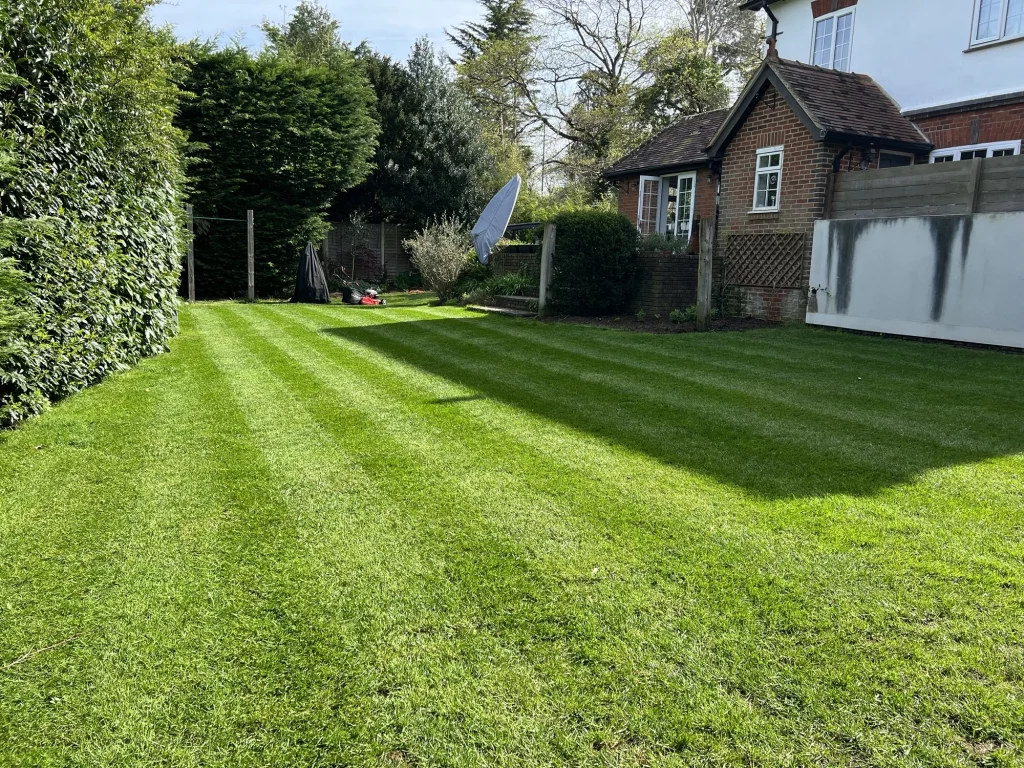
- First mow: when the soil temperature has reached 8°C for several consecutive days (usually mid-to-late March in Surrey). Take only the top third off; do not scalp. A sharp blade matters: a blunt blade tears rather than cuts and leaves the grass tips bruised and vulnerable to disease.
- Scarify: remove the thatch (the dead matted layer between living grass and soil) with a wire rake or powered scarifier. The lawn will look wrecked afterwards for a fortnight. This is normal.
- Aerate: hollow-tine aeration on compacted lawns relieves the surface compaction that London clay accumulates over winter. A garden fork to a depth of 100 mm at 150 mm spacings is fine for small lawns; a hired hollow-tine machine is faster.
- Top-dress: a thin layer (5 to 10 mm) of sandy loam or composted bark, brushed in with a stiff broom to fill the aeration holes and level minor undulations.
- Overseed: apply 15 to 25 g/sq m of grass seed over the whole lawn (more on bare patches). See our lawn seeding guide for the right mixtures.
- Spring feed: a balanced spring lawn fertiliser (typically NPK 11-5-5 or similar) applied at the manufacturer’s rate, usually 30 to 40 g/sq m. Apply when the lawn is actively growing, not before.
- Edges: a sharp half-moon edging iron along the lawn edge transforms how the whole garden reads. The single highest-impact-per-minute task in the spring tidy.
Mulching: the single most useful spring task
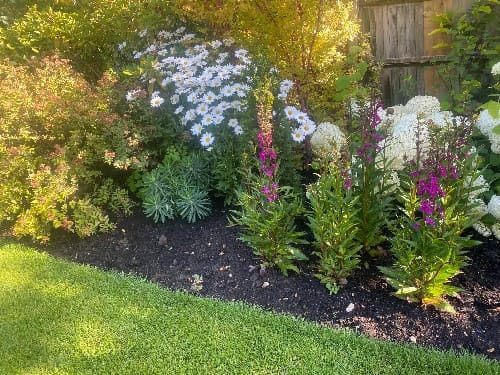
A 50 to 75 mm layer of mulch on every border, applied after cutting back and before the perennials have grown more than 100 mm, does more for a garden than any other single task. It suppresses weeds, retains soil moisture through the summer, gradually improves soil structure as it breaks down, and gives borders a deep, even, dark backdrop that makes the planting read sharper.
- Composted bark: the standard ornamental garden choice. Lasts 18 to 24 months before needing topping up.
- Well-rotted garden compost or leaf mould: the soil-improvement choice. Less visually neat but feeds the soil more effectively.
- Composted woodchip: larger particle size, lasts longer, suits a more naturalistic look.
- Strulch (mineralised straw mulch): excellent slug suppression, particularly useful around Hosta, Dahlia and other slug-vulnerable plants.
Critical detail: never pile mulch against plant stems or tree trunks. The ‘mulch volcano’ common around amateur tree plantings causes bark rot and root collar damage. Keep the mulch 50 mm clear of every stem.
Spring planting and dividing
- Lift and divide overcrowded perennials. Most herbaceous perennials benefit from being lifted every three to five years, the clump split with two forks back-to-back, and the strongest outer sections replanted. Hemerocallis, Hosta, Geranium, Achillea, Heuchera and ornamental grasses all respond well. Done in March, the divisions establish in time for the same season.
- Plant summer bulbs and tubers. Dahlia tubers, Gladiolus, summer-flowering Lilium, Begonia and Canna all go in from April once soil has warmed and the risk of hard frost has passed. See our dahlias guide for the full late-summer programme.
- Sow hardy annuals. Cornflowers, Calendula, Nigella, poppies and sunflowers can be direct-sown into prepared soil from mid-March.
- Plant out new shrubs and trees. March and April are the second-best planting window of the year (after autumn). Container-grown stock can go in any time; bare-root and rootballed stock should be planted by the end of March before bud-break.
Hard landscaping and outdoor structures
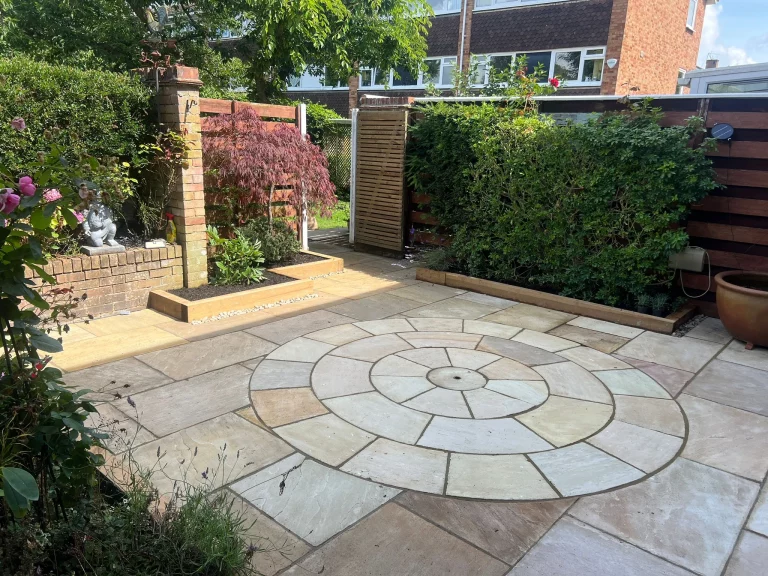
- Jet wash patios and paths. Use a medium pressure setting on porcelain paving (excessive pressure can damage the surface seal); higher pressure is fine on natural stone and concrete. Always wash from the centre outward to avoid forcing water under coping or steps.
- Clean decking. A stiff brush with diluted decking cleaner removes winter algae and grime. Re-stain or re-oil hardwood decking annually; softwood decking every two or three years.
- Check and re-point paving. Cracked or missing pointing lets water under the slabs, accelerating frost damage. Spring is the right time for repairs.
- Fences and gates. Check for storm-damaged panels, loose posts and rotted rails. Re-stain or paint after a dry spell. Replace any fixings showing rust.
- Outdoor lighting. Check connections, clean lenses, replace dead bulbs. Wire-in 24 V garden lighting often needs a connection refresh after a wet winter.
- Irrigation systems. Reconnect, test for leaks, check controller settings. See our garden irrigation guide.
- Garden furniture. Bring out from storage, clean, treat. Hardwood needs a coat of oil; metal furniture needs anti-rust touch-ups.
Wildlife: don’t be too tidy
The garden ecology principle: a slightly less tidy garden is a healthier garden. Some of the most useful things to do are to do less.
- Leave a patch of leaf litter. Hedgehogs, ground beetles, queen bumblebees and other invertebrates hibernate under it. Wait until April to clear leaves from behind sheds or in quiet corners.
- Don’t cut hedges in nesting season. See above. The legal point is real.
- Check for hedgehog activity before turning compost heaps or moving log piles. Surrey gardens are a significant remaining hedgehog stronghold.
- Leave a 100 mm strip of last year’s grass stems at the base of clumps when you cut grasses back. This is overwintering habitat for ladybirds and lacewings.
- Refresh ponds gently. If a pond needs clearing, do it in late February at the latest, before frog spawn arrives. Spawn is laid in mild February and March nights in Surrey.
Preparing the garden for sale or rental
For owners marketing a property in spring or early summer, the garden tidy carries extra weight. A neat, well-presented garden suggests a cared-for home and lifts listing photos significantly. The same tasks above apply, with a few additions for kerb appeal:
- Jet-wash the front driveway and path. Moss-covered surfaces look neglected in photos.
- Add seasonal pots beside the front door (Narcissus, Tulipa, Muscari in March; Pelargonium, Petunia, Lavandula from April).
- Repaint the front door if it is tired; polish letterboxes and door numbers.
- Hide the bins behind a screen or temporarily reposition for viewing and photo days.
- Replace any rotted fence panels and patch the bottom edges of gates (the most common visual flaw on rear elevations).
- Mow on the morning of viewings: a freshly cut lawn registers in photos and in person.
What to avoid in spring
- Cutting hedges between March and August. The Wildlife and Countryside Act and the RSPB nesting season advice. The legal risk is real.
- Mowing too short on the first cut. The top third only. Scalping the lawn after winter sets it back six weeks.
- Pruning spring-flowering shrubs. Forsythia, Viburnum tinus, Chaenomeles, Camellia, Magnolia, early Hydrangea all flower on last year’s growth. Wait until after they have flowered.
- Walking on the lawn while it is soggy. Wet clay compacts under foot traffic and the damage lasts the whole season.
- Applying lawn weedkillers too early. Selective lawn herbicides need actively growing grass; before mid-April they are ineffective and risk damaging weak grass.
- Mulch piled against trunks. Tree collar rot is one of the most common avoidable killers of young trees.
- Planting summer bulbs into cold, wet clay. Wait for April. Dahlia tubers in particular rot before they sprout if planted into saturated cold soil.
Frequently asked questions
When should I do my spring garden tidy?
The main spring tidy in Surrey is best done in late February to mid-March, when the first new shoots of perennials are visible at ground level but before the new growth becomes substantial. Cutting back grasses, mulching borders and final hedge trimming all happen in this window. Lawn work and summer-bulb planting come a few weeks later, from late March into April once the soil has warmed.
Is it illegal to cut a hedge in spring?
Cutting a hedge containing an active bird nest is an offence under the Wildlife and Countryside Act 1981, which protects all wild birds, their nests and their eggs. The RSPB advises avoiding hedge-cutting between 1 March and 31 August (the UK bird-nesting season). For domestic gardens we treat late February as the cut-off for any substantial hedge work, with maintenance trimming possible mid-season only after careful inspection confirms no nesting activity.
When should I cut back my ornamental grasses?
Deciduous grasses like Miscanthus, Calamagrostis and Panicum are cut back hard (to 50 to 100 mm above the ground) in late February or early March, before the new shoots have grown more than 100 mm. Evergreen grasses like Carex and Festuca glauca are not cut at all; instead, comb through them with gloved hands to pull out dead material.
When should I do my first lawn cut of the year?
Wait until soil temperatures have reached 8°C for several consecutive days, usually mid-to-late March in Surrey. Take only the top third off (so if the grass is 100 mm tall, cut to about 65 mm); never scalp the lawn in its first cut. A sharp blade matters: a blunt blade tears rather than cuts and leaves the grass tips bruised and vulnerable to disease.
What is the best mulch for spring borders?
For ornamental borders, composted bark gives the cleanest, longest-lasting finish (18 to 24 months between applications) and a deep, even backdrop that makes planting read sharper. For soil improvement, well-rotted garden compost or leaf mould feeds the soil more effectively but looks less neat. For slug-vulnerable plants like hostas and dahlias, Strulch (mineralised straw mulch) provides genuine slug suppression. Apply 50 to 75 mm and keep it 50 mm clear of all stems and trunks.
Should I prune my roses in spring?
Yes, late February to early March is the main rose pruning window, before strong new growth begins. Hybrid teas and floribundas are pruned hard to a low outward-facing bud at 150 to 300 mm above the ground; shrub roses are pruned lightly to maintain shape; climbing roses are tied in horizontally to maximise side-shoot flowering. Always cut to an outward-facing bud at a 45-degree angle. Newly planted roses get only a light first-year prune.
Let’s get your garden ready for the year
If you would rather have the spring tidy done properly by an experienced team than spend a soggy weekend doing it yourself, we’d be glad to help. Flourish Landscaping carries out spring tidies and ongoing maintenance across Kingston, Surbiton, Richmond, Esher and the wider Surrey area. See our garden maintenance service for one-off tidies and annual care contracts.
Contact us to arrange a consultation and book a spring tidy.
Good to know
Frequently asked questions
The main spring tidy in Surrey is best done in late February to mid-March, when the first new shoots of perennials are visible at ground level but before the new growth becomes substantial. Cutting back grasses, mulching borders and final hedge trimming all happen in this window. Lawn work and summer-bulb planting come a few weeks later, from late March into April once the soil has warmed.
Cutting a hedge containing an active bird nest is an offence under the Wildlife and Countryside Act 1981, which protects all wild birds, their nests and their eggs. The RSPB advises avoiding hedge-cutting between 1 March and 31 August (the UK bird-nesting season). For domestic gardens we treat late February as the cut-off for any substantial hedge work, with maintenance trimming possible mid-season only after careful inspection confirms no nesting activity.
Deciduous grasses like Miscanthus, Calamagrostis and Panicum are cut back hard (to 50 to 100 mm above the ground) in late February or early March, before the new shoots have grown more than 100 mm. Evergreen grasses like Carex and Festuca glauca are not cut at all; instead, comb through them with gloved hands to pull out dead material.
Wait until soil temperatures have reached 8C for several consecutive days, usually mid-to-late March in Surrey. Take only the top third off (so if the grass is 100 mm tall, cut to about 65 mm); never scalp the lawn in its first cut. A sharp blade matters: a blunt blade tears rather than cuts and leaves the grass tips bruised and vulnerable to disease.
For ornamental borders, composted bark gives the cleanest, longest-lasting finish (18 to 24 months between applications) and a deep, even backdrop that makes planting read sharper. For soil improvement, well-rotted garden compost or leaf mould feeds the soil more effectively but looks less neat. For slug-vulnerable plants like hostas and dahlias, Strulch (mineralised straw mulch) provides genuine slug suppression. Apply 50 to 75 mm and keep it 50 mm clear of all stems and trunks.
Yes, late February to early March is the main rose pruning window, before strong new growth begins. Hybrid teas and floribundas are pruned hard to a low outward-facing bud at 150 to 300 mm above the ground; shrub roses are pruned lightly to maintain shape; climbing roses are tied in horizontally to maximise side-shoot flowering. Always cut to an outward-facing bud at a 45-degree angle. Newly planted roses get only a light first-year prune.