
Roses for London gardens: best varieties for clay soil, front gardens and walls
The varieties we trust on heavy clay and through real Surrey summers, with practical planting and pruning advice.
Roses have a reputation for being temperamental. In reality, the right variety in the right place is one of the most generous, long-lived plants you can grow. Modern English shrub roses combine the fragrance of old-fashioned varieties with the disease resistance and repeat flowering of contemporary breeding. On the heavy London clay that runs through Kingston, Surbiton and Richmond, they perform beautifully when planted properly.
Flourish Landscaping designs and plants gardens across Kingston, Surbiton, Richmond, Esher and the wider Surrey area. Over the years certain roses consistently prove themselves, and others quietly disappoint. This guide brings together the varieties we trust, the colour combinations that work, and the practical advice that separates roses that struggle from roses that flourish.
The roses we trust
Most of the varieties below are from David Austin Roses, the Shropshire breeder whose modern English roses combine old-rose fragrance with contemporary disease resistance. AGM denotes the RHS Award of Garden Merit, awarded to plants that perform consistently well in UK gardens.
Pinks and creams
Rosa ‘Olivia Rose Austin’ (David Austin, AGM)
Soft blush pink. Perfectly formed cupped blooms with a fresh fruity fragrance. Exceptional disease resistance, compact tidy habit, continuous flowering from June to first frosts. Reaches about 1.1 m x 1 m. Performs impeccably on heavy clay. If we had to recommend one rose to a client who’d never grown one before, this would be it.
Rosa ‘Gertrude Jekyll’ (David Austin, AGM)
Deep rich pink. The benchmark for rose fragrance — a powerful old-rose scent that carries across a garden on a still summer evening. Vigorous and bold, reaching 1.5 m x 1 m as a shrub or trainable as a short climber to about 3 m. Needs space, rewards it spectacularly. Plant where the scent will be appreciated: near doors, paths and seating.
Rosa ‘Claire Austin’ (David Austin)
Creamy white with a soft lemon blush at the centre. Strong fragrance with vanilla and meadowsweet notes. Elegant and adaptable — works as a 1.5 m shrub or trained as a short climber to 3 m. Copes well with partial shade and heavier soils, which makes it a problem-solver for north-east aspects and overlooked town gardens.
Rosa ‘Bonica’ (Meilland, AGM)
Soft mid-pink. Outstandingly healthy ground-cover-style shrub rose, about 1 m x 1.2 m, smothered in flowers from June until autumn. Light fragrance, but the disease resistance and reliability are the selling points. Excellent for front gardens, low-maintenance schemes and mass planting along a drive.
Yellows, apricots and peaches
Yellow roses can be difficult. Too bright and they jar against neighbouring planting; too pale and they disappear. The best varieties bring warmth and luminosity without overpowering the garden.
Rosa ‘Teasing Georgia’ (David Austin)
One of the most refined yellow roses available. Warm golden yellow fading to buttery cream at the petal edges. Large generously-cupped blooms held on elegant stems. Strong classic fragrance with tea-rose notes. Genuinely flexible — short climber to about 3 m against a wall or large 1.5 m arching shrub in a mixed border. Soil note: performs well on improved clay but dislikes sitting in winter wet; plant slightly raised with plenty of organic matter.
Rosa ‘Lady of Shalott’ (David Austin)
Warm apricot-orange with golden-yellow undersides. A genuinely glowing rose with excellent garden presence — establishes quickly, flowers for months, copes with mixed soils and more exposed sites. Medium tea-rose fragrance. Reaches about 1.3 m x 1.1 m. The colour works particularly well against brick, stone and evergreen planting. One of the toughest roses on this list.
Rosa ‘Grace’ (David Austin)
Pure soft apricot, deeper in the bud, paling at the petal edges. Beautifully formed rosette blooms with a gentle warm tea fragrance. About 1.2 m x 1 m. Suits gardens where subtlety matters more than bold colour. Best in lighter or well-improved soil; less forgiving than ‘Lady of Shalott’ on heavy clay.
Rosa ‘Roald Dahl’ (David Austin)
Peach-apricot, slightly softer than ‘Lady of Shalott’. Compact at about 1.1 m x 1 m, cheerful and easy to live with. Repeat flowers continuously and stays well behaved. Light fragrance. Ideal for smaller gardens and front gardens where restraint matters.
Rosa ‘The Pilgrim’ (David Austin, AGM)
Soft pale yellow, very full quartered rosettes. Medium fragrance with myrrh and tea notes. Vigorous shrub of about 1.5 m or trainable as a short climber to 3.5 m. AGM-rated; one of the most reliable pale-yellow English roses for walls and fences.
Rosa ‘Bathsheba’ (David Austin)
Apricot-pink with deeper centres and paler outer petals. A true climbing rose reaching 3-3.5 m, perfect for walls, fences and arbours. Strong myrrh fragrance. Repeat flowers all season once established. Particularly good for north or east-facing walls where many roses struggle.
Reds and crimsons
Rosa ‘Munstead Wood’ (David Austin, AGM)
Deep velvety crimson with light-crimson outer petals. Strong old-rose fragrance with fruity blackberry notes. Compact at about 1 m x 0.8 m. Named after Gertrude Jekyll’s Surrey garden. Rich, dramatic colour in a manageable size; ideal for the front of a border or grown in a generous pot. Disease-resistant and AGM-rated. Good companion to silver-leaved planting and cool blues.
Rosa ‘Darcey Bussell’ (David Austin)
Rich crimson with subtle plum undertones, deep cupped rosettes. Compact at about 1.1 m x 0.9 m. Strong fruity old-rose fragrance. Excellent disease resistance. A perfect front-garden red where space is limited; works well planted in groups of three or five.
Whites
Rosa ‘Desdemona’ (David Austin)
Pure chalk-white with the faintest pink blush in the bud. Beautifully shaped cupped blooms, strong myrrh fragrance. About 1.2 m x 1 m. Excellent disease resistance. White roses can dominate a planting scheme by daylight and glow at dusk; this is the best contemporary white we know for English gardens.
Roses for heavy clay soil
Large parts of Kingston, Surbiton, Richmond and the Thames-side suburbs sit on heavy London clay. Clay is nutrient-rich and holds moisture well, both of which roses love, but it’s slow-draining and compacts easily, which roses do not. With proper planting, modern shrub roses thrive on improved clay.
Roses that perform particularly well on improved clay:
- Rosa ‘Olivia Rose Austin’. Blush pink, AGM, the most reliable rose on heavy clay we know.
- Rosa ‘Gertrude Jekyll’. Deep pink, AGM, vigorous enough to push through difficult conditions.
- Rosa ‘Claire Austin’. Creamy white, tolerates partial shade and heavier soils.
- Rosa ‘Lady of Shalott’. Apricot-orange, exceptionally tough.
- Rosa ‘Munstead Wood’. Deep crimson, AGM, copes well with improved clay.
How to plant a rose on London clay
- Time it right. Bare-root roses planted November to March establish far better than container-grown roses planted in summer, and cost 30-50% less. November is ideal: soil is still warm enough for root growth.
- Dig a generous hole. Roughly 45 cm wide and deep. The hole needs to be big enough that you’re working with loose soil around the plant rather than wedging it into a clay socket.
- Fork the base. Break up the bottom of the planting hole to improve drainage and let roots travel down rather than sitting on a pan of compacted clay.
- Mix in organic matter. Two-thirds existing soil to one-third well-rotted compost or rose-specific planting compost. Add a handful of mycorrhizal fungi (Rootgrow or similar) sprinkled directly onto the roots before backfilling.
- Plant slightly proud. On heavy clay, set the rose so the graft union (the knobbly point where the variety meets the rootstock) sits at or just above soil level. Sunken planting in clay traps water around the crown and causes losses.
- Firm gently, water in, mulch. Don’t compact the soil back into the hole with your boots; firm by hand. Water thoroughly to settle the soil, then mulch with 50-75 mm of compost or composted bark, keeping it clear of the stems.
Climbing roses for walls and fences
Brick walls and timber fences are common in London gardens and can be ideal for climbing roses, provided the soil at the base isn’t bone dry. Rain shadow from buildings and overhanging eaves is the most common reason wall-trained roses underperform.
Good choices for walls and fences:
- Rosa ‘Teasing Georgia’. Golden yellow to cream, refined and elegant.
- Rosa ‘Claire Austin’. Creamy white, tolerant of partial shade.
- Rosa ‘The Pilgrim’, AGM. Soft pale yellow, reliable on walls.
- Rosa ‘Bathsheba’. Apricot-pink, true climber, copes with cooler aspects.
- Rosa ‘Gertrude Jekyll’, AGM. As a shorter climber for fragrant entrance archways.
Plant climbing roses at least 30 cm out from the base of a wall to escape the rain shadow, lean the plant towards the wall when backfilling, and water deeply once a week during the first two summers. Install proper horizontal wires (galvanised wire on vine eyes spaced 45 cm apart vertically) before planting; trellis alone rarely holds a mature climbing rose. Tie new growth in horizontally where possible — horizontal stems flower along their entire length, vertical stems mostly at the top.
Roses for front gardens
Front gardens need roses that are compact, repeat-flowering, well-behaved and ideally fragrant where they’ll be passed daily. Reliable choices:
- Rosa ‘Olivia Rose Austin’, AGM. Blush pink, the front-garden default.
- Rosa ‘Roald Dahl’. Peach-apricot, compact, cheerful.
- Rosa ‘Darcey Bussell’. Rich crimson, modestly sized.
- Rosa ‘Bonica’, AGM. Soft pink, very low maintenance, excellent for mass planting.
- Rosa ‘Munstead Wood’, AGM. Crimson, compact, statement variety in a small space.
Avoid overly vigorous climbers and large shrub roses unless space genuinely allows. A 2 m climbing rose lurching over a 1.2 m front-garden path quickly stops being charming. See our Victorian front gardens guide for period-appropriate planting context.
Companion planting for roses
Roses on their own can look bare at the base and uninteresting between flowering flushes. The classic English approach is to underplant with low-growing perennials that flower at the same time and bring contrast in foliage texture. Reliable companions:
- Nepeta ‘Walker’s Low’ (AGM). Soft lavender-blue mist around the base of roses; flowers all summer; bees love it; aromatic foliage helps deter aphids.
- Lavandula angustifolia ‘Hidcote’ (AGM). Silver-grey foliage and deep purple flowers; classic with pale and apricot roses; needs sun and good drainage so site at the front of the border.
- Geranium ‘Rozanne’ (AGM). Violet-blue saucer flowers from June to October; spreads gently without becoming invasive; works particularly well with pink and crimson roses.
- Alchemilla mollis. Pleated lime-green foliage and frothy chartreuse flowers; classic Sissinghurst combination with crimson and pink roses.
- Allium hollandicum ‘Purple Sensation’ (AGM). Drumstick purple flower heads in May and June, just before the first rose flush; the alliums’ foliage dies back as the roses take over. There’s also old gardener’s lore (with some real basis) that members of the onion family deter aphids when planted near roses.
- Salvia nemorosa ‘Caradonna’. Deep purple vertical spires of flower that contrast beautifully with the rounded forms of rose blooms.
When and how to prune roses
Roses respond well to bold pruning. The single most common reason for poor flowering is a rose that’s been left to its own devices for several years. Most repeat-flowering shrub and climbing roses need a thorough annual prune.
Related articles
Shade plants
Most disappointing shade plantings are not failures of plant choice but failures of shade assessment. The difference between partial shade beneath deciduous trees and deep shade against a north-facing wall is larger than the difference between partial shade and full sun.
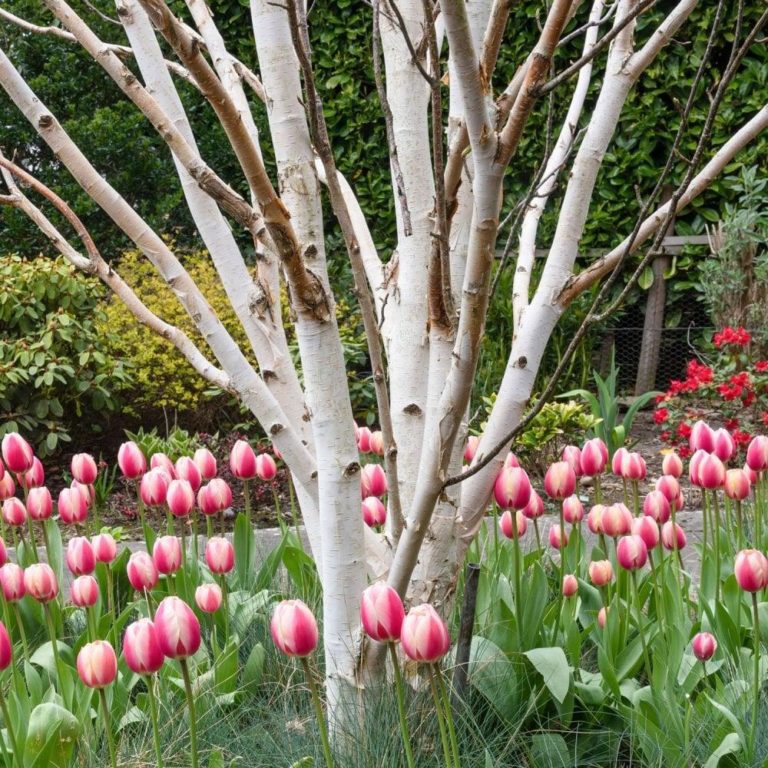
Multi-stem trees
Multi-stem trees Structure, beauty and year-round interest in the garden Multi-stem trees are one of the most elegant planting choices you can introduce into a garden. They combine sculptural beauty, seasonal interest, wildlife value and practical design benefits, all without dominating the space. At Flourish Landscaping we use multi-stem trees regularly in planting schemes across…
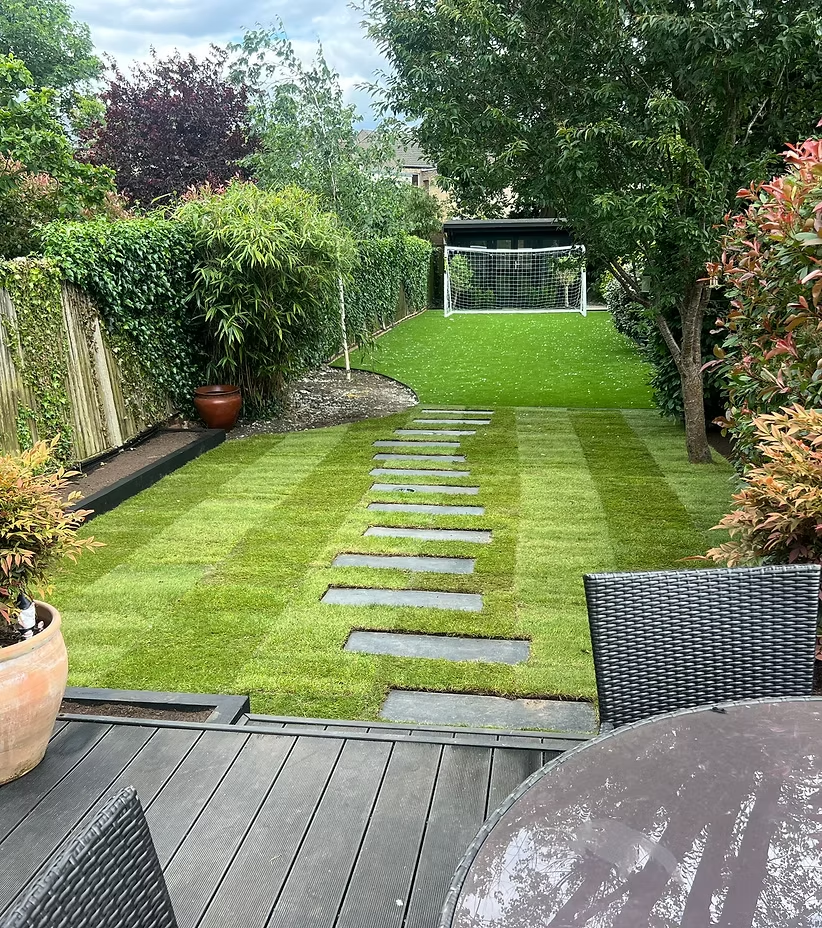
Refreshing a garden with new planting
Refreshing a garden with new planting How to transform a long suburban garden without rebuilding everything. Many gardens already have a layout that works reasonably well. The patio sits outside the house, there is a stretch of lawn through the middle, and somewhere towards the end of the garden there is often a shed, trampoline…
Gardening is good – and does good
Gardening is good, and does good What the RHS State of Gardening Report 2025 means for UK gardens. Gardening is often described as a hobby, but the Royal Horticultural Society’s first ever State of Gardening Report 2025 confirms something much bigger. For the first time, the true scale and impact of gardening across the UK…
Garden centres
Garden centres How to get the best out of your local garden centre visits. If you enjoy gardening, whether that means planting out borders, refreshing containers or just browsing for something new, a good garden centre is one of the most useful resources you have. Here in South West London and Surrey, we are well…
Garden pests and diseases
Garden pests and diseases A practical UK guide to the pests and diseases that actually affect gardens in our area, and the plants that resist them. Almost every garden in Kingston, Surbiton, Esher and Coombe will see some pest or disease pressure across the year. The aim is not to eliminate it, which is neither…



Do we work near you?
Based in Kingston and Surbiton, we work within a five–mile radius — covering a focused patch of South West London and North Surrey.