Refreshing your borders: a naturalistic planting approach
A contemporary planting approach for Kingston and Surbiton gardens that delivers structure, colour and wildlife value all year round.
Homeowners across Kingston, Surbiton and the wider Surrey area often come to us with the same picture: borders gradually taken over by vigorous plants — Buddleja davidii, cherry laurel, self-sown sycamore, green alkanet — set against heavy London clay that holds water through winter. The traditional answer is to clear everything and start again. The contemporary answer is to identify what’s worth keeping, address the soil, and layer in a naturalistic planting scheme that gives the garden structure, colour and wildlife value through every month of the year.
This guide covers the naturalistic planting approach we use most often in client gardens: the principles behind it, the plants we trust on London clay, the framework for layering, and how it fits a phased refresh rather than starting from scratch.
What naturalistic planting is
Naturalistic planting is a contemporary garden design approach that works in partnership with nature rather than against it. Plants are chosen for their structure and form across the whole year, not just for peak summer flower; perennials and grasses are planted in drifts that mimic how they grow in the wild; and the planting is allowed to evolve and self-perpetuate rather than being held in stasis by intensive pruning, replanting and chemical inputs.
The philosophy traces back to William Robinson’s 1870 publication The Wild Garden, which argued for hardy perennials and a more relaxed approach against the bedding-heavy Victorian fashion of the time. Robinson’s near-contemporary Gertrude Jekyll developed naturalistic colour-massed planting alongside the geometric architecture of Edwin Lutyens, demonstrating how soft planting could marry to formal hard landscape — a pairing as relevant to a contemporary Surbiton family garden as to a Lutyens manor.
In modern practice, the approach has been refined and made famous by designers including Dutch nurseryman Piet Oudolf (RHS Wisley Oudolf Field, New York’s High Line), Dan Pearson (Lowther Castle, Tokachi Millennium Forest, Japan) and Sarah Price (multiple Chelsea Gold Medals, the 2012 Olympic Park planting). What was once a niche philosophy is now the default approach in serious contemporary garden design.
Common reasons to rethink your borders
- Overgrown shrubs that have lost their shape and now block light from the rest of the planting.
- Vigorous self-seeders taking over — Buddleja davidii, cherry laurel (Prunus laurocerasus), sycamore (Acer pseudoplatanus), green alkanet (Pentaglottis sempervirens).
- Gaps in seasonal colour or structure — bursts of peak summer flower, then nothing from October to April.
- Maintenance demand that no longer fits available time. Bedding cycles, intensive pruning, frequent watering and chemical feeding are exactly the things naturalistic planting reduces.
- Desire to attract more pollinators and wildlife. The single best change most gardens can make is shifting from intensively-bred bedding to ecologically richer perennials.
- Outdated planting styles — heavy heather/conifer combinations, dated shrub mixtures, lawn-and-edge planting that doesn’t work for current household use.
Refreshing doesn’t mean starting over. Most gardens have valuable framework — mature trees, well-positioned hedges, established shrubs that can be reshaped — that should be kept and built around.
Understanding your soil
No two Kingston gardens are quite alike. Established gardens often have rich, workable clay-loam built up by decades of cultivation; newer developments may have thin topsoil over compacted London clay; gardens closer to the Thames sometimes have sandier, more free-draining soil. The first task in any planting refresh is matching the plants to the site.
Heavy clay (most of Kingston, Surbiton, Richmond)
Clay is nutrient-rich but slow-draining and prone to compaction. The approach is to improve structure with bulk organic matter applied as an annual mulch, avoid over-digging (which destroys soil structure), and choose deep-rooted perennials and grasses that thrive in moist nutrient-rich ground. Reliable clay performers:
- Persicaria amplexicaulis ‘Firetail’ (AGM) – red bistort. Tall crimson flower spikes June to October, deep-rooted, almost indestructible.
- Rudbeckia fulgida var. sullivantii ‘Goldsturm’ (AGM) – black-eyed Susan. Golden daisies July to October, the most reliable late-summer perennial for clay.
- Helenium ‘Moerheim Beauty’ – sneezeweed. Mahogany-red daisies on tall stems, July to September.
- Phlomis russeliana – Jerusalem sage. Whorls of soft yellow flowers in summer, sculptural seed heads through winter.
- Calamagrostis × acutiflora ‘Karl Foerster’ (AGM) – feather reed grass. Tall vertical accent, beautiful from June through winter.
- Geranium ‘Rozanne’ (AGM). Violet-blue flowers from May to first frosts, exceptional ground cover.
- Sanguisorba officinalis. Tall wiry stems with deep red bottlebrush flowers, summer-long airy structure.
Lighter and free-draining soils
Closer to the river and in pockets across the area, some gardens have sandier soil that drains too fast and leaches nutrients quickly. The approach is to enrich with compost annually, mulch generously to retain moisture, and choose Mediterranean and drought-tolerant species:
- Lavandula angustifolia ‘Hidcote’ (AGM) – English lavender. Silver foliage, deep purple flowers, intense scent.
- Achillea millefolium ‘Terracotta’ – yarrow. Flat plates of warm orange flowers fading to cream.
- Nassella tenuissima (formerly Stipa tenuissima) – Mexican feather grass. Soft silver-green hair-like grass, beautiful movement.
- Eryngium bourgatii – sea holly. Architectural metallic-blue thistle flowers.
- Salvia nemorosa ‘Caradonna’. Deep purple vertical spires, black stems.
For more on dry-site planting see our drought-tolerant planting guide. For wet sites, our flooded garden guide covers the relevant plant palette.
The naturalistic planting framework
A successful naturalistic border isn’t just a collection of good plants thrown together. It works because of how the plants are arranged in space and through the year. Four principles shape every planting scheme we design.
Plant in three vertical layers
- Back layer (1.2-2 m tall). Vertical grasses and tall perennials that anchor the border and catch the light. Calamagrostis ‘Karl Foerster’, Miscanthus sinensis ‘Malepartus’, Molinia caerulea subsp. arundinacea ‘Transparent’, Verbena bonariensis (AGM), Veronicastrum virginicum, Stipa gigantea (AGM).
- Middle layer (60 cm-1 m tall). The flowering body of the border. Echinacea purpurea, Salvia nemorosa ‘Caradonna’, Rudbeckia ‘Goldsturm’ AGM, Helenium ‘Moerheim Beauty’, Persicaria amplexicaulis ‘Firetail’ AGM, Phlomis russeliana, Knautia macedonica, Achillea cultivars.
- Front layer (20-50 cm tall). Ground cover and edge plants that knit the scheme together at floor level. Geranium ‘Rozanne’ AGM, Alchemilla mollis, Sesleria autumnalis, Stachys byzantina, Nepeta ‘Walker’s Low’ AGM, Calamintha nepeta.
Plant in drifts, not singles
Use groups of three, five or seven of each variety. Single specimens scattered through a border look fussy and lose all visual impact; meaningful drifts hold the eye, support significantly more pollinators (a bee finding multiple plants of the same flower gets a much better feed than picking one here and one there), and let each species do its job. The exception is hero plants (see below), which are sometimes deliberately used as single specimens.
Design for year-round structure (70/30 rule)
The most common mistake in border design is choosing plants for their flowers alone. Naturalistic planting flips the priority: around 70 per cent of the planting should earn its place through form, foliage and seed-head structure, with flower as a bonus on top. This is why Phlomis russeliana, ornamental grasses like Panicum virgatum, and architectural perennials like Eryngium planum are central to the style — they hold the border together when nothing is in flower.
Celebrate seasonal change — leave seed heads
Don’t cut perennials back in autumn. Leave the spent stems and seed heads standing through winter — they catch the frost, feed birds (goldfinches strip Echinacea seed heads; tits work over Rudbeckia), shelter overwintering insects, and add genuine structural beauty to the garden during the bleakest months. Cut everything back in late February before the new growth pushes through. See our winter gardening guide for more on winter structure planting.
Evergreen structure
Naturalistic planting works best when set against firm evergreen structure — the soft sweeping perennials need something solid to play against. The classic evergreens for English gardens:
- Taxus baccata (AGM) – yew. The English garden classic — clipped hedges, columns and shaped specimens. Long-lived, takes shade, holds its shape. The single best dark backdrop for naturalistic planting.
- Buxus sempervirens – box. Clipped low hedging, balls and topiary. Note: box blight (Calonectria pseudonaviculata) is a continuing UK problem; consider alternatives like Ilex crenata (Japanese holly) or Pittosporum tobira ‘Nanum’ for new plantings.
- Sarcococca confusa (AGM) – sweet box. Glossy evergreen leaves, intensely fragrant tiny white flowers in January-February. Excellent for shaded boundaries and below windows.
- Pittosporum tobira. Dense rounded evergreen with whorled glossy leaves; fragrant cream flowers in early summer. Excellent contemporary alternative to box.
- Choisya ternata (AGM) – Mexican orange blossom. Aromatic evergreen, white spring flowers, reliable in sun or part shade.
Small trees for the upper canopy
A well-chosen small tree gives a garden vertical presence, seasonal drama and habitat value. For most domestic gardens, 6-10 m at maturity is the sensible size limit. Reliable choices:
- Amelanchier lamarckii (AGM) – juneberry, snowy mespilus. White spring blossom, edible summer berries valued by birds, exceptional autumn colour. Slim, elegant, suits small gardens.
- Crataegus persimilis ‘Prunifolia’ (AGM) – broad-leaved cockspur thorn. Glossy leaves, white spring flowers, persistent red berries into winter, fiery autumn colour. Wildlife-rich.
- Malus transitoria (AGM) – crab apple. White blossom in spring, tiny yellow autumn fruits in great quantity. Excellent for blackbirds and waxwings.
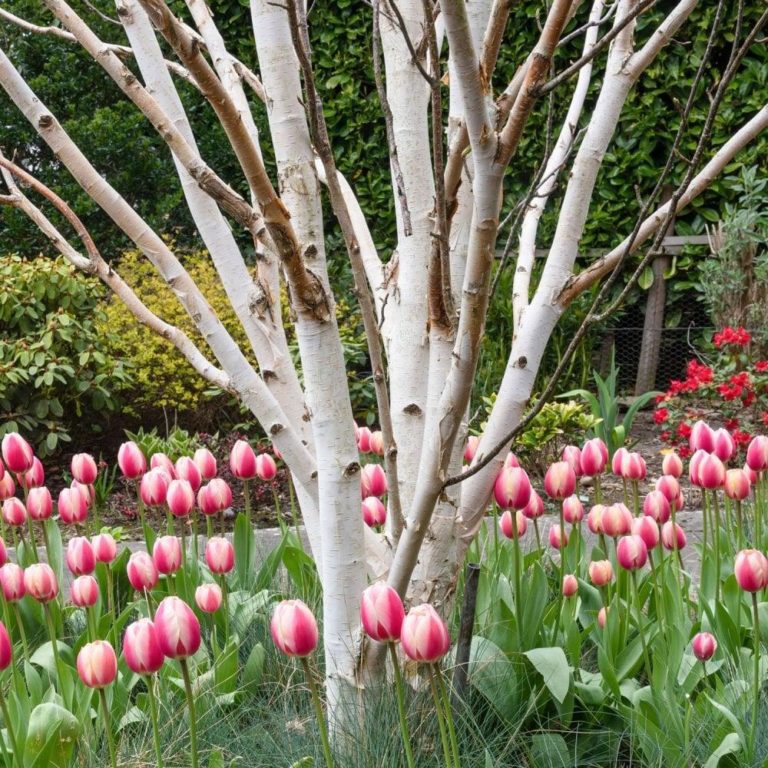
- Betula utilis var. jacquemontii (AGM) – Himalayan birch. Brilliant white bark stands out spectacularly in winter, light dappled summer shade. Use as a multi-stem specimen.
- Acer griseum (AGM) – paperbark maple. Peeling cinnamon-coloured bark all year, scarlet autumn foliage. Slow-growing, suits small gardens, year-round interest.
Hero plants used sparingly
Within the drift framework, a few sculptural specimens placed deliberately as single accents create rhythm and surprise. Reliable hero plants:
- Miscanthus sinensis ‘Malepartus’ (AGM) – maiden grass. Tall (1.8 m) silvery-pink flower plumes in late summer, beautiful through winter.
- Stipa gigantea (AGM) – golden oat grass. Airy panicles of golden flower-heads from June, catching summer light at 2 m height.
- Phlomis russeliana. Already mentioned for clay tolerance — also outstanding as a sculptural specimen.
- Veronicastrum virginicum – culver’s root. Tall (1.5 m) candelabra spires of pale lilac or white. Architectural at the back of borders.
- Echinacea purpurea (purple coneflower). Classic prairie perennial, valuable to bees and butterflies, seed heads attract goldfinches.
Colour palette directions
A coherent colour palette is what separates a thoughtful scheme from a riot. Three directions we use most often in client gardens:
- Natural harmony – soft greens, silvers and pinks. Stachys byzantina silver, Geranium ‘Rozanne’, Sanguisorba officinalis, Persicaria amplexicaulis, ornamental grasses. Calm, contemplative, suits classic and contemporary architecture.
- Warm and lively – reds, oranges and deep purples. Helenium ‘Moerheim Beauty’, Achillea ‘Terracotta’, Rudbeckia ‘Goldsturm’, Salvia ‘Caradonna’, late-summer energy. Suits sunnier aspects and brick-fronted properties.
- Calm and contemporary – whites, blues and grasses. Verbena bonariensis, Nepeta, Calamintha nepeta, white Echinacea ‘White Swan’, Calamagrostis ‘Karl Foerster’. Crisp, modern, suits sleek extensions and clean architectural lines.
Beyond the planting itself
A refreshed border doesn’t sit in isolation. The strongest gardens integrate naturalistic planting with the wider garden infrastructure:
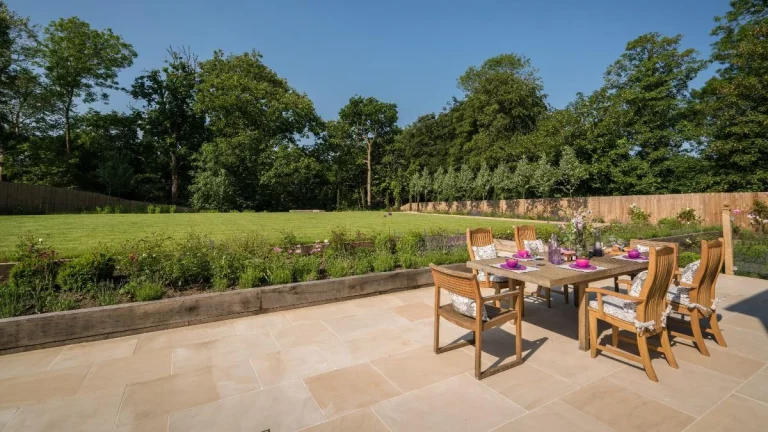
- Hard landscape. Natural stone or porcelain paving for entertaining areas; gravel paths through naturalistic plantings (which the planting will self-seed into beautifully).
- Structures. Timber or galvanised steel pergolas with climbing roses (Rosa), Wisteria sinensis (with twice-yearly pruning), Group 3 Clematis, and native honeysuckle (Lonicera periclymenum ‘Serotina’). For more on pergola planting see our wooden pergolas guide.
- Water. Even a small wildlife pool or rill transforms the ecological richness of a garden and brings movement and sound. See our water features guide.
- Lighting. Low-voltage path and uplight schemes extend garden use into evenings and bring out the architectural qualities of grasses and seed heads after dusk.
- Screening. Native mixed hedging (Fagus sylvatica, Carpinus betulus, Crataegus monogyna, Acer campestre) instead of close-board fencing where space allows — better for wildlife, more attractive and more durable over decades.
The Flourish process for a border refresh
- 1. Assessment. Site visit to study soil, drainage, aspect, mature trees, existing planting worth keeping, and your priorities. Usually 60-90 minutes. Free for an initial conversation.
- 2. Design. A planting plan to scale with named species and quantities, drift layout, succession of flower through the year, and a coherent colour palette. Includes a plant schedule and supplier list. Typical design fee for a border refresh is £600-2,000 depending on scale.
- 3. Implementation. Clear and improve the site, address any drainage issues, plant in the right season (autumn ideal, spring acceptable), mulch generously. A typical refresh of a 20-30 sq m border takes 2-3 days on site.
- 4. Aftercare. Guidance through the first 12-18 months as the planting establishes — watering schedule for the first summer, late-February cut-back the following year, plant adjustments where needed. Optional ongoing maintenance contract.
Frequently asked questions
Will naturalistic planting look messy?
Not when it’s designed properly. The misconception comes from confusing naturalistic with neglected. A naturalistic border is highly considered — clear drift structure, deliberate vertical layers, evergreen anchors, controlled colour palette, regular editing. It looks looser than a Victorian bedding scheme but it isn’t random. The reason great naturalistic gardens (the High Line, Sissinghurst, Hermannshof in Germany, Beth Chatto’s gravel garden) look effortless is precisely because of how much structural thought goes into them.
How much maintenance does a naturalistic border need?
Significantly less than a traditional border once established. The main tasks: one major cut-back in late February (an afternoon’s work for a typical border), an annual mulch of compost in autumn, occasional weeding through the first year while the planting fills in, and a watering schedule only through the establishment summer. From year three onwards, most naturalistic borders need 4-8 hours of attention per year per typical residential border. Compare that to a bedding scheme (replanted twice yearly, watered daily, fed weekly) and the difference is dramatic.
When’s the best time to plant a new border?
Late September to early November is ideal. The soil is still warm enough for root establishment, autumn rain reduces watering needs, and the plants have six months to settle before their first summer. March to early May is the second-best window. Summer planting is possible but needs daily watering for at least the first month and rarely produces results as good as the autumn window.
Can I keep my existing shrubs?
Usually yes, and we always start by identifying what’s worth keeping. Mature trees, well-shaped evergreens, established hedging and structural shrubs are all assets to build around. The ones we usually recommend removing or relocating: vigorous self-seeders that have outgrown the space (cherry laurel, sycamore, butterfly bush in dominant positions), shrubs in failing health, and anything that fundamentally clashes with the new scheme. A planting refresh works far better when it edits and adds rather than starting from bare earth.
How long until the border looks established?
The traditional rule is “year one they sleep, year two they creep, year three they leap”. Most perennials look modest in year one (this is correct establishment behaviour — they’re building roots, not foliage), fill out visibly in year two, and reach maturity in year three. The garden looks intentional from the moment of planting if the structural plants and grasses are at decent specimen size; the impression of fullness builds over the first three years. By year five most schemes need their first divisions and editing to keep them vigorous.
Does naturalistic planting work in a small garden?
Yes, but the principles need scaling. Smaller drifts (groups of three rather than seven), more emphasis on evergreen structure to carry the scheme through winter, single specimens of hero plants rather than multiples, and careful attention to repeat planting through the available space so the eye reads the border as coherent rather than crowded. The approach actually rewards smaller gardens, because every plant is doing visible work; large naturalistic schemes can absorb mistakes that a small scheme cannot.
Ready to refresh your garden?
Flourish Landscaping designs and plants naturalistic schemes across Kingston, Surbiton, Richmond, Esher and the wider Surrey area. See our planting design and installation service for the way we work, or our eco-friendly planting guide for the broader sustainability case.
Contact us to arrange a consultation. All plants on this page are chosen for proven performance in south-west London conditions.
Good to know
Frequently asked questions
Not when it's designed properly. The misconception comes from confusing naturalistic with neglected. A naturalistic border is highly considered - clear drift structure, deliberate vertical layers, evergreen anchors, controlled colour palette, regular editing. It looks looser than a Victorian bedding scheme but it isn't random. The reason great naturalistic gardens (the High Line, Sissinghurst, Hermannshof in Germany, Beth Chatto's gravel garden) look effortless is precisely because of how much structural thought goes into them.
Significantly less than a traditional border once established. The main tasks: one major cut-back in late February, an annual mulch of compost in autumn, occasional weeding through the first year while the planting fills in, and a watering schedule only through the establishment summer. From year three onwards, most naturalistic borders need 4-8 hours of attention per year per typical residential border.
Late September to early November is ideal. The soil is still warm enough for root establishment, autumn rain reduces watering needs, and the plants have six months to settle before their first summer. March to early May is the second-best window. Summer planting is possible but needs daily watering for at least the first month.
Usually yes, and we always start by identifying what's worth keeping. Mature trees, well-shaped evergreens, established hedging and structural shrubs are all assets to build around. The ones we usually recommend removing or relocating: vigorous self-seeders that have outgrown the space (cherry laurel, sycamore, butterfly bush in dominant positions), shrubs in failing health, and anything that fundamentally clashes with the new scheme.
The traditional rule is 'year one they sleep, year two they creep, year three they leap'. Most perennials look modest in year one (this is correct establishment behaviour - they're building roots, not foliage), fill out visibly in year two, and reach maturity in year three. The garden looks intentional from the moment of planting if the structural plants and grasses are at decent specimen size; the impression of fullness builds over the first three years.
Yes, but the principles need scaling. Smaller drifts (groups of three rather than seven), more emphasis on evergreen structure to carry the scheme through winter, single specimens of hero plants rather than multiples, and careful attention to repeat planting through the available space so the eye reads the border as coherent rather than crowded. The approach actually rewards smaller gardens, because every plant is doing visible work.