Garden Paving
Choosing paving that lasts: slabs, setts, colours and textures explained by designers and installers.
If you have been researching paving online, you may have read supplier blogs from companies such as Infinite Paving. These are useful for understanding products, finishes and trends, but they rarely explain what really matters once paving is installed in a real garden.
At Flourish, we design and install gardens across Surbiton, Kingston and the surrounding Surrey areas, working with clay soils, mature planting, shaded plots and family gardens that are used every day, and have been professionally building patios and garden paving for years. This guide brings everything together in one place, paving slabs, setts and clay pavers, colours, textures, sizes, laying patterns and construction, and explains how we choose what genuinely lasts.
Paving slabs and where they work best
Paving slabs are most effective in main seating areas and terraces where clarity, comfort and furniture placement matter. The right slab choice depends on context rather than fashion.
Natural stone paving slabs
Natural stone such as sandstone or limestone remains popular across Surrey gardens because it sits comfortably alongside planting and older architecture.
Best suited to:
- Traditional and semi-formal gardens
- Properties with mature planting
- Clients who prefer natural variation
Things we factor in:
- Variation in thickness and colour
- Drainage and shading
- How the stone will weather over time
In Kingston and Surbiton gardens with trees and borders close to paving, riven or lightly textured stone is often more forgiving than very smooth finishes.
Suppliers:
Porcelain paving slabs
Porcelain is a dense, manufactured product with consistent sizing and very low porosity.
Best suited to:
- Contemporary garden designs
- Courtyard gardens and shaded plots
- Clients looking for low maintenance
Porcelain performs exceptionally well when installed correctly, with full mortar bedding, accurate falls and an adhesive bond bridge. It is not a shortcut product and demands good ground preparation.
Suppliers:
Concrete paving slabs
Concrete slabs can work well in practical areas or where budget is a key driver.
They are most appropriate for:
- Utility spaces
- Simple layouts
- Secondary garden areas
Quality varies widely, so specification matters.
Stone setts and clay pavers, where detail matters
Many of the best gardens we build do not rely on slabs alone. Setts and clay pavers often provide the structure, durability and detailing that slabs alone cannot.
Stone setts
Setts are small rectangular blocks, traditionally used in streets and courtyards, which tells you a lot about their durability.
We commonly use setts for:
- Driveway entrances and edges
- Steps and risers
- Drainage channels
- Thresholds and transitions between materials
Granite setts are extremely hard-wearing and well suited to driveways and high-traffic areas. Sandstone setts feel softer and sit more naturally in planted gardens.
Because setts cope well with curves, slopes and movement, they are particularly useful on sites with level changes or awkward geometry.
Clay pavers and bricks
Clay pavers are fired rather than cast, so colour runs all the way through the material. They age exceptionally well and feel at home in older properties.
We use clay pavers for:
- Garden paths
- Courtyards
- Edging and detailing
- Linking period buildings with new landscaping
Pattern choice matters. Herringbone offers strength, stretcher bond suits paths, and basket weave works well in courtyards.
Suppliers:
How we choose paving sizes, layouts and laying patterns
We do not start with a fixed preference for slabs, setts or pavers. Each scheme is assessed on its own merits.
Because we design and install, material choice, slab size and laying pattern are considered together from the outset.
Slab sizes and proportion
Large-format slabs can look calm and contemporary, but in smaller Surbiton or Kingston gardens they can feel oversized and visually heavy.
We consider:
- Scale of the space
- Relationship to the house and doors
- Sightlines from inside
- How paving meets planting and edges
Laying patterns are functional as well as visual
Pattern affects strength, movement tolerance and how forgiving paving is over time.
Examples include:
- Random or coursed layouts
- Linear patterns
- Herringbone for structural strength
- Setts used as borders to lock slabs in place
Paving textures, riven, sawn and flamed explained
Texture affects grip, cleaning and how paving looks after several winters.
Riven stone is forgiving and natural.
Sawn stone is clean-lined but less forgiving of dirt.
Flamed stone offers excellent slip resistance and durability.
Paving colours, trends versus what lasts
Current trends favour pale greys and light porcelains, but these show staining quickly in shaded gardens.
Timeless choices include:
- Warm buffs and honey tones
- Mid greys with variation
- Earthy sandstone blends
- Clay reds and brindles
Paving construction details, what sits beneath the surface
Paving performance is determined far more by its construction than by the slab itself.
Porcelain is typically non-permeable.
Sandstone may be permeable or non-permeable.
Clay pavers are often used in permeable systems in addition to sandstone slabs.
We work in line with BS 7533 and SuDS guidance.
Adhesive bond bridges, why they matter
An adhesive bond bridge is applied to the underside of dense paving such as porcelain and sawn stone.
Without it:
- Slabs rely on gravity
- Micro-movement develops
- Water tracks between layers
With it:
- Full adhesion is achieved
- Longevity improves significantly
Common paving problems, causes and consequences
Rocking slabs, standing water, failed joints and cracking are almost always construction-related rather than material failures.
Diagnosing patio problems, repair or rebuild?
Localised issues can sometimes be repaired. Widespread movement or drainage failure usually requires rebuilding.
What does garden paving cost?
Paving costs vary significantly and are driven by excavation, sub-base, drainage, detailing and access, not just the slab.
Two patios of the same size can have very different costs once ground conditions are factored in.
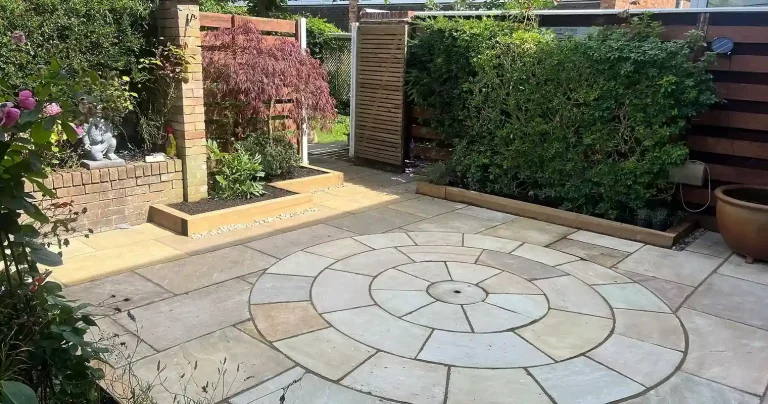
See about what affects the costs of garden design in addition to this completed sandstone patio completed in Sheen.
A practical note on maintenance
All paving needs some maintenance. Low maintenance is realistic. No maintenance is not.
Suppliers and material quality
Approved installers for: London Stone Pavestone
Also working with: C E L Silverlands Marble Mosaics Mandarin Stone All Green Kebur
Final thoughts
Good paving is not about fashion. It is about materials, construction and design working together.
See another blog on a related topic
Let’s create your perfect garden
Get in touch to arrange an initial conversation
Contact us today to arrange a consultation and start transforming your garden into the perfect outdoor space for you and your family.