Designing your garden
The key principles behind a garden that really works.
Designing a garden should feel exciting, not overwhelming. Done well, the process turns a difficult plot into a garden that solves real domestic problems and lasts decades. Done badly, it produces an expensive patio surrounded by a tired lawn. This guide sets out the six-stage process we use on every project across the south west London clay belt, and the practical decisions that make the difference between the two outcomes.
Gardens in our part of south west London (Kingston, Surbiton, Coombe, Richmond, Esher and the surrounding areas) come with their own characteristic challenges: heavy London Clay soil, narrow side returns, overlooked boundaries, awkward level changes, and shaded ends from neighbouring trees. None of these are problems if they are addressed in the right order, at the right stage. They become expensive problems if they are addressed after the build. The sequence below is the one we follow, in this order, on every project.
The six stages of garden design we work through:
- Stage 1: Brief – understanding what the garden needs to do
- Stage 2: Site analysis – measuring soil, levels, drainage, sun, services
- Stage 3: Layout – zoning, flow and the structural plan
- Stage 4: Materials – paving, walls, fences, structures
- Stage 5: Planting – the structural and seasonal layers
- Stage 6: Lighting, irrigation and finishing
Stage 1: the brief
Before paving or planting is discussed, the garden needs a brief. The brief is a clear, written statement of what the garden has to do, who it is for, and how it has to feel. Three questions get to the heart of it:
How will you actually use the garden?
A garden is an extension of the house, but unlike rooms inside the house, every square metre of it has to earn its place. Be honest about which of these matter, and which only sound nice:
- a morning coffee spot catching the sunrise
- a sociable dining space for six to eight people
- a safe play space for children or pets
- a quiet reading corner
- a low-maintenance scheme that survives a busy life
- a wildlife-friendly garden
- a productive herb or cut-flower patch
- a shed, studio, gym or home office
- a hot tub, fire pit or outdoor kitchen
Most domestic gardens need to do four or five things well. Naming the priorities now prevents design overload at stage three.
What feeling should the garden have?
No design vocabulary needed. Save images that move you (Pinterest, Instagram, Houzz, the RHS website, design magazines), and themes emerge. Some of the styles we work in most often:
- Cottage garden: abundant, layered, romantic, traditionally English. Rosa, Delphinium, Lupinus, Aquilegia, hollyhocks.
- Naturalistic / new perennial: the Piet Oudolf and Dan Pearson influence. Grasses, late-season perennials, prairie feel.
- Mediterranean: gravel, drought-tolerant planting, hot colours, the influence of Beth Chatto’s gravel garden.
- Contemporary minimal: clean lines, restrained planting, large-format paving, the look of the Marcus Barnett or Tom Stuart-Smith Chelsea show gardens.
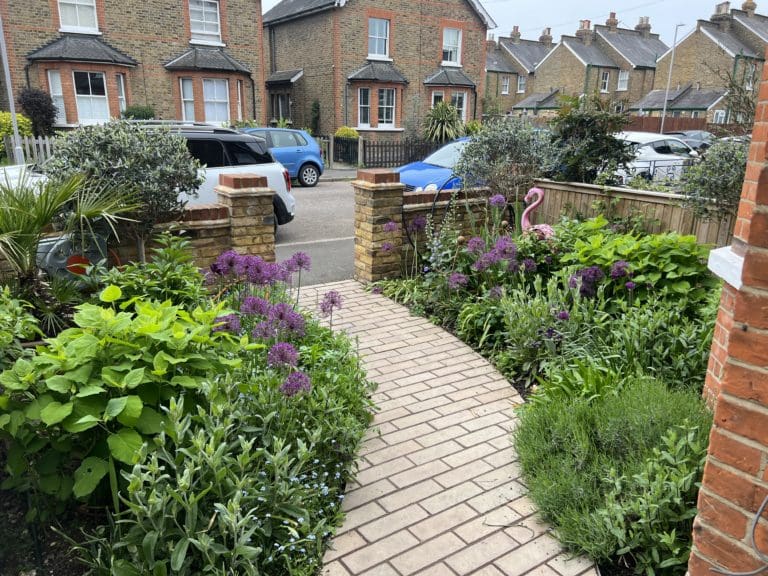
- Classic London garden: stock brick walls, formal box (or its Ilex crenata replacement), white roses, climbers, traditional materials.
What must stay, and what is the budget?
Some elements are usually fixed: boundaries (and their ownership), mature trees (particularly any with a Tree Preservation Order), drains and manholes, the position of soil pipes and gas meters, the doorway from the kitchen, and the access route the contractor will need. List these honestly before stage three.
Budget honesty matters too. There is no point designing for a budget that is not there; equally, working to a tight budget produces a different (and often better) design than working with no constraint at all. See the realistic cost bands later in this guide.
Stage 2: site analysis
Before any layout is drawn, the site is measured and recorded. A proper site survey includes:
- Dimensions and levels. The boundary line, the position of the house, any level changes (steps, slopes, retained walls). Even apparently flat London gardens often have 100 to 300 mm of fall from front to back, and that fall has to be planned for at the patio stage.
- Sun and shade through the day. Where the sun lands at breakfast, lunch and dinner; which areas get morning vs afternoon sun; what casts shadow at what time of year. See our guides to south-facing and north-facing planting.
- Soil. Almost all of central south west London sits on London Clay, which is alkaline, slow-draining, sticky when wet, and rock-hard when dry. A few areas (Esher, Cobham, Oxshott) sit on free-draining Bagshot Sands, and a strip along the river is on Thames alluvium. A simple soil sample test (the ‘sausage test’: roll a moist sample between your hands; if it rolls into a sausage and stays together, it’s clay) settles the question.
- Drainage and wet spots. Where does water sit after heavy rain? On clay, this is critical. Patios laid over poorly draining clay heave and crack within five years.
- Existing services. Drains, manholes, downpipes, soakaways, electricity supply to outbuildings, water taps. All marked on the survey before any digging begins.
- Views from inside the house. Garden design starts indoors. What do you see from the kitchen sink, the living room sofa, the bedroom window? Most domestic gardens are looked at far more than walked in. The view from the house is what the garden mostly is.
- Existing plants worth keeping. Mature trees and good shrubs add decades of structural value that no new design can buy. List them, photograph them, and design around them where possible.
Stage 3: layout
Layout is the skeleton of the garden. Get this right and almost any planting and material choice will work; get it wrong and no amount of finishing will save the result.
Zoning
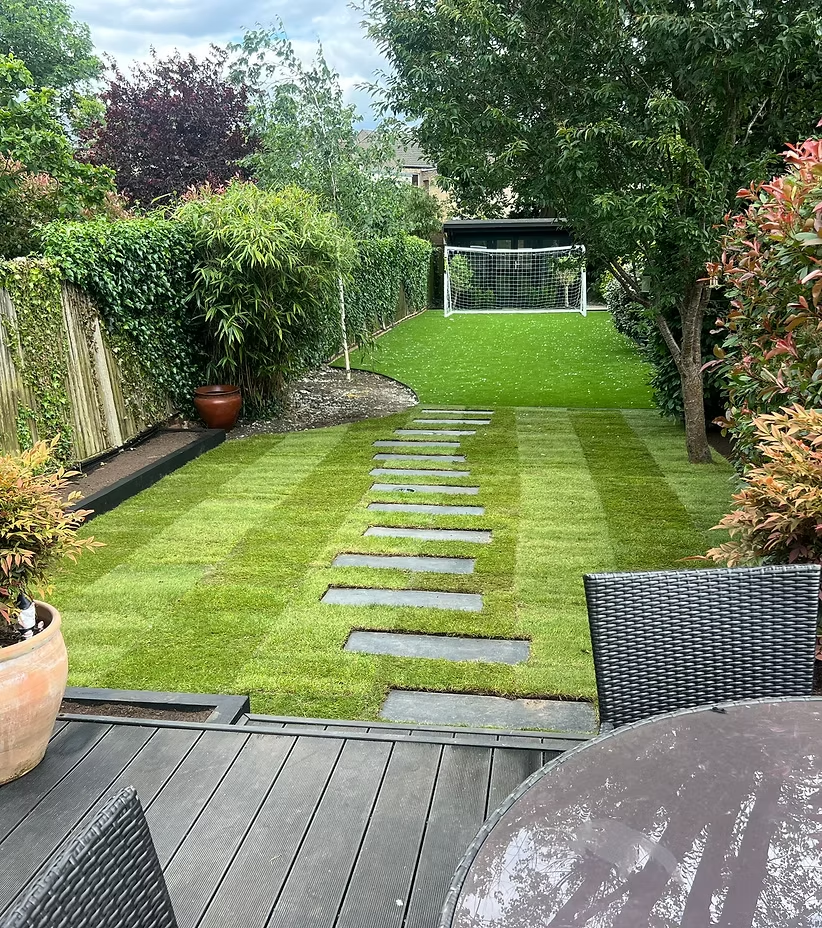
Every zone serves a purpose. A typical Surrey domestic garden contains some of: dining, lounge or fire pit, lawn, play space, kitchen garden or raised beds, compost, shed or studio, and a utility lane in the side return. The trick is sizing each zone realistically (a six-seat dining table needs 3.5 m by 3 m of clear paving, not the 2.5 m by 2 m people usually allow), and placing each one where the sun, shade and access work for it.
Flow and movement
Good gardens feel natural to move through. Things to test on the plan:
- Is the journey from kitchen to dining table direct?
- Are paths a generous 900 to 1200 mm wide where two people walk side by side, narrower where they don’t? Anything below 600 mm feels mean.
- Can bikes, wheelbarrows and rubbish bins move through the side return without obstruction?
- Do the steps feel safe? A comfortable garden riser is 100 to 150 mm, with a generous tread of 350 mm or more.
- Do the main views from the house terminate in something deliberate (a tree, a piece of sculpture, a bench, a focal pot)?
Levels and drainage on clay
On London Clay, drainage must be planned at the layout stage, not as an afterthought. Designed in, it costs little. Retrofitted, it costs thousands.
- Patios laid with falls of 1:80 (12.5 mm per metre) away from the house, never toward it
- Linear or channel drains where the patio meets the house
- French drains in low-lying areas or at the foot of slopes
- Permeable surfaces in front gardens (Sustainable urban Drainage Systems / SuDS rules apply to any paving above 5 sq m at the front)
- Raised beds for planting where clay is particularly wet
- Strong sub-bases (MOT Type 1 at 100 to 150 mm compacted) under all paving
The side return: design it, don’t leave it
The narrow passage from the front to the back garden is one of the most useful and most neglected spaces in a London property. Designed properly, it absorbs the things that would otherwise spoil the main garden:
- bike storage (purpose-built timber sheds or proprietary metal units)
- bin storage and recycling sorting
- cushion cupboards for garden furniture
- log stores
- outdoor sinks and dog-washing stations
- hose points and tap manifolds
- discreet cable routes for outdoor lighting and power
Stage 4: materials
Materials set the visual tone and the maintenance burden for the next twenty to thirty years. The right material in the right place ages beautifully; the wrong one looks dated within five.
Paving
- Porcelain. The dominant choice across UK domestic projects, particularly in large-format (900 × 600 mm or larger). 20 mm thickness for external use, R11 slip rating minimum, requires a full mortar bed and a slurry primer on the underside. Excellent on clay with the right foundation. See our paving guide for current trends.
- Indian sandstone. Warm tones, textured surface, traditional look, modest price. Available riven (rougher) or sawn (cleaner). Stains more easily than porcelain.
- Limestone. Cleaner, finer-grained, more uniform than sandstone. The classic contemporary choice in cream and silver-grey.
- Granite. The premium hard-wearing option, particularly setts and cobbles for paths, driveways and accent borders. Exceptional longevity.
- Clay pavers. Traditional brick paving, often in herringbone or stretcher bond. Best in classic London gardens and front-garden settings.
- Gravel and resin-bound aggregate. Permeable, affordable, easy to repair. Resin-bound is now the front-garden standard where SuDS rules apply.
Walls and raised beds
Vertical structure is what gives a garden its three-dimensional shape. The honest workhorses: London stock brick (sympathetic to most of the housing stock here), rendered blockwork (a fraction of brick’s cost, painted in soft greys or off-whites), timber sleepers (warm, generous, ideal for kitchen gardens), Corten weathering steel (the contemporary standard for raised beds and edging), and gabions (industrial-looking, increasingly used in naturalistic schemes).
Raised beds also lift plant roots above the heavy clay water table, which is why they consistently outperform in-ground borders in poor-draining gardens.
Fences, screens and pergolas
Slatted hardwood batten fencing is now the dominant contemporary boundary style; closeboard remains the traditional and most affordable option; trellis raises height visually without adding solid mass; pleached trees handle the overlooking-window problem that a fence cannot solve. See our full fencing and screening service for current options.
Pergolas add height and shade, frame a dining or seating area, hide power and lighting cabling, and provide structure for climbers (Wisteria, Clematis armandii, Trachelospermum jasminoides, Rosa ‘Madame Alfred Carrière’). They are one of the most useful single structures in a garden.
Sheds, studios and storage
Size, access, electrics and how it sits in the wider garden all matter. Cedar cladding, larch or composite timbers all age well; pressure-treated softwood is the budget option but looks tired within five years. For garden offices and studios, allow a proper concrete or screw-pile foundation, insulated walls and floor, and consider whether you need full Building Regulations compliance (most domestic studios under 30 sq m are exempt).
Stage 5: planting
A well-designed garden looks good even before the planting goes in. But the planting is what makes the difference between a garden that works and one that feels alive. A coherent planting scheme has four layers:
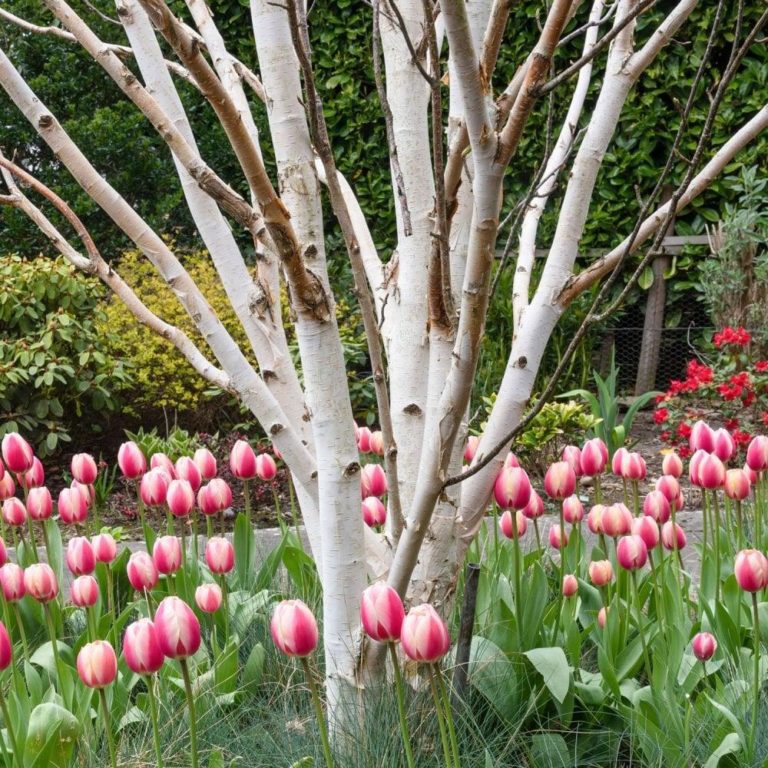
- Trees and large shrubs. The structural backbone. Multi-stem birches (Betula utilis var. jacquemontii), Amelanchier lamarckii, ornamental cherries, Japanese maples (Acer palmatum) for smaller gardens.
- Mid-height evergreen shrubs. Year-round structure. Pittosporum tobira, Choisya ternata, Sarcococca confusa, the box-alternative Ilex crenata.
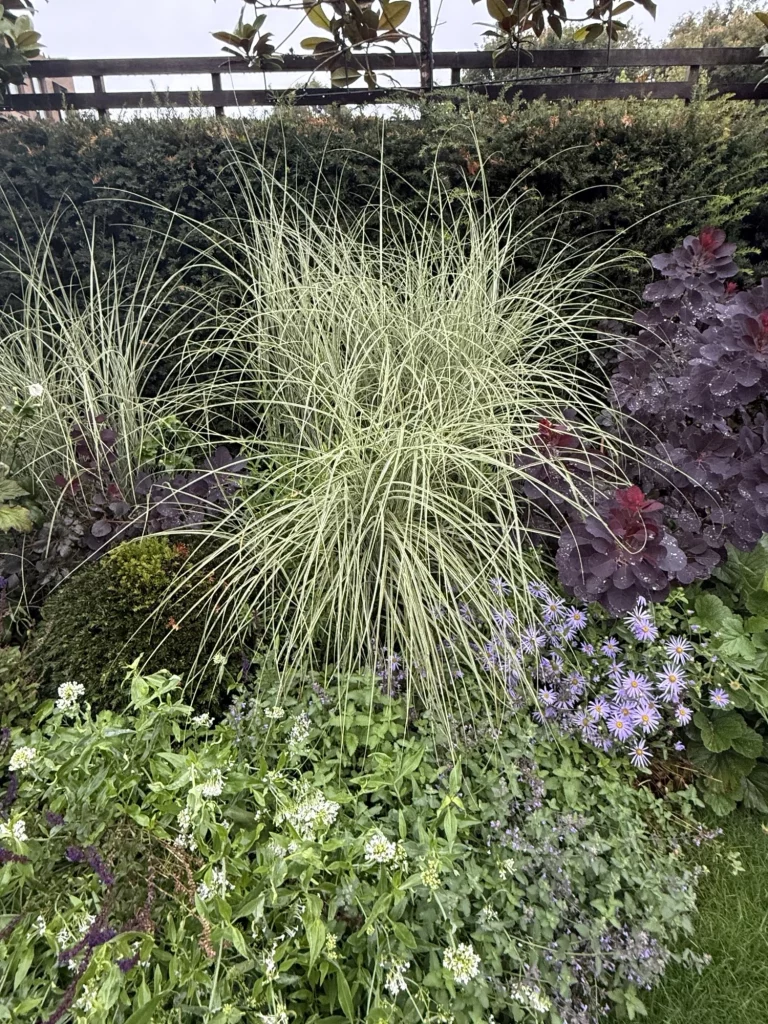
- Perennials and grasses. The seasonal performers. Geranium ‘Rozanne’, Salvia nemorosa ‘Caradonna’, Echinacea purpurea, Miscanthus sinensis, Stipa tenuissima.
- Bulbs and seasonal accents. The succession of detail. Snowdrops, daffodils, alliums, tulips, then bulbs for autumn (Nerine, Colchicum).
Clay-tolerant planting that actually works
London Clay is not a planting catastrophe; it is, in many ways, a fertile soil that just needs the right species. Plants that genuinely thrive on Surrey clay: Hydrangea macrophylla, Viburnum tinus, Cornus alba ‘Sibirica’, Rosa ‘Gertrude Jekyll’ (most David Austin English roses cope well with clay), Carex oshimensis ‘Everillo’, and most of the late perennials in the new-perennial palette.
Year-round interest
Most domestic gardens peak in late June and have lost most of their interest by October. A well-designed scheme works through all twelve months: winter bark and form (Cornus, multi-stem birch, evergreen shrubs), spring bulbs and blossom (March to May), summer perennials (June to August), and the long late season that the new-perennial movement is built on (September to first frost). Group plants by their water, sun and soil needs (the principle Beth Chatto called ‘right plant, right place’).
Stage 6: lighting, irrigation and finishing
The hidden services. All of these are straightforward during the build and disruptive afterwards. If you might want any of them at some point, allow the cable ducts and pipe runs now.
- Lighting. Step lights, path lights, spike lights uplighting trees, downlights tucked into pergolas, all on a low-voltage 24 V system with a single controller. A garden lit at night extends the use of the garden by 60 days a year.
- Outdoor power. Sockets near seating areas for fairy lights and heaters; a 16 A supply to any studio or shed; a separate fused spur for any pond, water feature or pool plant.
- Water and irrigation. A tap near the house, a tap at the back of the garden, a hose point in the side return, and ideally a drip-line irrigation system on a controller for borders and pots. The most-skipped item in domestic garden design and the one that most consistently saves the planting in dry summers.
- Finishing. Pots and planters, garden mirrors, outdoor rugs, lanterns, furniture, water features, planting in the gaps. The detail that completes the atmosphere.
Realistic budget bands for Surrey gardens
Indicative cost bands for a complete design-and-build project in Kingston, Surbiton and the wider Surrey area. These are honest 2026 figures, including labour, materials, plants and aftercare. Final costs depend on access, ground conditions, material choice and the level of structural work.
- Garden refresh (£15,000 to £30,000): A new patio (20 to 40 sq m), refreshed planting, a new fence run, lighting essentials. Existing layout largely retained.
- Garden remodel (£30,000 to £60,000): New patio, new lawn or substantial planting, garden lighting throughout, irrigation, perhaps a small structure (pergola, raised beds, bin store).
- Full garden redesign (£60,000 to £120,000): Substantial earthworks, level changes, multiple zones, premium materials, comprehensive planting, lighting, irrigation, garden studio or office.
- High-end project (£120,000 and upward): Architectural structures, water features, swimming or wild-swim pools, bespoke metalwork, full premium plant specification. Mature specimen trees, professional design-and-build delivery.
Working with a designer vs designing it yourself
For a garden refresh under £20,000, a homeowner with confidence and a clear brief can produce a perfectly good result. For anything more substantial, a designer earns their fee back several times over in fewer mistakes, better materials specification, and a more coherent result. A garden designer’s value is in three things: experience of what works (and what doesn’t), command of the available palette of plants and materials, and the discipline to say no to ideas that won’t survive contact with the actual site.
If working with an external designer, look for membership of the Society of Garden Designers (SGD). For design-and-build firms, look for the Association of Professional Landscapers (APL) and the British Association of Landscape Industries (BALI). Flourish is APL-accredited; our in-house designer, Eli Jacobacci, develops most of the planting schemes that go through the studio.
What to avoid
- Starting with paving samples. The brief, site analysis and layout come first. Material choice is stage four for good reason.
- Designing for a flat site that isn’t flat. A 200 mm fall across a 10 m garden is easy to miss on a casual walk-around and an expensive surprise after the patio is laid.
- Ignoring drainage. The most common reason for a patio failing within five years on clay soil is inadequate falls and a missing channel drain. The most common reason for a planting scheme failing is poor drainage in the borders.
- Forgetting the view from the house. A garden looked at from indoors for 95 per cent of the time should be designed accordingly. The best focal points are sited where they catch the eye from the kitchen window.
- Specifying too many materials. A coherent garden uses two or three hard-landscape materials at most. Sandstone, brick and gravel works; throwing in porcelain, decking and resin-bound besides looks busy and dates fast.
- Skipping the cable ducts. Lighting and power retrofitted across a finished patio means lifting and relaying it. Spend the £200 on duct now.
- Buying the plants before the soil is improved. On clay, soil preparation matters more than plant selection. Improve, then plant.
Frequently asked questions
How long does it take to design a garden?
For a domestic garden of typical Surrey size (50 to 200 sq m), the design phase takes six to ten weeks: initial site visit and brief, two to three weeks for survey and concept design, a presentation, one or two rounds of revision, then a fortnight to finalise the detailed drawings, planting plan and tender documents. Larger or more complex projects can take three to four months at design stage alone.
When is the best time of year to start a garden project?
Design work can happen at any time of year. Build work is best from late February to early November, avoiding mid-winter when wet clay makes excavation difficult and frost interferes with mortars. The optimum is to design over the winter for a spring start; that way the garden is built, planted and watered in by mid-summer, with the planting establishing through the autumn and into its first proper season the following year.
Do I need planning permission to redesign my garden?
For most domestic garden remodels, no. Hard-landscaping (paving, paths, raised beds) does not require permission. Fences need permission above 2 m on rear and side boundaries and above 1 m next to a highway. Garden structures (sheds, studios, summerhouses) are permitted development if they remain under 2.5 m in eaves height and under 30 sq m floor area, sit at least 2 m from any boundary, and meet other minor conditions. Trees with a TPO and properties in Conservation Areas have additional restrictions. We check the position before any project starts.
How much should I budget for a complete garden redesign?
For a typical Surrey domestic garden, £30,000 to £60,000 covers a comprehensive remodel including new patio, planting, fencing, lighting and irrigation. Below £15,000 you are looking at a refresh rather than a redesign. Above £60,000 the budget can accommodate substantial structures, level changes and high-end materials. Garden designers’ fees are typically 10 to 15 per cent of the build budget for a full design service.
What is the most important thing to get right when designing a garden?
Layout, by a long way. A garden with a coherent layout will look reasonable even with modest materials and ordinary planting. A garden with a poor layout cannot be saved by expensive paving or premium plants. Layout decides whether the garden feels generous or cramped, easy to move through or awkward, calm or busy. The hour spent walking the site with a tape measure and a sketchpad is worth more than the next month of Pinterest research.
Can a small garden still be properly designed?
Small gardens often benefit from professional design more than large ones, because every square metre has to work harder. A 30 sq m London courtyard can be a magnificent piece of design with the right plan; the same space treated as an afterthought feels like the back of a house. Restricted budgets and tight spaces tend to produce sharper design decisions, not weaker ones.
Let’s design the garden you want
Flourish Landscaping designs and builds gardens across Kingston, Surbiton, Richmond, Esher and the wider Surrey area, working through every one of the six stages above with each client. See our full garden design and build service for the way we work, or browse our portfolio for built examples of the principles set out here.
Contact us to arrange a consultation and start the conversation.
Good to know
Frequently asked questions
For a domestic garden of typical Surrey size (50 to 200 sq m), the design phase takes six to ten weeks: initial site visit and brief, two to three weeks for survey and concept design, a presentation, one or two rounds of revision, then a fortnight to finalise the detailed drawings, planting plan and tender documents. Larger or more complex projects can take three to four months at design stage alone.
Design work can happen at any time of year. Build work is best from late February to early November, avoiding mid-winter when wet clay makes excavation difficult and frost interferes with mortars. The optimum is to design over the winter for a spring start; that way the garden is built, planted and watered in by mid-summer, with the planting establishing through the autumn and into its first proper season the following year.
For most domestic garden remodels, no. Hard-landscaping (paving, paths, raised beds) does not require permission. Fences need permission above 2 m on rear and side boundaries and above 1 m next to a highway. Garden structures (sheds, studios, summerhouses) are permitted development if they remain under 2.5 m in eaves height and under 30 sq m floor area, sit at least 2 m from any boundary, and meet other minor conditions. Trees with a TPO and properties in Conservation Areas have additional restrictions.
For a typical Surrey domestic garden, 30000 to 60000 pounds covers a comprehensive remodel including new patio, planting, fencing, lighting and irrigation. Below 15000 you are looking at a refresh rather than a redesign. Above 60000 the budget can accommodate substantial structures, level changes and high-end materials. Garden designers' fees are typically 10 to 15 per cent of the build budget for a full design service.
Layout, by a long way. A garden with a coherent layout will look reasonable even with modest materials and ordinary planting. A garden with a poor layout cannot be saved by expensive paving or premium plants. Layout decides whether the garden feels generous or cramped, easy to move through or awkward, calm or busy. The hour spent walking the site with a tape measure and a sketchpad is worth more than the next month of Pinterest research.
Small gardens often benefit from professional design more than large ones, because every square metre has to work harder. A 30 sq m London courtyard can be a magnificent piece of design with the right plan; the same space treated as an afterthought feels like the back of a house. Restricted budgets and tight spaces tend to produce sharper design decisions, not weaker ones.